
2 layers68.8 × 53.6 mm
ZArduino
zmaker/arduino_cookbook
gli sketch del nuovo progetto Arduino Cookbook e dei video di YouTube
46 parts269

 wirenux/USBC-UART
A simple project to convert a traditional USB-B UART bridge schematic to a modern USB-C interface.
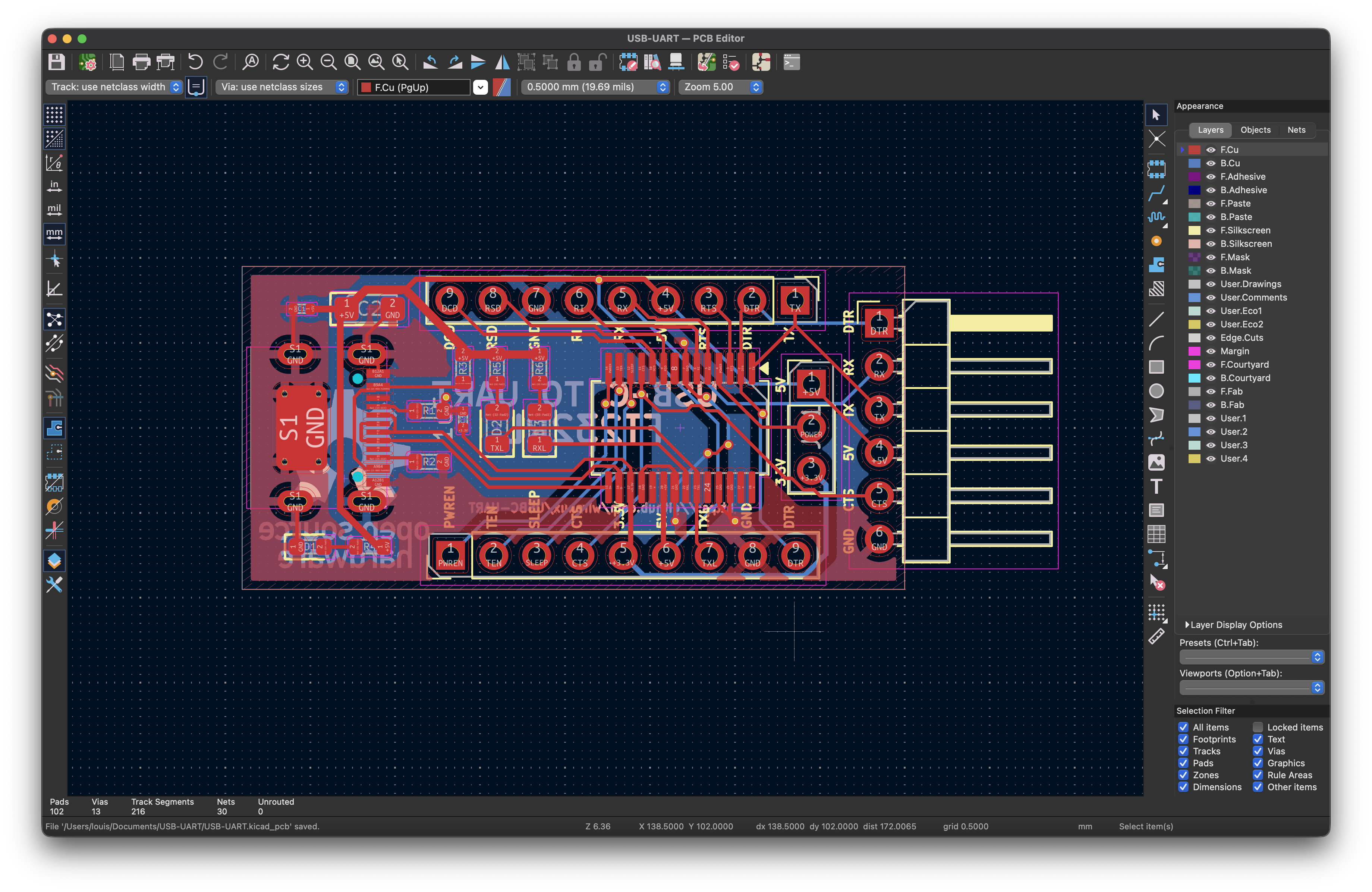
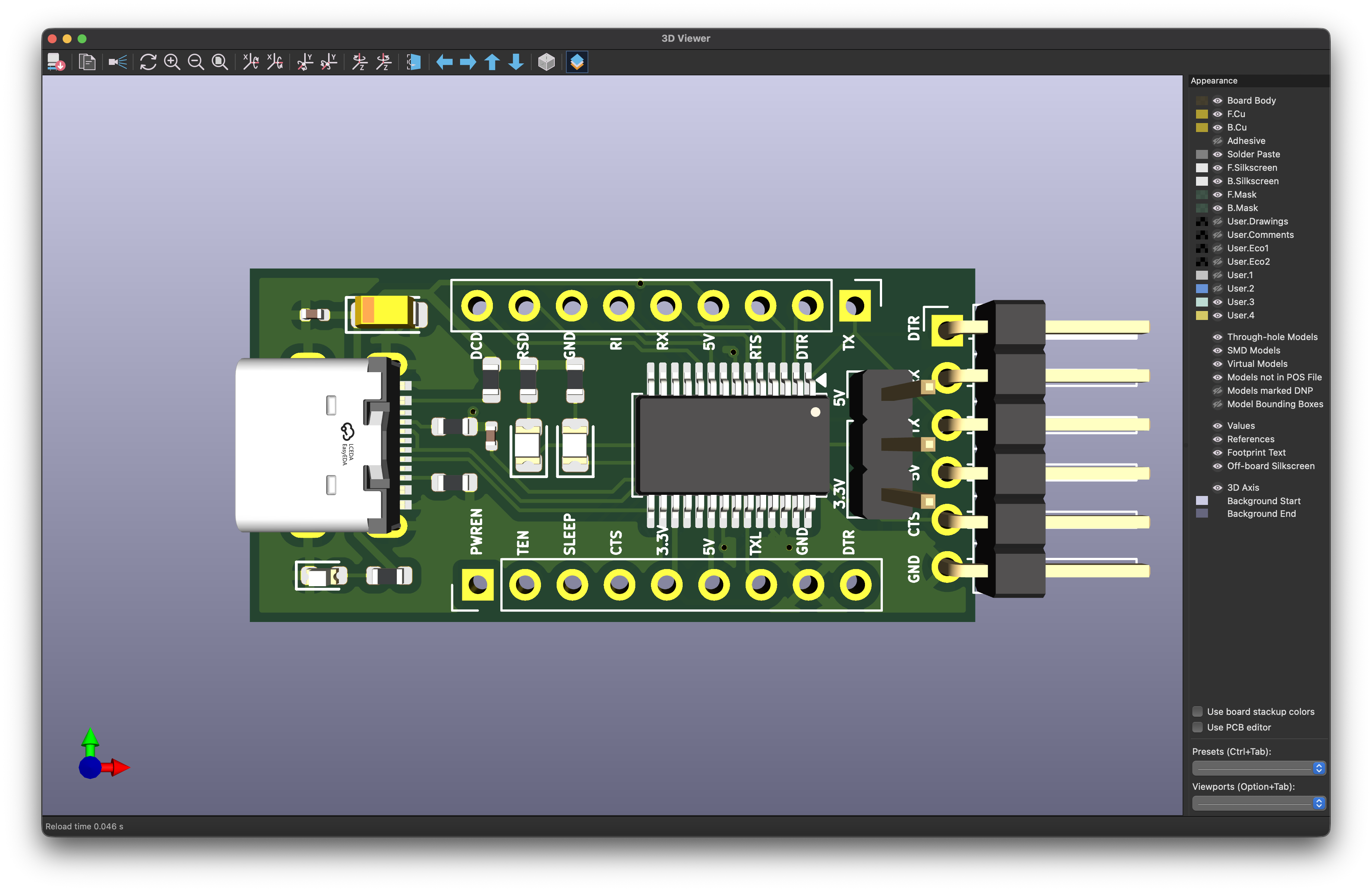
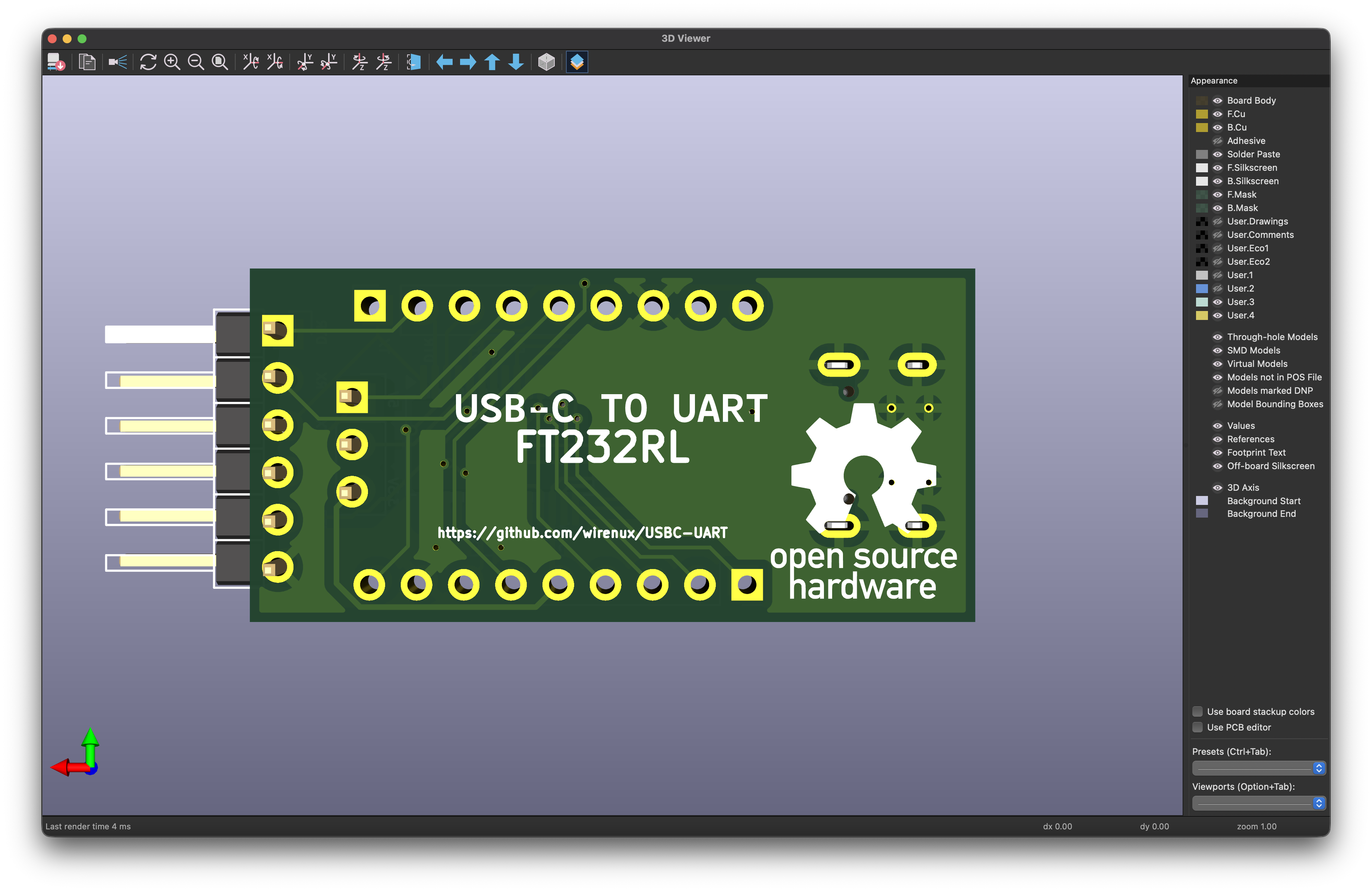
USB UART is an open-source printed circuit board by wirenux, from the wirenux/USBC-UART repository on GitHub, published under the MIT licence. It is a 2-layer board of 39 × 19 mm with 19 parts on 30 nets, routed with 216 tracks and 13 vias.
It is built around the FT232RL. Its parts include 6 resistors, 4 connectors, 3 capacitors, 3 diodes and 1 IC. It belongs with the interfaces and adapters boards of this library.
A simple project to convert a traditional USB-B UART bridge schematic to a modern USB-C interface.
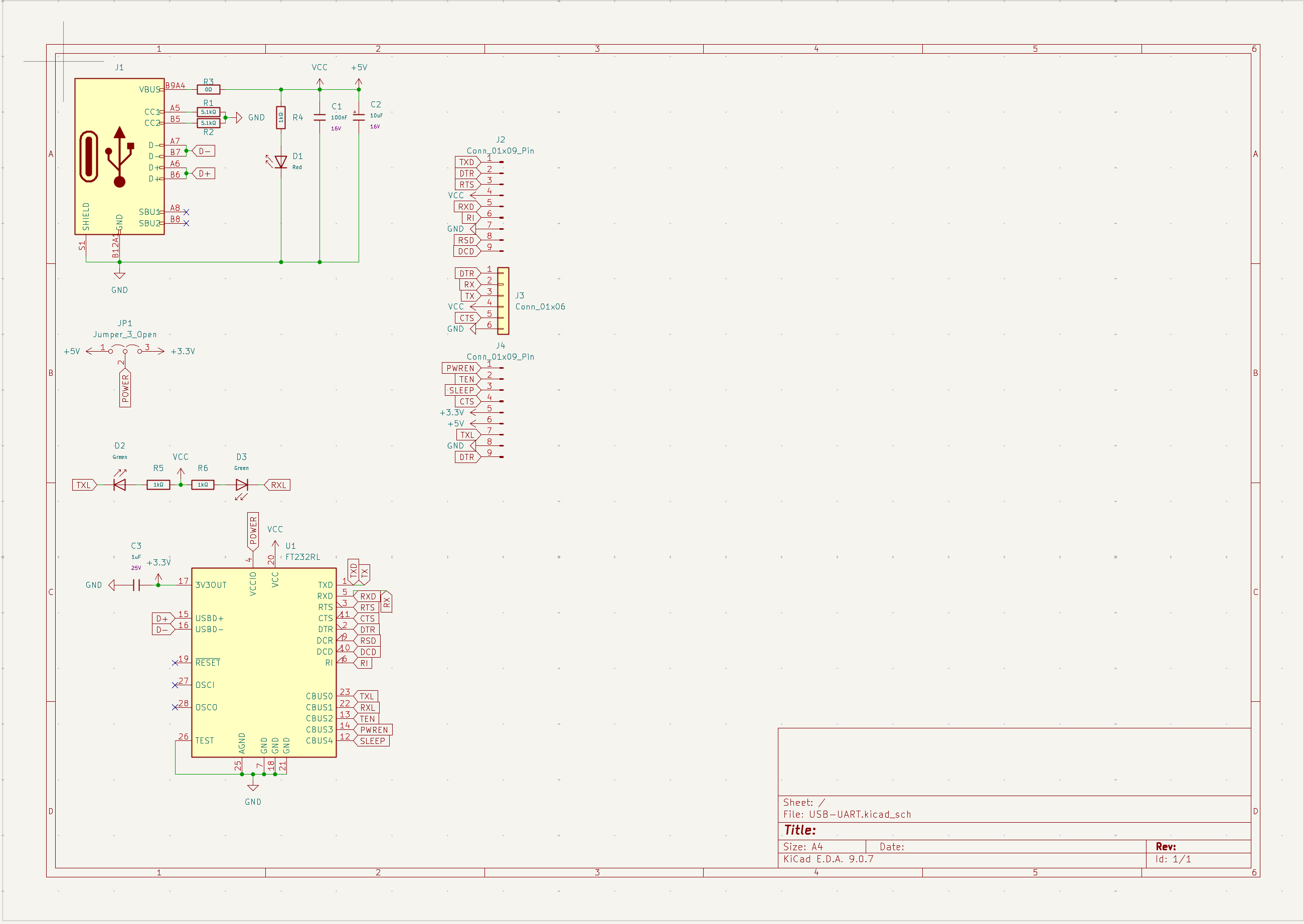
For the device to work with USB-C to USB-C cables, you must add two resistors to the configuration pins:
This project is under MIT license.
| Qty | Value | Footprint | References |
|---|---|---|---|
| 3 | 1kΩ | PCM_JLCPCB:R_0603 | R4, R5, R6 |
| 2 | 5.1kΩ | PCM_JLCPCB:R_0603 | R1, R2 |
| 2 | Conn_01x09_Pin | Connector_PinHeader_2.54mm:PinHeader_1x09_P2.54mm_Vertical | J2, J4 |
| 2 | Green | PCM_JLCPCB:D_0805 | D2, D3 |
| 1 | 0Ω | PCM_JLCPCB:R_0603 | R3 |
| 1 | 100nF | PCM_JLCPCB:C_0402 | C1 |
| 1 | 10uF | PCM_JLCPCB:C_CASE-A-3216-18(mm) | C2 |
| 1 | 1uF | PCM_JLCPCB:C_0402 | C3 |
| 1 | Conn_01x06 | Connector_PinHeader_2.54mm:PinHeader_1x06_P2.54mm_Horizontal | J3 |
| 1 | Connector, USB-TYPE-C-16P | PCM_JLCPCB:TYPE-C-SMD_HX-TYPE-C-16PIN | J1 |
| 1 | FT232RL | Package_SO:SSOP-28_5.3x10.2mm_P0.65mm | U1 |
| 1 | Jumper_3_Open | Connector_PinHeader_2.54mm:PinHeader_1x03_P2.54mm_Vertical | JP1 |
| 1 | LOGO | OSH-Logo:OSH-Logo | G*** |
| 1 | Red | PCM_JLCPCB:D_0603 | D1 |
zmaker/arduino_cookbook
gli sketch del nuovo progetto Arduino Cookbook e dei video di YouTube


Ledger-Donjon/silicon-toaster
SiliconToaster is an open-source hardware electromagnetic fault injection device, designed for hardware security research. It has the following features:


jsjolund/dmx512-controller-board
Controller board for DMX512 compatible devices, built around the STM32F4 processor

It measures 39 × 19 mm and has 2 copper layers, 1.6 mm thick.
19 parts, built around the FT232RL. The full list of its parts is on this page, with links to each part's symbol and footprint where PCBKit's library has them.
From the wirenux/USBC-UART repository on GitHub, at the commit this page was made from: the board is USB-UART.kicad_pcb and its schematic USB-UART.kicad_sch. PCBKit opens the board in the browser, with nothing to install.
Its repository publishes it under the MIT licence: you may reuse it on that licence's terms (keep the author's notice, and for a copyleft licence share your changes alike).