
4 layers99 × 53.3 mm
PSLab
fossasia/pslab-hardware
PSLab Hardware Design and Schematics https://pslab.io
199 parts1.7kApache-2.0

 UNewHaven-CIT/ectf-2024-devboard
Our own spin on the MAX78000FT dev board
UNewHaven eCTF is an open-source printed circuit board by UNewHaven-CIT, from the UNewHaven-CIT/ectf-2024-devboard repository on GitHub, published under the GPL-3.0 licence. It is a 2-layer board of 64.8 × 104.1 mm with 70 parts on 47 nets, routed with 223 tracks and 9 vias.
It is built around the WS2812B. Its parts include 13 diodes, 13 connectors, 3 resistors and 2 switches. It belongs with the microcontroller boards boards of this library.
This is a daughterboard for the MAX78000FT development board, designed for the 2024 eCTF competition.
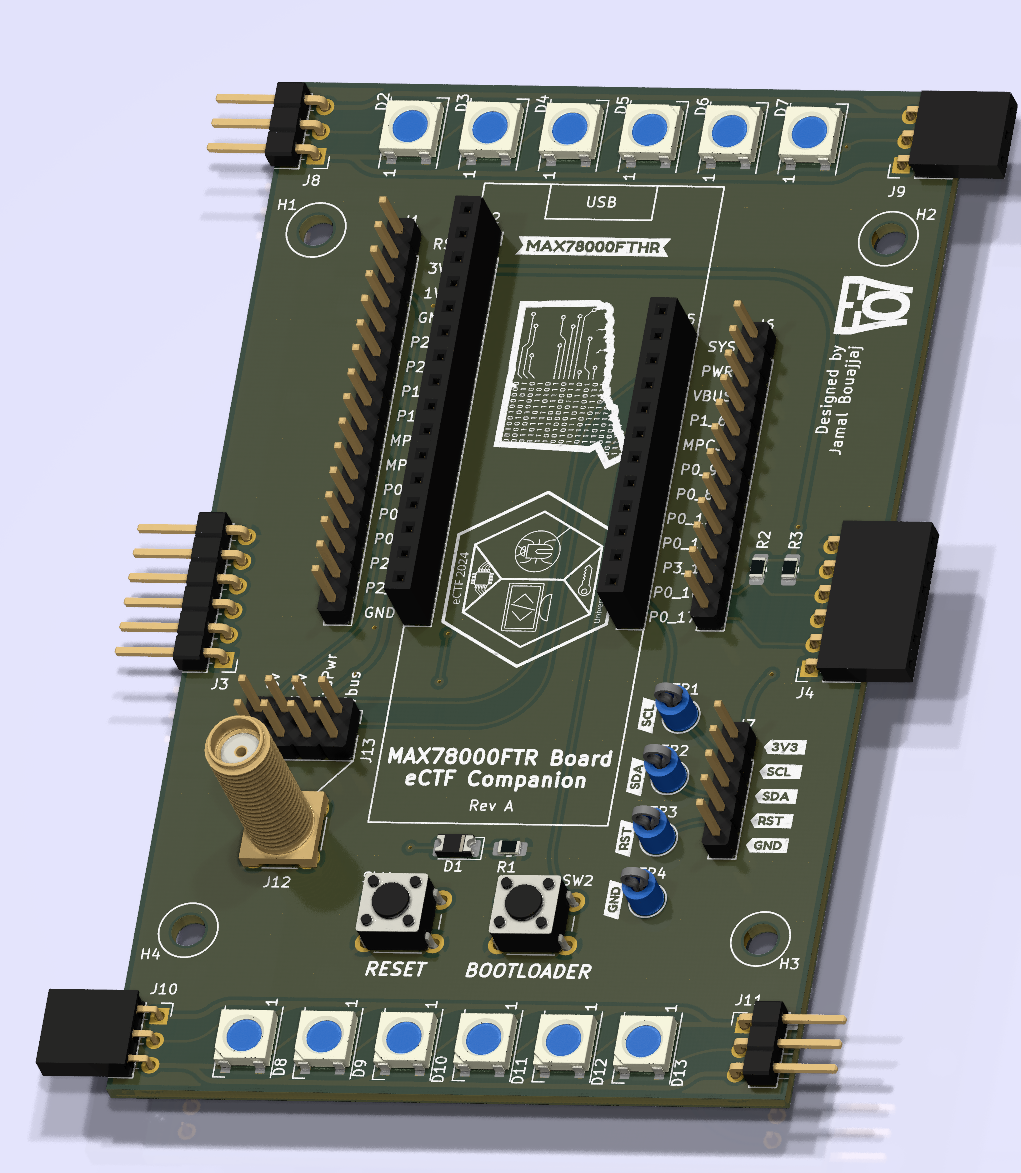
This was partially inspired by MITRE's own board design, and from a joke gone too far (the leds are what started it all).
This project is licensed under GPLv3.
| Qty | Value | Footprint | References |
|---|---|---|---|
| 18 | LOGO | LOGO | G***, G***, G***, G***, G***, G***, G***, G***, G***, G***, G***, G***, G***, G***, G***, G*** +2 |
| 12 | WS2812B | LED_SMD:LED_WS2812B_PLCC4_5.0x5.0mm_P3.2mm | D2, D3, D4, D5, D6, D7, D8, D9, D10, D11, D12, D13 |
| 4 | MountingHole | MountingHole:MountingHole_3.2mm_M3_DIN965 | H1, H2, H3, H4 |
| 4 | TestPoint | TestPoint:TestPoint_Keystone_5005-5009_Compact | TP1, TP2, TP3, TP4 |
| 3 | Jumper_2_Open | Resistor_SMD:R_0805_2012Metric_Pad1.20x1.40mm_HandSolder | JP1, JP2, JP3 |
| 2 | 4k7 | Resistor_SMD:R_0805_2012Metric_Pad1.20x1.40mm_HandSolder | R2, R3 |
| 2 | Conn_01x03_Pin | Connector_PinHeader_2.54mm:PinHeader_1x03_P2.54mm_Horizontal | J8, J11 |
| 2 | Conn_01x03_Socket | Connector_PinSocket_2.54mm:PinSocket_1x03_P2.54mm_Horizontal | J9, J10 |
| 2 | SW_Push | Button_Switch_THT:SW_PUSH_6mm | SW1, SW2 |
| 1 | 1k | Resistor_SMD:R_0805_2012Metric_Pad1.20x1.40mm_HandSolder | R1 |
| 1 | Conn_01x05_Pin | Connector_PinHeader_2.54mm:PinHeader_1x05_P2.54mm_Vertical | J7 |
| 1 | Conn_01x06_Pin | Connector_PinHeader_2.54mm:PinHeader_1x06_P2.54mm_Horizontal | J3 |
| 1 | Conn_01x06_Socket | Connector_PinSocket_2.54mm:PinSocket_1x06_P2.54mm_Horizontal | J4 |
| 1 | Conn_01x12_Pin | Connector_PinHeader_2.54mm:PinHeader_1x12_P2.54mm_Vertical | J6 |
| 1 | Conn_01x12_Socket | Connector_PinSocket_2.54mm:PinSocket_1x12_P2.54mm_Vertical | J5 |
| 1 | Conn_01x16_Pin | Connector_PinHeader_2.54mm:PinHeader_1x16_P2.54mm_Vertical | J1 |
| 1 | Conn_01x16_Socket | Connector_PinSocket_2.54mm:PinSocket_1x16_P2.54mm_Vertical | J2 |
| 1 | Conn_02x04_Odd_Even | Connector_PinHeader_2.54mm:PinHeader_2x04_P2.54mm_Vertical | J13 |
| 1 | Conn_Coaxial | Connector_Coaxial:SMA_Amphenol_132291_Vertical | J12 |
| 1 | G*** | kibuzzard-65C19DCD | kibuzzard-65C19DCD |
| 1 | G*** | kibuzzard-65C1A1F1 | kibuzzard-65C1A1F1 |
| 1 | G*** | kibuzzard-65C1A1F5 | kibuzzard-65C1A1F5 |
| 1 | G*** | kibuzzard-65C1A1E7 | kibuzzard-65C1A1E7 |
| 1 | G*** | kibuzzard-65C19E6E | kibuzzard-65C19E6E |
| 1 | G*** | kibuzzard-65C1A1FF | kibuzzard-65C1A1FF |
| 1 | G*** | kibuzzard-65C19DC0 | kibuzzard-65C19DC0 |
| 1 | G*** | kibuzzard-65C1A1FA | kibuzzard-65C1A1FA |
| 1 | G*** | kibuzzard-65C19DD2 | kibuzzard-65C19DD2 |
| 1 | G*** | kibuzzard-65C19DD8 | kibuzzard-65C19DD8 |
| 1 | LED | Diode_SMD:D_1206_3216Metric_Pad1.42x1.75mm_HandSolder | D1 |
fossasia/pslab-hardware
PSLab Hardware Design and Schematics https://pslab.io

FrameworkComputer/ExpansionCards
Reference designs and documentation to create Expansion Cards for the Framework Laptop


PrintersForAnts/Micron
If you want to purchase full kits there are 3 available (Kits are slowly updating to R1 hardware just make sure to double check the included hardware in your kit and if you have any questions reach out in the discord)


It measures 64.8 × 104.1 mm and has 2 copper layers, 1.6 mm thick.
70 parts, built around the WS2812B. The full list of its parts is on this page, with links to each part's symbol and footprint where PCBKit's library has them.
From the UNewHaven-CIT/ectf-2024-devboard repository on GitHub, at the commit this page was made from: the board is uNewHaven_eCTF.kicad_pcb and its schematic uNewHaven_eCTF.kicad_sch. PCBKit opens the board in the browser, with nothing to install.
Its repository publishes it under the GPL-3.0 licence: you may reuse it on that licence's terms (keep the author's notice, and for a copyleft licence share your changes alike).