2 layers89.5 × 77.5 mm

 tjboldt/Apple2-IO-RPi140
Apple II expansion card using a Raspberry Pi for I/O
Apple2-IO RPi is an open-source printed circuit board by tjboldt, from the tjboldt/Apple2-IO-RPi repository on GitHub, published under the MIT licence. It is a 2-layer board of 89.5 × 77.5 mm with 24 parts on 108 nets, routed with 1,021 tracks and 98 vias.
It is built around the 74LVC245AD, 74LS245SC and 74LS32SC, with the 74LVC374AD and 74LS00SC among its other parts. Its parts include 9 capacitors, 9 ICs and 2 connectors. It belongs with the retro computing and games boards of this library.


Apple II expansion card using a Raspberry Pi for I/O
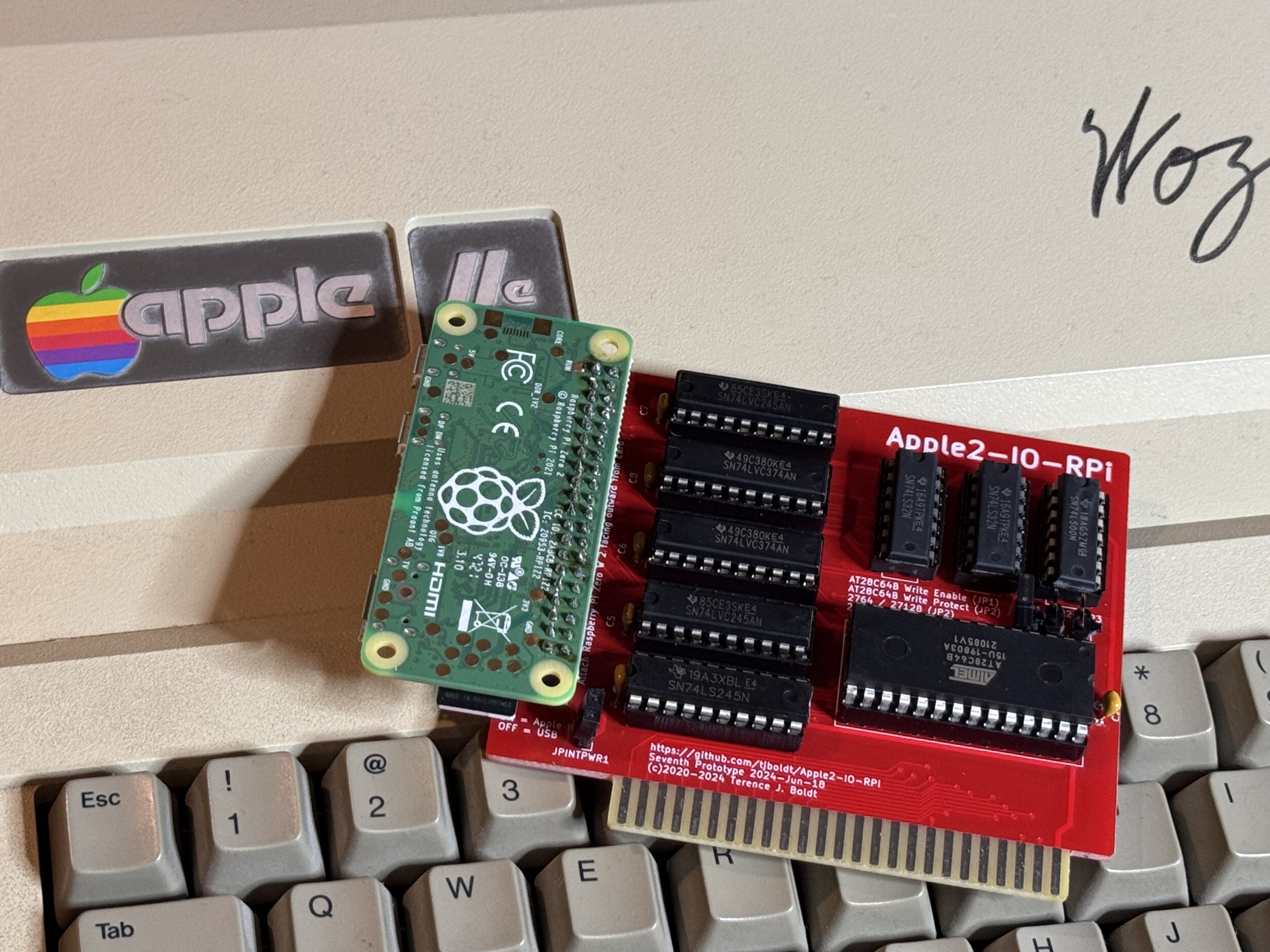
The purpose of this project is to provide I/O for an Apple II series 8 bit computer via a Raspberry Pi Zero 2 W which is powered by the Apple II expansion bus. This includes using the attached RPi Zero 2 W for it's storage, network and processor to provide new functionality for the Apple II.
-SHELL from ProDOS10 PRINT CHR$(4);"RPI ls -al /"So far, this is still a project and not a finished product. The current prototype is on the seventh revision. I have sold about 60 boards including previous prototypes. There are several hundred in the wild between self made and ones purchased in places like eBay that were made by others. The seventh prototype is functionally equivalent to the sixth other than support for write-protect and reintroducing EPROM support. The fifth revision was similar and compatible with the sixth, other than a new jumper to select internal/external power on the sixth.
The card enables the Apple II to boot from and write to virtual hard drive images stored on the RPi in any slot (except slot 3), execute Linux commands from Applesoft BASIC and run a bash shell with VT100 emulation. The code has very few tests and is incomplete. Note that currently the firmware assumes an 80 column card is in slot 3 and than you have lowercase support. Most development has been done with an enhanced Apple //e with the card in slot 7. If you have other drive controllers earlier in the boot cycle, you can still boot from the Apple2-IO-RPi. For example, if the card was in slot 4, you could type PR#4 from the BASIC prompt to boot the card. Note that the Raspberry Pi Zero W (and W 2) consume 170 - 250 mA and there is only 500 mA available to all expansion slots according to Apple. It is not recommended to have a lot of other cards in the system at the same time. With the sixth revision of the prototype, it is possible to remove the power jumper and run the RPi on an external USB power source. If configured for external power, note that the card's firmware will hang on boot without USB power on as the latch chips are powered by the 3.3V output of the RPi.
If you have a problem or idea for enhancement, log an issue here or start a discussion. I recommend starring/watching the project for updates on GitHub. You are welcome to fork the project and submit pull requests which I will review. The latest version has an in-memory virtual drive representing current working directory in Linux for ease of copying files between Linux and ProDOS when the drive 1 is not specified as a file.
Ralle Palaveev has a version of the hardware that uses a RPi Pico to handle firmware and communications to the host over USB. This uses Oliver Schmidt's PIO code.
See List of issues tagged roadmap
If you prefer having Apple II peripherals control a Raspberry Pi rather than simply using the Raspberry Pi to provide storage, network access and processing to the Apple II, have a look at David Schmenk's excellent Apple2Pi project. I am often asked about differences between these two projects. They are similar in some ways but essentially opposite. The Apple2Pi is meant for the primary machine to be the RPi, using the Apple II for it's peripherals. The Apple2-IO-RPi is meant to have the Apple II as the primary machine and just use the RPi for its processing, storage and network.
| Qty | Value | Footprint | References |
|---|---|---|---|
| 9 | 0.1 µF | Apple2:Capacitor | C1, C2, C3, C4, C5, C6, C7, C8, C9 |
| 2 | 74LS32 | Apple2:74LS32 | U3, U8 |
| 2 | 74LVC245 | Package_DIP:DIP-20_W7.62mm | U4, U6 |
| 2 | 74LVC374 | Package_DIP:DIP-20_W7.62mm | U5, U7 |
| 1 | 27256 / 27512 | Connector_PinHeader_2.54mm:PinHeader_1x02_P2.54mm_Vertical | JP3 |
| 1 | 2764 / 27128 / AT28C64B WP | Connector_PinHeader_2.54mm:PinHeader_1x02_P2.54mm_Vertical | JP2 |
| 1 | 74LS00 | Apple2:74LS00 | U2 |
| 1 | 74LS245 | Package_DIP:DIP-20_W7.62mm | U0 |
| 1 | AT28C64B | Connector_PinHeader_2.54mm:PinHeader_1x02_P2.54mm_Vertical | JP1 |
| 1 | AT28C64B | Package_DIP:DIP-28_W15.24mm_Socket | U1 |
| 1 | Apple II Expansion Bus | Apple2:Apple II Expansion Edge Connector | J0 |
| 1 | Open for USB power, close for bus power | Connector_PinHeader_2.54mm:PinHeader_1x02_P2.54mm_Vertical | JPINTPWR1 |
| 1 | Raspberry_Pi_2_3 | Connector_PinSocket_2.54mm:PinSocket_2x20_P2.54mm_Vertical | J1 |


mudmin/AnotherMaker
This is where I will store code snippets for AnotherMaker Videos

The-Invent0r/8-bit-Computer-PCB
These are the KiCAD files for my 8-Bit Computer.

tjboldt/ProDOS-ROM-Drive
A bootable 1 MB solid state disk for Apple ][ computers

hkzlab/CGA_Redux
The Color Graphics Adapter Redux board is a more or less faithful clone of the original IBM CGA, based on the original schematics

It measures 89.5 × 77.5 mm and has 2 copper layers, 1.6 mm thick.
24 parts, built around the 74LVC245AD, 74LS245SC, 74LS32SC and 74LVC374AD. The full list of its parts is on this page, with links to each part's symbol and footprint where PCBKit's library has them.
From the tjboldt/Apple2-IO-RPi repository on GitHub, at the commit this page was made from: the board is Hardware/Apple2IORPi.kicad_pcb and its schematic Hardware/Apple2IORPi.kicad_sch. PCBKit opens the board in the browser, with nothing to install.
Its repository publishes it under the MIT licence: you may reuse it on that licence's terms (keep the author's notice, and for a copyleft licence share your changes alike).