2 layers74.5 × 40 mm
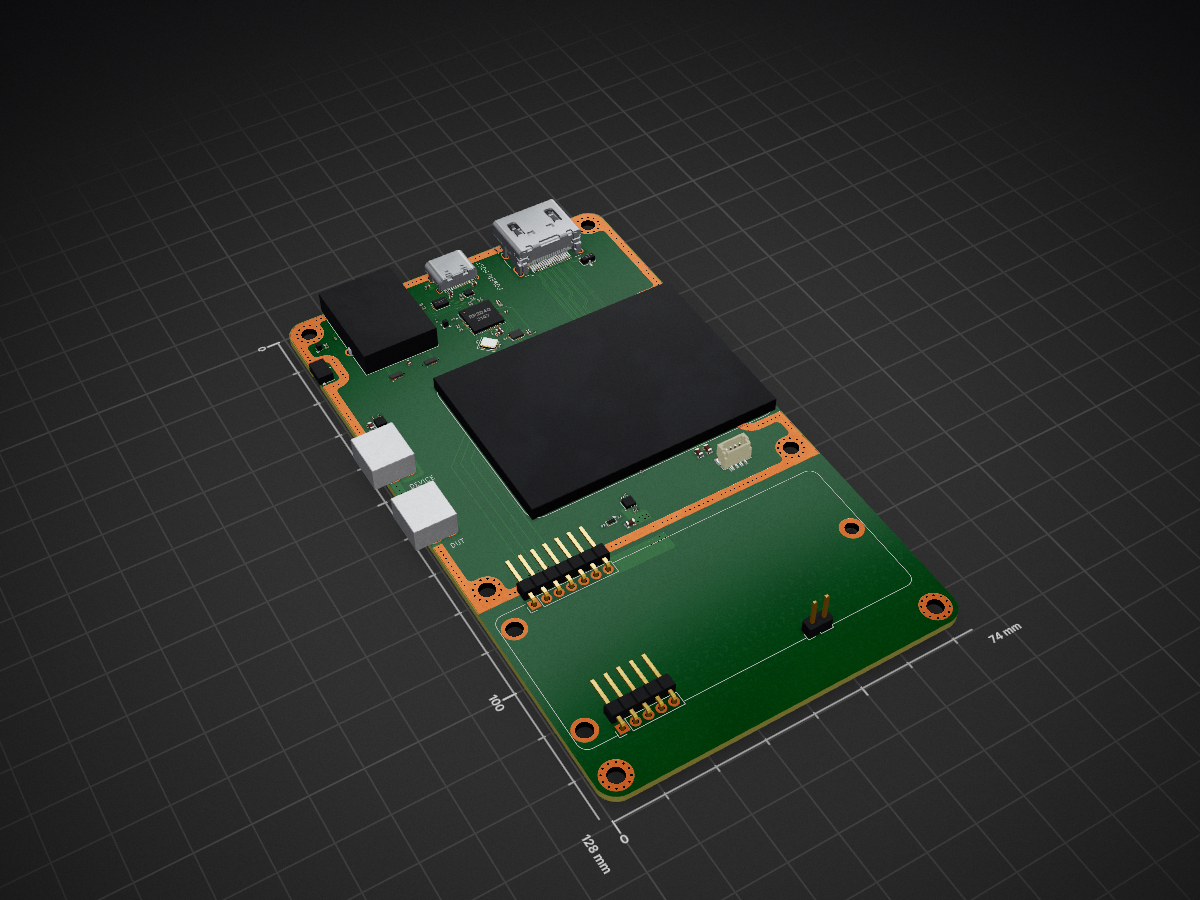
 taskx6004/limejig1
Open-source LimeJig fixture firmware, host tools, KiCad source, and synthetic test examples
Limejig is an open-source printed circuit board by taskx6004, from the taskx6004/limejig repository on GitHub, published under the MIT licence. It is an 8-layer board of 74 × 128 mm with 92 parts on 246 nets, routed with 949 tracks and 592 vias.
It is built around the RP2040, SN74LVC1G06YZVR and INA236AIYBJR, with the W25Q16JVUXIQ, TPD4EUSB30DQAR and TPS25200DRVR among its other parts. Its parts include 31 resistors, 28 capacitors, 18 connectors, 11 ICs and 1 switch. It belongs with the RP2040 and Raspberry Pi (Linux) boards of this library.


Public source snapshot for the LimeJig V0 LimeSDR Mini fixture.
This repository contains the RP2040 controller firmware, host CLI/Qt source, test policy and result schema, and the editable KiCad schematic/PCB with lean project-local symbol and footprint libraries.

Both previews were exported with KiCad 10.0.3. The schematic PDF comes from the sanitized editable source. The 3D preview is a rendered derivative made with the controlled private model set; the underlying vendor 3D files are not included here.
This is a sanitized source-only repository with new Git history. It does not contain the private production repository, production DUT records, serials, operator logs, HIL/release evidence, fixture recovery captures, credentials, network configuration, deployment images, or fabrication correspondence.
The initial snapshot was prepared from private LimeJig source commit
50d1615f8766ef7c7afc20b8388b80bd5dc6c6c7 without importing that repository's
commits or tags. See PUBLIC-SOURCE-MANIFEST.md for the exact inclusion and
exclusion boundary.
The records under examples/test-data/ are synthetic documentation/test
fixtures. They are not production results.
| Path | Contents |
|---|---|
firmware/rp2040/ | RP2040 firmware and source-level verification helpers |
host/cli/ | Fixture and DUT workflow command-line helpers |
host/gui/ | Qt 6 operator GUI |
host/python/ | Shared policy and crash-safe result-record support |
host/kiosk/ | Linux kiosk integration |
policy/ | DUT acceptance policy and limejig.result/v1 schema |
hardware/kicad/ | Editable KiCad V0 schematic, PCB, symbols, and footprints |
examples/test-data/ | Small synthetic pass/fail examples only |
docs/rendered/ | Public schematic PDF and top-side PCB 3D preview |
tools/check-public.sh | Public-tree syntax, privacy, and optional GUI checks |
This repository does not define a default login or password. Never assume that a credential used on a development fixture is suitable for another jig. Create each appliance credential during OS provisioning, prefer SSH keys, and use a unique password if password login remains enabled.
The supplied kiosk service runs as the dedicated limejig OS account and uses
/var/lib/limejig as its working directory. A manual deployment must create
that account and directory, grant the hardware permissions required by the
fixture, install the runtime files, and only then enable the service. Merely
cloning this repository does not perform those system changes.
There is no LimeJig apt repository or public CM5 appliance bootstrap in this snapshot. The apt command in the GitHub Actions workflow installs only the generic dependency needed by the public source check; it is not a jig install procedure. A CM5 that already has the controlled appliance packages and their dependencies can use this source for review and development. A fresh CM5 needs an independently maintained OS/package provisioning procedure.
Run the non-hardware public gate:
tools/check-public.sh --skip-guiWith Qt 6 development packages, CMake, and Ninja installed:
tools/check-public.shFirmware build prerequisites and commands are described in
firmware/rp2040/README.md. No command above accesses USB devices, fixture
power, FT601 EEPROM, QSPI flash, or a DUT.
LimeJig is released under the MIT License; see LICENSE. Inherited RP2040
DirtyJTAG material also retains its original MIT notices in
firmware/rp2040/LICENSE and applicable source headers.
| Qty | Value | Footprint | References |
|---|---|---|---|
| 16 | 100nF | MANUAL_PASSIVES:C_0201 | C6, C7, C8, C10, C12, C13, C14, C15, C16, C17, C18, C20, C21, C23, C24, C25 |
| 8 | 100k | MANUAL_PASSIVES:R_0201 | R12, R15, R17, R21, R22, R25, R26, R27 |
| 7 | 1k | MANUAL_PASSIVES:R_0201 | R1, R2, R3, R4, R10, R18, R31 |
| 6 | ~ | MANUAL_MECHANICAL:standoff-phi=3.2-5 | P1, P2, P3, P4, P8, P9 |
| 4 | 47uF | MANUAL_PASSIVES:C_0805 | C22, C26, C27, C28 |
| 3 | 0R | MANUAL_PASSIVES:R_0201 | R6, R9, R29 |
| 3 | 100nF | MANUAL_PASSIVES:C_0402 | C1, C4, C5 |
| 3 | 10k | MANUAL_PASSIVES:R_0201 | R5, R11, R20 |
| 2 | 15p | MANUAL_PASSIVES:C_0201 | C2, C3 |
| 2 | 1u | MANUAL_PASSIVES:C_0402 | C9, C11 |
| 2 | 2305018-2 | MANUAL_CONNECTORS:TE_2305018-2_USB-C_Receptacle_OnBoard | J4, J5 |
| 2 | 27R | MANUAL_PASSIVES:R_0201 | R13, R14 |
| 2 | 300k | MANUAL_PASSIVES:R_0201 | R23, R28 |
| 2 | 4.7k | MANUAL_PASSIVES:R_0201 | R8, R19 |
| 2 | 68k | MANUAL_PASSIVES:R_0201 | R16, R24 |
| 2 | TPD4EUSB30DQAR | MANUAL_GENERATED:TPD4EUSB30DQAR_DQA_USON-10_1x2.5mm_P0.5mm | U1, U2 |
| 2 | TPS25200DRVR | MANUAL_GENERATED:TPS25200DRVR_DRV_WSON-6_2x2mm_P0.65mm_EP1x1.6mm | U9, U10 |
| 2 | ~ | MANUAL_MECHANICAL:standoff-phi=3.2 | P5, P6 |
| 1 | 0.02R | MANUAL_PASSIVES:PA2512FKE7W0R02E_2512_CurrentSense | R7 |
| 1 | 1nF | MANUAL_PASSIVES:C_0201 | C19 |
| 1 | 2.2k | MANUAL_PASSIVES:R_0402 | R30 |
| 1 | 2171790001 | MANUAL_CONNECTORS:Molex_2171790001_USB-C_Receptacle_16P_TopMount | J7 |
| 1 | 690-019-298-412 | MANUAL_CONNECTORS:EDAC_690-019-298-412 | J8 |
| 1 | ABM8-272-T3 | MANUAL_GENERATED:ABM8-272-T3_ABM8G_3225_4Pin | Y1 |
| 1 | BM04B-SRSS-TB(LF)(SN) | MANUAL_CONNECTORS:JST_SH_BM04B-SRSS-TB_1x04-1MP_P1.00mm_Vertical | J9 |
| 1 | CM5 | MANUAL_CM5:CM5 | XA1 |
| 1 | EVPAEBB2A | MANUAL_GENERATED:EVPAEBB2A | SW1 |
| 1 | INA236AIYBJR | MANUAL_GENERATED:INA236AIYBJR_YBJ_DSBGA-8_P0.4mm | U4 |
| 1 | LPJG0926HENL | MANUAL_CONNECTORS:LPJG0926HENL | J6 |
| 1 | MHPA1010RGBDT | MANUAL_GENERATED:MHPA1010RGBDT_1010_RGB | LD1 |
| 1 | RP2040 | MANUAL_GENERATED:RP2040_QFN-56-1EP_7x7mm_P0.4mm_EP3.2x3.2mm | U7 |
| 1 | RT9742SNGV | MANUAL_GENERATED:RT9742SNGV_SOT-23-3 | U3 |
| 1 | SN74AXC4T774RSVR | MANUAL_GENERATED:SN74AXC4T774RSVR_RSV_UQFN-16_1.8x2.6mm_P0.4mm | U11 |
| 1 | SN74LVC1G06YZVR | MANUAL_GENERATED:SN74LVC1G06YZVR_Texas_YZV_DSBGA-4_1.25x1.25mm_P0.5mm | U8 |
| 1 | TMUXHS221NKGR | MANUAL_GENERATED:TMUXHS221NKGR_NKG_UQFN-10_1.4x1.8mm_P0.4mm | U5 |
| 1 | W25Q16JVUXIQ | MANUAL_GENERATED:W25Q16JVUXIQ_USON-8_3x2mm_P0.5mm_EP0.2x1.6mm | U6 |
| 1 | YZ85915058P-07025-01 | MANUAL_CONNECTORS:YZ85915058P-07025-01 | J1 |
| 1 | YZ85915058P-07025-01-2 | MANUAL_CONNECTORS:YZ85915058P-07025-01-2 | J2 |
| 1 | YZ85915058P-07025-01-5 | MANUAL_CONNECTORS:YZ85915058P-07025-01-5 | J3 |
| 1 | ~ | MANUAL_MECHANICAL:standoff-phi=2.7 | P7 |
It measures 74 × 128 mm and has 8 copper layers, 1.56 mm thick.
92 parts, built around the RP2040, SN74LVC1G06YZVR, INA236AIYBJR and W25Q16JVUXIQ. The full list of its parts is on this page, with links to each part's symbol and footprint where PCBKit's library has them.
From the taskx6004/limejig repository on GitHub, at the commit this page was made from: the board is hardware/kicad/limejig.kicad_pcb and its schematic hardware/kicad/limejig.kicad_sch. PCBKit opens the board in the browser, with nothing to install.
Its repository publishes it under the MIT licence: you may reuse it on that licence's terms (keep the author's notice, and for a copyleft licence share your changes alike).

jrseti/Dish
Simple controller with toggle switches to move the dish motors


loopj/short-stack
World's Smallest Nintendo Wii, using a trimmed motherboard and custom stacked PCBs

the78mole/jumpstarter-mono
This is a monorepo containing all jumpstarter tools and (hopefully) adds a standalone server soon.

david0ha/astra-cm5-nano
KiCad files and specifications for a 55 × 40 mm CM5 carrier board.

