
2 layers83.3 × 68.2 mm
Yet another 8bit Retro Computer
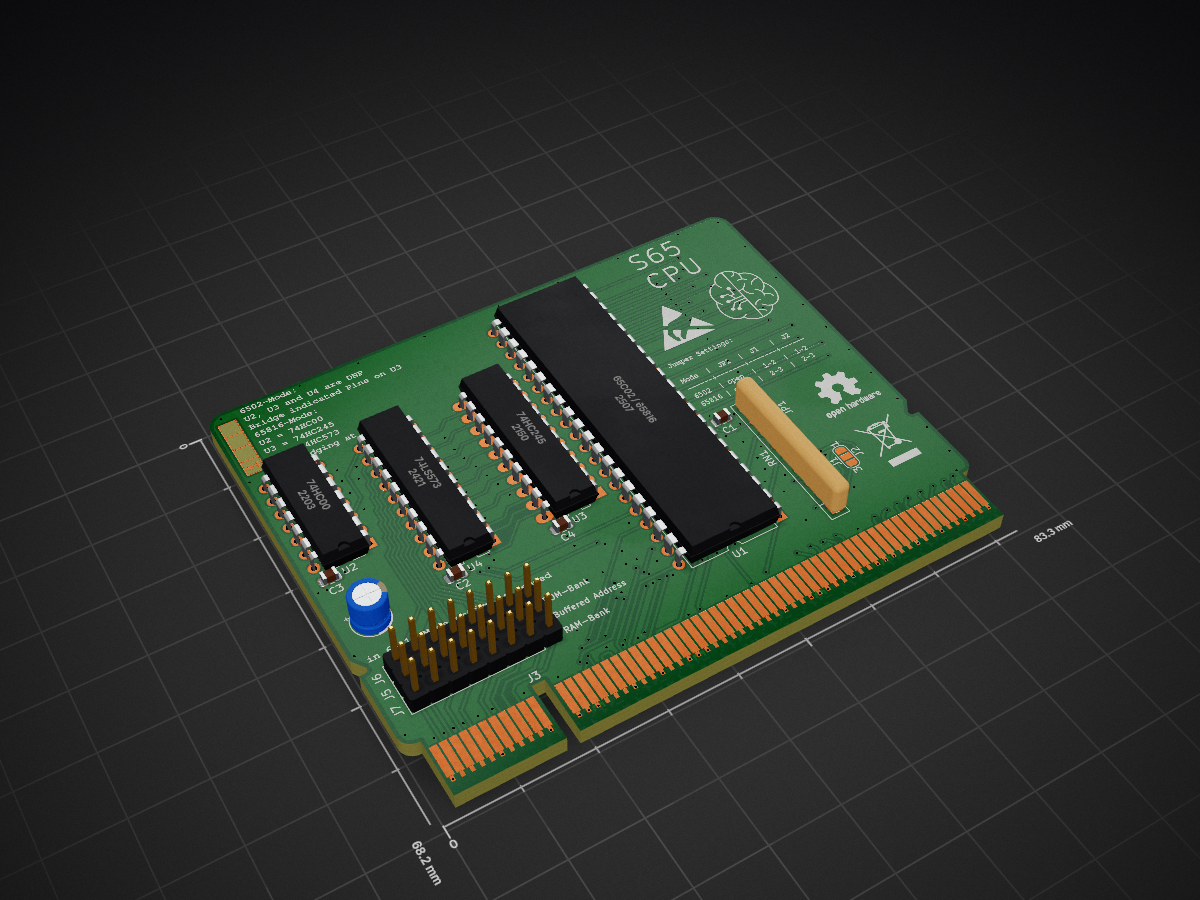
CPU is an open-source printed circuit board by Synthron, from the Synthron/S65 repository on GitHub. It is a 4-layer board of 83.3 × 68.2 mm with 22 parts on 119 nets, routed with 561 tracks and 240 vias.
It is built around the 74HC245D, 74HC00D and 74LS573PC. Its parts include 6 connectors, 5 capacitors and 4 ICs. It belongs with the retro computing and games boards of this library.


Yet another 8bit Retro Computer
Completely bloated, overkill and fully hackable!
boot routine:
General:
| Start | End | Usage | Size |
|---|---|---|---|
| 0000 | 7FFF | RAM | 32.768 |
| 8000 | BEFF | RAM Banked | 16.128 |
| BF00 | BFFF | IO Space | 256 |
| C000 | FFFF | ROM Banked | 16.384 |
IO Space:
| Start | End | Usage | Size |
|---|---|---|---|
| BF00 | BF07 | Bank & IRQ | 8 |
| BF08 | BF0F | TPI IDE | 8 |
| BF10 | BF12 | LPT | 2 |
| BF13 | BF14 | --- (LPT2) | 2 |
| BF14 | BF16 | MyCPU VGA | 3 |
| BF17 | BF1B | --- | 5 |
| BF1C | BF1F | PIA LEDs | 4 |
| BF20 | BF2F | VIA 1 LCD IRQ | 16 |
| BF30 | BF3F | VIA 2 | 16 |
| BF40 | BF4F | VIA 3 | 16 |
| BF50 | BF53 | ACIA 1 | 4 |
| BF54 | BF57 | ACIA 2 | 4 |
| BF58 | BF5B | --- (ACIA 3) | 4 |
| BF5C | BF5F | --- (ACIA 4) | 4 |
| BF60 | BF7F | SID 8580 | 32 |
| BF80 | BF87 | Simple IDE | 8 |
| BF88 | BF8F | CF Card | 8 |
| BF90 | BF9F | RTC | 16 |
| BFA0 | BFFF | --- | 96 |
The TPI Chip for the memory banks also functions as a priority interrupt controller, providing 5 seperate interrupt lines.
IRQ_0 is further divided into 8 lines for communication modules, giving an overall of 14 available IRQ-Lines.
These are currently used as follows:
Note that the NMI is connected to a push button on the bus board.
| Qty | Value | Footprint | References |
|---|---|---|---|
| 4 | 100n | Capacitor_SMD:C_0805_2012Metric | C1, C2, C3, C4 |
| 1 | 10µ | Capacitor_THT:CP_Radial_D5.0mm_P2.50mm | C5 |
| 1 | 3k3 | Resistor_THT:R_Array_SIP9 | RN1 |
| 1 | 65C02 / 65816 | Package_DIP:DIP-40_W15.24mm | U1 |
| 1 | 74HC00 | Package_DIP:DIP-14_W7.62mm | U2 |
| 1 | 74HC245 | Package_DIP:DIP-20_W7.62mm_LongPads | U3 |
| 1 | 74LS573 | Package_DIP:DIP-20_W7.62mm | U4 |
| 1 | ABORT | Jumper:SolderJumper-3_P1.3mm_Open_RoundedPad1.0x1.5mm_NumberLabels | J1 |
| 1 | Bank Bridge A | Connector_PinHeader_2.54mm:PinHeader_1x08_P2.54mm_Vertical | J5 |
| 1 | Bank Bridge B | Connector_PinHeader_2.54mm:PinHeader_1x08_P2.54mm_Vertical | J6 |
| 1 | Bank Bridge C | Connector_PinHeader_2.54mm:PinHeader_1x08_P2.54mm_Vertical | J7 |
| 1 | Bus_PCI_6502 | Connector_PCBEdge:BUS_PCI | J3 |
| 1 | E | Jumper:SolderJumper-2_P1.3mm_Open_RoundedPad1.0x1.5mm | JP1 |
| 1 | LOGO | Eigene:logo | G*** |
| 1 | SO/MX | Jumper:SolderJumper-3_P1.3mm_Open_RoundedPad1.0x1.5mm_NumberLabels | J2 |
| 1 | Val** | Eigene:ladder_4 | Ref** |
The 19 most common of 22 parts.
It measures 83.3 × 68.2 mm and has 4 copper layers, 2.61 mm thick.
22 parts, built around the 74HC245D, 74HC00D and 74LS573PC. The full list of its parts is on this page, with links to each part's symbol and footprint where PCBKit's library has them.
From the Synthron/S65 repository on GitHub, at the commit this page was made from: the board is Hardware/modules/CPU/CPU.kicad_pcb and its schematic Hardware/modules/ACIA2/ACIA2.kicad_sch. PCBKit opens the board in the browser, with nothing to install.
Its repository states no licence, so its author keeps all rights: ask Synthron before reusing the design.


dennis9819/Z8C-Homebrew-Computer
To easily develop for my Z80 homebrew system, I designed a simple assempler development environment. This packs the following tasks into one script: zmac assembly object file creation (for xmodem upload) monitor file…
