


2 layers138.1 × 89.7 mm
Tao Te Ching LEFT
sudo-apt-install-tap/TaoTeChing
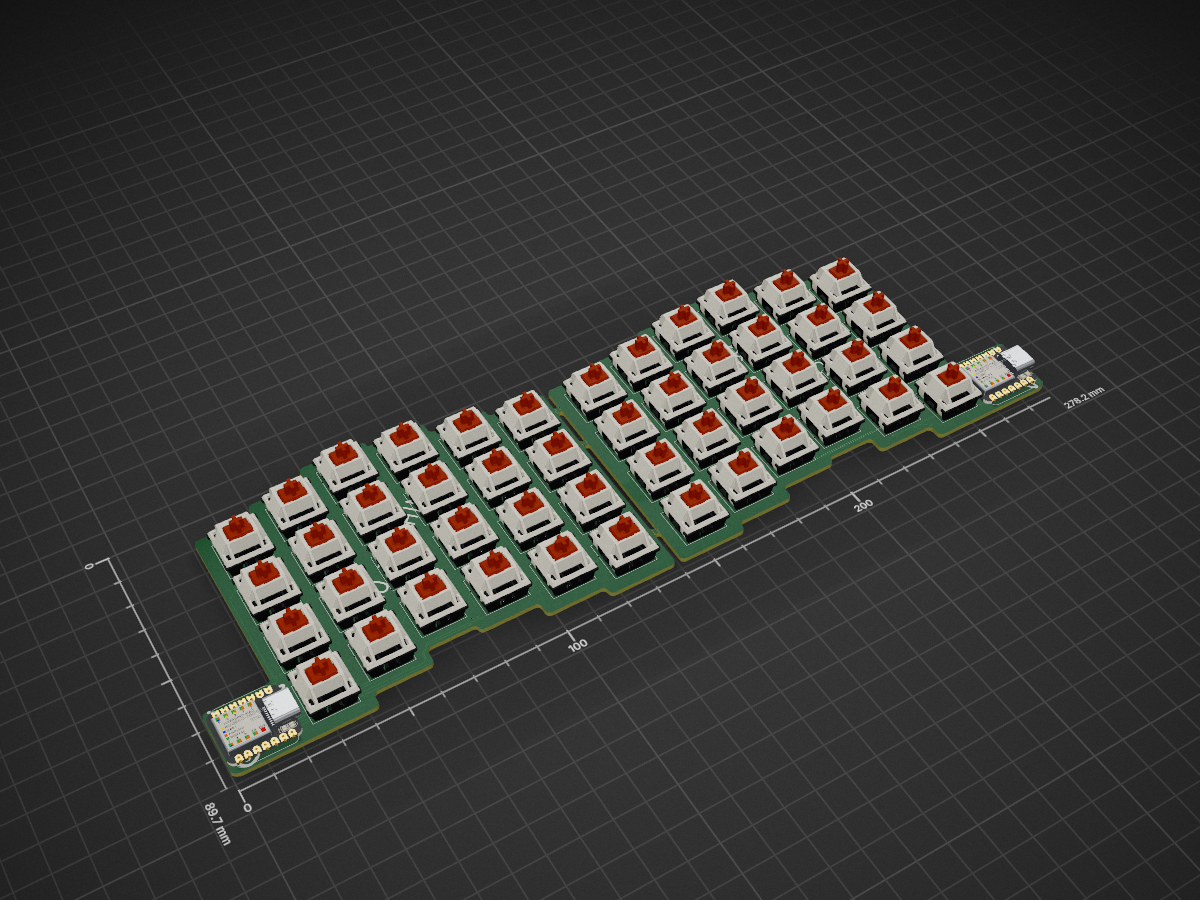
A open-source split keyboard made for ergonomics!! Made to feel minimalist. This is a ortholinear keyboard.
49 parts3
 sudo-apt-install-tap/TaoTeChing3
A open-source split keyboard made for ergonomics!! Made to feel minimalist. This is a ortholinear keyboard.
Tao Te Ching is an open-source printed circuit board by sudo-apt-install-tap, from the sudo-apt-install-tap/TaoTeChing repository on GitHub. It is a 2-layer board of 278.2 × 89.7 mm with 113 parts on 76 nets, routed with 556 tracks and 71 vias.
Its parts include 48 diodes, 48 switches and 2 ICs. It belongs with the keyboards and input boards and the nRF52 and nRF5x boards of this library.
Split keyboard. Ortholinear grid with column stagger. Built for comfort and long sessions.
Tao Te Ching is a split mechanical keyboard that combines the predictability of ortholinear rows with the ergonomics of column stagger. Each half is compact, symmetric, and designed to keep hands in a neutral position.
This will be my first split keyboard. Ive seen many people make splits. But nearly noone uses custom layout. So I made this layout.
You can write up a simple firmware or use the KMK script in my repo.
See renders and PCB files for exact spacing and geometry.
Plates can be 3D-printed (PLA works) or CNCed.
Designed to work with common keyboard firmware:


| Item | Description | Cost Per Unit | Quantity | Total | Link |
|---|---|---|---|---|---|
| Keycaps | Full keycap set | ₹1,400.00 | 1 | ₹1,400.00 | https://curiositycaps.in/products/gradient-gray-polar-day-oem-side-backlit-keycaps |
| PCB | Custom PCB fabrication | ₹3,726.00 | 1 | ₹3,726.00 | https://www.JLCPCB.COM |
| Switches | Keygeek x MZ Y1 Keyboard Switch (Pack of 10) | ₹255.00 | 5 | ₹1,275.00 | https://www.stackskb.com/store/keygeek-y1-keyboard-switch/ |
| Diodes | Per-key matrix diodes | ₹2.04 | 50 | ₹102.00 | https://robu.in/product/1n4148w-sod-123-1206-diodereel-of-3000/ |
| MCU | Seeed Studio XIAO RP2040 | ₹618.00 | 2 | ₹1,236.00 | https://robu.in/product/seeed-studio-xiao-rp2040-v1-0/ |
| Case & Plate | 3D printed case and plate (shipping included) | ₹500.00 | 1 | ₹500.00 | NUL (This was before Print Legion gave printers shipping money) |
| Total | ₹8,239.00 |
Project Cost: ₹8,239 (~$95 USD)
Open source. Build it, modify it, improve it.
| Qty | Value | Footprint | References |
|---|---|---|---|
| 48 | D | Diode_SMD:D_SOD-123 | D1, D2, D10, D11, D12, D13, D14, D15, D16, D17, D18, D19, D20, D21, D22, D23 +32 |
| 48 | SW_Push_45deg | KEYS:SW_Hotswap_Kailh_MX | SW1, SW2, SW10, SW11, SW12, SW13, SW14, SW15, SW16, SW17, SW18, SW19, SW20, SW21, SW22, SW23 +32 |
| 12 | LOGO | LOGO | G***, G***, G***, G***, G***, G***, G***, G***, G***, G***, G***, G*** |
| 3 | MouseBite | Panelization:MouseBite-Slot_2.0x2.0mm_outset_D0.5mm_P0.85mm_3h | B1, B2, B3 |
| 2 | XIAO-nRF52840-DIP | XIAO:XIAO-nRF52840-DIP | U1, U2 |
sudo-apt-install-tap/TaoTeChing
A open-source split keyboard made for ergonomics!! Made to feel minimalist. This is a ortholinear keyboard.


hirakuni45/RX
Renesas RX Microcontroller, C++ framework, Library, Sample


It measures 278.2 × 89.7 mm and has 2 copper layers, 1.6 mm thick.
113 parts. The full list of its parts is on this page, with links to each part's symbol and footprint where PCBKit's library has them.
From the sudo-apt-install-tap/TaoTeChing repository on GitHub, at the commit this page was made from: the board is PCB/Tao Te Ching.kicad_pcb and its schematic PCB/Right Sheet.kicad_sch. PCBKit opens the board in the browser, with nothing to install.
Its repository states no licence, so its author keeps all rights: ask sudo-apt-install-tap before reusing the design.