2 layers99.8 × 99.8 mm

 stevegg/Steve-68k2
Single Board 68k Computer
Steve 68k is an open-source printed circuit board by stevegg, from the stevegg/Steve-68k repository on GitHub. It is a 2-layer board of 177 × 140.7 mm with 91 parts on 161 nets.
It is built around the 74LS373SC, 74LS148P-E and MAX705CSA. Its parts include 31 resistors, 19 diodes, 18 capacitors, 11 connectors and 9 ICs. It belongs with the FPGA and CPLD boards of this library.


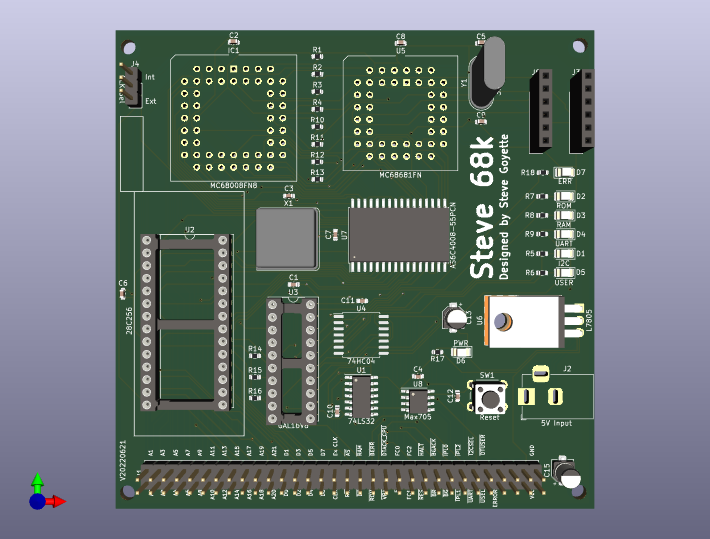
This is my extremely simple 68000 single board computer. It has 512k of ROM and 512k of RAM.
I'm building this to learn the fundamentals of microprocessors and their use in computer systems. Modern day computers are complex and require specific supporting chip sets. These retro processors were simple and much easier to understand but in the end the principles are the same.
This design HEAVILLY borrows from Neil Klingensmith whose explanations really helped me grasp some of the fundamentals.
V20220621 was sent for fab on the evening of June 21, 2022. This version's changes:
Still having a problem with serial input....challenges are what make the victory sweeter I suppose.
| Qty | Value | Footprint | References |
|---|---|---|---|
| 19 | 470 | Resistor_THT:R_Axial_DIN0207_L6.3mm_D2.5mm_P7.62mm_Horizontal | R12, R14, R15, R18, R19, R20, R21, R22, R23, R24, R25, R26, R27, R28, R29, R30 +3 |
| 11 | .1uF | Capacitor_THT:C_Disc_D3.4mm_W2.1mm_P2.50mm | C2, C3, C4, C5, C6, C7, C8, C9, C12, C14, C15 |
| 9 | 4K7 | Resistor_THT:R_Axial_DIN0207_L6.3mm_D2.5mm_P7.62mm_Horizontal | R2, R3, R4, R5, R6, R7, R8, R9, R10 |
| 3 | 100uF | Capacitor_THT:CP_Radial_D5.0mm_P2.50mm | C17, C18, C19 |
| 3 | Conn_02x32_Odd_Even | Connector_PinSocket_2.54mm:PinSocket_2x32_P2.54mm_Vertical | J2, J5, J9 |
| 3 | GAL16V8 | Package_DIP:DIP-20_W7.62mm_Socket_LongPads | U1, U3, U5 |
| 2 | 4k7 | Resistor_THT:R_Axial_DIN0207_L6.3mm_D2.5mm_P7.62mm_Horizontal | R11, R13 |
| 2 | 74LS373 | Package_DIP:DIP-20_W7.62mm_Socket_LongPads | U9, U10 |
| 2 | Serial A | Connector_PinHeader_2.54mm:PinHeader_1x06_P2.54mm_Vertical | J3, J4 |
| 1 | 100nf | Capacitor_THT:C_Disc_D3.4mm_W2.1mm_P2.50mm | C1 |
| 1 | 15pf | Capacitor_THT:C_Disc_D3.4mm_W2.1mm_P2.50mm | C10 |
| 1 | 3.6864MHz | Crystal:Crystal_HC49-4H_Vertical | Q1 |
| 1 | 470uF | Capacitor_THT:CP_Radial_D6.3mm_P2.50mm | C16 |
| 1 | 5pf | Capacitor_THT:C_Disc_D3.4mm_W2.1mm_P2.50mm | C11 |
| 1 | 68010D | Package_DIP:DIP-64_W22.86mm_Socket_LongPads | U2 |
| 1 | 68681 | Package_DIP:DIP-40_W15.24mm_Socket_LongPads | U6 |
| 1 | 74LS148 | Package_DIP:DIP-16_W7.62mm_Socket_LongPads | U4 |
| 1 | 8Mhz | Oscillator:Oscillator_DIP-8 | X1 |
| 1 | Data Bus | Connector_PinHeader_2.54mm:PinHeader_1x18_P2.54mm_Vertical | J6 |
| 1 | Data0 | LED_THT:LED_D3.0mm_Clear | D6 |
| 1 | Data1 | LED_THT:LED_D3.0mm_Clear | D7 |
| 1 | Data10 | LED_THT:LED_D3.0mm_Clear | D16 |
| 1 | Data11 | LED_THT:LED_D3.0mm_Clear | D17 |
| 1 | Data12 | LED_THT:LED_D3.0mm_Clear | D18 |
| 1 | Data13 | LED_THT:LED_D3.0mm_Clear | D19 |
| 1 | Data14 | LED_THT:LED_D3.0mm_Clear | D20 |
| 1 | Data15 | LED_THT:LED_D3.0mm_Clear | D21 |
| 1 | Data2 | LED_THT:LED_D3.0mm_Clear | D8 |
| 1 | Data3 | LED_THT:LED_D3.0mm_Clear | D9 |
| 1 | Data4 | LED_THT:LED_D3.0mm_Clear | D10 |
| 1 | Data5 | LED_THT:LED_D3.0mm_Clear | D11 |
| 1 | Data6 | LED_THT:LED_D3.0mm_Clear | D12 |
| 1 | Data7 | LED_THT:LED_D3.0mm_Clear | D13 |
| 1 | Data8 | LED_THT:LED_D3.0mm_Clear | D14 |
| 1 | Data9 | LED_THT:LED_D3.0mm_Clear | D15 |
| 1 | Debug | Connector_PinHeader_2.54mm:PinHeader_1x10_P2.54mm_Vertical | J7 |
| 1 | Debug 2 | Connector_PinHeader_2.54mm:PinHeader_1x12_P2.54mm_Vertical | J10 |
| 1 | Duart IP | Connector_PinHeader_2.54mm:PinHeader_1x06_P2.54mm_Vertical | J11 |
| 1 | Duart OP | Connector_PinHeader_2.54mm:PinHeader_1x08_P2.54mm_Vertical | J8 |
| 1 | HALT | LED_THT:LED_D3.0mm_Clear | D2 |
| 1 | Max705 | Package_DIP:DIP-8_W7.62mm_Socket_LongPads | U8 |
| 1 | PWR LED | LED_THT:LED_D3.0mm_Clear | D1 |
| 1 | Power | Connector_PinHeader_2.54mm:PinHeader_1x06_P2.54mm_Vertical | J1 |
| 1 | RUN | LED_THT:LED_D3.0mm_Clear | D3 |
| 1 | Reset | Button_Switch_THT:SW_PUSH_6mm | SW1 |
| 1 | Rk7 | Resistor_THT:R_Axial_DIN0207_L6.3mm_D2.5mm_P7.62mm_Horizontal | R1 |


jimbro1000/DIY-Video
General purpose video system for 8-bit computers using 74LS logic

jimbro1000/C64-Dragon-Remix-KeyboardController
Translation interface to allow a Dragon keyboard to operate a C64


lynchaj/duodyne
Duodyne is a hobbyist retrocomputer system designed to run ROMWBW. It is comprised of modules on a system bus

rosco-m68k/rosco_m68k
Design, documentation and software for the Really Old School Computer (M68K)


agranlund/raven
Homemade MC68060 + DSP56303 Atari-compatible computer. Hardware, firmware, and software stack

ProbablyNotArtyom/Blitz
Blitz is a 68030 based homebrew computer I designed over the course of nearly 3 years, starting in late 2017.
It measures 177 × 140.7 mm and has 2 copper layers, 1.6 mm thick.
91 parts, built around the 74LS373SC, 74LS148P-E and MAX705CSA. The full list of its parts is on this page, with links to each part's symbol and footprint where PCBKit's library has them.
From the stevegg/Steve-68k repository on GitHub, at the commit this page was made from: the board is hardware/Steve 68k.kicad_pcb and its schematic Backplane/Backplane.kicad_sch. PCBKit opens the board in the browser, with nothing to install.
Its repository states no licence, so its author keeps all rights: ask stevegg before reusing the design.