
2 layers63 × 46 mm
Pi485
bvarner/pi485
An open-source TTL UART <-> RS485 converter, intended for a Raspberry Pi or Arduino
31 parts41MIT

 StefanKrupop/XyloShield17
Shield for Arduino that hosts a RFM26W radio module and allows DMX-512 connectivity
XyloShield is an open-source printed circuit board by StefanKrupop, from the StefanKrupop/XyloShield repository on GitHub. It is a 2-layer board of 68.6 × 53.3 mm with 19 parts on 52 nets, routed with 205 tracks and 14 vias.
It is built around the MAX485ED. Its parts include 7 connectors, 5 resistors, 3 capacitors and 3 ICs. It belongs with the radio and wireless boards and the AVR (ATmega, ATtiny) boards of this library.
The XyloShield DMX is a simple Shield for Arduinos like the Uno that has two functions: On the one hand, it hosts a RFM26W radio module and the necessary level shifting to use it with a 5 V Arduino. On the other hand (and because enough space was left...), it contains an RDM capable DMX-512 transceiver. Both functions are completely separate, so the board can also be populated only partially to support the function you want. The board was designed using KiCad (my first project with that package, so be warned!).
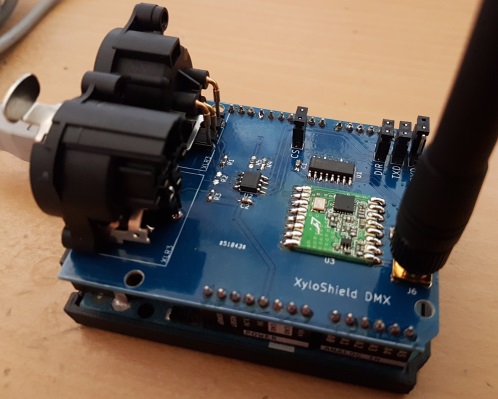
There is also an Arduino library for the shield: XyloLibrary (https://github.com/StefanKrupop/XyloLibrary)
The main functionality (and where its name comes from) of the board is to be able to send radio packets to "Xylobands" LED bracelets in order to study the proprietary protocol used by them. An 868 MHz RFM26W radio module was selected as it uses a compatible radio controller to that one on the Xylobands. As this part is 3.3 V only, a 74HC4050 was added as a level shifter for the 5 V Arduino. The chip can be disabled by removing the "CS" jumper, which disconnects the Arduino pin from the shield. A pull-up resistor then keeps the radio module disabled.
The radio module uses SPI and is connected to the following Arduino pins: D3 <- nIRQ D4 -> SDN D10 -> nSEL (/CS) MISO <- SDO MOSI -> SDI SCK -> SCK
The radio part is comprised of the following components (that can be left unpopulated if you do not need this functionality): C1, C3, J6, J7, R5, U1, U3
The DMX part can be used to build a DMX-512 sender, receiver or an RDM capable device. It uses a standard RS485 transceiver and a "Line Bias Network" to be able to support RDM. If the DMX part should be used as a receiver (with or without RDM), resistors R1 to R3 should be left unpopulated, as the Line Bias Network should only be used by a DMX sender. Jumpers J3 to J5 can be used to disconnect the Arduino pins from the shield.
ATTENTION: When using e.g. the Arduino Uno, J5 needs to be open to be able to upload a sketch!
The DMX part uses the UART and is connected to the following Arduino pins: D0 <- RXD D1 -> TXD D2 -> Receive/Transmit select
The DMX part is comprised of the following components (that can be left unpopulated if you do not need this functionality): C2, J1, J2, J3, J4, J5, R1, R2, R3, R4, U2
| Part | Value | Conrad Electronics order nr. |
|---|---|---|
| C1-C3 | 100 nF, 25 V, 0603 | 1279656 |
| J1 | Neutrik NC3MAAH | 651105 |
| J2 | Neutrik NC3FAAH1 | 651095 |
| J3-J5, J7 | 2,54 mm pin header | 1390109 |
| J6 | RP-SMA connector | 1565639 |
| R1, R3 | 562 Ohms, 0603 | 437643 |
| R2 | 133 Ohms, 0603 | 433625 |
| R4, R5 | 10 k, 0603 | 1208549 |
| U1 | 74HC4050, SOIC-16 | 1015779 |
| U2 | SN75176, SOIC-8 | 1048058 |
| U3 | RFM26W | - |
| - | Matching antenna | 673977 |
| - | 32 pins 2,54 mm pin header | 1390109 |
| - | 2x3 pins socket | 1492284 |
| - | 4 jumper caps | 1560848 |
| Qty | Value | Footprint | References |
|---|---|---|---|
| 4 | Conn_01x02 | Pin_Headers:Pin_Header_Straight_1x02_Pitch2.54mm | J3, J4, J5, J7 |
| 3 | 100n | Capacitors_SMD:C_0603_HandSoldering | C1, C2, C3 |
| 2 | 10k | Resistors_SMD:R_0603_HandSoldering | R4, R5 |
| 2 | 562 | Resistors_SMD:R_0603_HandSoldering | R1, R3 |
| 1 | 133 | Resistors_SMD:R_0603_HandSoldering | R2 |
| 1 | 4050 | Housings_SOIC:SOIC-16_3.9x9.9mm_Pitch1.27mm | U1 |
| 1 | Arduino_Uno_Shield | Arduino:Arduino_Uno_Shield | XA1 |
| 1 | Conn_Coaxial | Connectors:SMA_THT_Jack_Straight | J6 |
| 1 | MAX485E | Housings_SOIC:SOIC-8_3.9x4.9mm_Pitch1.27mm | U2 |
| 1 | RFM26W | RFM26W:RFM26W | U3 |
| 1 | XLR3 | XLR:XLR-NC3FA | J2 |
| 1 | XLR3 | XLR:XLR-NC3MA | J1 |
It measures 68.6 × 53.3 mm and has 2 copper layers, 1.6 mm thick.
19 parts, built around the MAX485ED. The full list of its parts is on this page, with links to each part's symbol and footprint where PCBKit's library has them.
From the StefanKrupop/XyloShield repository on GitHub, at the commit this page was made from: the board is XyloShield.kicad_pcb. PCBKit opens the board in the browser, with nothing to install.
Its repository states no licence, so its author keeps all rights: ask StefanKrupop before reusing the design.
bvarner/pi485
An open-source TTL UART <-> RS485 converter, intended for a Raspberry Pi or Arduino


GrappleRobotics/JMS
Another alternative field management system for the FIRST Robotics Competition.

SylvainVanIniitu/Piccolo-4C-Black
Piccolo MIDI stochastic sequencer

ChaseDurand/Pool-Pi
Hardware+software solution for controlling a Goldline/Hayward Aqualogic pool control board over WiFi via a Raspberry Pi.

flxkrmr/eec-iv-reader-arduino
Arduino based diagnostics-tool for Fords EEC IV ECUs

KarlVaello/VehicleControlSystem
Vehicle Control System. Using C++ Qt and C. Hardware and Software