



4 layers98.5 × 48.5 mm

Schematics and layouts
Arm is an open-source printed circuit board by SpokeSpice, from the SpokeSpice/Hardware repository on GitHub, published under the CERN-OHL-S-2.0 licence. It is a 2-layer board of 87.7 × 254.8 mm with 62 parts on 37 nets, routed with 239 tracks and 42 vias.
It is built around the SM351LT and WS2812B. Its parts include 32 diodes, 2 ICs and 2 connectors.
The project is divided into two parts, the controller and the arms. Typically a system would have 4 arms, each running at an angle of 90 degrees to the next.
This repository contains the KiCad project files for the controller and the arm PCBs.
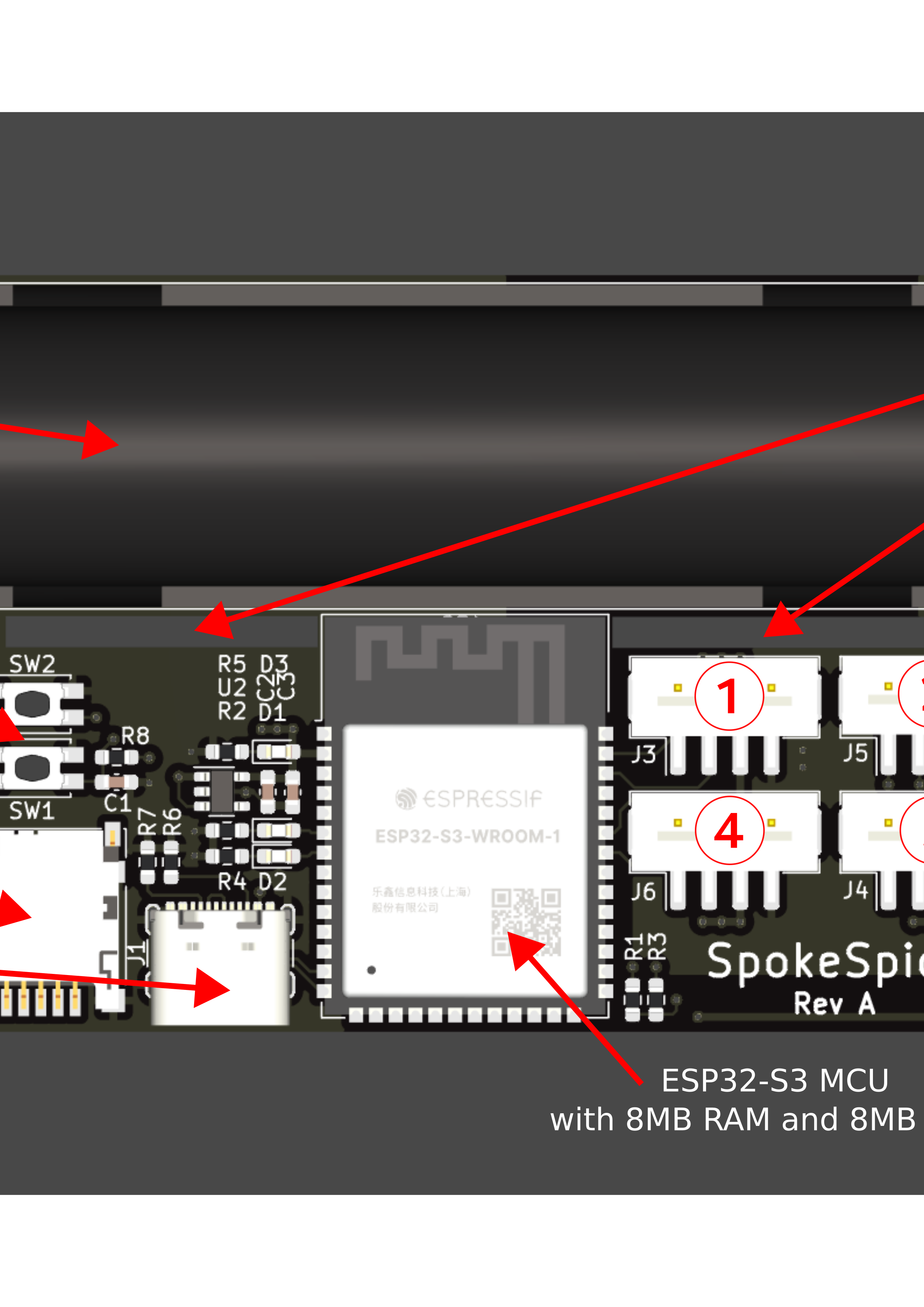
The controller board is based on the ESP32 microcontroller and features a USB-C connector for programming. It features a battery holder for an 18650 Li-Ion cell, a 3.3V LDO regulator, an SD card slot and 4 connectors for the arms.
Several mounting holes in the PCB allow it to be mounted in a variety of different spoke configurations.
For the sake of simplicity, the controller board does not feature a battery charging circuit. The battery must be charged externally.
There is also no voltage regulation for the LEDs. The LEDs are powered directly from the battery, which is a 3.7V cell. Consequently, there is also no reverse polarity protection to avoid the voltage drop and hence the energy loss. The battery must hence be inserted with the correct polarity.
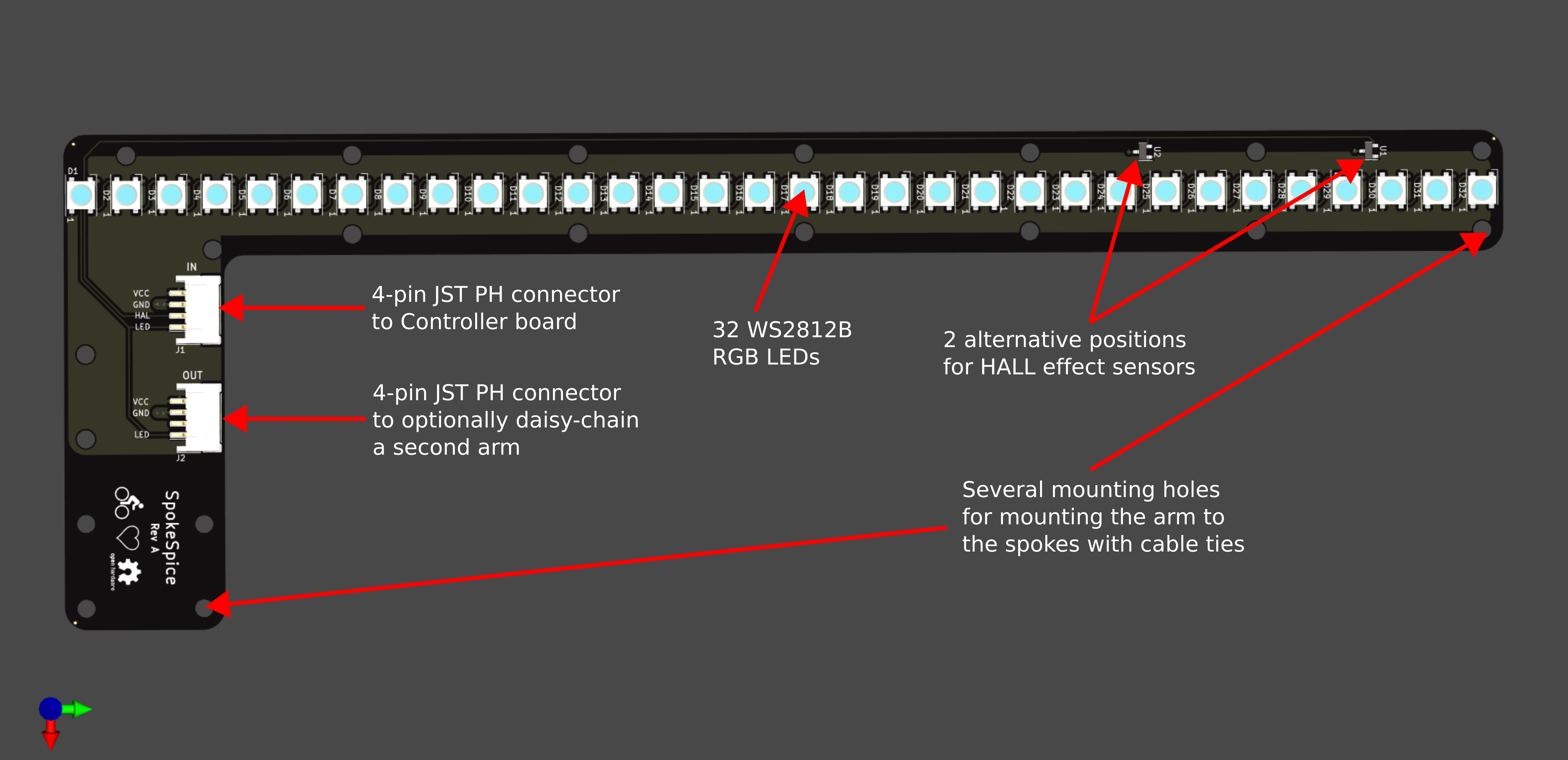
Arms are made to be attached to the spokes of a 28-inch bicycle wheel.
Several mounting holes in the PCB allow them to be mounted in a variety of different spoke configurations.
Each arm PCB features 32 WS2812B RGB LEDs and is connected to the controller board via a 4-pin cable. A second 4-pin cable can be used to daisy-chain a second arm on the other side of the wheel, which will then display the same content.
A hall effect sensor is used to detect the speed of the wheel and to synchronize the display with the rotation. There are two positions for this sensor.
As the controller and the arms are mounted to the spokes with cable ties, it's recommended to install everything on a spare wheel that you mount and dismount from the bicycle as needed.
Several additional components are needed to build the project:
If you would like to contribute to the project, please open an issue or a pull request.

This project is licensed under the CERN Open Hardware License v2. You may redistribute and modify this project under the terms of the CERN-OHL-S v2 (https://ohwr.org/cern_ohl_s_v2.txt). This documentation is distributed without any warranty. Without even the implied warranty of merchantability or fitness for a particular purpose.
| Qty | Value | Footprint | References |
|---|---|---|---|
| 32 | WS2812B | LED_SMD:LED_WS2812B_PLCC4_5.0x5.0mm_P3.2mm | D1, D2, D10, D11, D12, D13, D14, D15, D16, D17, D18, D19, D20, D21, D22, D23 +16 |
| 20 | MountingHole | MountingHole:MountingHole_3.2mm_M3 | H1, H2, H3, H4, H5, H10, H11, H12, H13, H14, H15, H16, H17, H18, H19, H20 +4 |
| 3 | Fiducial | Fiducial:Fiducial_0.5mm_Mask1mm | FID1, FID2, FID3 |
| 2 | Conn_01x04 | Connector_JST:JST_PH_S4B-PH-SM4-TB_1x04-1MP_P2.00mm_Horizontal | J1, J2 |
| 2 | SM351LT | Package_TO_SOT_SMD:SOT-23 | U1, U2 |
The 59 most common of 62 parts.
It measures 87.7 × 254.8 mm and has 2 copper layers, 1.6 mm thick.
62 parts, built around the SM351LT and WS2812B. The full list of its parts is on this page, with links to each part's symbol and footprint where PCBKit's library has them.
From the SpokeSpice/Hardware repository on GitHub, at the commit this page was made from: the board is Arm/A/Arm.kicad_pcb and its schematic Arm/A/Arm.kicad_sch. PCBKit opens the board in the browser, with nothing to install.
Its repository publishes it under the CERN-OHL-S-2.0 licence: you may reuse it on that licence's terms (keep the author's notice, and for a copyleft licence share your changes alike).


benjibst/echessboard
electronic chess board schematic and PCB layout using STM32 microcontroller and hall sensors for detecting pieces

Boardoza/Boardoza_SM351LT_Hall_Effect_Sensor_Breakout_Board
A compact hall-effect sensor module for detecting lid, door, and drawer positions with omnipolar sensing.

wbsipz/hardware-design-portfolio
Hardware design portfolio featuring power electronics, embedded control, and PCB projects.