2 layers29.8 × 38.1 mm

 sgreg/rudy7
RUDY - the Random USB Device and generic ATmega328 development board
Rudy is an open-source printed circuit board by sgreg, from the sgreg/rudy repository on GitHub. It is a 2-layer board of 15.7 × 67.1 mm with 26 parts on 34 nets, routed with 156 tracks and 10 vias.
It is built around the ATMEGA328-PU, LD1117S33TR(MS) and JUMPER3. Its parts include 6 capacitors, 6 resistors, 4 diodes, 4 connectors and 2 ICs. It belongs with the microcontroller boards boards and the AVR (ATmega, ATtiny) boards of this library.


RUDY started out as a test and play-around device for USB development using the Objective Development V-USB library, but also serves as standard ATmega328 development board.
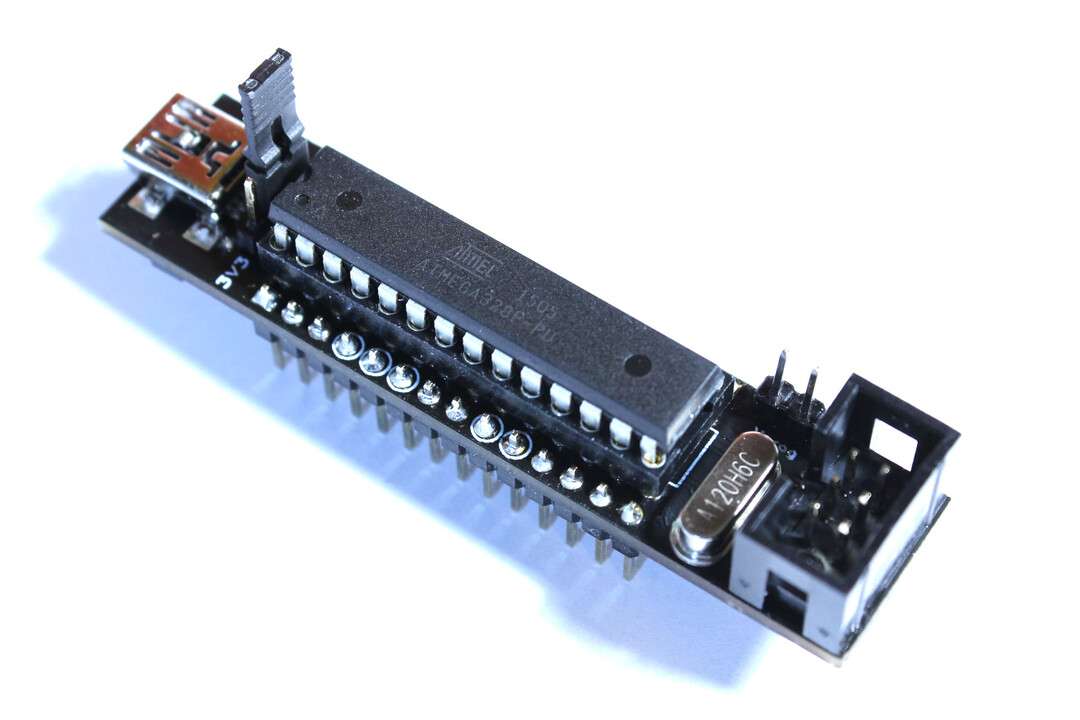
RUDY is primarily a hardware project, so all the design file for KiCad along with the schematic as PDF and Gerber files are found in the hardware/ directory. And if you want to go straight ahead and build your own board, the PCB is available from OSH Park.
As RUDY can theoretically function as an USBasp programmer, there's also an adapter board available - and is also available from OSH Park
Again, RUDY is primarily a development board, and as such is there for your firmware. But well, everything and everyone has to start somewhere, so the firmware/ directory has a (still-to-grow) collection of example projects, both using the V-USB library and using RUDY as regular, ATmega328 microcontroller board.
RUDY is fully open source. All hardware files are released under the CERN Open Hardware License v1.2, all example source code is released under the MIT License, and all documentation within this git repository is provided under the terms of a Creative Commons Attribution 4.0 International (CC BY 4.0) license.
| Qty | Value | Footprint | References |
|---|---|---|---|
| 2 | 100n | Capacitor_SMD:C_0805_2012Metric | C1, C6 |
| 2 | 10u | Capacitors_Tantalum_SMD:CP_Tantalum_Case-A_EIA-3216-18_Reflow | C2, C3 |
| 2 | 120R | Resistor_SMD:R_0805_2012Metric | R5, R6 |
| 2 | 22p | Capacitor_SMD:C_0805_2012Metric | C4, C5 |
| 2 | 3V6 | Diodes_SMD:D_SOD-323F | D1, D2 |
| 2 | 68R | Resistor_SMD:R_0805_2012Metric | R1, R2 |
| 2 | LED | LED_SMD:LED_0805_2012Metric | D3, D4 |
| 1 | 1M | Resistor_SMD:R_0805_2012Metric | R4 |
| 1 | 1k5 | Resistor_SMD:R_0805_2012Metric | R3 |
| 1 | ATMEGA328-P | Housings_DIP:DIP-28_W7.62mm | IC1 |
| 1 | CONN1 | Socket_Strips:Socket_Strip_Straight_1x14_Pitch2.54mm | P1 |
| 1 | CONN2 | Socket_Strips:Socket_Strip_Straight_1x14_Pitch2.54mm | P2 |
| 1 | Crystal | Crystals:Crystal_HC49-U_Vertical | Y1 |
| 1 | JUMPER | Pin_Headers:Pin_Header_Straight_1x02_Pitch2.54mm | JP2 |
| 1 | JUMPER3 | Pin_Headers:Pin_Header_Straight_1x03_Pitch2.54mm | JP1 |
| 1 | LD1117S33TR | TO_SOT_Packages_SMD:SOT-223 | U1 |
| 1 | LOGO | Artwork_4chord-midi:oshw_50 | oshw |
| 1 | SERPROG | Connect:IDC_Header_Straight_6pins | P3 |
| 1 | USB_B | Connect:USB_Mini-B | P4 |


PostTenebrasLab/PTL-ino
The PTL-ino (“petilino”) is a *uino-compatbile board that is fully made of easily solderable through-hole components.

ParadigmHyperloop/electrical
All schematics and layouts in KiCad, plus some simulations

Ardumower/ardumower
Develop an open source robotic lawn mower (HW+SW reference platform)

Teslafly/Dead-OpenBMS-dead
A scalable, open source battery management system


It measures 15.7 × 67.1 mm and has 2 copper layers, 1.6 mm thick.
26 parts, built around the ATMEGA328-PU, LD1117S33TR(MS) and JUMPER3. The full list of its parts is on this page, with links to each part's symbol and footprint where PCBKit's library has them.
From the sgreg/rudy repository on GitHub, at the commit this page was made from: the board is hardware/rudy/rudy.kicad_pcb. PCBKit opens the board in the browser, with nothing to install.
Its repository states no licence, so its author keeps all rights: ask sgreg before reusing the design.