Skip to the content
2 layers176.7 × 88.6 mmEAS ERM Driver mini PANEL, the printed circuit board in 3D

EAS ERM Driver mini PANEL

sagar-aryan/ead-v1

A right-leg, barefoot wearable for gait research after stroke, built on error augmentation. Two IMUs on the foot and shank detect every gait cycle; the device scores each cycle against the wearer's own recorded baseline…

Size
176.7 × 88.6 mm
Copper layers
2
Thickness
1.6 mm
Parts
384
Nets
22
Pads
708
Tracks, vias
1,050, 0
Pours
282
Routed
Yes
KiCad
KiCad 10.0 (file 20260206)
Created
16 Sep 2026
Updated
8 Oct 2026

Overview

EAS ERM Driver mini PANEL is an open-source printed circuit board by sagar-aryan, from the sagar-aryan/ead-v1 repository on GitHub, published under the MIT licence. It is a 2-layer board of 176.7 × 88.6 mm with 384 parts on 22 nets, routed with 1,050 tracks and 0 vias.

It is built around the HT7833, 1N5819W and IRLML6344. Its parts include 120 capacitors, 108 connectors, 72 resistors, 36 diodes and 36 transistors.

Main components

3

README

README.md

EAD V1

A right-leg, barefoot wearable for gait research after stroke, built on error augmentation. Two IMUs on the foot and shank detect every gait cycle; the device scores each cycle against the wearer's own recorded baseline and, when a step is off, cues it through six vibration motors on a calf band. A desktop dashboard records the raw data, manages baselines and sessions, and exports CSV, MATLAB and PDF.

Research and engineering prototype. Not a medical device and not a validated clinical tool.

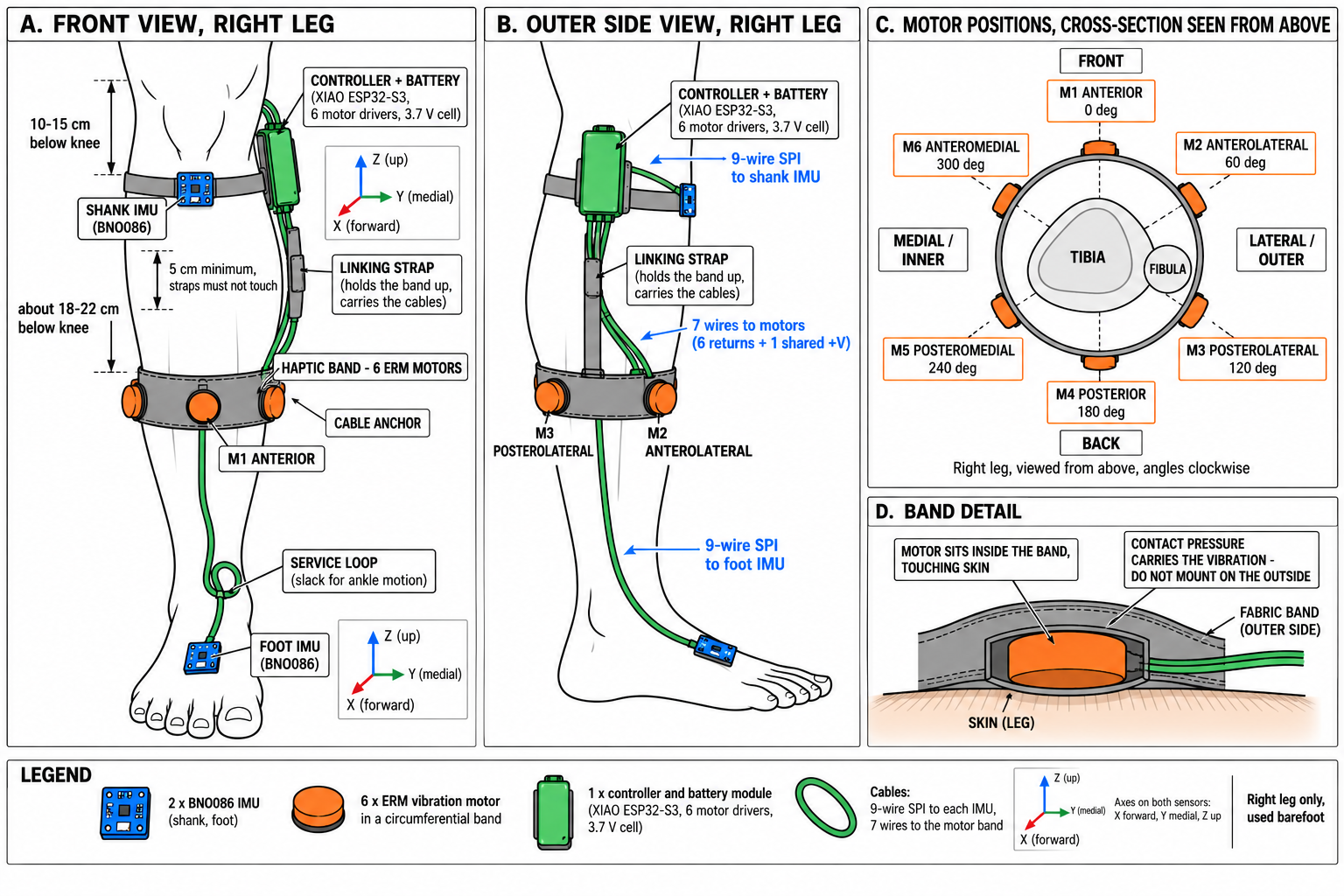
Worn assembly: foot and shank IMUs, controller, and the six-motor calf band

Illustration of the worn layout and motor positions. Exact placement and wiring: docs/hardware.md, worn assembly.

How it works

text
foot + shank BNO086 (SPI, 200 Hz)
  → XIAO ESP32-S3: orientation, gait events, zero-velocity updates, per-cycle score
  → vibration cue on the device (no laptop in the loop)
  → Wi-Fi access point or USB → dashboard (Tauri): live view, SQLite store, exports
  • Gait: each right-leg cycle is found from the shank's swing; heel strike, toe-off, stance, swing, cadence, stride length and speed are computed on the device, with foot-flat zero-velocity updates to bound integration drift.
  • Score: seven features (swing dorsiflexion, contact angle, inversion/eversion, cycle time, stance ratio, stride distance, shank swing rate) are compared with the baseline's medians and spreads and combined into one score from 0 to 1.
  • Cue: a score of 0.35 or more starts a 0.5 s buzz, 60–100 % strength by how far off the step was. Where it buzzes names the error, on the side to move away from: the back of the calf for too little toe lift or a toe-first landing, the inner side for rolling onto the outer edge (inversion), the outer side for rolling in (eversion), front and back in turn for timing. The buzz stops at the first good step. On-time limits (5 s continuous, 50 % over any 10 s) are enforced on the device; sensor faults, a switched off feedback toggle, or 5 s without the laptop hold cues back.
  • Data: every raw sample is kept. A 6 MB buffer on the device holds about 4.5 min, so a Wi-Fi dropout is filled in after reconnecting.

Hardware

PartDetail
ControllerSeeed XIAO ESP32-S3 (plain, not Sense)
IMUs2 × 7Semi BNO086 breakout on SPI: foot (dorsum) and shank (anterior shin)
Haptics6 ERM coin motors around the calf, driven by the PCB in hardware/erm-driver-pcb/ (tight variant): low-side MOSFETs, two 3.3 V regulators
Power1S Li-ion cell, charger module, master switch

Every pin and connection, with its evidence: docs/wiring_reference.md. All 15 usable XIAO GPIOs are in use.

Repository

FolderContents
firmware/Device firmware (PlatformIO, Arduino-ESP32); portable, host-tested core in lib/ead_core
dashboard/Desktop app: Rust backend (device link, SQLite, exports) and React frontend
hardware/erm-driver-pcb/KiCad project of the motor driver board, with its own docs
protocol/vectors/Golden wire-protocol messages and their generator
tools/eadprobe.py (independent device client), export checkers, walk replay
recordings/Walk recordings with counted steps, used to test gait detection
docs/Engineering docs: architecture, implementation, hardware, wiring, protocol, handoff
ead_agent_docs_v2/The original V1 specification (read-only)

Getting started

Prerequisites: PlatformIO, Node.js 20+, a stable Rust toolchain, Python 3 with pyserial (numpy and scipy for the export checker), and on Linux WebKitGTK 4.1. scripts/setup-linux.sh check reports what is missing. Linux is the tested platform; setup scripts for macOS and Windows are included.

Firmware:

sh
pio run -d firmware -t upload        # build and flash over USB
python3 tools/eadprobe.py hello      # identity, protocol schema, firmware version
python3 tools/eadprobe.py check      # per-wire sensor check

The first build creates firmware/include/ead_secrets.h with a random Wi-Fi passphrase. It is ignored by git; never commit it.

Dashboard:

sh
cd dashboard && npm install
npx tauri dev                        # development
npx tauri build --no-bundle          # release build; see dashboard/README.md for `ead`

Connecting: over USB, or join the device's access point EAD-V1-xxxx (passphrase in ead_secrets.h) and connect the dashboard to ws://192.168.4.1:8080/ws.

Using it

  1. Calibrate: stand still for 5 s with the sensors strapped on.
  2. Baseline: walk normally on a straight path until at least 30 valid cycles (about 60 steps) are collected. Baselines are versioned per patient and locked.
  3. Check: a short scored walk against the baseline.
  4. Evaluate: walk with feedback on; the session's limits (cycles, errors) are set first.
  5. Export: raw samples, cycles, events and cues as CSV, plus metadata.json, session.mat and a PDF report.

Calibrate after every restart. A baseline belongs to the strapping it was recorded in, so record a new one after re-strapping the sensors.

Testing

sh
pio test -d firmware -e native                     # firmware core
(cd dashboard/src-tauri && cargo test)             # backend
(cd dashboard && npm test && npm run build)        # frontend
python3 tools/eadprobe.py vectors                  # protocol, against the golden vectors

On hardware, eadprobe stats and cargo test hardware -- --ignored --test-threads=1.

Safety

  • Never turn the battery switch on while USB is plugged in. Motor tests run on battery over Wi-Fi with USB unplugged.
  • Motors are held off from power-up; GPIO39 must never drive a motor (docs/wiring_reference.md §10).

Status

Working end to end, worn on battery over Wi-Fi: step detection, per-step scoring against the wearer's own baseline, directional graded cues, and full raw-data export. Current state and roadmap: docs/handoff.md.

Documentation

Start with docs/handoff.md; docs/README.md indexes the rest, including the wire protocol (docs/protocol.md).

License

MIT (LICENSE): firmware, dashboard, tools, hardware design files and documentation. Exceptions keep their own licences: the IBM Plex fonts in dashboard/src-tauri/assets/fonts/ (SIL Open Font License 1.1, OFL.txt beside them) and the agent skills in .claude/skills/ (Apache 2.0 and MIT, as each states). The software comes with no warranty, and nothing here is cleared for clinical use.

Parts

384
QtyValueFootprintReferences
36100Resistor_SMD:R_1206_3216MetricR1, R1, R1, R1, R1, R1, R2, R2, R2, R2, R2, R2, R3, R3, R3, R3 +20
36100kResistor_SMD:R_1206_3216MetricR10, R10, R10, R10, R10, R10, R11, R11, R11, R11, R11, R11, R12, R12, R12, R12 +20
36100nFCapacitor_SMD:C_1206_3216MetricC15, C15, C15, C15, C15, C15, C16, C16, C16, C16, C16, C16, C17, C17, C17, C17 +20
3610nFCapacitor_SMD:C_1206_3216MetricC10, C10, C10, C10, C10, C10, C11, C11, C11, C11, C11, C11, C12, C12, C12, C12 +20
361N5819WDiode_SMD:D_SOD-123D1, D1, D1, D1, D1, D1, D2, D2, D2, D2, D2, D2, D3, D3, D3, D3 +20
36IRLML6344Package_TO_SOT_SMD:SOT-23Q1, Q1, Q1, Q1, Q1, Q1, Q2, Q2, Q2, Q2, Q2, Q2, Q3, Q3, Q3, Q3 +20
241uFCapacitor_SMD:C_1206_3216MetricC1, C1, C1, C1, C1, C1, C2, C2, C2, C2, C2, C2, C5, C5, C5, C5 +8
1210uFCapacitor_SMD:C_1206_3216MetricC3, C3, C3, C3, C3, C3, C4, C4, C4, C4, C4, C4
12220uFCapacitor_SMD:CP_Elec_5x5.9C7, C7, C7, C7, C7, C7, C8, C8, C8, C8, C8, C8
12HT7833EAS:SOT-89-3_0.4mmU1, U1, U1, U1, U1, U1, U2, U2, U2, U2, U2, U2
6ESP_GNDEAS:WirePad_2.0x2.0mmJ4, J4, J4, J4, J4, J4
6ESP_SW_BAT+EAS:WirePad_2.0x2.0mmJ3, J3, J3, J3, J3, J3
6GNDEAS:WirePad_3.0x2.5mmJ2, J2, J2, J2, J2, J2
6M1-EAS:WirePad_2.5x2.5mmJ12, J12, J12, J12, J12, J12
6M2-EAS:WirePad_2.5x2.5mmJ13, J13, J13, J13, J13, J13
6M3-EAS:WirePad_2.5x2.5mmJ14, J14, J14, J14, J14, J14
6M4-EAS:WirePad_2.5x2.5mmJ16, J16, J16, J16, J16, J16
6M5-EAS:WirePad_2.5x2.5mmJ17, J17, J17, J17, J17, J17
6M6-EAS:WirePad_2.5x2.5mmJ18, J18, J18, J18, J18, J18
6MOTOR_A+EAS:WirePad_2.5x7.0mmJ11, J11, J11, J11, J11, J11
6MOTOR_B+EAS:WirePad_2.5x7.0mmJ15, J15, J15, J15, J15, J15
6PWM1EAS:WirePad_2.0x2.0mmJ5, J5, J5, J5, J5, J5
6PWM2EAS:WirePad_2.0x2.0mmJ6, J6, J6, J6, J6, J6
6PWM3EAS:WirePad_2.0x2.0mmJ7, J7, J7, J7, J7, J7
6PWM4EAS:WirePad_2.0x2.0mmJ8, J8, J8, J8, J8, J8
6PWM5EAS:WirePad_2.0x2.0mmJ9, J9, J9, J9, J9, J9
6PWM6EAS:WirePad_2.0x2.0mmJ10, J10, J10, J10, J10, J10
6SWITCHED_SYSTEM+EAS:WirePad_3.0x2.5mmJ1, J1, J1, J1, J1, J1

More from sagar-aryan/ead-v1

2
  • 2 layers44.7 × 32.6 mmEAS ERM Driver compact, the printed circuit board in 3D

    EAS ERM Driver compact

    sagar-aryan/ead-v1

    A right-leg, barefoot wearable for gait research after stroke, built on error augmentation. Two IMUs on the foot and shank detect every gait cycle; the device scores each cycle against the wearer's own recorded baseline…

    64 partsMIT
  • 2 layers38.9 × 29.3 mmEAS ERM Driver mini, the printed circuit board in 3D

    EAS ERM Driver mini

    sagar-aryan/ead-v1

    A right-leg, barefoot wearable for gait research after stroke, built on error augmentation. Two IMUs on the foot and shank detect every gait cycle; the device scores each cycle against the wearer's own recorded baseline…

    64 partsMIT

Similar boards

  • 2 layers73.7 × 38.1 mmSTLinkForm, the printed circuit board in 3D

    STLinkForm

    grumat/glossy-msp430

    Glossy MSP430 - Embedded GDB Debugger for MSP430

    68 parts15GPL-2.0
  • 2 layers36.4 × 60.8 mmMcu, the printed circuit board in 3D

    Mcu

    victor-chew/rbx

    Robotics Brick Extension

    15 parts9Apache-2.0
  • 2 layers98.3 × 98.3 mmDrone swarm, the printed circuit board in 3D

    Drone swarm

    ManhTi3012/MiniDrone

    A mini drone based on ESP32

    83 parts4MIT
  • 4 layers340.8 × 104.6 mmNiphar, the printed circuit board in 3D

    Niphar

    mornepousse/Niphargus

    Niphargus — a slim, indestructible wireless split keyboard. ESP32 + nRF24, wired fallback, and an emergency kit hidden behind the USB port. The successor to the Rouge-Gorge.

    287 parts4MIT
  • 2 layers65.5 × 57.2 mmEspclock3, the printed circuit board in 3D

    Espclock3

    victor-chew/espclock3

    Internet-enabled Analog Clock using ESP8266 and ATtiny85

    26 parts3Apache-2.0
  • 4 layers45 × 53 mmOpenTRV ESP, the printed circuit board in 3D

    OpenTRV ESP

    mpiraux/OpenTRV-ESP

    An open-source and open-hardware thermostatic radiator valve based on the ESP32C6 and the 28BYJ-48 stepper motor.

    64 parts2CERN-OHL-P-2.0
  • 2 layers55.8 × 44.5 mmSlimeVR board Full, the printed circuit board in 3D

    SlimeVR board Full

    Skaut0071/SlimeVR_Tracker

    Cutsom PCB based on SlimeVR project for Full Body Tracking for Virtual Reality without need of expensive base stations.

    47 parts1
  • 2 layers77.2 × 30 mmSolarSense v1, the printed circuit board in 3D

    SolarSense v1

    CaioTeraoka/SolarSense_v1

    This project is an IoT device that is capable of reading the current of solar panels and send the information through the LoRaWAN communication

    40 parts

Questions

How big is the EAS ERM Driver mini PANEL PCB?

It measures 176.7 × 88.6 mm and has 2 copper layers, 1.6 mm thick.

What parts does the EAS ERM Driver mini PANEL use?

384 parts, built around the HT7833, 1N5819W and IRLML6344. The full list of its parts is on this page, with links to each part's symbol and footprint where PCBKit's library has them.

Where can I download the EAS ERM Driver mini PANEL KiCad files?

From the sagar-aryan/ead-v1 repository on GitHub, at the commit this page was made from: the board is hardware/erm-driver-pcb/EAS_ERM_Driver_mini/output/EAS_ERM_Driver_mini_PANEL.kicad_pcb and its schematic hardware/erm-driver-pcb/EAS_ERM_Driver/EAS_ERM_Driver.kicad_sch. PCBKit opens the board in the browser, with nothing to install.

Can I use the EAS ERM Driver mini PANEL design in my own project?

Its repository publishes it under the MIT licence: you may reuse it on that licence's terms (keep the author's notice, and for a copyleft licence share your changes alike).