4 layers39 × 81.6 mm
Conchodytes
mornepousse/Conchodytes
Sleeper mouse: a wireless PMW3360 PCB inside a Logitech M100/M90 shell, talking to the same KaSe dongle as the Niphargus keyboard
65 parts

 mornepousse/Niphargus4
Niphargus — a slim, indestructible wireless split keyboard. ESP32 + nRF24, wired fallback, and an emergency kit hidden behind the USB port. The successor to the Rouge-Gorge.
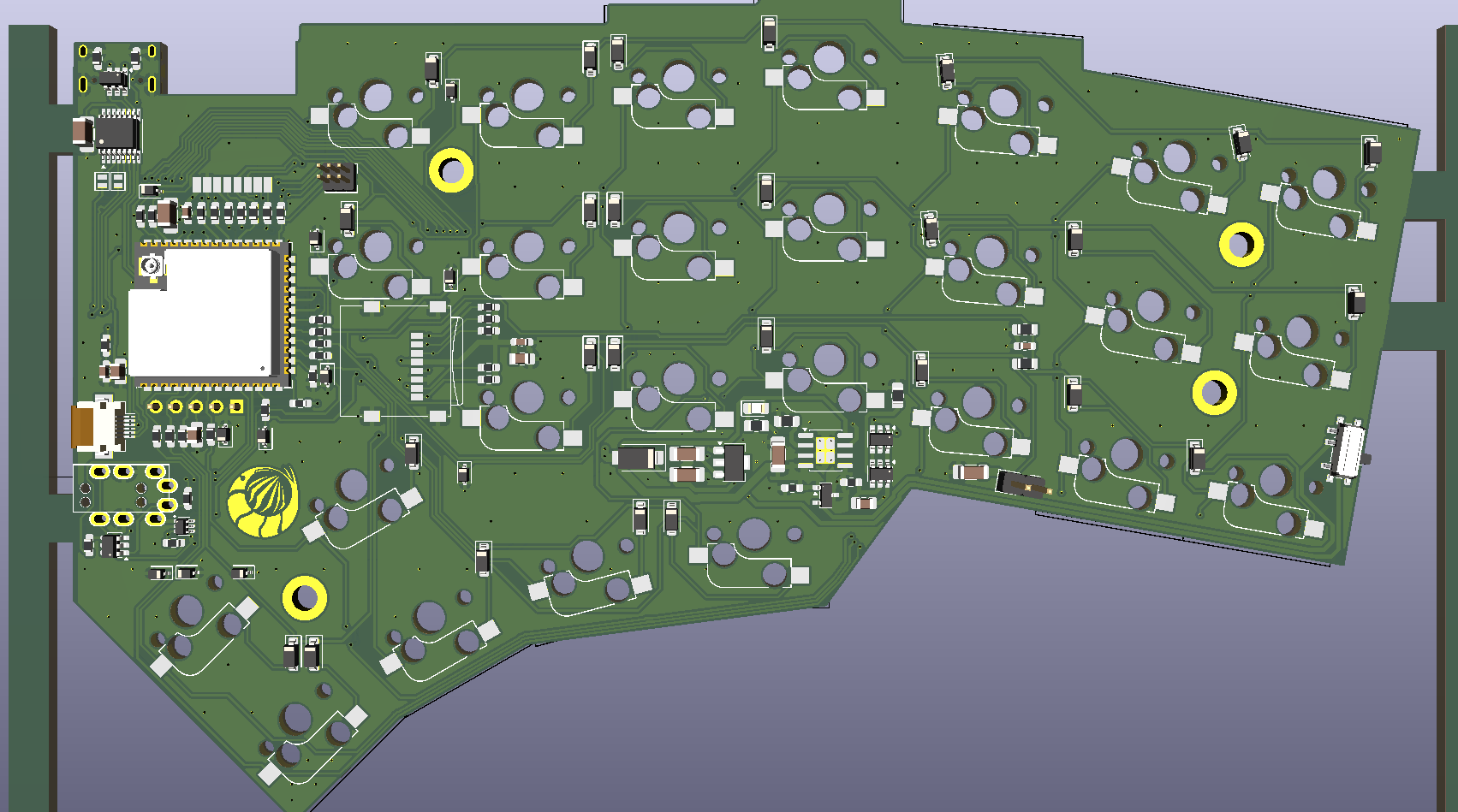
Niphar is an open-source printed circuit board by mornepousse, from the mornepousse/Niphargus repository on GitHub, published under the MIT licence. It is a 4-layer board of 340.8 × 104.6 mm with 287 parts on 292 nets, routed with 2,869 tracks and 569 vias.
It is built around the ESP32-S3-WROOM-1-N8, DW01A and HT7833, with the SRV05-4, TP4056-42-ESOP8 and USBLC6-2SC6 among its other parts. Its parts include 78 diodes, 73 resistors, 54 switches, 30 capacitors and 19 ICs. It belongs with the keyboards and input boards and the ESP32 and RISC-V boards of this library.


The cave shrimp: blind, discreet, indestructible.
La crevette des cavernes : aveugle, discrète, indestructible.
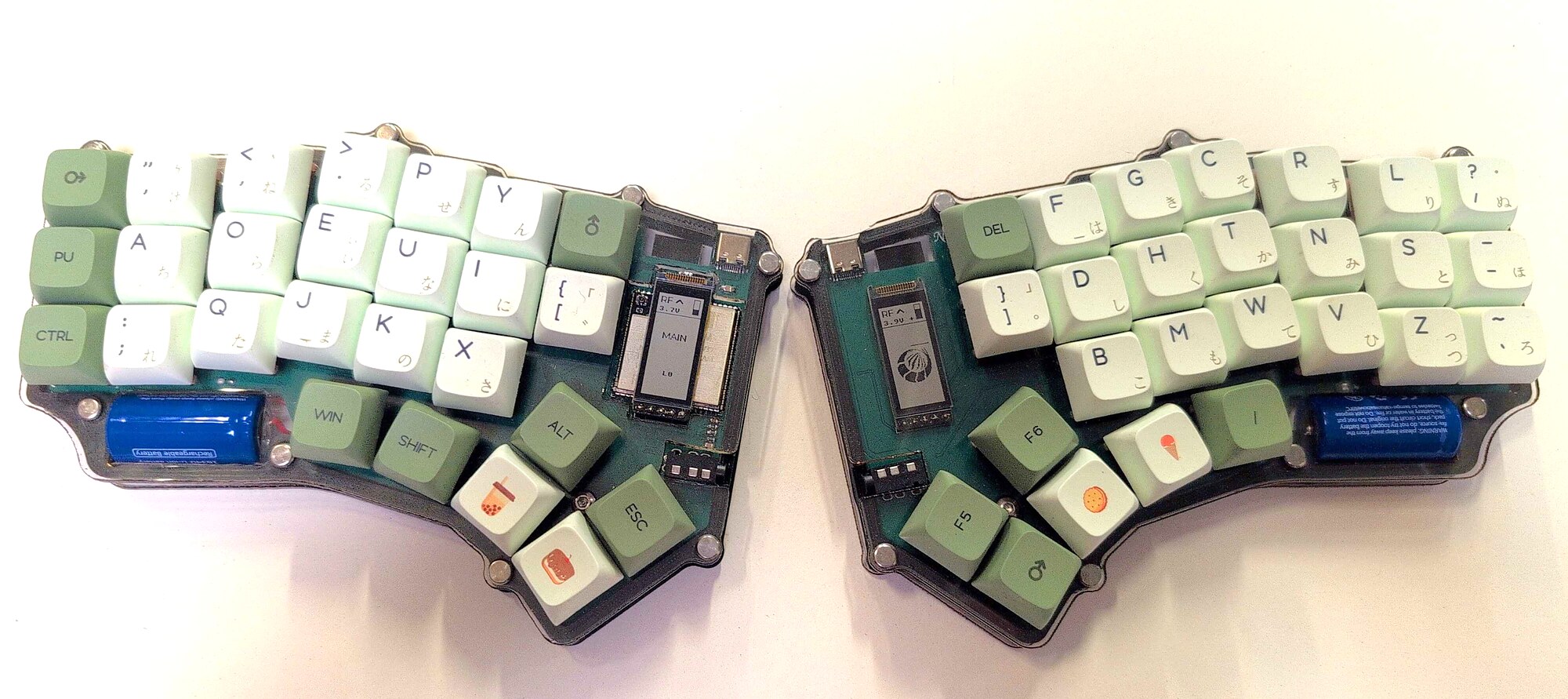
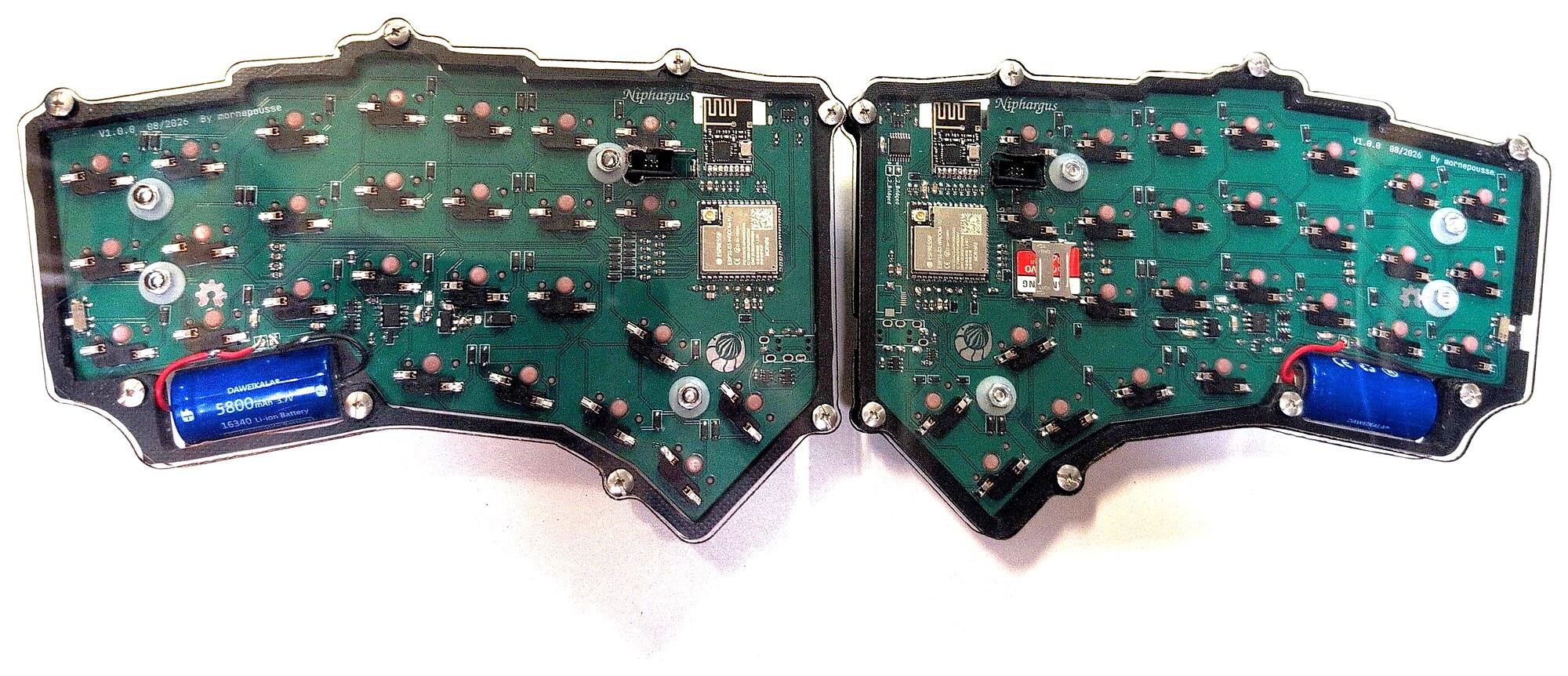
First assembled units, September 2026. Working on battery and USB, with a few hand-fixes on the
mechanics — see the bench notes.
Premiers exemplaires montés, septembre 2026. Fonctionnels sur batterie et USB, avec quelques
rattrapages mécaniques à la main — voir les notes de banc.
Niphargus is a thin, unkillable wireless split keyboard.
A complete redesign of the Rouge-Gorge (v1, 2022), a Jorne / Kyria rev2 derivative that was never built. This repository carries the full history: Rouge-Gorge → rili → Niphargus.
Status (2026-08) — v2 schematic complete and reviewed, board routed, ERC and DRC clean. Case in progress (see below). Firmware in KeSp_firmware.
Niphargus est un clavier split sans fil, fin et increvable.
Refonte complète du Rouge-Gorge (v1, 2022), un dérivé du Jorne et du Kyria rev2 resté sur le papier. Le dépôt porte tout l'historique : Rouge-Gorge → rili → Niphargus.
État (2026-08) — schéma v2 terminé et relu, carte routée, ERC et DRC au vert. Boîtier en cours (ci-dessous). Firmware dans KeSp_firmware.
| Path | Contents |
|---|---|
hardware/pcb/ | KiCad project — niphar.kicad_pro (schematic, board, footprints) |
hardware/order-*.csv | Part orders: TME, LCSC, AliExpress |
hardware/kit-jlcpcb/ | Gerbers, BOM and CPL for JLCPCB |
case/ | Case generator and CAD output |
scripts/ | Anti-regression checks |
docs/ | Design specs and plans |
Three parts: a CNC-machined 8.5 mm aluminium frame, sandwiched between two 2 mm polycarbonate plates, 12.5 mm overall. The 16340 cell sits beside the board, in a pocket milled into the frame itself.
Trois pièces : un cadre aluminium usiné de 8,5 mm pris entre deux plaques polycarbonate de 2 mm, 12,5 mm hors tout. La 16340 se loge à côté de la carte, dans une poche fraisée à même le cadre.
The frame outline is not computed — it is drawn. Edit case/case_outline.svg
(KiCad coordinates, 1 unit = 1 mm), then run:
Le contour du cadre n'est pas calculé, il est dessiné. Éditez
case/case_outline.svg (repère KiCad, 1 unité = 1 mm), puis lancez :
freecad --console case/gen_case.pyThis regenerates the .FCStd, the STEP, the STL files and case_plan.svg.
./scripts/check.sh --fast   # schematic ERC against the committed baseline
./scripts/check.sh          # + full board DRC
./scripts/install-hooks.sh  # once per clone: pre-push runs the full check
Green means never more ERC/DRC errors or warnings than the committed baseline
(.tripwire-kicad-baseline). CI is pinned to KiCad 10.0.4 with its own reference.
Vert signifie jamais plus d'erreurs ni de warnings ERC/DRC que la référence committée. La CI est épinglée sur KiCad 10.0.4 avec sa propre référence.
| Qty | Value | Footprint | References |
|---|---|---|---|
| 52 | D | Diode_SMD:D_SOD-123 | D1, D2, D10, D11, D12, D13, D14, D15, D16, D17, D18, D19, D20, D21, D22, D23 +36 |
| 52 | SW_PUSH | key:SW_Cherry_MX_1.00u_PCB | SW1, SW2, SW10, SW11, SW12, SW13, SW14, SW15, SW16, SW17, SW18, SW19, SW20, SW21, SW22, SW23 +36 |
| 40 | 100 | Resistor_SMD:R_0603_1608Metric_Pad0.98x0.95mm_HandSolder | R10, R11, R12, R13, R14, R15, R16, R17, R18, R19, R20, R21, R22, R23, R24, R25 +24 |
| 22 | SD05C-01F | Diode_SMD:D_SOD-323 | D100, D101, D102, D103, D104, D105, D106, D107, D108, D109, D110, D111, D112, D113, D114, D115 +6 |
| 13 | 10uF | Capacitor_SMD:C_1206_3216Metric_Pad1.33x1.80mm_HandSolder | C11, C12, C13, C15, C16, C19, C20, C23, C24, C25, C26, C29, C30 |
| 12 | 10k | Resistor_SMD:R_0603_1608Metric_Pad0.98x0.95mm_HandSolder | R1, R2, R33, R34, R48, R49, R54, R55, R56, R57, R58, R59 |
| 9 | 100nF | Capacitor_SMD:C_0603_1608Metric_Pad1.08x0.95mm_HandSolder | C1, C2, C5, C6, C7, C8, C17, C21, C22 |
| 8 | 1uF | Capacitor_SMD:C_0805_2012Metric_Pad1.18x1.45mm_HandSolder | C3, C4, C9, C10, C14, C18, C27, C28 |
| 8 | MountingHole_Pad_MP | MountingHole:MountingHole_3.2mm_M3_DIN965_Pad | H1, H2, H3, H4, H5, H6, H7, H8 |
| 5 | 100k | Resistor_SMD:R_0603_1608Metric_Pad0.98x0.95mm_HandSolder | R35, R42, R43, R60, R61 |
| 4 | 1M | Resistor_SMD:R_0805_2012Metric_Pad1.20x1.40mm_HandSolder | R64, R65, R66, R67 |
| 4 | 1k | Resistor_SMD:R_0805_2012Metric_Pad1.20x1.40mm_HandSolder | R62, R63, R72, R73 |
| 4 | 5k1 | Resistor_SMD:R_0603_1608Metric_Pad0.98x0.95mm_HandSolder | R50, R51, R52, R53 |
| 2 | 2k4 | Resistor_SMD:R_0805_2012Metric_Pad1.20x1.40mm_HandSolder | R68, R69 |
| 2 | 4.7k | Resistor_SMD:R_0603_1608Metric_Pad0.98x0.95mm_HandSolder | R29, R32 |
| 2 | AO3407 | Package_TO_SOT_SMD:SOT-23 | Q1, Q2 |
| 2 | AudioJack4 | EKR82-footprint:MJ-4PP-9_rev3 | J5, J6 |
| 2 | Battery | Connector_PinHeader_2.54mm:PinHeader_1x02_P2.54mm_Vertical | J10, J11 |
| 2 | Conn_01x05_Pin | Connector_PinHeader_2.54mm:PinHeader_1x05_P2.54mm_Vertical | J4, J12 |
| 2 | Conn_02x03_Odd_Even | Connector_PinHeader_1.27mm:PinHeader_2x03_P1.27mm_Vertical | J1, J2 |
| 2 | DW01A | Package_TO_SOT_SMD:SOT-23-6 | U22, U23 |
| 2 | ESP32-S3-WROOM-1 | PCM_Espressif:ESP32-S3-WROOM-1U | U5, U6 |
| 2 | FS8205 | Package_TO_SOT_SMD:SOT-23-6 | Q3, Q4 |
| 2 | HT7833 | Package_TO_SOT_SMD:SOT-89-3 | U20, U21 |
| 2 | Heatsink_Pad | MaeLid:Niphargus_10mm_Cu | HS1, HS2 |
| 2 | Jumper_2_Bridged | EKR82-footprint:Jumper | JP1, JP2 |
| 2 | LED | LED_SMD:LED_0805_2012Metric_Pad1.15x1.40mm_HandSolder | D49, D50 |
| 2 | NRF24L01_Breakout | MaeLid:NRF24L01 | U7, U8 |
| 2 | SRV05-4 | Package_TO_SOT_SMD:SOT-23-6 | U9, U10 |
| 2 | SS14 | Diode_SMD:D_SMA | D51, D52 |
| 2 | SW_SPDT | Button_Switch_SMD:SW_SPDT_PCM12 | SW53, SW54 |
| 2 | SiP32431DR3 | Package_TO_SOT_SMD:SOT-363_SC-70-6 | U11, U12 |
| 2 | TP4056-42-ESOP8 | Package_SO:SOIC-8-1EP_3.9x4.9mm_P1.27mm_EP2.41x3.3mm_ThermalVias | U18, U19 |
| 2 | USBLC6-2SC6 | Package_TO_SOT_SMD:SOT-23-6 | U14, U15 |
| 2 | USB_C_Receptacle_USB2.0_16P | Connector_USB:USB_C_Receptacle_HRO_TYPE-C-31-M-12 | J7, J8 |
| 1 | AMS1117-3.3 | Package_TO_SOT_SMD:SOT-223-3_TabPin2 | U17 |
| 1 | CH334R | Package_SO:QSOP-16_3.9x4.9mm_P0.635mm | U13 |
| 1 | ESP32P4_QFN104 | MaeLid:JC-ESP32P4-M3_V0.2 | U16 |
| 1 | Heatsink_Pad | MaeLid:Niphargus_text_3mm_silk | HS3 |
| 1 | Micro_SD_Card | Connector_Card:microSD_HC_Wuerth_693072010801 | J9 |
| 1 | TPS43_FPC | Connector_FFC-FPC:Hirose_FH12-6S-0.5SH_1x06-1MP_P0.50mm_Horizontal | J3 |
The 283 most common of 287 parts.
mornepousse/Conchodytes
Sleeper mouse: a wireless PMW3360 PCB inside a Logitech M100/M90 shell, talking to the same KaSe dongle as the Niphargus keyboard

KaliAssistant/Fox-Jack
Portable social-engineering LAN tool for automated payloads and wired audits — based on Luckfox Pico Max

rizalfanex/SkillEye
Submission for the 8th CTCI Science and Technology Creativity Competition 2026 (Sports theme).

petnica-rac-seminari/BCD-0o27-Tetris
The BalcCon Cyberdeck 0o27 (BCD-0o27) comes with a development framework that makes it easier to add functionality to the cyberdeck.


KazimGL/ESP32-PowerIoT-DevBoard
ESP32 battery-powered IoT dev board with Li-ion charging, protection, and sensor support — designed in KiCad

ZharbolatDinmukhamed/Haptic-Glove-PCB
A wrist-mounted PCB for a haptic feedback glove, developed as part of my Research Assistantship at the Tactile Laboratory, Nazarbayev University.

HYLDAIC/Flagshep-V1_Audio-Player
A high fidelity semi-portable audio player student project with provided PCB files, 3D files and Code
It measures 340.8 × 104.6 mm and has 4 copper layers, 1.6 mm thick.
287 parts, built around the ESP32-S3-WROOM-1-N8, DW01A, HT7833 and SRV05-4. The full list of its parts is on this page, with links to each part's symbol and footprint where PCBKit's library has them.
From the mornepousse/Niphargus repository on GitHub, at the commit this page was made from: the board is hardware/pcb/niphar.kicad_pcb and its schematic hardware/pcb/bat.kicad_sch. PCBKit opens the board in the browser, with nothing to install.
Its repository publishes it under the MIT licence: you may reuse it on that licence's terms (keep the author's notice, and for a copyleft licence share your changes alike).