
2 layers379.1 × 273.4 mm
NE Delta
frubem/NE_Delta_Schematics
Forked from https://codeberg.org/hkzlab/NE_Delta_Schematics
185 parts

 roybaer/renovation_ssi_200126
Innovation SSI-2001 replica that can be built without vintage components
Renovation ssi 2001 is an open-source printed circuit board by roybaer, from the roybaer/renovation_ssi_2001 repository on GitHub. It is a 2-layer board of 134.6 × 106.4 mm with 95 parts on 170 nets, routed with 1,224 tracks and 14 vias.
It is built around the 74LS245SC, 74LS74PC and NE556, with the 74HC192P-E, 74LS00SC and 74LS04PC among its other parts. Its parts include 21 capacitors, 18 resistors, 15 ICs, 6 connectors and 2 transistors. It belongs with the retro computing and games boards and the STM32 boards of this library.


This repository contains the design files for the Renovation SSI-2001 sound card, a replica of the Innovation SSI-2001 with some unobtrusive modifications that eliminate the dependency on vintage parts. The Innovation SSI-2001 was an 8-bit ISA sound card from the late 1980s that was based on Commodore's SID synthesizer chip.
This modified design can optionally use an STM32 microcontroller, instead. It can also use two NE556 dual timer ICs instead of a single NE558 quad timer IC for the integrated analog joystick interface. All optional modern replacement components share the location of the vintage parts they replace, so that the modifications are largely invisible in combination with vintage parts.
This picture shows the front of the card.
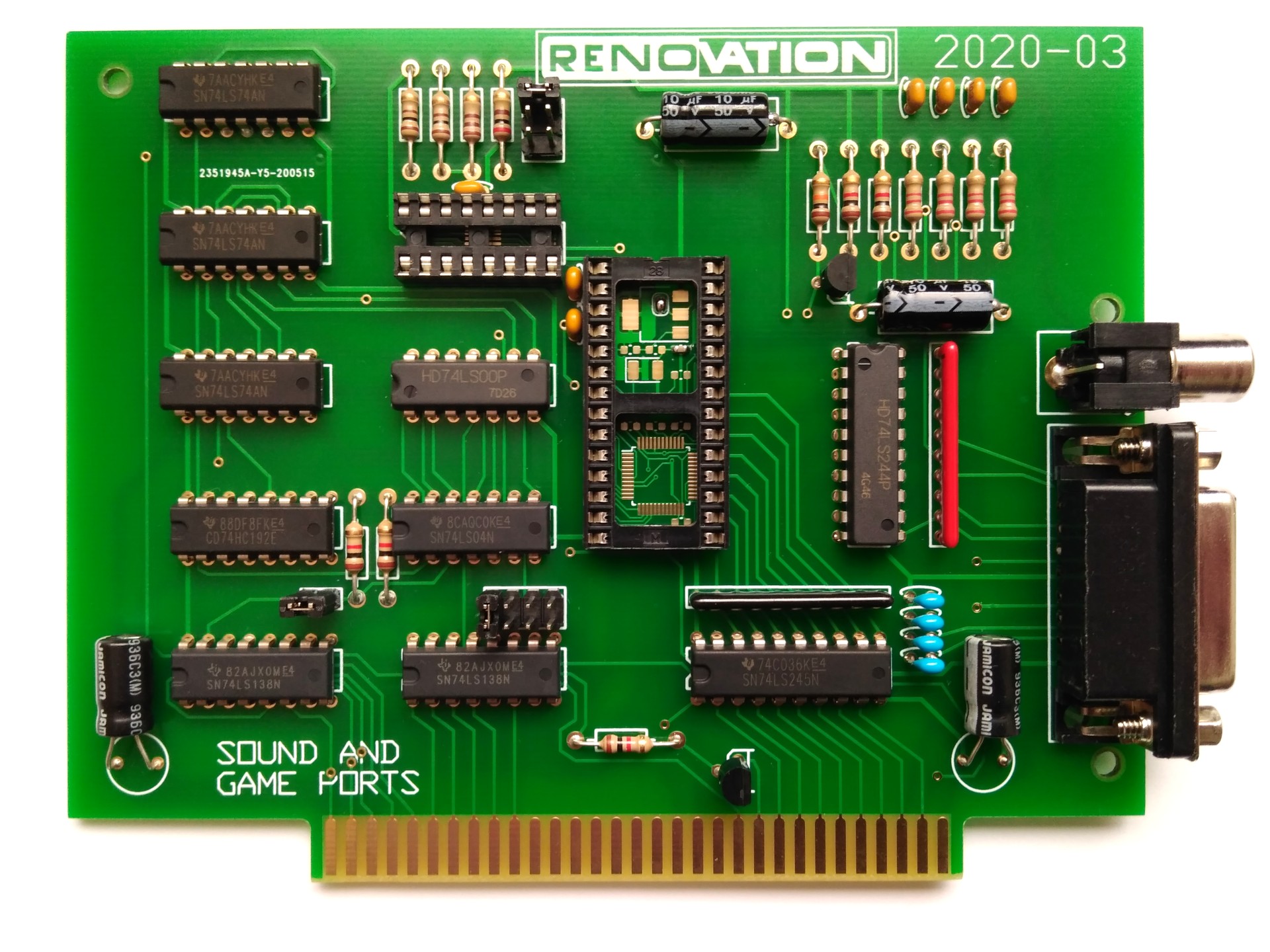
There is also a picture of the back side of the card.
You will need the following vintage components for a visually accurate replica:
The design files of this project combine multiple possible hardware configurations in the same schematic diagram and PCB layout. Hence, the unmodified tool-generated BOM will not yield a sensible hardware configuration. Please read the notes in the schematic diagram, decide which variant you want to build and adjust the BOM, accordingly.
Please consult the settings document for jumper settings.
The planned adaptation of the STM32-SID-PLAYER firmware for this card, i.e. the implementation of an ISA interface for the synthesizer core is still pending. Right now, this card is therefore only usable in combination with either an original SID or a modern substitute like the SwinSID.
The exact DA15 and RCA connectors found on the original card are no longer available and have therefore been replaced by affordable modern variants. Furthermore, the RCA jack and the mounting holes have been shifted to simplify the adaptation of the generic Keystone 9202 ISA bracket.
The following license applies to the files in this repository:
This work is licensed under the Creative Commons Attribution-ShareAlike 4.0 International License. To view a copy of this license, visit http://creativecommons.org/licenses/by-sa/4.0/ or send a letter to Creative Commons, PO Box 1866, Mountain View, CA 94042, USA.
| Qty | Value | Footprint | References |
|---|---|---|---|
| 5 | 10nF | SSI_2001:C_Disc_D3.4mm_W2.1mm_P2.50mm | C2, C9, C10, C11, C16 |
| 5 | 1k | SSI_2001:R_Axial_DIN0309_L9.0mm_D3.2mm_P12.70mm_Horizontal | R1, R2, R8, R12, R13 |
| 4 | 100nF | Capacitor_SMD:C_0603_1608Metric | C18, C19, C20, C21 |
| 4 | 100nF | SSI_2001:C_Disc_D3.4mm_W2.1mm_P2.50mm | C12, C13, C14, C15 |
| 4 | 2.2k | SSI_2001:R_Axial_DIN0309_L9.0mm_D3.2mm_P12.70mm_Horizontal | R14, R15, R16, R17 |
| 3 | 74LS74 | SSI_2001:DIP-14_W7.62mm | U1, U2, U3 |
| 3 | MountingHole | SSI_2001:MountingHole_3.2mm_M3 | H1, H2, H3 |
| 2 | 100 | SSI_2001:R_Axial_DIN0309_L9.0mm_D3.2mm_P12.70mm_Horizontal | R3, R4 |
| 2 | 100µF | SSI_2001:CP_Radial_D6.3mm_P2.50mm | C1, C8 |
| 2 | 10µF | SSI_2001:CP_Axial_L11.0mm_D5.0mm_P18.00mm_Horizontal | C5, C6 |
| 2 | 1nF | SSI_2001:C_Disc_D3.4mm_W2.1mm_P2.50mm | C3, C4 |
| 2 | 74LS138 | SSI_2001:DIP-16_W7.62mm | U5, U10 |
| 2 | NE556 | SSI_2001:SSOP-14_5.3x6.2mm_P0.65mm | U6, U7 |
| 2 | PN2222A | SSI_2001:TO-92 | Q1, Q2 |
| 2 | SolderJumper_2_Open | Jumper:SolderJumper-2_P1.3mm_Open_RoundedPad1.0x1.5mm | JP2, JP4 |
| 1 | 100 | Resistor_SMD:R_0603_1608Metric | R7 |
| 1 | 10k | SSI_2001:R_Axial_DIN0309_L9.0mm_D3.2mm_P12.70mm_Horizontal | R11 |
| 1 | 110 | SSI_2001:R_Axial_DIN0309_L9.0mm_D3.2mm_P12.70mm_Horizontal | R5 |
| 1 | 110 | Resistor_SMD:R_0603_1608Metric | R9 |
| 1 | 180 | Resistor_SMD:R_0603_1608Metric | R10 |
| 1 | 1k_Network09 | SSI_2001:R_Array_SIP10 | RN2 |
| 1 | 200 | SSI_2001:R_Axial_DIN0309_L9.0mm_D3.2mm_P12.70mm_Horizontal | R6 |
| 1 | 22µF | Capacitor_Tantalum_SMD:CP_EIA-3528-21_Kemet-B | C17 |
| 1 | 4.7k_Network09 | SSI_2001:R_Array_SIP10 | RN1 |
| 1 | 74HC192 | SSI_2001:DIP-16_W7.62mm | U4 |
| 1 | 74LS00 | SSI_2001:DIP-14_W7.62mm | U8 |
| 1 | 74LS04 | SSI_2001:DIP-14_W7.62mm | U9 |
| 1 | 74LS244 | SSI_2001:DIP-20_W7.62mm | U14 |
| 1 | 74LS245 | SSI_2001:DIP-20_W7.62mm | U13 |
| 1 | Bus_ISA_8bit | SSI_2001:BUS_XT | J4 |
| 1 | DB15_Female | SSI_2001:DSUB-15_Female_Horizontal_P2.77x2.84mm_EdgePinOffset7.70mm_Housed_MountingHolesOffset9.12mm | J2 |
| 1 | DNP | SSI_2001:C_Disc_D3.4mm_W2.1mm_P2.50mm_alt | C7 |
| 1 | Jumper | SSI_2001:PinHeader_1x02_P2.54mm_Vertical | JP1 |
| 1 | KLPX-0848A-2-B | SSI_2001:Cinch_Kycon_KLPX-0848A-2-B | J1 |
| 1 | LM1117-ADJ | Package_TO_SOT_SMD:SOT-223-3_TabPin2 | U11 |
| 1 | NE558 | SSI_2001:DIP-16_W7.62mm | U67 |
| 1 | Pins_02x03 | SSI_2001:PinHeader_2x03_P2.54mm_Vertical | J6 |
| 1 | Pins_02x04 | SSI_2001:PinHeader_2x04_P2.54mm_Vertical | J5 |
| 1 | R | Resistor_SMD:R_0603_1608Metric | R18 |
| 1 | SID_Socket | SSI_2001:DIP-28_W15.24mm | J7 |
| 1 | STM32F103C8Tx | Package_QFP:LQFP-48_7x7mm_P0.5mm | U12 |
| 1 | SolderJumper_2_Bridged | Jumper:SolderJumper-2_P1.3mm_Bridged_RoundedPad1.0x1.5mm | JP3 |
| 1 | TestPoint | TestPoint:TestPoint_Pad_1.5x1.5mm | TP1 |
The 72 most common of 95 parts.
frubem/NE_Delta_Schematics
Forked from https://codeberg.org/hkzlab/NE_Delta_Schematics

sladek/SBC_8080_ECB
This is my attempt to build a single-board microcomputer based on the Intel 8080 CPU. It contains the following features:


Nakazoto/CenturionComputer
This is just a simple backup of all the files related to the Centurion that I have stored on my HD. The Wiki itself has far more in-depth information about the Centurion and it's individual cards.

hkzlab/CGA_Redux
The Color Graphics Adapter Redux board is a more or less faithful clone of the original IBM CGA, based on the original schematics

It measures 134.6 × 106.4 mm and has 2 copper layers, 1.6 mm thick.
95 parts, built around the 74LS245SC, 74LS74PC, NE556 and 74HC192P-E. The full list of its parts is on this page, with links to each part's symbol and footprint where PCBKit's library has them.
From the roybaer/renovation_ssi_2001 repository on GitHub, at the commit this page was made from: the board is renovation_ssi_2001/renovation_ssi_2001.kicad_pcb. PCBKit opens the board in the browser, with nothing to install.
Its repository states no licence, so its author keeps all rights: ask roybaer before reusing the design.