
2 layers103 × 100 mm
 RoboFEI/Eletronics
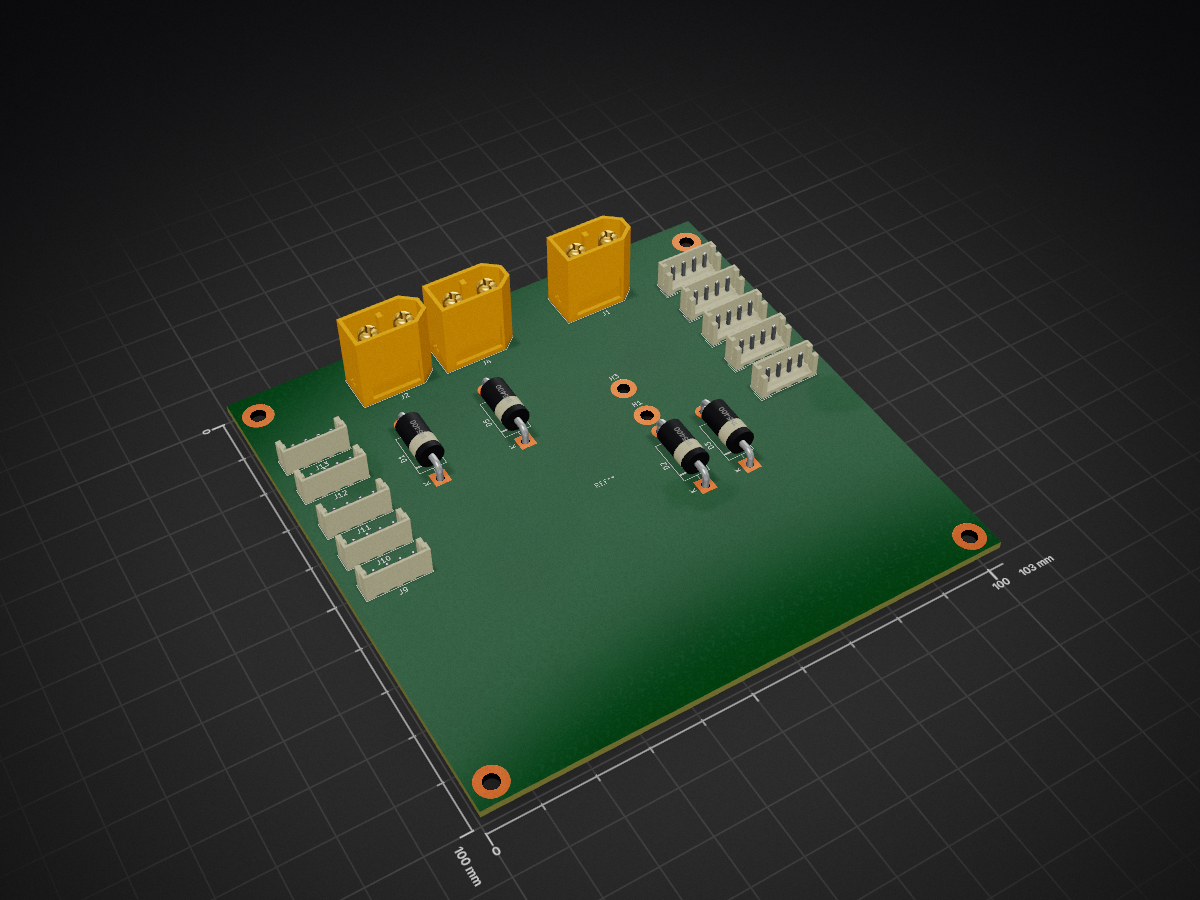
Power Board is an open-source printed circuit board by RoboFEI, from the RoboFEI/Eletronics repository on GitHub. It is a 2-layer board of 103 × 100 mm with 20 parts on 8 nets, routed with 39 tracks and 0 vias.
It is built around the B4B-XH-A. Its parts include 13 connectors and 4 diodes.
| Qty | Value | Footprint | References |
|---|---|---|---|
| 10 | B4B-XH-A | Humanoid:XM_conn_vertical-B4B-EH-A | J3, J5, J6, J7, J8, J9, J10, J11, J12, J13 |
| 4 | 1N5400 | Diode_THT:D_DO-201AD_P15.24mm_Horizontal | D1, D2, D3, D5 |
| 3 | XT60 | Humanoid:XT60-M_Vertical | J1, J2, J4 |
| 2 | MountingHole_Pad | MountingHole:MountingHole_2.5mm_Pad | H1, H3 |
The 19 most common of 20 parts.
It measures 103 × 100 mm and has 2 copper layers, 1.6 mm thick.
20 parts, built around the B4B-XH-A. The full list of its parts is on this page, with links to each part's symbol and footprint where PCBKit's library has them.
From the RoboFEI/Eletronics repository on GitHub, at the commit this page was made from: the board is Power_Board/Power_Board/Power_Board.kicad_pcb and its schematic Communication_Board/Communication_Board/Communication_Board.kicad_sch. PCBKit opens the board in the browser, with nothing to install.
Its repository states no licence, so its author keeps all rights: ask RoboFEI before reusing the design.

mnemocron/FHNW-Pro4E-FS19T8-3DPrinterBoard-STM32
Marlin 2.0 compatible 3D printer board based on STM32F103 (KiCad)

CNES/argos-demo-board
Demo board designed to use the ARRIBADA SMD module via USB to send ARGOS messages to the Kineis constellation.

jujojujo2003/Ender-3-3DPrinter-Load-Cell-Bed-Leveling-Sensor
This is a Load Cell based bed leveling sensor based on the RP2040 and TI ADS1235 ADC that should mount onto any vertical MGN12H gantry. My printer is an Ender 3 with a bunch of linear rail mods.

Valar-Systems/valar-motion
The easiest, fastest, cheapest, and safest way to spin a stepper motor wirelessly. Valar Motion is a family of tiny Wi-Fi stepper controllers built around a Trinamic TMC2209 driver — precisely control a motor's…

0xEBD/fumeXsense
The idea behind fumeXsense is simple: understand what the Weller WX2 is doing via its serial interface and use that information to control the existing fume extractor automatically.

SG295/ece477_guitartuner
Automatic Guitar Tuner Project for ECE477 (Senior Design) @ Purdue University

themarcolab/Stardrive-Shield
With STARDRIVE SHIELD you can implement from 6 step to FOC motor control algorithms.

Valar-Systems/VAL3100
The VAL3100 is now part of the Valar Motion mono-repo, alongside the VAL3000 and VAL3101 controllers: