4 layers40 × 52.5 mm
VAL3100
Valar-Systems/VAL3100
The VAL3100 is now part of the Valar Motion mono-repo, alongside the VAL3000 and VAL3101 controllers:
67 parts2CERN-OHL-S-2.0

 Valar-Systems/valar-motion3
The easiest, fastest, cheapest, and safest way to spin a stepper motor wirelessly. Valar Motion is a family of tiny Wi-Fi stepper controllers built around a Trinamic TMC2209 driver — precisely control a motor's…
VAL3000 is an open-source printed circuit board by Valar-Systems, from the Valar-Systems/valar-motion repository on GitHub. It is a 4-layer board of 40 × 52.5 mm with 61 parts on 50 nets, routed with 416 tracks and 99 vias.
It is built around the ESP32-C3-WROOM-02-H4, TMC2209-LA-T and TC-6615-4.5-160G, with the RT9080-33GJ5, ESD9L3.3ST5GB and BSD5C051L among its other parts. Its parts include 21 capacitors, 14 resistors, 7 ICs, 7 diodes and 6 connectors. It belongs with the ESP32 and RISC-V boards of this library.


The easiest, fastest, cheapest, and safest way to spin a stepper motor wirelessly. Valar Motion is a family of tiny Wi-Fi stepper controllers built around a Trinamic TMC2209 driver — precisely control a motor's distance, speed, current, and stall behaviour within minutes of unboxing, from any browser, with no Home Assistant required.
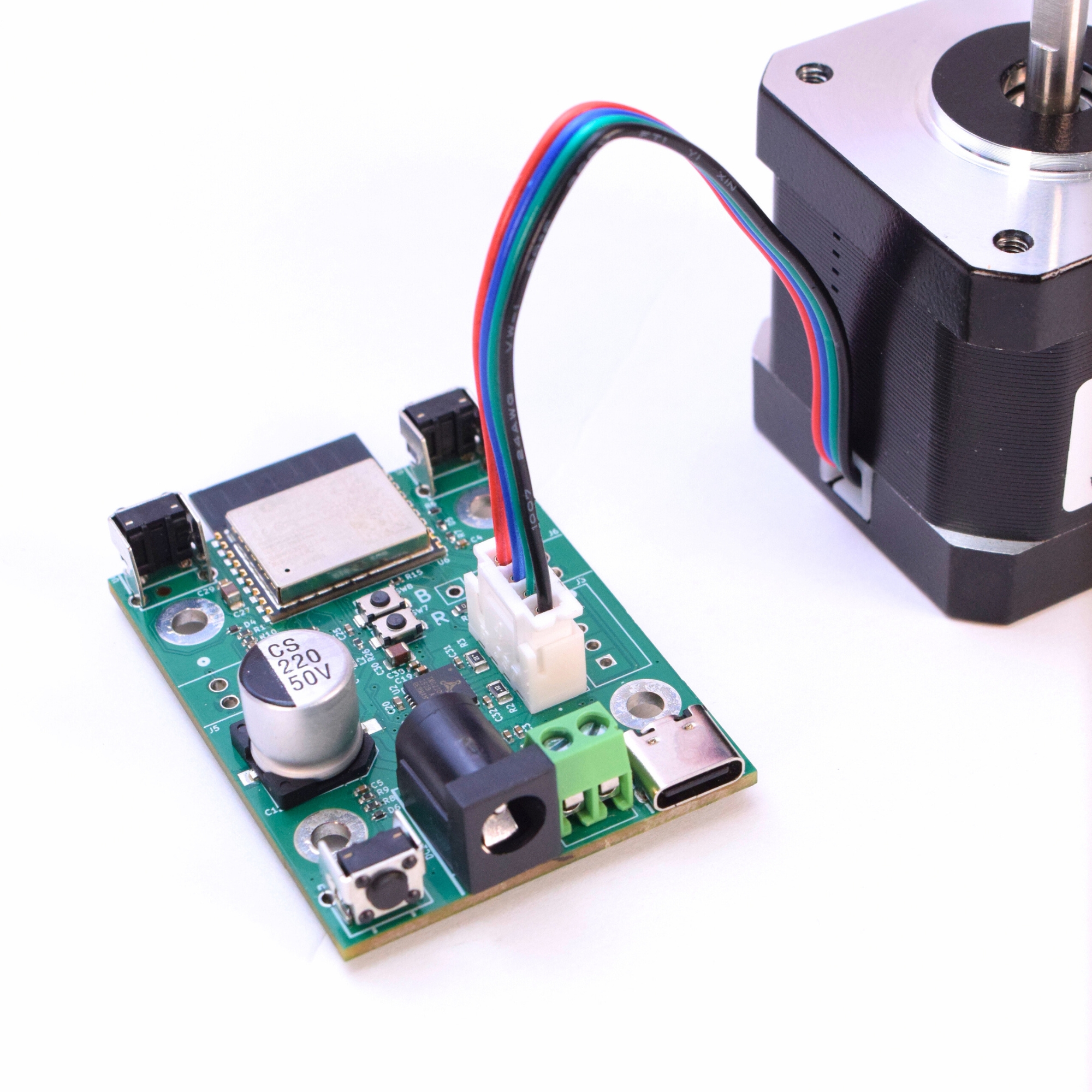
All three boards share the same TMC2209 driver, a synchronous DC/DC converter, three buttons, end-stop inputs, and a USB-C port for flashing. They differ only in the microcontroller and — on the 3101 — an onboard magnetic encoder.
| Board | MCU | Radios | Extra | Price |
|---|---|---|---|---|
| VAL3000 | ESP32-C3 | Wi-Fi | — | $34.99 |
| VAL3100 | ESP32-C6 | Wi-Fi / Thread / Zigbee / Matter / BLE | Status LED | $44.99 |
| VAL3101 | ESP32-C6 | Wi-Fi / Thread / Zigbee / Matter / BLE | Status LED + AS5600 encoder (closed-loop) | $54.99 |
Buy them at valarsystems.com. Sold out? Hit the "Notify me when available" button — that's the only way we know to make more.
The board packs a full wireless stepper controller into a footprint that bolts onto the back of a NEMA 17 motor (the four mounting holes line up with the motor face):
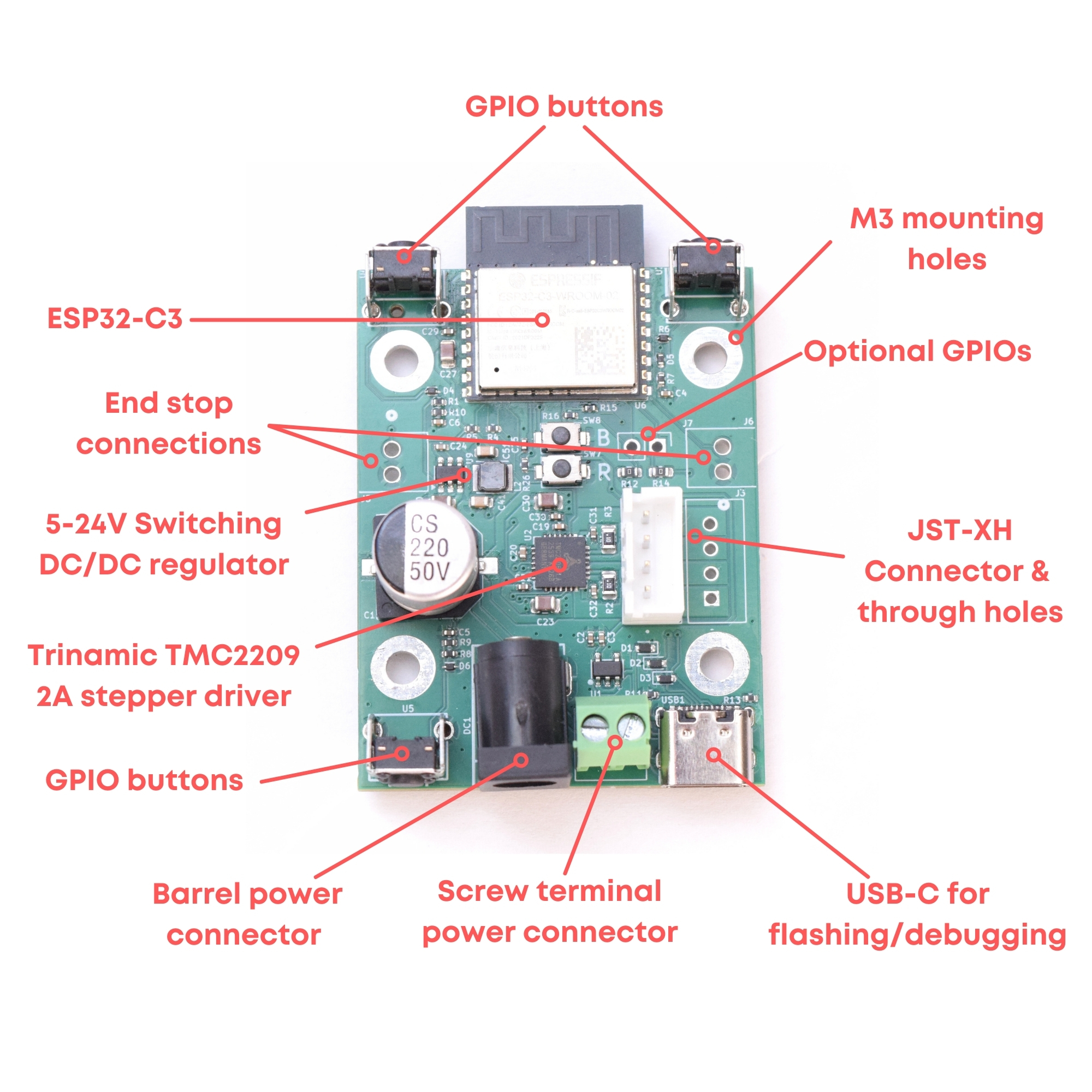
Board anatomy (VAL3000 shown; the VAL3100/3101 share the same layout on an ESP32-C6).
Setup takes about three minutes:
That's it. When you're ready to customize, plug in USB-C and flash a build below.
⚠️ VAL3000 only: the VAL3000 has no reverse-polarity protection — double-check your supply is center-positive before powering on. The VAL3100 / VAL3101 add reverse-polarity protection.
The board ships bare. Grab the prebuilt binary for your board from the latest release and flash it from your browser at web.esphome.io with a USB-C cable — no toolchain, no soldering, no Home Assistant required. On first boot the board makes its own Wi-Fi hotspot; connect, join it to your network, and control it from any browser. It's discoverable in Home Assistant over the ESPHome API too.
First-time flashing note: the USB-C port connects straight to the ESP32 (USB CDC — no USB-to-UART bridge). If the board isn't detected on a brand-new unit, enter download mode manually: hold BOOT, tap RESET, then release BOOT. After the first upload this is automatic.
python3 -m venv venv && source venv/bin/activate
pip install esphome
cp secrets.example.yaml secrets.yaml     # not needed for a bare flash

esphome compile boards/val3100/val3100.yaml
# → factory image at:
#   boards/val3100/.esphome/build/val3100/.pioenvs/val3100/firmware.factory.bin
Swap val3100 for val3000 or val3101. CI
(.github/workflows/build-firmware.yml) builds all three on every push and
attaches *.factory.bin / *.ota.bin to tagged releases.
Boards can update themselves over Wi-Fi — no computer needed — by fetching the
newest release asset for their board. Release asset names are an API: keep
val3000.factory.bin, val3100.ota.bin, etc. stable so units already in the
field keep updating after any repo move. See docs/MIGRATION.md.
The TMC2209 is one of the best stepper drivers on the market — feature-rich yet affordable, with silent StealthChop operation and sensorless stall detection. StallGuard stops the motor whenever the load exceeds a threshold you set — no limit switches needed — which makes the board safe for curtains, windows, blinds, and anything that could pinch or jam. The driver is controlled over a single-wire UART, so speed, current, microstepping, and stall sensitivity are all tunable live from the web UI.
Connect a motor three ways: the on-board 4-pin JST-XH plug, the included 4-pin screw terminal (solder it to the exposed pins), or by soldering the motor wires directly to the board.
Flash firmware and monitor serial over USB-C — no programmer needed. Three on-board buttons give physical open / close control plus a Wi-Fi reset, handy for products built on the board (our Ropener curtain opener uses exactly this).
valar-motion/
├── boards/
│   ├── val3000/val3000.yaml   # ESP32-C3 pin map + substitutions
│   ├── val3100/val3100.yaml   # ESP32-C6 + status LED
│   └── val3101/val3101.yaml   # ESP32-C6 + status LED + AS5600 encoder
├── common/
│   └── valar-core.yaml        # shared, board-independent behaviour
├── hardware/                  # PCB, schematics, libraries (per board)
├── docs/                      # datasheets, guides, media
└── .github/workflows/         # CI: builds a factory + OTA bin per board
The important idea: behaviour lives in common/valar-core.yaml, which every
board pulls in as a package. Each boards/<board>/<board>.yaml is a thin wrapper
that only sets that board's chip, GPIO pin map, and OTA asset name. Change the
core once and all three boards inherit it.
docs/hardware-guide.md — power/voltage/current/heat, driving the TMC2209 (UART vs STEP/DIR), and mounting to a NEMA 17hardware/val3000,
hardware/val3100 (the VAL3101 uses the VAL3100 board with
the AS5600 encoder populated — see hardware/val3101)docs/val3000/schematic.pdfdocs/val3000/Trinamic_Book_V4.pdf — in-depth guide to Trinamic driversThis repo is the board firmware. Products built on these boards live in their
own repos and layer their behaviour on top of common/valar-core.yaml — e.g.
The Ropener, a smart curtain opener,
which adds cover/position logic and homing on the same boards.
Licensed under the CERN Open Hardware Licence Version 2 — Strongly Reciprocal.
| Qty | Value | Footprint | References |
|---|---|---|---|
| 12 | 0.1uF | Capacitor_SMD:C_0402_1005Metric | C2, C3, C4, C5, C6, C21, C24, C25, C29, C31, C32, C38 |
| 5 | 10K | Resistor_SMD:R_0402_1005Metric | R1, R5, R6, R8, R26 |
| 5 | 5.1K | Resistor_SMD:R_0402_1005Metric | R7, R9, R10, R11, R13 |
| 4 | 10uF | Capacitor_SMD:C_0805_2012Metric | C10, C23, C27, C30 |
| 3 | ESD9L3.3ST5G | ESD9L3-3ST5G:SOD-923_L0.8-W0.6-LS1.0-RD | D4, D5, D6 |
| 3 | SOD-523_BSD5C051L | Diode_SMD:D_SOD-523 | D1, D2, D3 |
| 3 | TC-6615-4.5-160G | TC-6615-4.5-160G:KEY-TH_TC-6615-4.5-160G | U3, U4, U5 |
| 2 | 0R10 | Capacitor_SMD:C_0805_2012Metric | R2, R3 |
| 2 | 22uF | Capacitor_SMD:C_0603_1608Metric | C41, C51 |
| 2 | OSTVN02A150 | footprints:CONN_OSTVN02A150_OST | J5, J6 |
| 2 | TS-1088-AR02016 | TS-1088-AR02016:SW-SMD_L3.9-W3.0-P4.45 | SW7, SW8 |
| 1 | 1984617 | 1984617:PHOENIX_1984617 | J1 |
| 1 | 1K | Resistor_SMD:R_0402_1005Metric | R4 |
| 1 | 220uF | UWT1H221MNL1GS:CAP-SMD_BD10.0-L10.3-W10.3-LS11.3-FD | C1 |
| 1 | 22nF | Capacitor_SMD:C_0402_1005Metric | C19 |
| 1 | 4.7uF | Capacitor_SMD:C_0402_1005Metric | C20 |
| 1 | 68 | Resistor_SMD:R_0402_1005Metric | R17 |
| 1 | AP63203QWU-7 | Package_TO_SOT_SMD:TSOT-23-6 | U9 |
| 1 | B4B-XH-A | B4B-XH-A:JST_B4B-XH-A | J4 |
| 1 | BSMD1812-200-33V | BSMD1812-200-30V:F1812 | F1 |
| 1 | Conn_01x01_Pin | Connector_Pin:Pin_D1.0mm_L10.0mm | J3 |
| 1 | DC-005 5.5-2.0MM | DC-005:DC-IN-TH_DC-005-5.5-2.0 | DC1 |
| 1 | ESP32-C3-WROOM-02 | RF_Module:ESP32-C3-WROOM-02 | U6 |
| 1 | L | SWPA3015S3R3MT:IND-SMD_L3.0-W3.0_FNR30XXS | L2 |
| 1 | LED | LED_SMD:LED_0603_1608Metric | D7 |
| 1 | OSTVN04A150 | footprints:CONN_OSTVN04A150_OST | J2 |
| 1 | RT9080-33GJ5 | RT9080-33GJ5:TSOT-23-5_L2.9-W1.6-P0.95-LS2.8-BL | U1 |
| 1 | TMC2209-LA-T | Package_DFN_QFN:VQFN-28-1EP_5x5mm_P0.5mm_EP3.7x3.7mm_ThermalVias | U2 |
| 1 | TYPE-C 16PIN 2MD(073) | USB-C-LCSC_C2765186:USB-C-SMD_TYPE-C-6PIN-2MD-073 | USB1 |
It measures 40 × 52.5 mm and has 4 copper layers, 1.6 mm thick.
61 parts, built around the ESP32-C3-WROOM-02-H4, TMC2209-LA-T, TC-6615-4.5-160G and RT9080-33GJ5. The full list of its parts is on this page, with links to each part's symbol and footprint where PCBKit's library has them.
From the Valar-Systems/valar-motion repository on GitHub, at the commit this page was made from: the board is hardware/val3000/PCB/VAL3000.kicad_pcb and its schematic hardware/val3000/PCB/VAL3000.kicad_sch. PCBKit opens the board in the browser, with nothing to install.
Its repository states no licence, so its author keeps all rights: ask Valar-Systems before reusing the design.
Valar-Systems/VAL3100
The VAL3100 is now part of the Valar Motion mono-repo, alongside the VAL3000 and VAL3101 controllers:


Corteil/EMF_space_unicorn
code and PCB design files for my Space Unicorn hextension for EMF 2026


RockSat-X/RSXVT2026
Our experiment aims to evaluate the use of optical navigation with Commercial-off-the-Shelf (COTS) products for use in spaceflight applications.

Wassasin/leddimmer
Quick low-side PWM device to crudely dim two 24V 4A LED strips

xlazam01/AstroUniBoard
STM32G0B1-based telescope focuser/rotator controller — OnStepX firmware port + KiCad PCB

henkjannl/RoomThermostat
Opentherm room thermostat that can be controlled through Telegram, but also locally