


4 layers118.1 × 105.4 mm
PocketBeagleCommandStation SMD
RobertPHeller/CommandStationsAndBoosters
Command Stations and Boosters
172 parts
 RobertPHeller/CommandStationsAndBoosters
Command Stations and Boosters
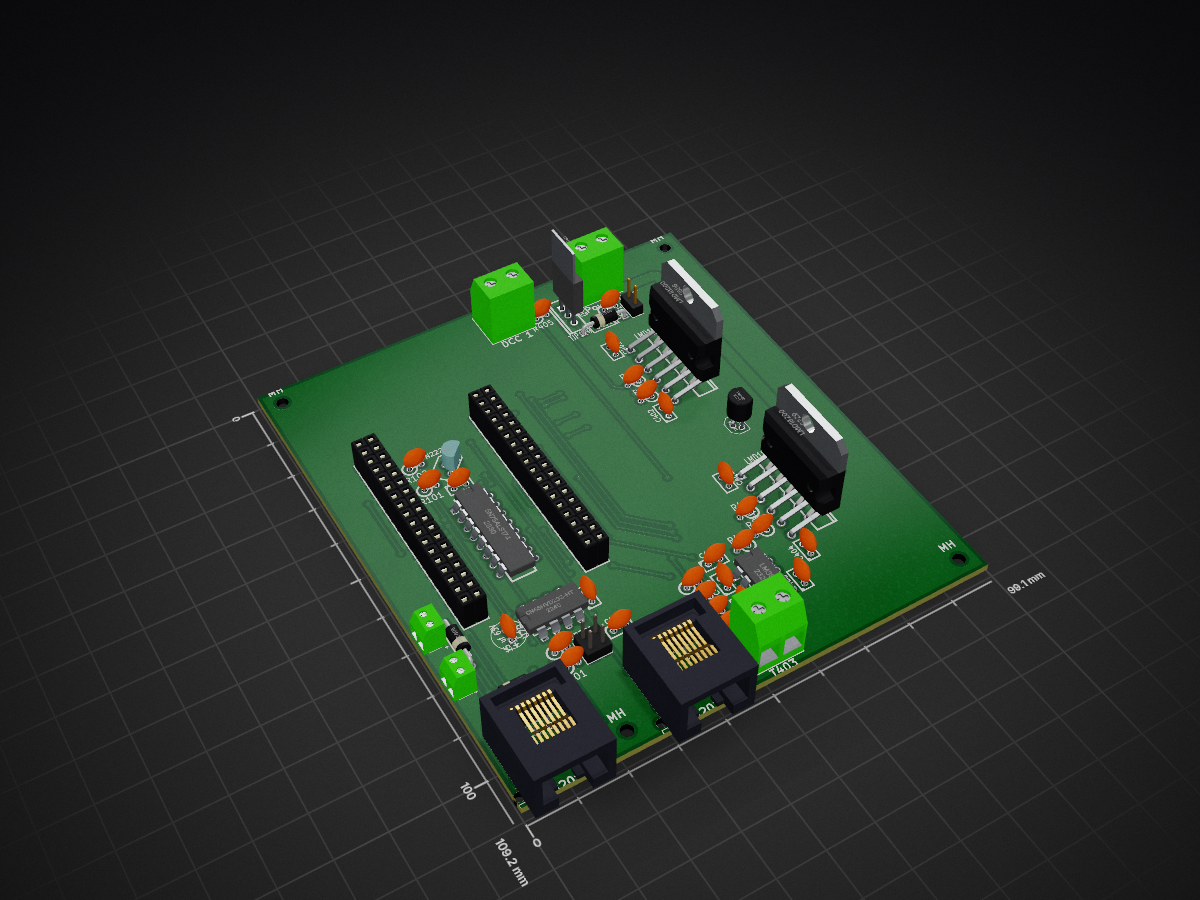
PBCommandStation is an open-source printed circuit board by RobertPHeller, from the RobertPHeller/CommandStationsAndBoosters repository on GitHub. It is a 2-layer board of 99.1 × 109.2 mm with 54 parts on 42 nets, routed with 366 tracks and 76 vias.
It is built around the LMD18200T, SN75ALS174DW and LM393, with the RJ45, SB240-E3 and PN2222A among its other parts. Its parts include 15 resistors, 12 capacitors, 7 ICs, 4 connectors and 3 diodes.


Through hole version of the PocketBeagle LCC/DCC Command Station. This is a DCC command station that is a LCC node. It implements the OpenLCB train protocol node over LCC and converts that to DCC commands. It includes a booster and puts the DCC signal on the LCC bus (pins 4 and 5). It implements a programming track and implements Railcom. The Command Station uses a PocketBeagle as the processing element and uses the PRUs (Programmable Realtime Units) to generate the DCC signal. (See PocketBeagleCommandStation_SMD for a SMD version.)
| Qty | Value | Footprint | References |
|---|---|---|---|
| 4 | .01 uf | C1 | C401, C402, C403, C404 |
| 4 | 10K Ohms | R1 | R401, R403, R407, R411 |
| 4 | MountingHole_2-5mm_RevA_Date21Jun2010 | MountingHole_2-5mm_RevA_Date21Jun2010 | MH, MH, MH, MH |
| 3 | 1K Ohms | R1 | R101, R102, R405 |
| 2 | .1 uf | C1 | C101, C201 |
| 2 | 1.591K Ohms | R1 | R402, R404 |
| 2 | 10 nf | C1 | C405, C407 |
| 2 | 1M Ohms | R1 | R409, R410 |
| 2 | 60 Ohms | R1 | R201, R202 |
| 2 | LMD18200 | TO220_11PIN_VERT | U401, U403 |
| 2 | RJ45 | RJ45_8N-S | J201, J202 |
| 2 | SB240E | DO-41 | D201, D202 |
| 1 | + 15 in - | ScrewTerm2.54-2 | T201 |
| 1 | + 15 out - | ScrewTerm2.54-2 | T202 |
| 1 | + Power In - | mors_2p | T401 |
| 1 | 1 uf | C1 | C406 |
| 1 | 1000 nf | C1 | C408 |
| 1 | 13K Ohms | R1 | R408 |
| 1 | 15 uf 63V | C1V7 | C202 |
| 1 | 1n5349 | DO-41 | D401 |
| 1 | 33 Ohms 1W | R1 | R406 |
| 1 | 47 nf | C1 | C203 |
| 1 | DCC 1 | mors_2p | T402 |
| 1 | DCC 2 | mors_2p | T403 |
| 1 | Fan | pin_strip_2 | H401 |
| 1 | LM393 | DIP-8__300 | U404 |
| 1 | PN2222A | TO92 | Q101 |
| 1 | POCKETBEAGLE-P1 | pin_socket_18x2 | P1 |
| 1 | POCKETBEAGLE-P2 | pin_socket_18x2 | P2 |
| 1 | SN65HVD233-HT | DIP-8__300 | U202 |
| 1 | SN75ALS174 | DIP-16__300 | U101 |
| 1 | TCAN332DR | SOIC-8_N | U201 |
| 1 | TIP120 | TO220_VERT | Q401 |
| 1 | TMP36 | TO92PN | U402 |
| 1 | Termination | pin_socket_2x2 | JP201 |
It measures 99.1 × 109.2 mm and has 2 copper layers, 1.6 mm thick.
54 parts, built around the LMD18200T, SN75ALS174DW, LM393 and RJ45. The full list of its parts is on this page, with links to each part's symbol and footprint where PCBKit's library has them.
From the RobertPHeller/CommandStationsAndBoosters repository on GitHub, at the commit this page was made from: the board is PBCommandStation/PBCommandStation.kicad_pcb. PCBKit opens the board in the browser, with nothing to install.
Its repository states no licence, so its author keeps all rights: ask RobertPHeller before reusing the design.
RobertPHeller/CommandStationsAndBoosters
Command Stations and Boosters

RobertPHeller/CommandStationsAndBoosters
Command Stations and Boosters

RobertPHeller/CommandStationsAndBoosters
Command Stations and Boosters


RobertPHeller/RPi-RRCircuits
A collection of circuit designs for various MCUs, not just Raspberry Pis relating to Model Railroading


RobertPHeller/2ndGenLocoControlStand
Model 2nd Generation Diesel Locomotive Control Stand

src1138/VMFB-MC
Simplified version of the VMFB PCB designed to rely on a microcontroller

Cemetech/TI-DCC
Direct z80 ASM DCC implementation for the TI-84 Plus C Silver Edition and similar calculators.

Pr0fiNoob/MopBot
MopBot ist ein experimenteller Bodenreinigungsroboter. Die Python-Software MopSlothOS läuft auf einem Raspberry Pi und übernimmt Navigation sowie die übergeordnete Steuerung.


ClubRobotInsat/cartes
Toutes les cartes ici sont les cartes en développement au club. Vous pouvez retrouver dans les release les cartes correspondant à chaque robot.