
2 layers26 × 30 mm
Microcontroller
FrameworkComputer/ExpansionCards
Reference designs and documentation to create Expansion Cards for the Framework Laptop
34 parts1.1kCC-BY-4.0

 riteshbonthalakoti/ATLASTAG3
AtlasTag. A compact, low-power, globally connected asset-tracking platform designed around GNSS, cellular IoT, motion sensing, adaptive power management, and a companion mobile application. Hack Club Half Life hardware project.
ATLASTAG is an open-source printed circuit board by riteshbonthalakoti, from the riteshbonthalakoti/ATLASTAG repository on GitHub. It is a 4-layer board of 45 × 35 mm with 30 parts on 23 nets, routed with 19 tracks and 0 vias.
It is built around the AP2112K-3.3. Its parts include 11 resistors, 8 capacitors, 5 connectors, 3 ICs and 2 diodes. It belongs with the radio and wireless and home automation and IoT boards of this library.

AtlasTag is an ultra-compact, long-battery-life hardware asset-tracking platform combining GNSS satellite positioning, cellular IoT connectivity (LTE-M / NB-IoT), motion-triggered intelligence, and local fail-safe telemetry storage. Developed for Hack Club Half Life.
[!NOTE] Idea & Concept Showcase: This video is an idea reel / conceptual mockup visualizing the intended asset-tracking experience, compact form-factor goals, and operational scenario for AtlasTag. It illustrates the project goals rather than physical bench-tested hardware (hardware design and subsystem validation are currently underway in Week 1).
https://github.com/user-attachments/assets/558ffe17-422e-43a5-9f9e-540db29d0795
Most popular asset trackers (such as Apple AirTags or Tile) rely exclusively on crowd-sourced Bluetooth networks. When an asset leaves urban density or moves along transit highways, rural routes, or industrial yards without nearby smartphones, tracking is lost.
AtlasTag is engineered to operate fully autonomously:
flowchart LR
    %% Main Pipeline
    Motion["🚶 Motion Sensor<br/><b>(Detects Movement)</b>"]
    -->|"1. Hardware Interrupt"| Brain["🧠 Host MCU / Controller<br/><b>(System Logic)</b>"]

    GPS["🛰️ GNSS Satellites<br/><b>(Latitude / Longitude)</b>"]
    -->|"2. Position Fix"| Brain

    Brain
    -->|"3. Formats Packet"| Modem["📶 Cellular Modem<br/><b>(LTE-M / NB-IoT)</b>"]

    Modem
    -->|"4. Cloud Uplink"| CloudApp["📱 Web / Mobile App<br/><b>(Live Map & Alerts)</b>"]

    %% Backup Storage
    Modem -.->|"No Signal (Offline)"| Storage["💾 SPI NOR Flash<br/><b>(Queues Telemetry)</b>"]
    Storage -.->|"Burst Upload on Reconnect"| Modem

    %% Power
    Power["🔋 Li-Po Battery & Charger<br/><b>(Power Management)</b>"]
    ==>|"Regulated 3.3V & VBAT Burst"| Brain

    %% Styling
style Motion fill:#E8F5E9,stroke:#2E7D32,stroke-width:2px,color:#1B5E20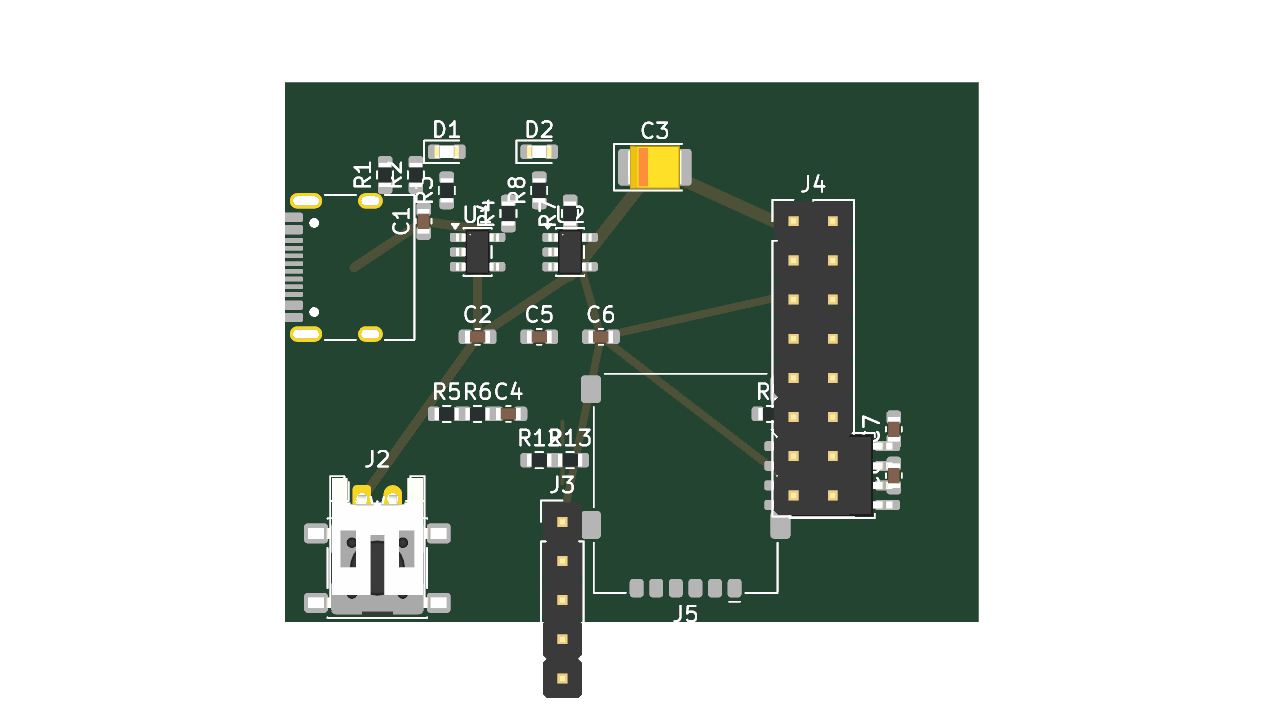 AtlasTag Week 1 Modular Prototype Baseboard (45 × 35 mm, 4-Layer Controlled-Impedance Stackup).
hardware/kicad/atlastag.kicad_sch), passing electrical rules check (ERC) with zero critical errors.To reconcile strict hand-assembly constraints (soldering iron only) with high-density cellular modules, AtlasTag separates the design into two distinct layers:
| Layer | Function | Primary Components | Assembly Method |
|---|---|---|---|
| Baseboard (45 × 35 mm) | Power management, charging, battery monitoring, offline flash, SIM interface, sensor header | MCP73831, AP2112K-3.3, Winbond W25Q32, Nano-SIM socket, USB-C | 100% Iron-Solderable (0603 passives, SOT-23-5, SOIC-8, through-hole headers) |
| Carrier / Mezzanine | Cellular connectivity (LTE-M/NB-IoT), GNSS receiver, RF front-end | Nordic nRF9151, Quectel BG95-M3, or SIMCom SIM7080G carrier | Pre-assembled SMT carrier or breakout connecting via 16-pin 2.54 mm header |
The primary modem platform decision remains deliberately open to ensure rigorous verification of network compatibility and hand-assembly feasibility:
| Candidate | Form Factor | Connectivity | Internal MCU | Assembly Assessment |
|---|---|---|---|---|
| Nordic nRF9151 | Compact SiP (11×12 mm) | LTE-M / NB-IoT / GNSS | ARM Cortex-M33 (64 MHz, 1 MB Flash) | High density; requires pre-assembled mezzanine carrier for iron assembly. |
| Quectel BG95-M3 | SMT Module (23.6×19.9 mm) | LTE-M / NB-IoT / EGPRS / GNSS | Requires external host MCU | Standard cellular module; requires carrier breakout or stencil reflow. |
| SIMCom SIM7080G | SMT Module (17.6×15.7 mm) | LTE-M / NB-IoT / GNSS | Requires external host MCU | Readily available development breakouts; low entry cost. |
Network Note: Reliance Jio NB-IoT SIM provisioning and local band coverage in India remain unverified pending active carrier SIM acquisition and bench validation.
AtlasTag is developed within the Hack Club Half Life Tier 3 budget limit of $100.00 USD (~₹9,670 INR at verified rate ₹96.70/USD).
| Subsystem | Cost (USD) | Cost (INR @ ₹96.70) | Notes |
|---|---|---|---|
| Physical Baseboard Parts | $11.70 | ₹1,131.41 | All baseboard SMT components, charger, regulator, flash, SIM socket, headers |
| Core System Projection | $44.25 | ₹4,278.98 | Baseboard + candidate cellular/GNSS engine + Li-Po cell + antennas |
| Budget Headroom | +$55.75 | +₹5,391.02 | Remaining contingency under the $100.00 USD Tier 3 grant limit |
Authoritative component details, manufacturer part numbers (MPNs), and distributor URLs are tracked in bom/BOM.md and bom.csv.
ATLASTAG/
├── bom/                      # Authoritative detailed Bill of Materials (BOM.md, bom.csv)
├── docs/
│   ├── architecture/         # System architecture & hardware block diagrams
│   ├── decisions/            # Formal engineering trade study logs (DECISION_LOG.md)
│   ├── requirements/         # System requirements & project boundary gates
│   └── research/             # Component research, datasheets & network investigations
├── firmware/
│   └── src/                  # Architectural state machine stubs & driver development
├── hardware/
│   ├── gerbers/              # Fabrication files (Marked NOT FOR FABRICATION during draft)
│   └── kicad/                # KiCad 10 schematic (*.kicad_sch), PCB (*.kicad_pcb), netlist
└── README.md # Primary project documentationdev. Stable milestones are promoted to main strictly through reviewed pull requests.feat:, fix:, docs:, chore:).AtlasTag is an independent open-hardware development project created for the Hack Club Half Life hardware initiative.
| Qty | Value | Footprint | References |
|---|---|---|---|
| 1 | 1.0M DIV_HI | R_0603_1608Metric | R5 |
| 1 | 1.0M DIV_LO | R_0603_1608Metric | R6 |
| 1 | 1.5k LED | R_0603_1608Metric | R3 |
| 1 | 100k LDO_EN | R_0603_1608Metric | R7 |
| 1 | 100nF Flash | C_0603_1608Metric | C7 |
| 1 | 100uF Bulk | CP_EIA-3528-21_Kemet-B_HandSolder | C3 |
| 1 | 10k CS_PU | R_0603_1608Metric | R9 |
| 1 | 10nF ADC | C_0603_1608Metric | C4 |
| 1 | 10uF VBAT | C_0603_1608Metric | C2 |
| 1 | 10uF VBUS | C_0603_1608Metric | C1 |
| 1 | 2.2k LED | R_0603_1608Metric | R8 |
| 1 | 4.7k PROG | R_0603_1608Metric | R4 |
| 1 | 4.7k SCL_PU | R_0603_1608Metric | R12 |
| 1 | 4.7k SDA_PU | R_0603_1608Metric | R13 |
| 1 | 4.7uF Flash | C_0603_1608Metric | C8 |
| 1 | 4.7uF LDO_IN | C_0603_1608Metric | C5 |
| 1 | 4.7uF LDO_OUT | C_0603_1608Metric | C6 |
| 1 | 5.1k CC1 | R_0603_1608Metric | R1 |
| 1 | 5.1k CC2 | R_0603_1608Metric | R2 |
| 1 | AP2112K-3.3 | SOT-23-5 | U2 |
| 1 | Green 3V3 | LED_0603_1608Metric | D2 |
| 1 | Li-Po Battery | JST_PH_S2B-PH-K_1x02_P2.00mm_Horizontal | J2 |
| 1 | MCP73831T | SOT-23-5 | U1 |
| 1 | Modem Mezzanine | PinHeader_2x08_P2.54mm_Vertical | J4 |
| 1 | Motion Port | PinHeader_1x05_P2.54mm_Vertical | J3 |
| 1 | Nano-SIM | nanoSIM_GCT_SIM8060-6-0-14-00 | J5 |
| 1 | Red CHG | LED_0603_1608Metric | D1 |
| 1 | USB-C 5V In | USB_C_Receptacle_HRO_TYPE-C-31-M-12 | J1 |
| 1 | User Button | SW_SPST_PTS645Sx43SMTR92 | SW1 |
| 1 | W25Q32JV | SOIC-8_5.3x5.3mm_P1.27mm | U3 |
FrameworkComputer/ExpansionCards
Reference designs and documentation to create Expansion Cards for the Framework Laptop


DDeGonge/OS-ARM
This arm is not industrial and it will not be fast, but that is not my goal. But it will hopefully be a very nice looking arm fully capable of 6dof motion, cheap enough to keep it accessable but capable enough to…


It measures 45 × 35 mm and has 4 copper layers, 1.6 mm thick.
30 parts, built around the AP2112K-3.3. The full list of its parts is on this page, with links to each part's symbol and footprint where PCBKit's library has them.
From the riteshbonthalakoti/ATLASTAG repository on GitHub, at the commit this page was made from: the board is hardware/kicad/atlastag.kicad_pcb and its schematic hardware/kicad/atlastag.kicad_sch. PCBKit opens the board in the browser, with nothing to install.
Its repository states no licence, so its author keeps all rights: ask riteshbonthalakoti before reusing the design.