4 layers55 × 30 mm
Stitch candidate
EthanKahn08/example-pcb
Design-stage RP2040 USB-C microSD reader: KiCad hardware, verification evidence, UART bring-up firmware, and assembly plan. Unbuilt and untested.
68 parts

 RandBeyy/Standalone_AVR_Programmer
A standalone, SD card based programmer for AVR microcontrollers. The device is built around an ATmega328P and programs a target without requiring a computer during normal use.
AVR Standalone Programmer is an open-source printed circuit board by RandBeyy, from the RandBeyy/Standalone_AVR_Programmer repository on GitHub. It is a 2-layer board of 60 × 56.8 mm with 45 parts on 54 nets, routed with 391 tracks and 59 vias.
It is built around the ATMEGA328P-AU and 74LVC125APW. Its parts include 17 resistors, 12 capacitors, 6 connectors, 3 ICs and 2 switches. It belongs with the interfaces and adapters boards and the AVR (ATmega, ATtiny) boards of this library.


A standalone, SD card based programmer for AVR microcontrollers. The device is built around an ATmega328P and programs a target without requiring a computer during normal use. A 20×4 I²C LCD and physical buttons provide a simple on-device interface for selecting firmware.
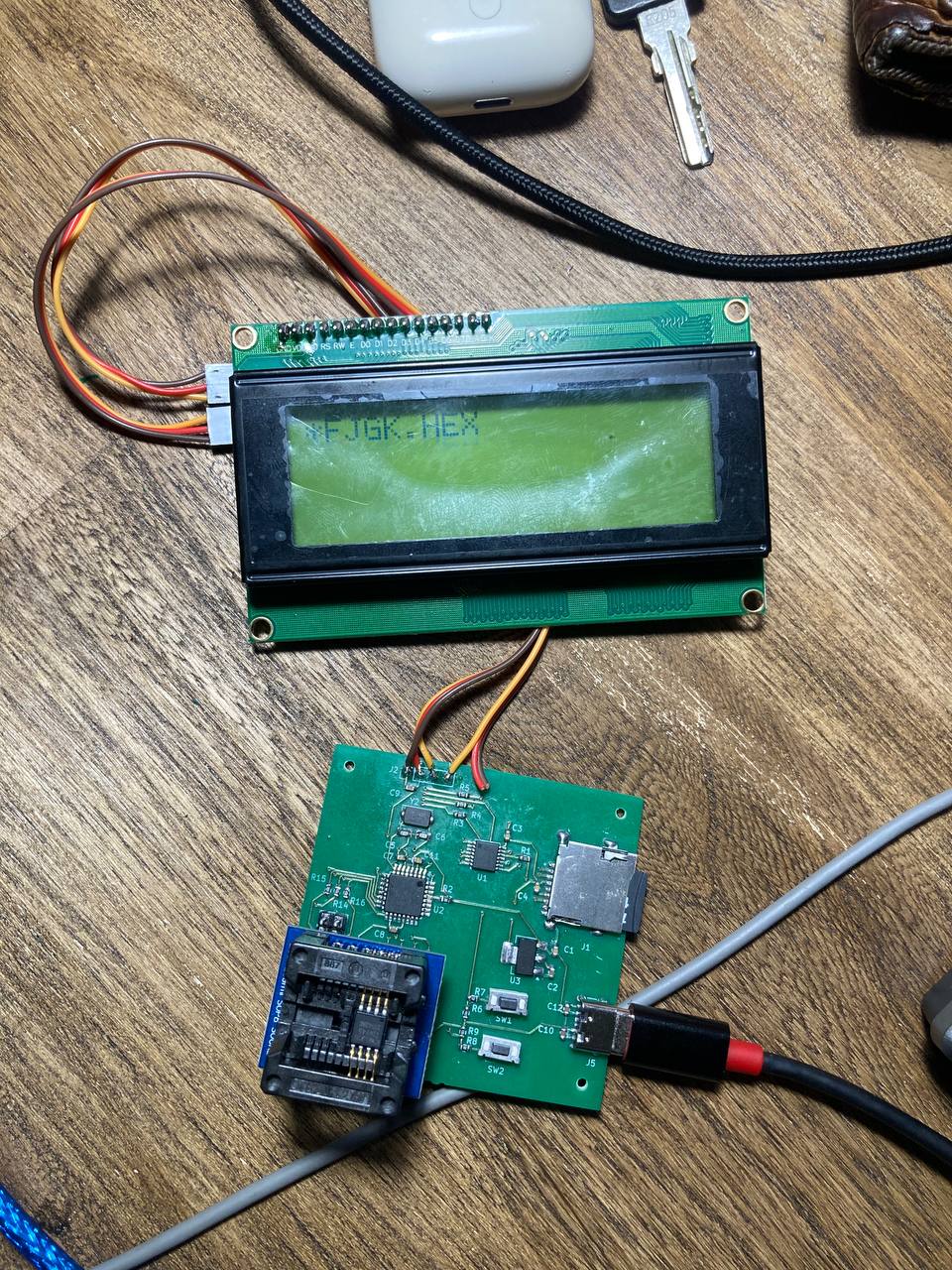
The current firmware configuration enables SD card support and ICSP programming. The source also contains options for high-voltage serial and parallel programming, but these modes are disabled in the current configuration.
This project is based on Nick Gammon's ATmega HEX uploader. I adapted it into a self-contained device by integrating a 20×4 I²C LCD and button-based interface, designing a custom PCB in KiCad, and adding an SD card workflow for selecting and programming firmware without a PC.
PCB/Open the software directory as a PlatformIO project and build the ATmega328P environment. The project uses the LiquidCrystal_I2C library; the SD card support is provided by SdFat.
Place supported .HEX firmware files in the SD card's root directory. The device lists up to ten matching files for selection.
| Qty | Value | Footprint | References |
|---|---|---|---|
| 5 | 100nF | Capacitor_SMD:C_0603_1608Metric | C1, C3, C4, C7, C11 |
| 5 | 10uF | Capacitor_SMD:C_0603_1608Metric | C2, C8, C9, C10, C12 |
| 4 | 0R | Resistor_SMD:R_0603_1608Metric | R10, R11, R12, R13 |
| 4 | 3.3k | Resistor_SMD:R_0603_1608Metric | R1, R3, R4, R5 |
| 4 | MountingHole | MountingHole:MountingHole_2.2mm_M2 | H1, H2, H3, H4 |
| 3 | 1k | Resistor_SMD:R_0603_1608Metric | R2, R7, R8 |
| 3 | 330R | Resistor_SMD:R_0603_1608Metric | R14, R15, R16 |
| 2 | 10k | Resistor_SMD:R_0603_1608Metric | R6, R9 |
| 2 | 22uF | Capacitor_SMD:C_0805_2012Metric | C5, C6 |
| 2 | Conn_01x04_Socket | Connector_PinSocket_2.54mm:PinSocket_1x04_P2.54mm_Vertical | J3, J4 |
| 2 | SW_DPST_x2 | Button_Switch_SMD:SW_Push_SPST_NO_Alps_SKRK | SW1, SW2 |
| 1 | 100 | Resistor_SMD:R_0603_1608Metric | R17 |
| 1 | 16Mhz | Crystal:Crystal_SMD_5032-2Pin_5.0x3.2mm | Y2 |
| 1 | 74LVC125APW | 74LPV125apw:SOT402-1_NEX | U1 |
| 1 | ATmega328P-A | Package_QFP:TQFP-32_7x7mm_P0.8mm | U2 |
| 1 | AVR-ISP-6 | Connector_PinHeader_2.54mm:PinHeader_2x03_P2.54mm_Vertical | J6 |
| 1 | Conn_01x04_Pin | Connector_PinHeader_2.54mm:PinHeader_1x04_P2.54mm_Vertical | J2 |
| 1 | LD1117S33TR_SOT223 | Package_TO_SOT_SMD:SOT-223-3_TabPin2 | U3 |
| 1 | MSD-3-A | CUI_MSD-3-A:CUI_MSD-3-A | J1 |
| 1 | USB_C_Receptacle_PowerOnly_6P | Connector_USB:USB_C_Receptacle_GCT_USB4125-xx-x_6P_TopMnt_Horizontal | J5 |
It measures 60 × 56.8 mm and has 2 copper layers, 1.09 mm thick.
45 parts, built around the ATMEGA328P-AU and 74LVC125APW. The full list of its parts is on this page, with links to each part's symbol and footprint where PCBKit's library has them.
From the RandBeyy/Standalone_AVR_Programmer repository on GitHub, at the commit this page was made from: the board is PCB/AVR_Standalone_Programmer/AVR_Standalone_Programmer.kicad_pcb and its schematic PCB/AVR_Standalone_Programmer/AVR_Standalone_Programmer.kicad_sch. PCBKit opens the board in the browser, with nothing to install.
Its repository states no licence, so its author keeps all rights: ask RandBeyy before reusing the design.
EthanKahn08/example-pcb
Design-stage RP2040 USB-C microSD reader: KiCad hardware, verification evidence, UART bring-up firmware, and assembly plan. Unbuilt and untested.


dmcke5/NucDeck
The Open Source DIY Handheld Gaming PC!


profdc9/RFBitBanger
A QRP digital transceiver created from readily available parts for off-the-grid maintenance

futureshocked/KLP4e_MCU-Datalogger
This is the repository for the "MCU Datalogger" project.