2 layers77.5 × 42.3 mm

 r-pv/rSTM32F030C8T6_ProMiniPlus14
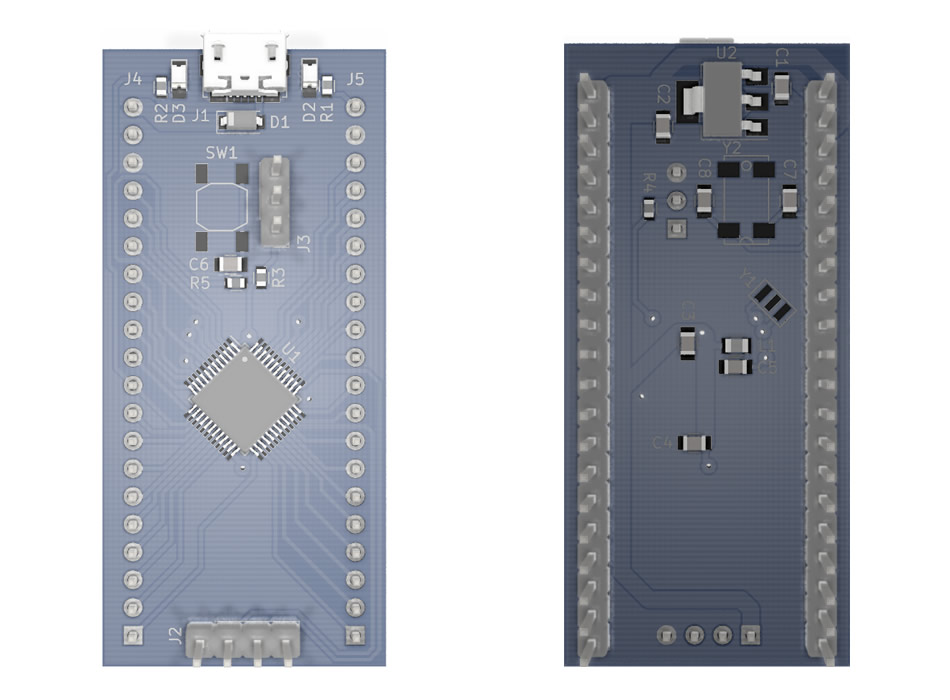
An ST development board based on the STM32F030C8T6 MCU compatible with STM32Duino (Arduino).
RSTM32F030C8T6 is an open-source printed circuit board by r-pv, from the r-pv/rSTM32F030C8T6_ProMiniPlus repository on GitHub, published under the GPL-3.0 licence. It is a 2-layer board of 25.9 × 56.4 mm with 27 parts on 55 nets, routed with 315 tracks and 7 vias.
It is built around the STM32F030C8T6, AMS1117 and MBR0530. Its parts include 8 capacitors, 5 resistors, 5 connectors, 3 diodes and 2 ICs. It belongs with the microcontroller boards boards and the STM32 boards of this library.


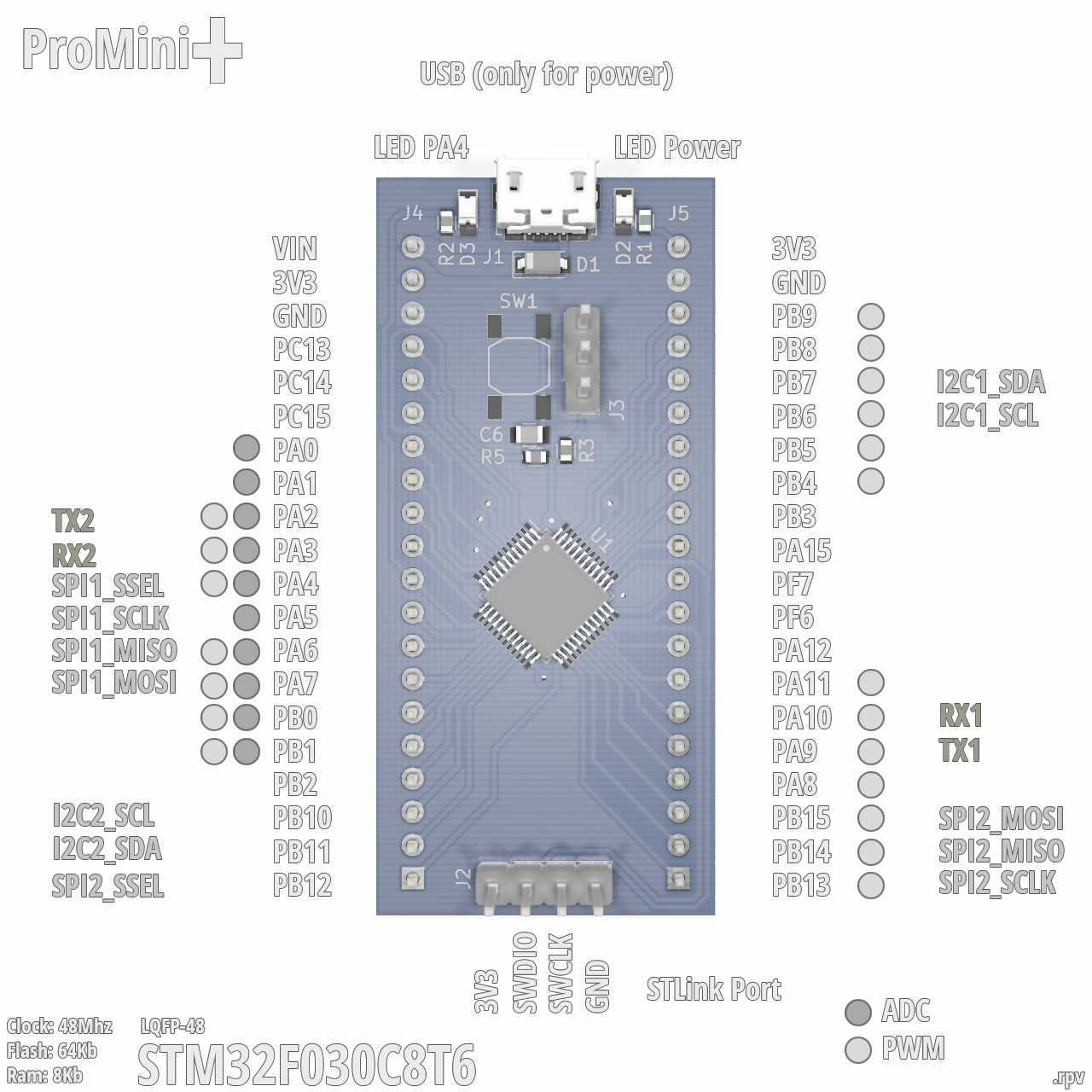
An ST development board based on the STM32F030C8T6 (Clock: 48MHz, Flash: 64Kb, Ram:8Kb) MCU compatible with STM32Duino (Arduino).
Pinout:
Update: STCore v2.0 includes support for this MCU, if you're using STCore v2.0 you don't need to install anything.
# DEMO_F030F4 board
# Support: Serial1 (USART1 on PA3, PA2)
GenF0.menu.pnum.DEMO_F030F4=STM32F030F4 Demo board
GenF0.menu.pnum.DEMO_F030F4.upload.maximum_data_size=4096
GenF0.menu.pnum.DEMO_F030F4.upload.maximum_size=16384
GenF0.menu.pnum.DEMO_F030F4.build.mcu=cortex-m0
GenF0.menu.pnum.DEMO_F030F4.build.board=DEMO_F030F4
GenF0.menu.pnum.DEMO_F030F4.build.series=STM32F0xx
GenF0.menu.pnum.DEMO_F030F4.build.product_line=STM32F030x6
GenF0.menu.pnum.DEMO_F030F4.build.variant=DEMO_F030F4
GenF0.menu.pnum.DEMO_F030F4.build.cmsis_lib_gcc=arm_cortexM0l_math

# RBOARD_F030C8T6 board
# Support: Serial1 (USART1 on PA3, PA2)
GenF0.menu.pnum.RBOARD_F030C8T6=STM32F030C8 STProMiniPlus
GenF0.menu.pnum.RBOARD_F030C8T6.upload.maximum_data_size=8192
GenF0.menu.pnum.RBOARD_F030C8T6.upload.maximum_size=65536
GenF0.menu.pnum.RBOARD_F030C8T6.build.mcu=cortex-m0
GenF0.menu.pnum.RBOARD_F030C8T6.build.board=RBOARD_F030C8T6
GenF0.menu.pnum.RBOARD_F030C8T6.build.series=STM32F0xx
GenF0.menu.pnum.RBOARD_F030C8T6.build.product_line=STM32F030x8
GenF0.menu.pnum.RBOARD_F030C8T6.build.variant=RBOARD_F030C8T6
GenF0.menu.pnum.RBOARD_F030C8T6.build.cmsis_lib_gcc=arm_cortexM0l_math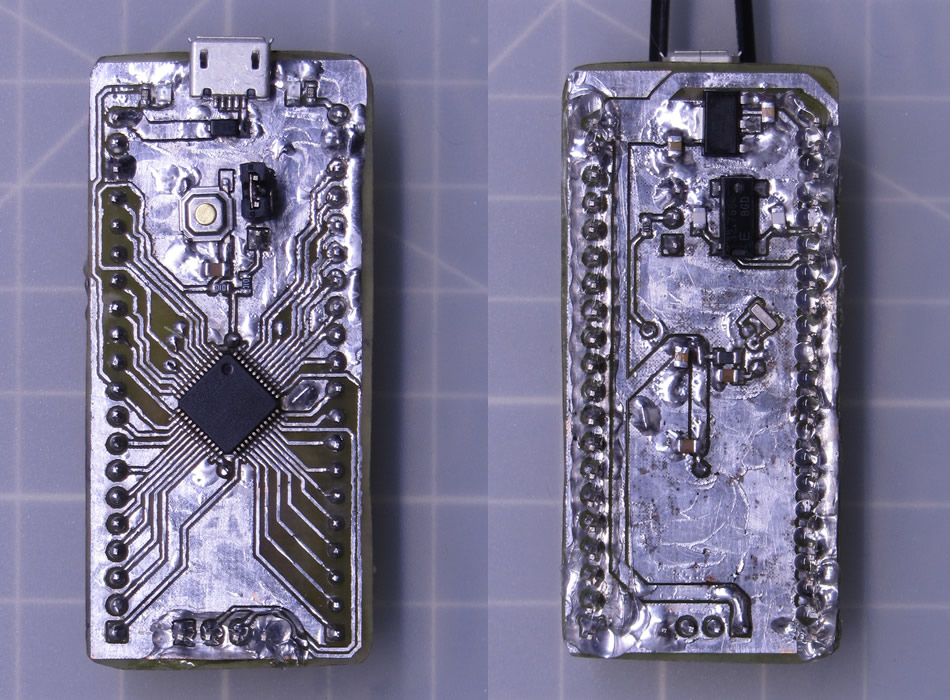
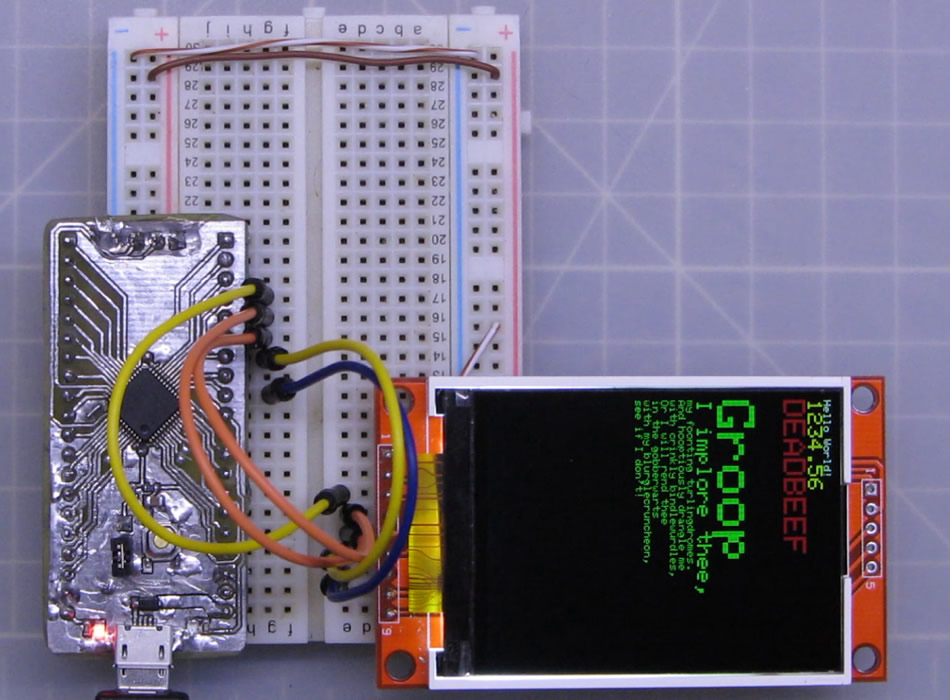
The ProMini+ running the Adafruit ILI9341 library over hardware SPI.
Video in progress...
| Qty | Value | Footprint | References |
|---|---|---|---|
| 3 | 100nF | Capacitors_SMD:C_0805 | C4, C5, C6 |
| 2 | Pin_Headers:Pin_Header_Straight_1x20_Pitch2.54mm | J4, J5 | |
| 2 | 10K | Resistors_SMD:R_0603 | R3, R5 |
| 2 | 20pF | Capacitors_SMD:C_0805 | C7, C8 |
| 2 | 22uF | Capacitors_SMD:C_0805 | C1, C2 |
| 2 | 4K91 | Resistors_SMD:R_0603 | R1, R2 |
| 2 | LED | LEDs:LED_0805 | D2, D3 |
| 1 | 10uF | Capacitors_SMD:C_0805 | C3 |
| 1 | 10uH | Inductors_SMD:L_0805 | L1 |
| 1 | 32.768K | .rpvM:Crystal_4pin_SMD_2.5x4.6 | Y2 |
| 1 | 560R | Resistors_SMD:R_0603 | R4 |
| 1 | AMS1117 | TO_SOT_Packages_SMD:SOT-223-3_TabPin2 | U2 |
| 1 | BOOT | Pin_Headers:Pin_Header_Straight_1x03_Pitch2.54mm | J3 |
| 1 | CSTCE8.000M | .rpvM:Crystal_CSTCE_3pin_3.2x1.3 | Y1 |
| 1 | MBR0530 | Diodes_SMD:D_SOD-123 | D1 |
| 1 | RESET | .rpvM:Switch_SMD_5.2x6.4_reset | SW1 |
| 1 | STLink | Pin_Headers:Pin_Header_Straight_1x04_Pitch2.54mm | J2 |
| 1 | STM32F030C8T6 | Housings_QFP:LQFP-48_7x7mm_Pitch0.5mm | U1 |
| 1 | USB_B_Micro | Connectors_USB:USB_Micro-B_Molex_47346-0001 | J1 |

trope-oshw/anthracite
MIDI-controllable fuzz pedal: open hardware (CERN-OHL-S-2.0), firmware (GPL-3.0-or-later)


rjhsun/stm32f0-devboard
A minimal development board featuring an STM32F030C8T6

AlanFord/CentralCommand
Central Command pcb for the Contextual Electronics class


khomyakova228-cell/pulse-oximeter
Домашнее задание по курсу «САПР электронных средств» «Проект печатного узла пульсоксиметра в KiCad: оформление по ГОСТ, библиотека компонентов, автоматизация проверки и выпуска» Обозначение документа: БИГЕ.149980.001 Э3

It measures 25.9 × 56.4 mm and has 2 copper layers, 1.6 mm thick.
27 parts, built around the STM32F030C8T6, AMS1117 and MBR0530. The full list of its parts is on this page, with links to each part's symbol and footprint where PCBKit's library has them.
From the r-pv/rSTM32F030C8T6_ProMiniPlus repository on GitHub, at the commit this page was made from: the board is rSTM32F030C8T6/rSTM32F030C8T6.kicad_pcb. PCBKit opens the board in the browser, with nothing to install.
Its repository publishes it under the GPL-3.0 licence: you may reuse it on that licence's terms (keep the author's notice, and for a copyleft licence share your changes alike).