Skip to the content
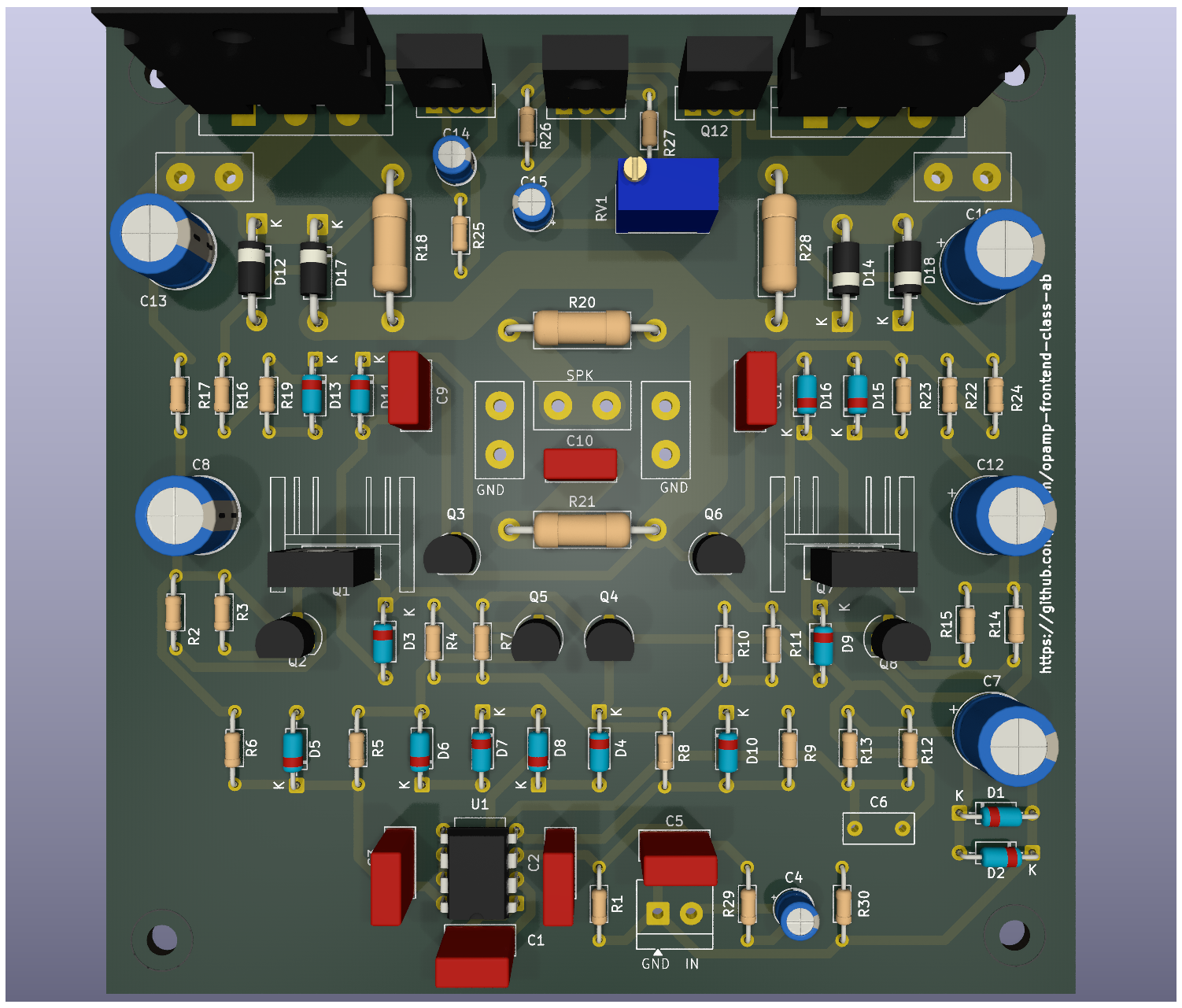
2 layers101.3 × 102.4 mmOpamp front, the printed circuit board in 3D

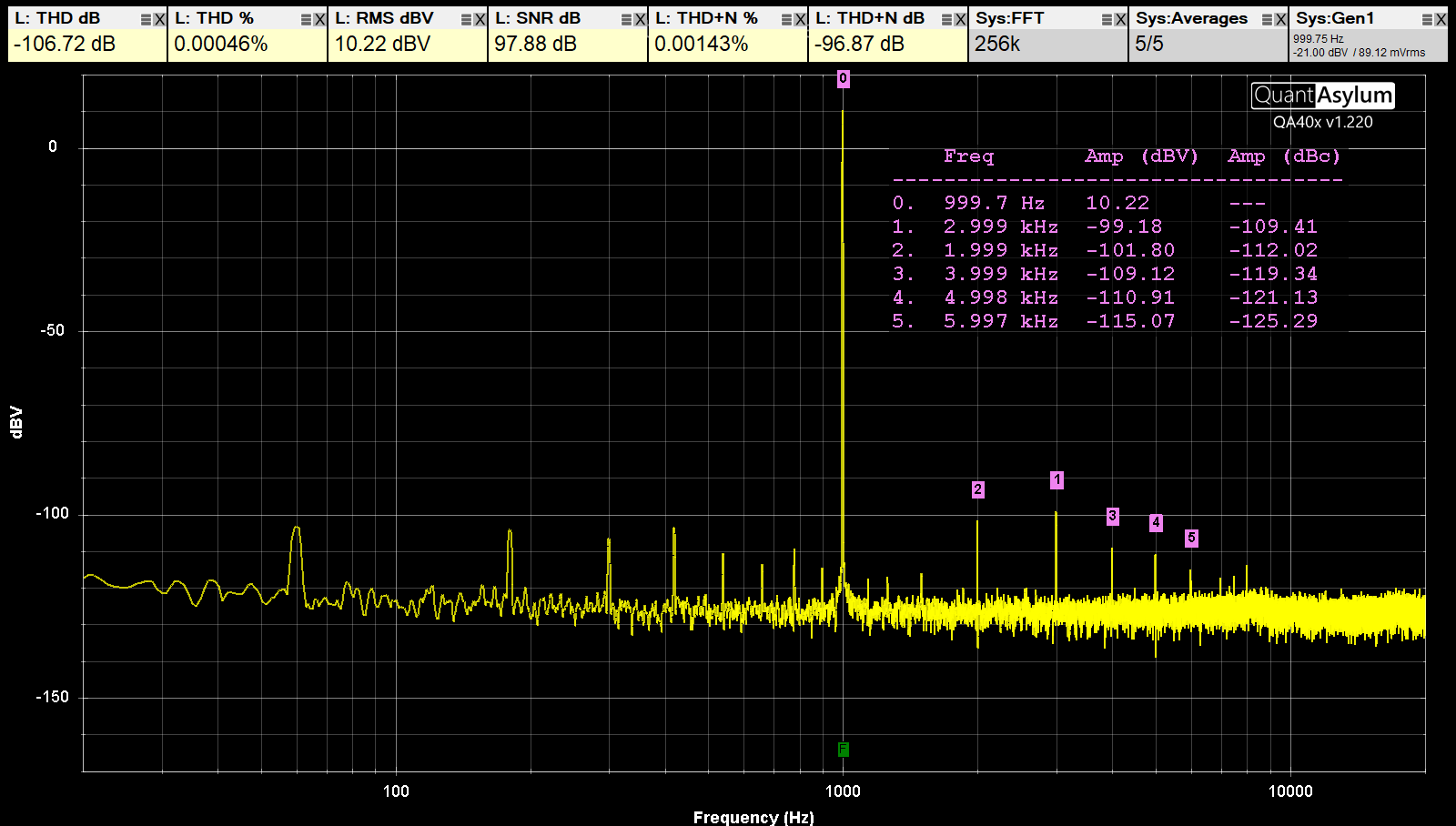
The result is a fast amplifier (>80V/us slew rate) with low distortion (0.00045% meadured @ 1kHz/1W/8ohm resistive load). It's undergone some preliminary measurements and looks quite promising.

Size
101.3 × 102.4 mm
Copper layers
2
Thickness
1.6 mm
Parts
93
Nets
44
Pads
198
Tracks, vias
341, 1
Pours
1
Routed
Yes
KiCad
KiCad 9.0 (file 20241229)
Created
6 Nov 2025
Updated
5 Dec 2025

Overview

Opamp front is an open-source printed circuit board by prydin, from the prydin/opamp-frontend-class-ab repository on GitHub. It is a 2-layer board of 101.3 × 102.4 mm with 93 parts on 44 nets, routed with 341 tracks and 1 via.

It is built around the LM4562NA, BD139 and 1N5245B, with the BD140 among its other parts. Its parts include 31 resistors, 18 diodes, 17 capacitors, 13 transistors and 6 connectors.

Main components

4

README

README.md

The Teamwork Amplifier - 50W (8 ohm) Low Distortion Class AB Audio Amplifier

Background

This is a team effort that started as a conversation on diyaudio.com. Member stigigemla and I were bouncing ideas back and forth and member steveu took one my design attempts and came up with an overhauled and much improved version. I just added some extra features like overcurrent protecton and VI limiters and slapped together a PCB. I built it as an experiment.

The result is a fast amplifier (>80V/us slew rate) with low distortion (0.00045% meadured @ 1kHz/1W/8ohm resistive load). It's undergone some preliminary measurements and looks quite promising.

Disclaimer

The schematic and PCB layout are free to use as you please, but bear in mind that it's only undergone a bare minimum of testing! Build at your own risk!

Credits and acknowledgements

There were several people involved in the creation of this design. If you're not mentioned and feel you should be, just add your name and issue a PR!

Schematic
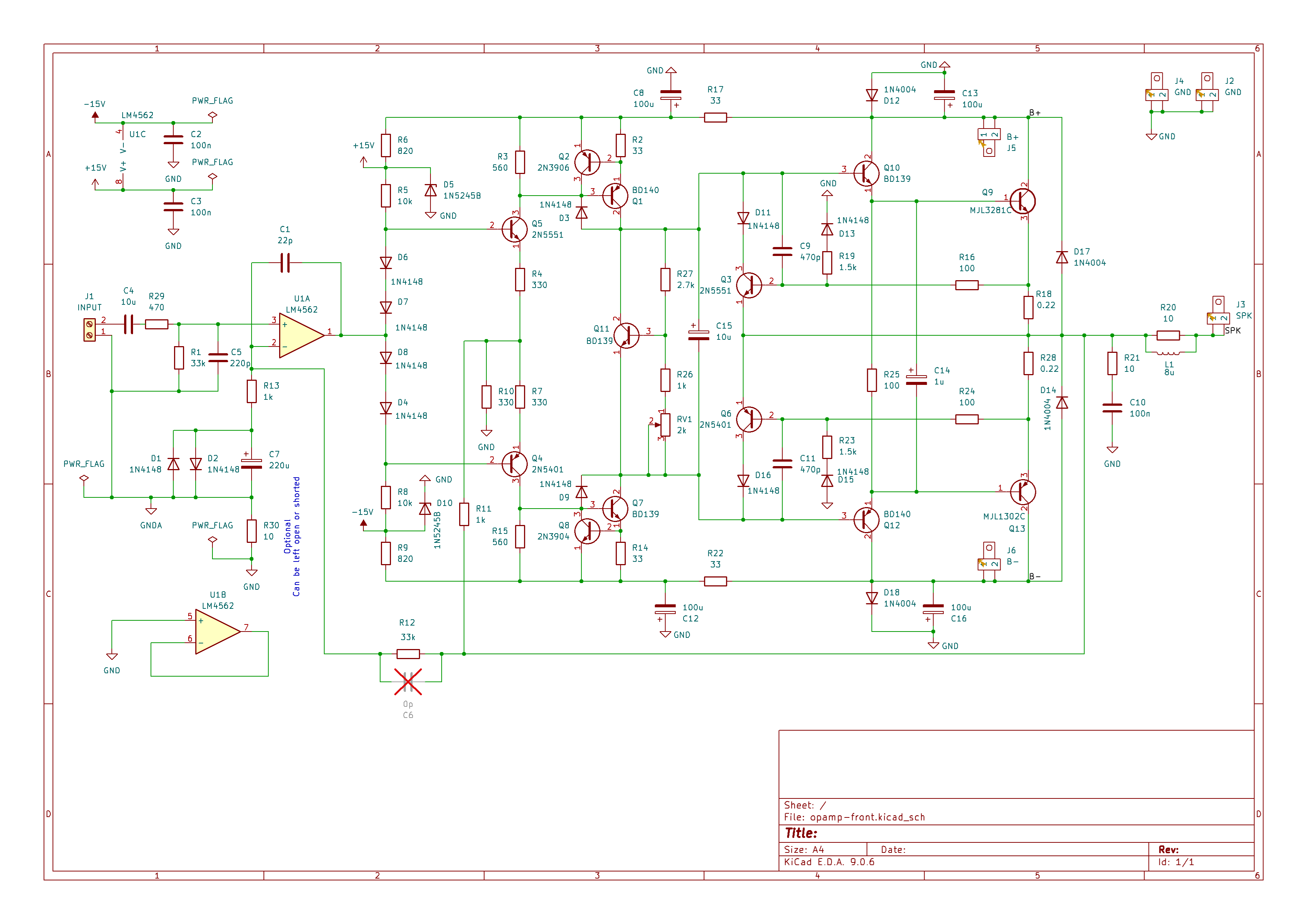
Schematic

PCB 3D rendering

PCB

Measurements

  • THD: 0.00045% @ 1W/1kHz/150mA bias
  • SNR: >95dB
  • Bandwidth: 10Hz-500kHz
  • Slew rate: >80V/us

Spectrum

Subjective listening impression

After a few hours of listening, I have to say I'm pleased with the sound quality. It character is very crisp and clean. Drum beats and cymbals feel very snappy. If you're looking for an amplifierthat colors the sound, this won't be your cup of tea. But so far I would say it does a great job at cleanly reproducing the source material.

Construction

I found an old, broken AudioSource Amp 100 on eBay for close to no money and reused the chassis, pots, connectors and transformer. The boards ended up fitting perfectly if I moved the heatsink maybe 3mm back and removed the input switching board (which I didn't want or need anyway). It ended up being a neat and inexpensive build that looks sleek and clean.
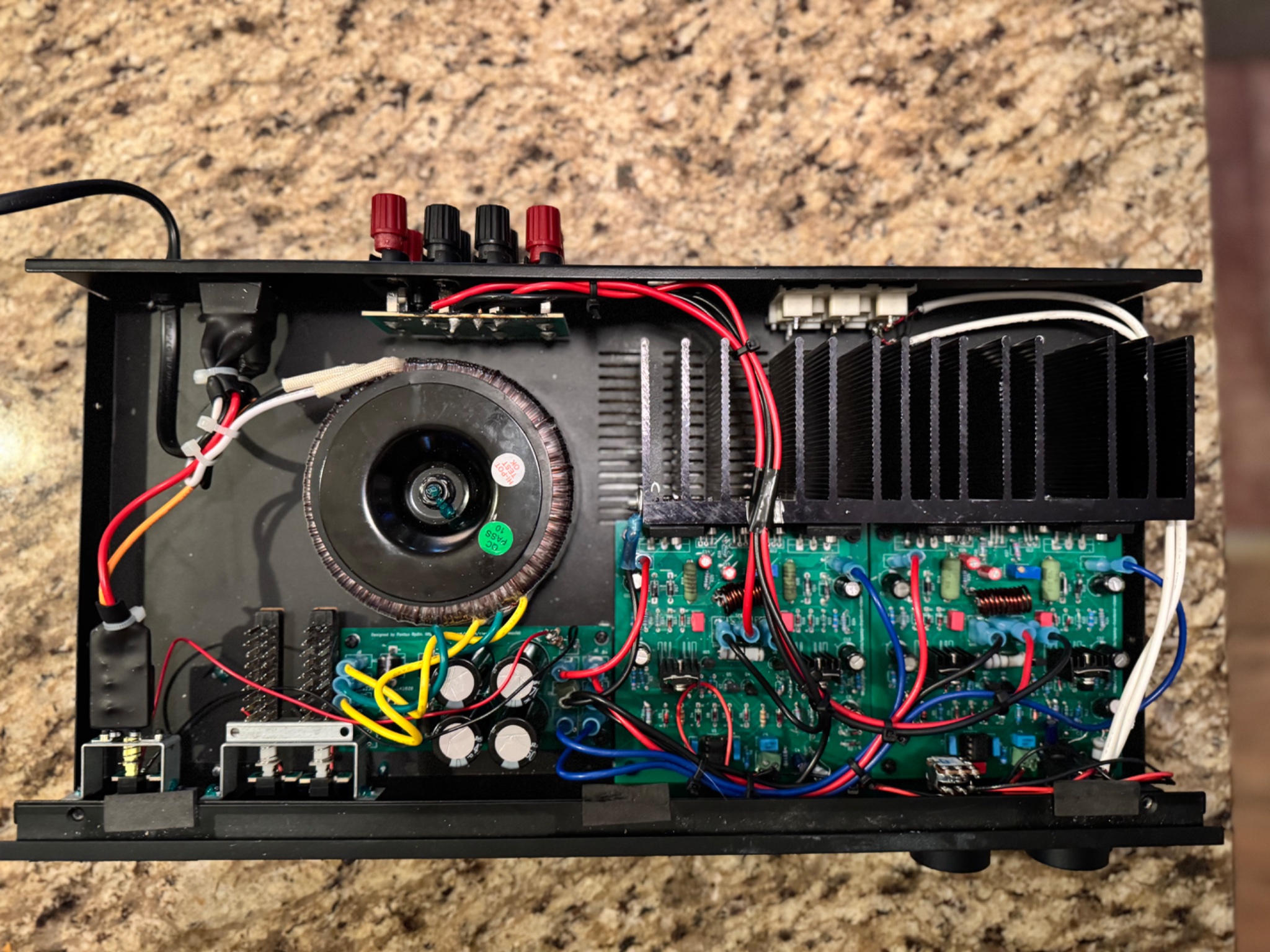
Build

Parts

93
QtyValueFootprintReferences
121N4148Diode_THT:D_DO-35_SOD27_P7.62mm_HorizontalD1, D2, D3, D4, D6, D7, D8, D9, D11, D13, D15, D16
4100uCapacitor_THT:CP_Radial_D8.0mm_P5.00mmC8, C12, C13, C16
41N4004Diode_THT:D_DO-41_SOD81_P10.16mm_HorizontalD12, D14, D17, D18
433Custom:R_Axial_DIN0204_L3.6mm_D1.6mm_P7.62mm_Horizontal_HandSolderR2, R14, R17, R22
3100Custom:R_Axial_DIN0204_L3.6mm_D1.6mm_P7.62mm_Horizontal_HandSolderR16, R24, R25
3100nCapacitor_THT:C_Rect_L7.2mm_W3.0mm_P5.00mm_FKS2_FKP2_MKS2_MKP2C2, C3, C10
3330Custom:R_Axial_DIN0204_L3.6mm_D1.6mm_P7.62mm_Horizontal_HandSolderR4, R7, R10
3680Custom:R_Axial_DIN0204_L3.6mm_D1.6mm_P7.62mm_Horizontal_HandSolderR6, R9, R11
3BD139Package_TO_SOT_THT:TO-126-3_VerticalQ7, Q10, Q11
20.22 3WResistor_THT:R_Axial_DIN0411_L9.9mm_D3.6mm_P15.24mm_HorizontalR18, R28
21.5kCustom:R_Axial_DIN0204_L3.6mm_D1.6mm_P7.62mm_Horizontal_HandSolderR19, R23
210Custom:R_Axial_DIN0204_L3.6mm_D1.6mm_P7.62mm_Horizontal_HandSolderR30, R31
210 3WResistor_THT:R_Axial_DIN0411_L9.9mm_D3.6mm_P15.24mm_HorizontalR20, R21
210uCapacitor_THT:CP_Radial_D4.0mm_P2.00mmC4, C15
21N5245BDiode_THT:D_DO-35_SOD27_P7.62mm_HorizontalD5, D10
21kCustom:R_Axial_DIN0204_L3.6mm_D1.6mm_P7.62mm_Horizontal_HandSolderR13, R26
2220pCapacitor_THT:C_Rect_L7.2mm_W3.0mm_P5.00mm_FKS2_FKP2_MKS2_MKP2C5, C17
22N5401Package_TO_SOT_THT:TO-92_HandSolderQ4, Q6
22N5551Package_TO_SOT_THT:TO-92_HandSolderQ3, Q5
233kCustom:R_Axial_DIN0204_L3.6mm_D1.6mm_P7.62mm_Horizontal_HandSolderR1, R12
2470pCapacitor_THT:C_Rect_L7.2mm_W3.0mm_P5.00mm_FKS2_FKP2_MKS2_MKP2C9, C11
2560Custom:R_Axial_DIN0204_L3.6mm_D1.6mm_P7.62mm_Horizontal_HandSolderR3, R15
26.8kCustom:R_Axial_DIN0204_L3.6mm_D1.6mm_P7.62mm_Horizontal_HandSolderR5, R8
2BD140Package_TO_SOT_THT:TO-126-3_VerticalQ1, Q12
2GNDCustom:Spade ConnectorJ2, J4
10pCapacitor_THT:C_Rect_L7.2mm_W3.0mm_P5.00mm_FKS2_FKP2_MKS2_MKP2C6
11uCapacitor_THT:CP_Radial_D4.0mm_P2.00mmC14
12.7kCustom:R_Axial_DIN0204_L3.6mm_D1.6mm_P7.62mm_Horizontal_HandSolderR27
1220uCapacitor_THT:CP_Radial_D8.0mm_P5.00mmC7
122pCapacitor_THT:C_Rect_L7.2mm_W3.0mm_P5.00mm_FKS2_FKP2_MKS2_MKP2C1
12N3904Package_TO_SOT_THT:TO-92_HandSolderQ8
12N3906Package_TO_SOT_THT:TO-92_HandSolderQ2
12kCustom:TRIM_T93YA103KT20RV1
1470Custom:R_Axial_DIN0204_L3.6mm_D1.6mm_P7.62mm_Horizontal_HandSolderR29
1B+Custom:Spade ConnectorJ5
1B-Custom:Spade ConnectorJ6
1INPUTTerminalBlock_4Ucon:TerminalBlock_4Ucon_1x02_P3.50mm_HorizontalJ1
1LM4562Package_DIP:DIP-8_W7.62mmU1
1MJL1302CPackage_TO_SOT_THT:TO-264-3_VerticalQ13
1MJL3281CPackage_TO_SOT_THT:TO-264-3_VerticalQ9
1SPKCustom:Spade ConnectorJ3

The 87 most common of 93 parts.

More from prydin/opamp-frontend-class-ab

1
  • 2 layers129 × 83.3 mmPower supply, the printed circuit board in 3D

    Power supply

    prydin/opamp-frontend-class-ab

    The result is a fast amplifier (>80V/us slew rate) with low distortion (0.00045% meadured @ 1kHz/1W/8ohm resistive load). It's undergone some preliminary measurements and looks quite promising.

    40 parts4

Similar boards

  • 2 layers174.8 × 84 mmDDS A2 rev1, the printed circuit board in 3D

    DDS A2 rev1

    apxco/Kicad

    Zum Testen von einigen Transistorschaltungen für Verstärker. Noch nicht fertig.

    69 parts
  • 2 layers190 × 75 mmQ17-TURBO, the printed circuit board in 3D

    Q17-TURBO

    stefaweb/Q17-Amplifier

    The Q17 is an error correction HIFI amplifier based on the QUAD405 current dumping principle.

    109 parts25GPL-3.0
  • 4 layers147.3 × 78.1 mmRC Car Design - Control On Board, the printed circuit board in 3D

    RC Car Design - Control On Board

    cjg-1/FPV-RC-CAR

    A wireless FPV control system for RC vehicles featuring real-time video transmission and custom embedded power management. Enables immersive first-person vehicle teleoperation with low-latency wireless architecture.

    51 parts2
  • 2 layers119.4 × 119.4 mmEsp32-pool controller, the printed circuit board in 3D

    Esp32-pool controller

    niko34/esp32-pool-controller

    Contrôleur automatique de piscine ESP32 avec gestion pH, ORP, température, filtration, éclairage, app web locale, MQTT (HomeAssistant auto-discovery), API

    93 partsMIT
  • 2 layers156.2 × 58.3 mmQ17, the printed circuit board in 3D

    Q17

    kitspace-test-repos/kicad6-file-collection

    83 partsMIT
  • 2 layers100 × 100 mmAmply, the printed circuit board in 3D

    Amply

    T76-org/amply

    A $10 desktop Bluetooth amplifier you'll love

    67 parts14GPL-3.0
  • 2 layers84.5 × 82.6 mmClassab amp, the printed circuit board in 3D

    Classab amp

    prydin/classab-amp-mosfet

    MOSFET-based 50W Class AB amplifier

    67 parts9
  • 2 layers40 × 99 mmOutput mixer, the printed circuit board in 3D

    Output mixer

    mohoyt/output_mixer

    Simple 4 channel Eurorack output mixer

    114 parts7CERN-OHL-S-2.0

Questions

How big is the Opamp front PCB?

It measures 101.3 × 102.4 mm and has 2 copper layers, 1.6 mm thick.

What parts does the Opamp front use?

93 parts, built around the LM4562NA, BD139, 1N5245B and BD140. The full list of its parts is on this page, with links to each part's symbol and footprint where PCBKit's library has them.

Where can I download the Opamp front KiCad files?

From the prydin/opamp-frontend-class-ab repository on GitHub, at the commit this page was made from: the board is kicad/opamp-front.kicad_pcb and its schematic kicad/opamp-front.kicad_sch. PCBKit opens the board in the browser, with nothing to install.

Can I use the Opamp front design in my own project?

Its repository states no licence, so its author keeps all rights: ask prydin before reusing the design.