
2 layers132.3 × 94.9 mm
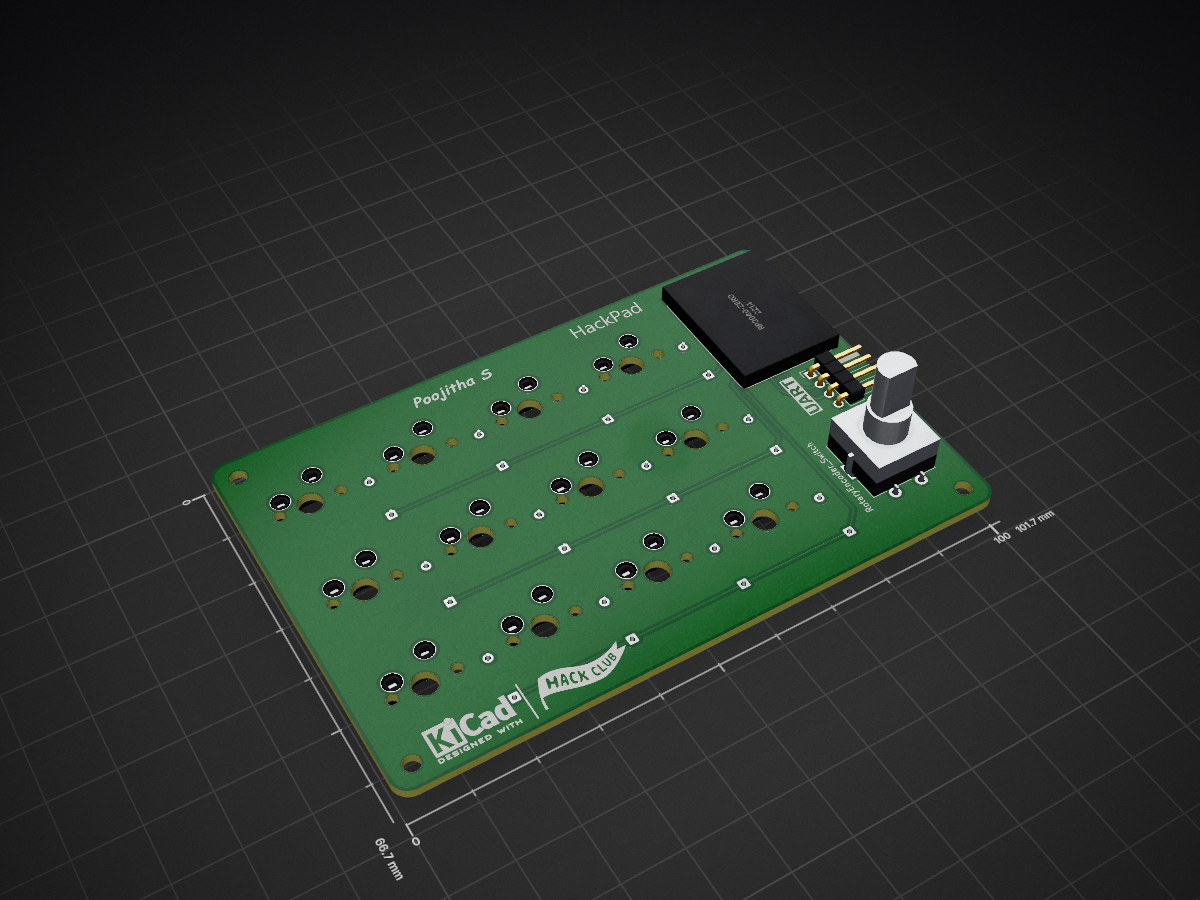
 poojithas956/HackPad
A custom mini keyboard or macro board, where every physical key is fully programmable to launch apps, trigger shortcuts, control media, or run multi-step automated commands with a single press of a button.
HackPad is an open-source printed circuit board by poojithas956, from the poojithas956/HackPad repository on GitHub, published under the MIT licence. It is a 2-layer board of 101.7 × 66.7 mm with 38 parts on 35 nets, routed with 91 tracks and 1 via.
It is built around the RP2040-ZERO. Its parts include 13 switches, 12 diodes, 1 IC and 1 connector. It belongs with the keyboards and input boards and the RP2040 boards of this library.
A 12-key macropad I built as my second hardware project for Stasis, designed to pair with my 60% keyboard for editing, shortcuts, media control, etc...
Hi there, this is my fully custom keypad from scratch, and I tried to keep it clean, practical, and actually buildable.
I wanted a dedicated macropad next to my keyboard for common shortcuts (copy/paste, app switching, media, timeline scrubbing, etc.) and I wanted to learn the full flow:



Approximate vendor pricing based on 1 USD = 94 INR.
| Item | Qty | Vendor | Price (USD) | Price (INR) | Notes |
|---|---|---|---|---|---|
| PCB | 5 | Robu | $10 | Rs. 960 | PCB |
| Waveshare RP2040 Zero without header | 1 | Robu | $4.47 | ₹420 | Main controller |
| 1N4148 diode | 12 | Robu | $0.83 total | ₹78 total | Matrix diodes |
| EC11 rotary encoder with push switch | 1 | Robu | $0.62 | ₹58 | Knob + click |
| MDA Lavender numpad keycaps | 12 | Stackskb | $1.60 | ₹150 | Keycaps |
| Gateron Baby Kangaroo 2.0 tactile switches | 20 | Stackskb | $9.57 | ₹900 | Pack of 20 |
| Gateron hotswap sockets | 13 | Stackskb | $1.38 total | ₹130 total | Socketed switch support |
| 1x4 right-angle pin header | 1 | Self-supplied | $0.00 | ₹0 | UART / expansion |
| Tax and Shipping | $5 | Rs400 | incl. Tax + Shipping fee + Conversion rate to INR | ||
| Total | — | — | $35 | ₹2,636 | Estimated project total |
For the KiCad design BOM, see production/bom.csv. The full project buying list is also available in bom.csv.
KMK firmware for this board is included in:
It is preconfigured for the exact matrix and encoder pins used in this PCB.
| Qty | Value | Footprint | References |
|---|---|---|---|
| 12 | 1N4148 | Diode_THT:D_DO-35_SOD27_P7.62mm_Horizontal | D1, D2, D3, D4, D5, D6, D7, D8, D9, D10, D11, D12 |
| 12 | SW_Push_45deg | PCM_marbastlib-xp-mx:SW_MX_HS_KS-2P02B01-01_1u | SW1, SW2, SW3, SW4, SW5, SW6, SW7, SW8, SW9, SW10, SW11, SW12 |
| 5 | MountingHole | MountingHole:MountingHole_2.7mm_M2.5 | H, H1, H2, H3, H4 |
| 1 | Conn_01x04_Pin | Connector_PinHeader_2.54mm:PinHeader_1x04_P2.54mm_Horizontal | J1 |
| 1 | LOGO | logo:HackClub | Pogo |
| 1 | RP2040-ZERO | RP2040-ZERO:MODULE_RP2040-ZERO | U1 |
| 1 | RotaryEncoder_Switch | Rotary_Encoder:RotaryEncoder_Alps_EC11E-Switch_Vertical_H20mm_MountingHoles | SW13 |
The 33 most common of 38 parts.
It measures 101.7 × 66.7 mm and has 2 copper layers, 1.6 mm thick.
38 parts, built around the RP2040-ZERO. The full list of its parts is on this page, with links to each part's symbol and footprint where PCBKit's library has them.
From the poojithas956/HackPad repository on GitHub, at the commit this page was made from: the board is PCB/HackPad.kicad_pcb and its schematic PCB/HackPad.kicad_sch. PCBKit opens the board in the browser, with nothing to install.
Its repository publishes it under the MIT licence: you may reuse it on that licence's terms (keep the author's notice, and for a copyleft licence share your changes alike).


beekeeb/zerosprey42
Zerosprey42 Keyboard is a wired, beginner friendly, choc hotswap, MonoBlockSplit (Unibody), column-staggered, DIY mechanical keyboard.


ravinrabbid/DonCon2040
RP2040 based firmware and hardware for DIY Taiko no Tatsujin Drum Controllers

nmur/RP2040-TestPatternGenerator
A simple test pattern generator running on the RP2040 microcontroller

ChrisChrisLoLo/bunchiez40
A pocket keyboard that makes use of mouse switches to achieve a miniscule size
