Skip to the content
4 layers17.8 × 33 mmNrf54l smol, the printed circuit board in 3D

Ebyte E73-2G4M08S1F nRF54L15-based dev board with similar form factor to Pro Micro/Supermini

Size
17.8 × 33 mm
Copper layers
4
Thickness
1.6 mm
Parts
29
Nets
48
Pads
141
Tracks, vias
213, 46
Pours
10
Routed
Yes
KiCad
KiCad 9.0 (file 20241229)
Created
7 Jul 2026
Updated
7 Jul 2026

Overview

Nrf54l smol is an open-source printed circuit board by picafe, from the picafe/nrf54l_smol repository on GitHub. It is a 4-layer board of 17.8 × 33 mm with 29 parts on 48 nets, routed with 213 tracks and 46 vias.

It is built around the E73-2G4M08S1F, EA8103ADHR and ME6215C33M5G, with the TP4057, B5817WS and BMSN3139 among its other parts. Its parts include 9 resistors, 7 capacitors, 4 ICs, 4 connectors and 2 diodes. It belongs with the power and microcontroller boards boards and the nRF52 and nRF5x boards of this library.

Main components

8

README

README.md

nrf54l_smol

A compact development board for the nRF54L15, built around the Ebyte E73-2G4M08S1F module. It adds USB-C power input, single-cell Li-ion battery charging, a 1.8 V buck regulator, a 3.3 V LDO, and castellated edge pins in a footprint similar to nRF52840 Pro Micro / SuperMini boards.

I started this project because I wanted an easy-to-use nRF54L15 devboard with the same features as the supermini. My main goal is Chrysalis backpack compatibility so I can reuse tracker firmware (Zephyr) and use existing cases.

3D model
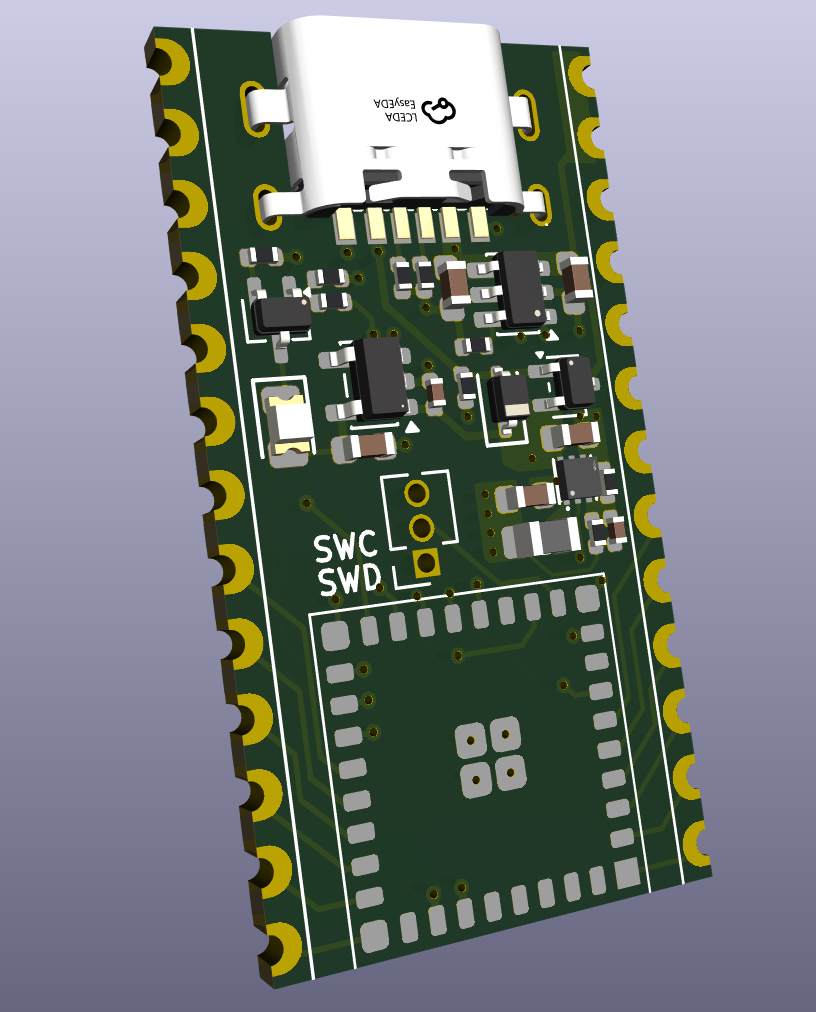
3D model of tracker

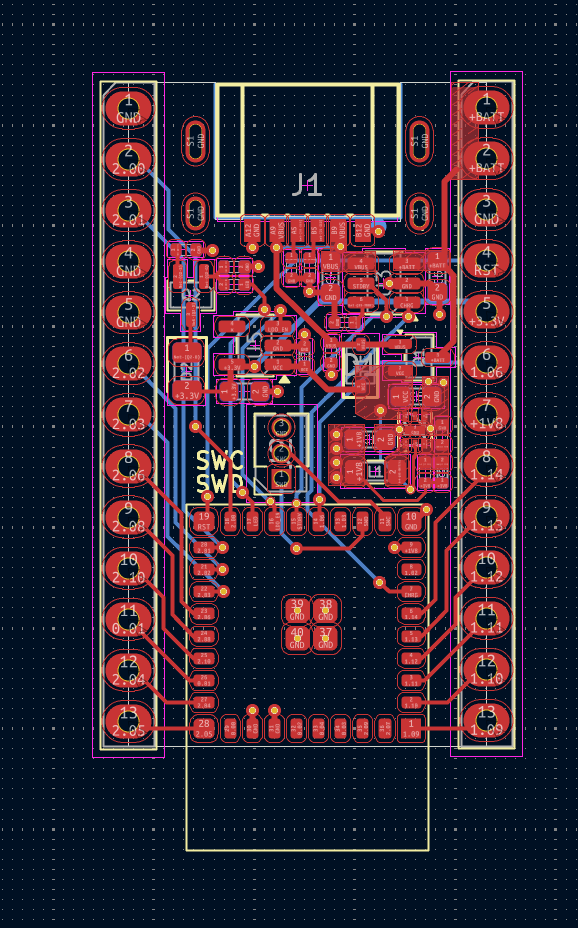
PCB

Top and bottom layer view of tracker PCB with inner layers hidden

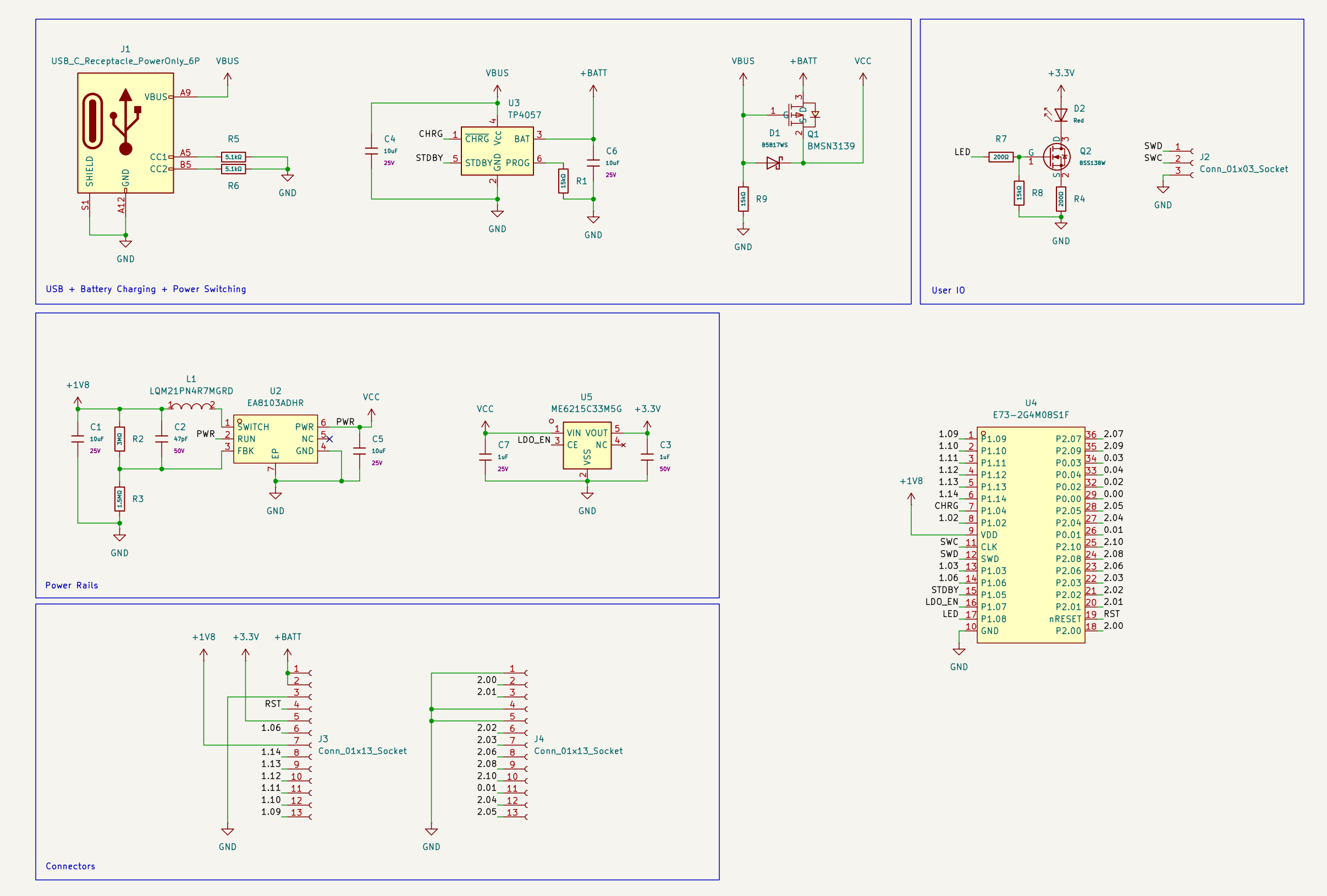
Schematic

Schematic of tracker

Wiring

All connections are on the PCB. Just USB-C power, an optional Li-ion cell on +BATT, and a 1.27 mm SWD cable to the programming header (pogo pins or wires soldered to the header).

Bill of materials

Prices are estimated from LCSC single-board quantities (July 2026) and should be verified manually before ordering.

DesignatorValueFootprintQtyLCSCUnit cost (est.)Line total (est.)
C1, C4, C5, C610 uF06034C96446$0.05$0.21
C247 pF04021C1567$0.003$0.003
C31 uF06031C15849$0.01$0.01
C71 uF04021C52923$0.01$0.01
D1B5817WSSOD-3231C7420329$0.05$0.05
D2Red LED08051C84256$0.02$0.02
J1USB-C (power only, 6P)SMD1C2858274$0.08$0.08
J21x03 socket, 1.27 mmThrough hole1C22438069$0.11$0.11
L1LQM21PN4R7MGRD (4.7 uH)08051C86090$0.13$0.13
Q1BMSN3139SOT-3231C19078062$0.05$0.05
Q2BSS138WSOT-3231C28646265$0.03$0.03
R1, R8, R915 kΩ04023C25756$0.002$0.006
R23 MΩ04021C2998139$0.003$0.003
R31.5 MΩ04021C138034$0.003$0.003
R4, R7200 Ω04022C25087$0.002$0.004
R5, R65.1 kΩ04022C25905$0.002$0.004
U2EA8103ADHRDFN-61C51912500$0.11$0.11
U3TP4057TSOT-23-61C440390$0.08$0.08
U4E73-2G4M08S1FModule1C54337734$5.66$5.66
U5ME6215C33M5GSOT-23-51C84119$0.08$0.08
Total (components only)~$6.67

The PCB cost is around ~$9 for 3 board on OshPark.

Parts

29
QtyValueFootprintReferences
410uFPCM_JLCPCB:C_0603C1, C4, C5, C6
315kΩPCM_JLCPCB:R_0402R1, R8, R9
2200ΩPCM_JLCPCB:R_0402R4, R7
25.1kΩPCM_JLCPCB:R_0402R5, R6
2Conn_01x13_SocketConnector_PinHeader_2.54mm:PinHeader_1x13_P2.54mm_VerticalJ3, J4
11.5MΩPCM_JLCPCB:R_0402R3
11uFPCM_JLCPCB:C_0402C7
11uFPCM_JLCPCB:C_0603C3
13MΩPCM_JLCPCB:R_0402R2
147pFPCM_JLCPCB:C_0402C2
1B5817WSPCM_JLCPCB:D_SOD-323D1
1BMSN3139Package_TO_SOT_SMD:SOT-323_SC-70Q1
1BSS138WPackage_TO_SOT_SMD:SOT-323_SC-70Q2
1Conn_01x03_SocketConnector_PinSocket_1.27mm:PinSocket_1x03_P1.27mm_VerticalJ2
1E73-2G4M08S1FE73-2G4M08S1F:E73-2G4M08S1FU4
1EA8103ADHReasyeda2kicad:DFN-6_L1.5-W1.5-P0.50-BL-EP1.0U2
1LQM21PN4R7MGRDInductor_SMD:L_0805_2012MetricL1
1ME6215C33M5GPackage_TO_SOT_SMD:SOT-23-5U5
1RedPCM_JLCPCB:D_0805D2
1TP4057Package_TO_SOT_SMD:TSOT-23-6U3
1USB_C_Receptacle_PowerOnly_6Peasyeda2kicad:USB-TYPE-C-SMD_TYPE-CJ1

Similar boards

  • 4 layers68.4 × 33.3 mmAdapter board r2, the printed circuit board in 3D

    Adapter board r2

    picafe/bicolor-matrix-v2

    A 32x8 bicolor LED matrix module composed of 4 8x8 matrices based on the Holtek HT16K33A I2C LED driver. V1 paired it with a stacked adapter (RP2040 Zero + DS3231 module); V2 redesigns the matrix routing and puts an…

    54 parts
  • 6 layers87.6 × 53.9 mmTeensy 4.1 attempt 1, the printed circuit board in 3D

    Teensy 4.1 attempt 1

    Wierdwizard2587/Custom-Teensy-4.1-PCB-Design

    Custom Designed MCU design based upon Teensy 4.1

    92 parts9
  • 2 layers29.5 × 29 mmOpenrz67-nrf, the printed circuit board in 3D

    Openrz67-nrf

    mhellevang/openrz67-trigger

    Bluetooth remote release for the Mamiya RZ67: ESP32-C3 firmware, KiCad PCB and enclosure. Shutter, bulb and countdown from your phone.

    15 parts3MIT
  • 4 layers60 × 60 mmE73-2G4M08S1F nRF54L15, the printed circuit board in 3D

    E73-2G4M08S1F nRF54L15

    plushugh/breakout_E73-2G4M08S1F_nRF54L15

    Ebyte E73-2G4M08S1F breakout board

    32 parts
  • 4 layers61.5 × 47.5 mmUpdated pcb file, the printed circuit board in 3D

    Updated pcb file

    AutoCuro/AutoCuro

    Designs/Documents Created at AutoCuro

    80 parts2MIT
  • 4 layers22.9 × 50.8 mmPenguino Feather-4260-v1, the printed circuit board in 3D

    Penguino Feather-4260-v1

    azerimaker/Penguino-RAK4260

    This repo contains all the necessary design and fabrication files for the RAK4260 based Penguino SAMR34 Feather breakout board.

    60 parts8
  • 2 layers55.9 × 58.2 mmGyroscope v03, the printed circuit board in 3D

    Gyroscope v03

    op1407/gyroscope

    Some symbols and footprints are also missing

    58 parts

Questions

How big is the Nrf54l smol PCB?

It measures 17.8 × 33 mm and has 4 copper layers, 1.6 mm thick.

What parts does the Nrf54l smol use?

29 parts, built around the E73-2G4M08S1F, EA8103ADHR, ME6215C33M5G and TP4057. The full list of its parts is on this page, with links to each part's symbol and footprint where PCBKit's library has them.

Where can I download the Nrf54l smol KiCad files?

From the picafe/nrf54l_smol repository on GitHub, at the commit this page was made from: the board is pcb/nrf54l_smol.kicad_pcb and its schematic pcb/nrf54l_smol.kicad_sch. PCBKit opens the board in the browser, with nothing to install.

Can I use the Nrf54l smol design in my own project?

Its repository states no licence, so its author keeps all rights: ask picafe before reusing the design.