2 layers285 × 94.6 mm

 ph-design/PH60163
A printable 60% multi-layout wireless keyboard suite.
PH60 Rev3 is an open-source printed circuit board by ph-design, from the ph-design/PH60 repository on GitHub. It is a 2-layer board of 285 × 94.6 mm with 213 parts on 148 nets, routed with 1,112 tracks and 305 vias.
It is built around the TP4057, TPS2116DRL and MCL1608S100MT, with the FHW0402UC4N7JST, LQG15HS15NJ02D and PRTR5V0U2X among its other parts. Its parts include 93 switches, 68 diodes, 24 capacitors, 8 resistors and 4 inductors. It belongs with the keyboards and input boards and the RP2040 and nRF52 and nRF5x boards of this library.


English Version | 中文版
GitHub Repo | Wiki | Discord | Taobao Store | QQ Group | Customizer
PH60 Rev.3 is a 60% tri-mode mechanical keyboard kit with an FDM 3D-printable case and the PH60 Rev.3 Multi PCB. This revision switches to the NRF52840 MCU with Bluetooth 5.3 and Nordic 2.4 GHz proprietary protocol (TBD), runs ZMKs firmware (our fork of ZMK), and redesigns the case for wireless use and multi-layout compatibility.
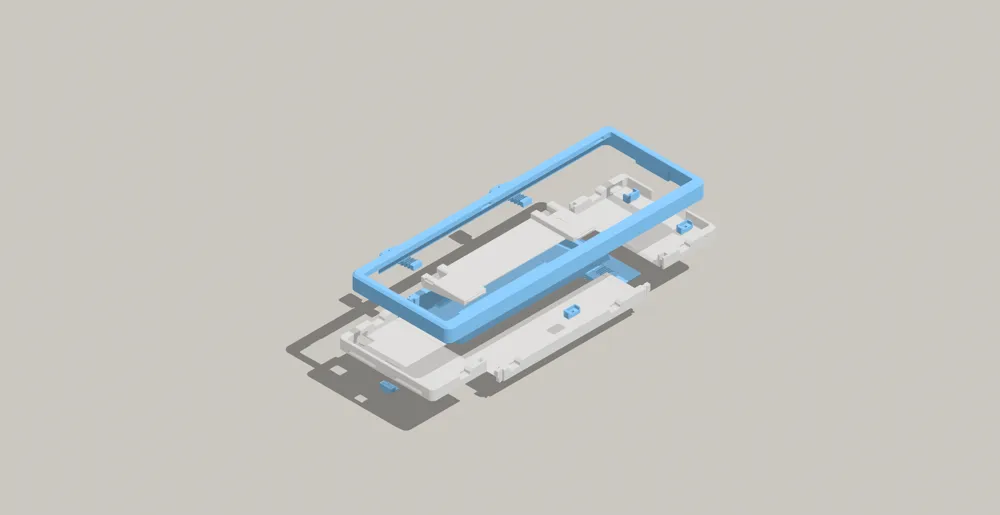
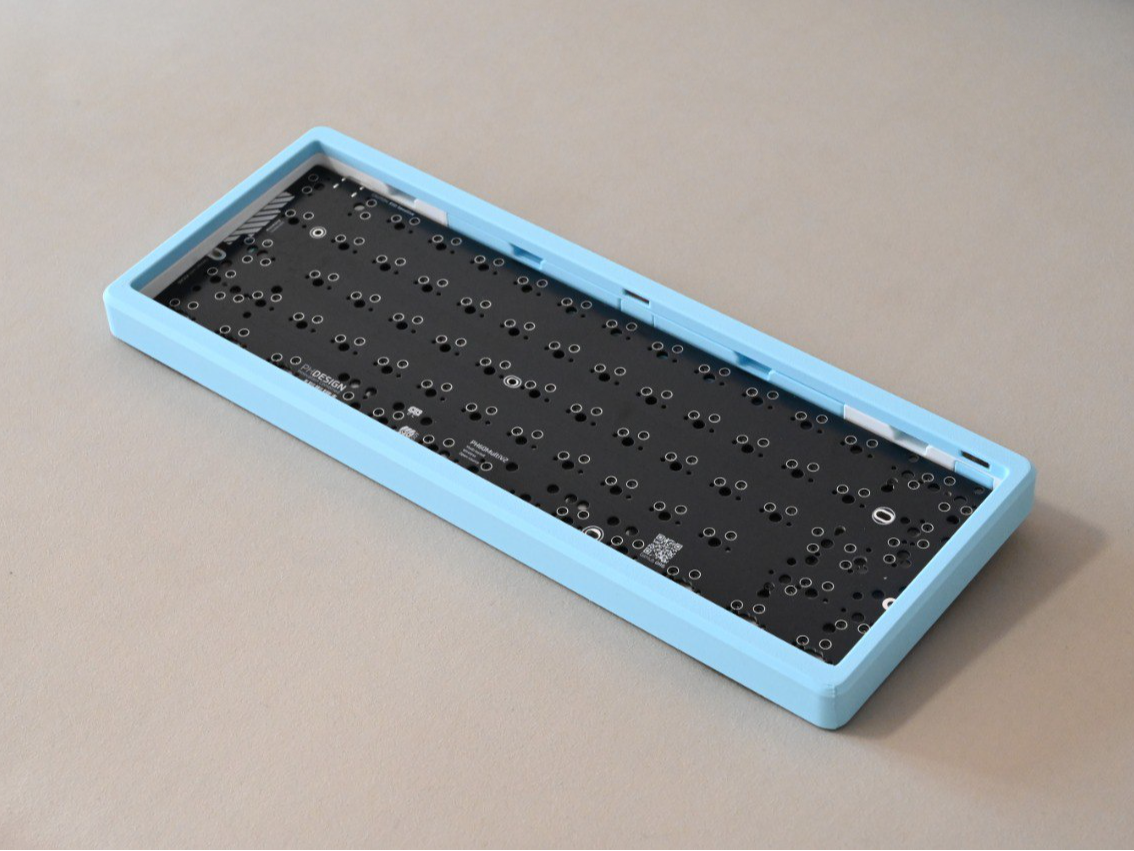
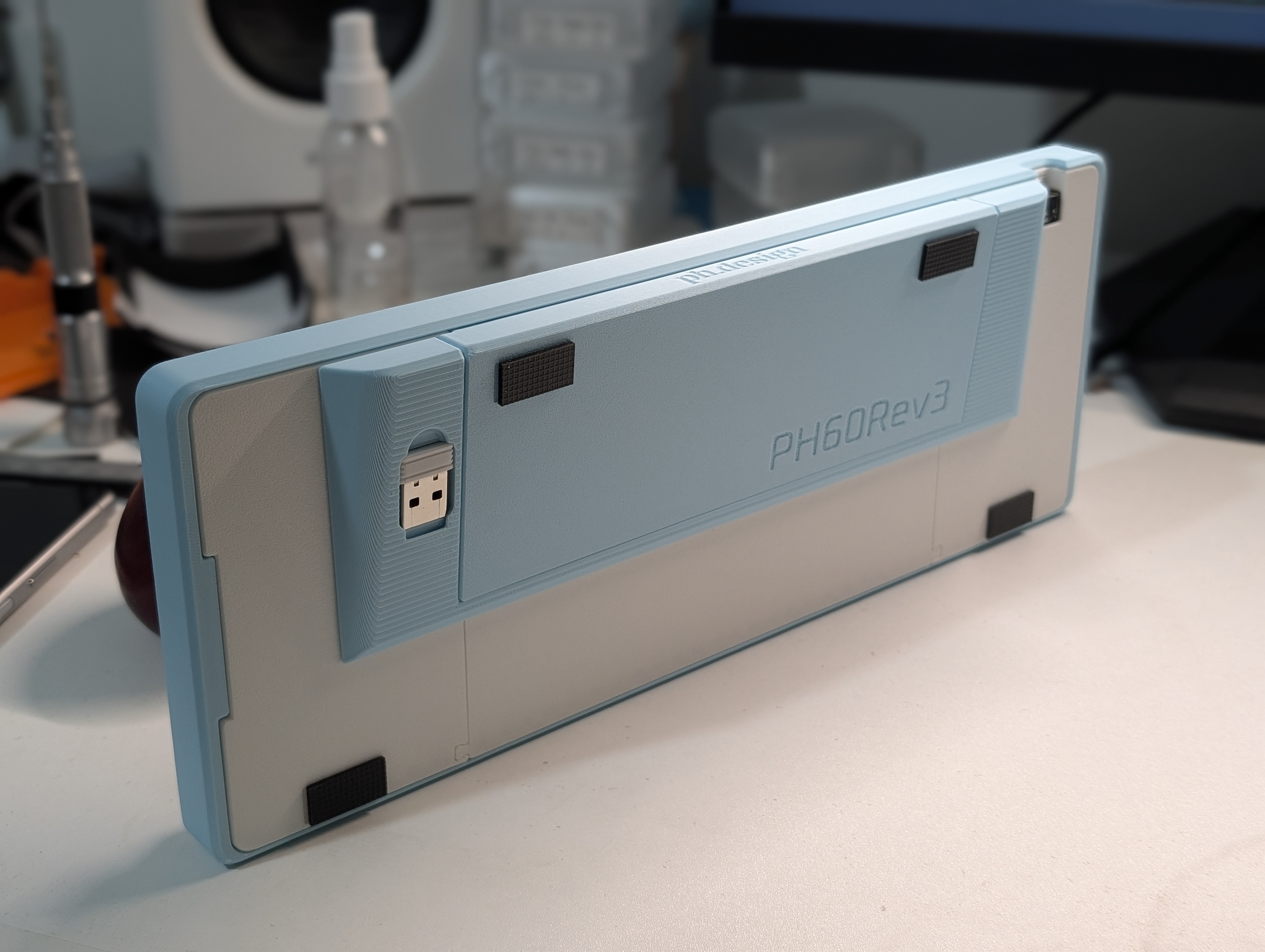
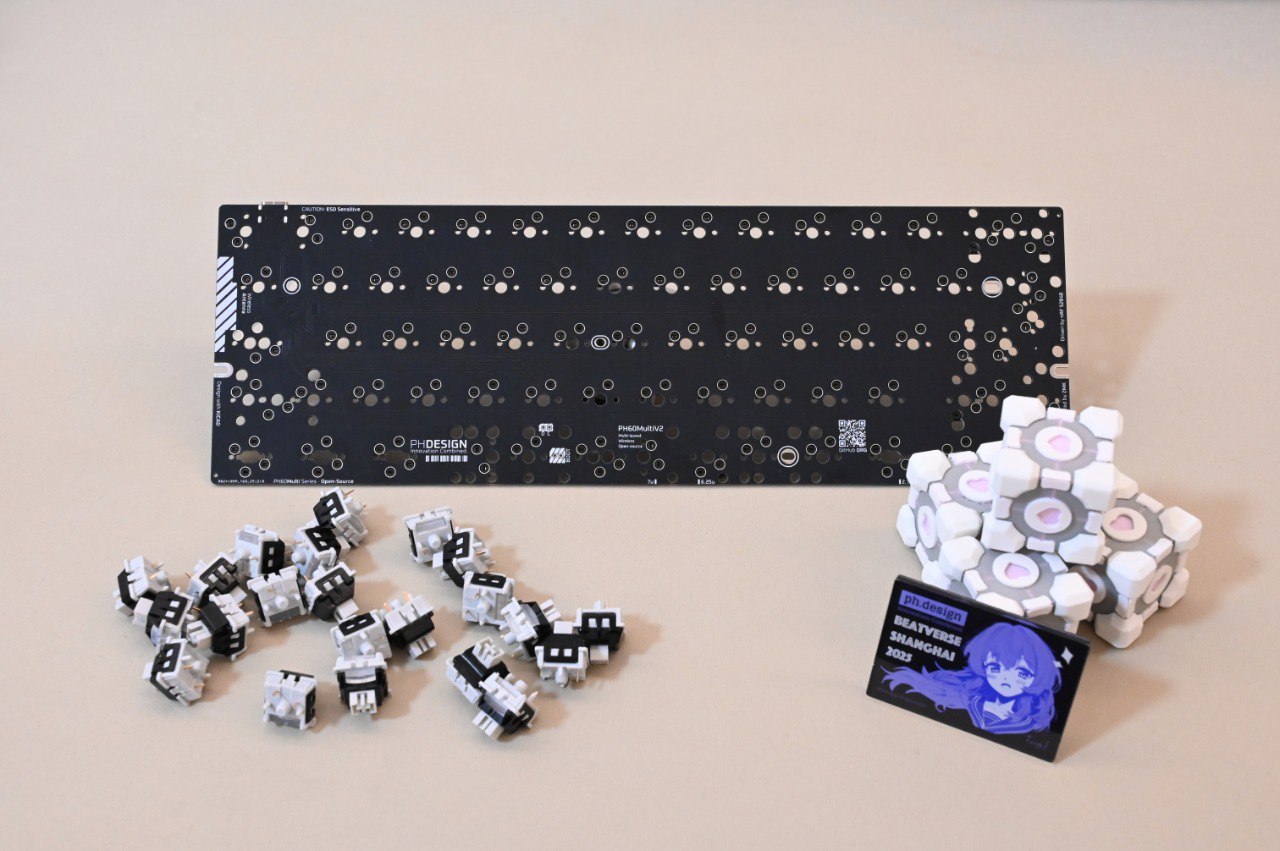
Note on ANSI/ISO variants: Rev.3 currently only ships the Multi layout PCB. The ANSI PCB in this repo is an early prototype with a fundamentally different design approach — there is no standalone ISO version. We may develop dedicated ANSI/ISO variants based on ZMKs in the future.
| Rev.2 | Rev.3 | |
|---|---|---|
| MCU | RP2040 | NRF52840 |
| Connectivity | USB only | USB + Bluetooth 5.3 + 2.4 GHz (TBD) |
| Firmware | QMK + VIA | ZMKs + ZMKs Studio |
| Power | USB powered | Battery powered |
| Split spacebar | Not supported | 6.25u & 7u split |
| Case | 3-piece modular | Magnetic quick-release, O-ring gasket |
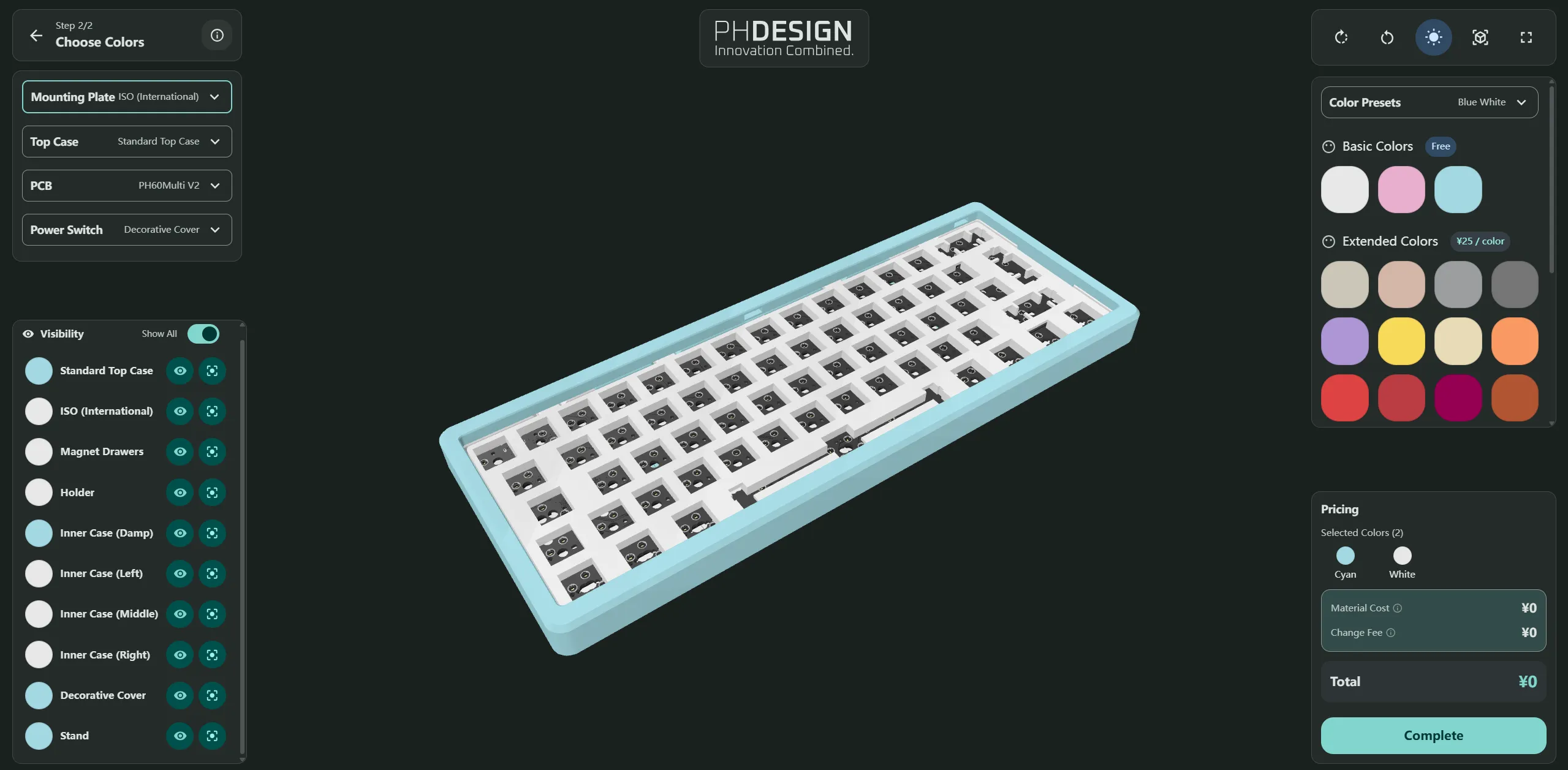
Configure your PH60 Rev.3 with live 3D preview at custom.phdesign.cc.
PH60 Rev.3
├── Assets/                         # Preview images
├── Case_Model_Rev3/                # Case 3D model files (STEP)
├── LICENSE
├── PCB_Model_Rev3/                 # PCB 3D model files
├── PCB_Rev3/
│   ├── ANSI/                       # ANSI variant (early prototype)
│   └── Multi/                      # Multi-layout variant (primary)
├── Plates_Rev3/                    # Plate files (STEP)
├── Production/
│   ├── PH60-Rev3-ANSI/             # ANSI production files
│   └── PH60-Rev3-Multi/            # Multi production files
├── README.md
└── README-zh_CN.mdThe case prints well with default FDM settings. Recommended parameters for best results:
| Setting | Recommended | Notes |
|---|---|---|
| Filament | PLA or PETG | High-temp materials increase warp risk |
| Layer height | 0.2 mm | Model designed around 0.2 mm |
| Wall count | 2 walls | — |
| Infill pattern | Gyroid | — |
| Infill density | 15% | — |
| Wall generator | Arachne | Improves print speed |
| Accurate outer wall | Enabled | Reduces visible layer lines |
| Support | Off | Designed for supportless printing |
Make sure the bed is leveled and clean before printing. Use adhesive on long parts like the top cover to prevent warping. Sand and clean prints for a better finish.
| Item | Qty | Notes |
|---|---|---|
| 3D printed case parts | 1 set | PLA or PETG recommended |
| PH60 Rev.3 Multi PCB | 1 | Pre-soldered SMD components |
| MX-compatible switches | 61+ | Varies by layout |
| Keycaps | 1 set | Compatible with 60% layout |
| LiPo battery (optional) | 1 | Recommended: 100 × 50 × 5 mm, Molex 1.25 mm connector |
| Magnets | 8 | Recommended: 10 × 5 × 3 mm, N52 |
| Silicone O-rings | 8 | OD 9 mm, cord 1.5 mm |
| Silicone anti-slip pads | 4 | Recommended: 20 × 10 × 2 mm |
For detailed assembly steps, refer to the Wiki.
FN + B + R, or remove the spacebar keycap and double-tap the BOOT pads with tweezers..uf2 file to it — the keyboard reboots automatically.Visit ZMKs Studio for real-time keymap editing.
Q: Which 3D printers can print the Rev.3 case? A: Any FDM printer with a bed ≥ 256 × 256 mm that can print PLA or PETG.
Q: Which layouts does the Rev.3 case support? A: ANSI, ISO, HHKB, WK, WKL, LS64, and EC60 (NIZ electrostatic capacitive). Plate designs are continuously updated.
Q: Why is there no dedicated ANSI or ISO PCB? A: The early ANSI prototype has a fundamentally different design from the Multi PCB. We focused on Multi to support all layouts with a single board. Dedicated variants may come later based on ZMKs.
Q: What battery and magnet sizes are supported? A: Up to 100 × 50 × 5 mm LiPo battery. Magnets: 10 × 5 × 3 mm (N52 recommended). The battery tray and magnet drawers can be modified for other sizes.
| Qty | Value | Footprint | References |
|---|---|---|---|
| 67 | DIODE | Diode_SMD:D_SOD-123 | D2, D10, D11, D12, D13, D14, D14-1, D15, D16, D17, D18, D19, D20, D21, D22, D23 +51 |
| 53 | MX1A | PCM_Switch_Keyboard_Hotswap_Kailh:SW_Hotswap_Kailh_MX_Plated_1.00u | S1, S2, S10, S11, S12, S13, S14-1, S14-2, S16, S17, S18, S19, S20, S21, S22, S23 +37 |
| 10 | MX1A | PCM_Switch_Keyboard_Hotswap_Kailh:SW_Hotswap_Kailh_MX_Plated_1.25u | S29-1, S43, S57, S59, S60, S61, S62, S63, S64, S65 |
| 9 | MX_stab | PCM_Mounting_Keyboard_Stabilizer:Stabilizer_Cherry_MX_2.00u | S14-x1, S29-x1, S41-x1, S41-x2, S55-x1, S60-x2, S60-x4, S60-x5, S60-x6 |
| 5 | 4u7 | Capacitor_SMD:C_0402_1005Metric | C3, C5, C6, C7, C18 |
| 5 | MX1A | PCM_Switch_Keyboard_Hotswap_Kailh:SW_Hotswap_Kailh_MX_Plated_1.50u | S15, S57-1, S59-1, S62-1, S64-1 |
| 4 | 100n | Capacitor_SMD:C_0402_1005Metric | C1, C20, C21, C22 |
| 4 | 12p | Capacitor_SMD:C_0402_1005Metric | C8, C10, C14, C15 |
| 3 | 1u | Capacitor_SMD:C_0402_1005Metric | C16, C19, C23 |
| 3 | VAL** | hole:PKRH | HOLE, HOLE, HOLE |
| 2 | 1R | Capacitor_SMD:C_0402_1005Metric | R5, R6 |
| 2 | 5K1 | Resistor_SMD:R_0402_1005Metric | R7, R8 |
| 2 | Conn_01x02_Pin | Connector_PinHeader_2.00mm:PinHeader_1x02_P2.00mm_Vertical | J1, J2 |
| 2 | MCL1608S100MT | Inductor_SMD:L_0603_1608Metric | L1, L2 |
| 2 | MX1A | PCM_Switch_Keyboard_Hotswap_Kailh:SW_Hotswap_Kailh_MX_Plated_2.75u | S55-1, S60-1-b1 |
| 2 | MX1A | PCM_Switch_Keyboard_Hotswap_Kailh:SW_Hotswap_Kailh_MX_Plated_2.25u | S43-1, S60-1-a1 |
| 2 | MX1A | PCM_Switch_Keyboard_Hotswap_Kailh:SW_Hotswap_Kailh_MX_Plated_1.75u | S30, S55 |
| 2 | MX1A | PCM_Switch_Keyboard_Hotswap_Kailh:SW_Hotswap_Kailh_MX_Plated_3.00u | S60-1-a2, S60-1-b2 |
| 2 | VAL** | hole:PKRHSL | HOLE, HOLE |
| 1 | 0.5p | Capacitor_SMD:C_0402_1005Metric | C12 |
| 1 | 0.8p | Capacitor_SMD:C_0402_1005Metric | C13 |
| 1 | 0R | Capacitor_SMD:C_0402_1005Metric | R4 |
| 1 | 1.5p | Capacitor_SMD:C_0402_1005Metric | C24 |
| 1 | 100k | Resistor_SMD:R_0402_1005Metric | R2 |
| 1 | 100p | Capacitor_SMD:C_0402_1005Metric | C4 |
| 1 | 2.2u | Capacitor_SMD:C_0402_1005Metric | C9 |
| 1 | 2k | Resistor_SMD:R_0402_1005Metric | R3 |
| 1 | 32.768kHz | PCM_Crystal_AKL:Crystal_SMD_3215-2Pin_3.2x1.5mm | X1 |
| 1 | 330k | Resistor_SMD:R_0402_1005Metric | R1 |
| 1 | 4.7u | Capacitor_SMD:C_0402_1005Metric | C11 |
| 1 | 47n | Capacitor_SMD:C_0603_1608Metric | C17 |
| 1 | 820p | Capacitor_SMD:C_0402_1005Metric | C2 |
| 1 | Antenna | Library:nrf52_ant_1.6mm | AE1 |
| 1 | Battery | Connector_Molex:Molex_PicoBlade_53261-0271_1x02-1MP_P1.25mm_Horizontal | BT1 |
| 1 | Crystal_Generic | PCM_Crystal_AKL:Crystal_SMD_2016-4Pin_2.0x1.6mm | X2 |
| 1 | FHW0402UC4N7JST | Inductor_SMD:L_0402_1005Metric | L3 |
| 1 | LQG15HS15NJ02D | Inductor_SMD:L_0402_1005Metric | L6 |
| 1 | MX1A | PCM_Switch_Keyboard_Hotswap_Kailh:SW_Hotswap_Kailh_MX_Plated_2.00u | S14 |
| 1 | MX1A | PCM_Switch_Keyboard_Hotswap_Kailh:SW_Hotswap_Kailh_MX_Plated_7.00u | S60-1 |
| 1 | MX1A | PCM_Switch_Keyboard_Hotswap_Kailh:SW_Hotswap_Kailh_MX_Plated_ISOEnter_90deg | S41-1 |
| 1 | MX1A | PCM_Switch_Keyboard_Hotswap_Kailh:SW_Hotswap_Kailh_MX_Plated_2.25u_90deg | S42 |
| 1 | MX1A | PCM_Switch_Keyboard_Hotswap_Kailh:SW_Hotswap_Kailh_MX_Plated_1.50u_90deg | S28 |
| 1 | MX1A | PCM_Switch_Keyboard_Hotswap_Kailh:SW_Hotswap_Kailh_MX_Plated_6.25u | S60-2 |
| 1 | MX_stab | PCM_Mounting_Keyboard_Stabilizer:Stabilizer_Cherry_MX_7.00u | S60-x3 |
| 1 | MX_stab | PCM_Mounting_Keyboard_Stabilizer:Stabilizer_Cherry_MX_6.25u | S60-x1 |
| 1 | PRTR5V0U2X | Package_TO_SOT_SMD:SOT-143 | D1 |
| 1 | TP4057 | Package_TO_SOT_SMD:TSOT-23-6 | U1 |
| 1 | TPS2116DRL | Package_TO_SOT_SMD:SOT-583-8 | U4 |
| 1 | USB_C_Receptacle_USB2.0_16P | Library:USB-C_16P_HandSolder | J3 |
| 1 | VAL** | hole:PKRHC | HOLE |
| 1 | nRF52840 | Library:Nordic_AQFN-73-1EP_7x7mm_P0.5mm_2_Layer_Board | U2 |

sean618/MakerTiles
Modular STM32 electronic-tile system: hardware, firmware, the MicroBus + Field Protocol stack, and a Python daemon.

Ribbit-Network/ribbit-network-frog-hardware
The sensor for the world's largest crowdsourced network of open-source, low-cost, GHG Gas Detection Sensors.

shorlee/TeleSTERN
The TeleSTERN Project is an Open Source Rocketry Flight Computer based on the TeleMega by Altus Metrum.

Iwetter/EEG32
32-channel ADS1299/nRF52832 acquisition board design in KiCad, with schematics, PCB layout, BOM, and pre-fabrication documentation. Bench tests pending.

GiovaSanta/PulseOxyemeter-LotiBloxy
a bluetooth pulse oxymeter Printed Circuit Board Design Project. PCB is meant to take spo2 measurements and sends results to an application via Bluetooth


Kev1n8088/OshTelemega
The Mega3080 FCU is an evolved clone of the Altus Metrum Telemega. Using the same firmware (meaning the same sensor suite), the primary developments are: - USB-C - Wago style spring terminals - Better GPS RF routing…

openenergymonitor/emonTH3
Hardware for the emonTH3 temperature, humidity, and pulse sensing node
It measures 285 × 94.6 mm and has 2 copper layers, 1.6 mm thick.
213 parts, built around the TP4057, TPS2116DRL, MCL1608S100MT and FHW0402UC4N7JST. The full list of its parts is on this page, with links to each part's symbol and footprint where PCBKit's library has them.
From the ph-design/PH60 repository on GitHub, at the commit this page was made from: the board is PCB_Rev3/Multi/PH60_Rev3.kicad_pcb and its schematic PCB_Rev3/ANSI/PH60_Rev3.kicad_sch. PCBKit opens the board in the browser, with nothing to install.
Its repository states no licence, so its author keeps all rights: ask ph-design before reusing the design.