2 layers121.5 × 136.5 mm

 petermaerki/2023_filament_dryer_git2
This page is explains the physical aspects.
Filament dryer is an open-source printed circuit board by petermaerki, from the petermaerki/2023_filament_dryer_git repository on GitHub. It is a 2-layer board of 70 × 122 mm with 192 parts on 54 nets, routed with 348 tracks and 82 vias.
Its parts include 12 resistors, 11 diodes, 3 capacitors, 3 ICs and 1 connector. It belongs with the RP2040 boards of this library.
This page is explains the physical aspects.
These topics are not covered:
This filament dryer is used to dry 3D printer filament.
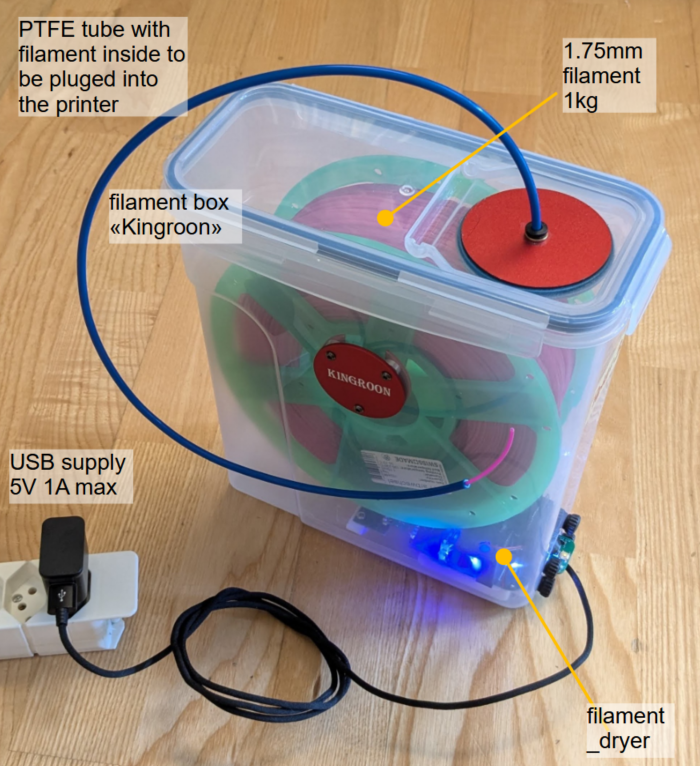
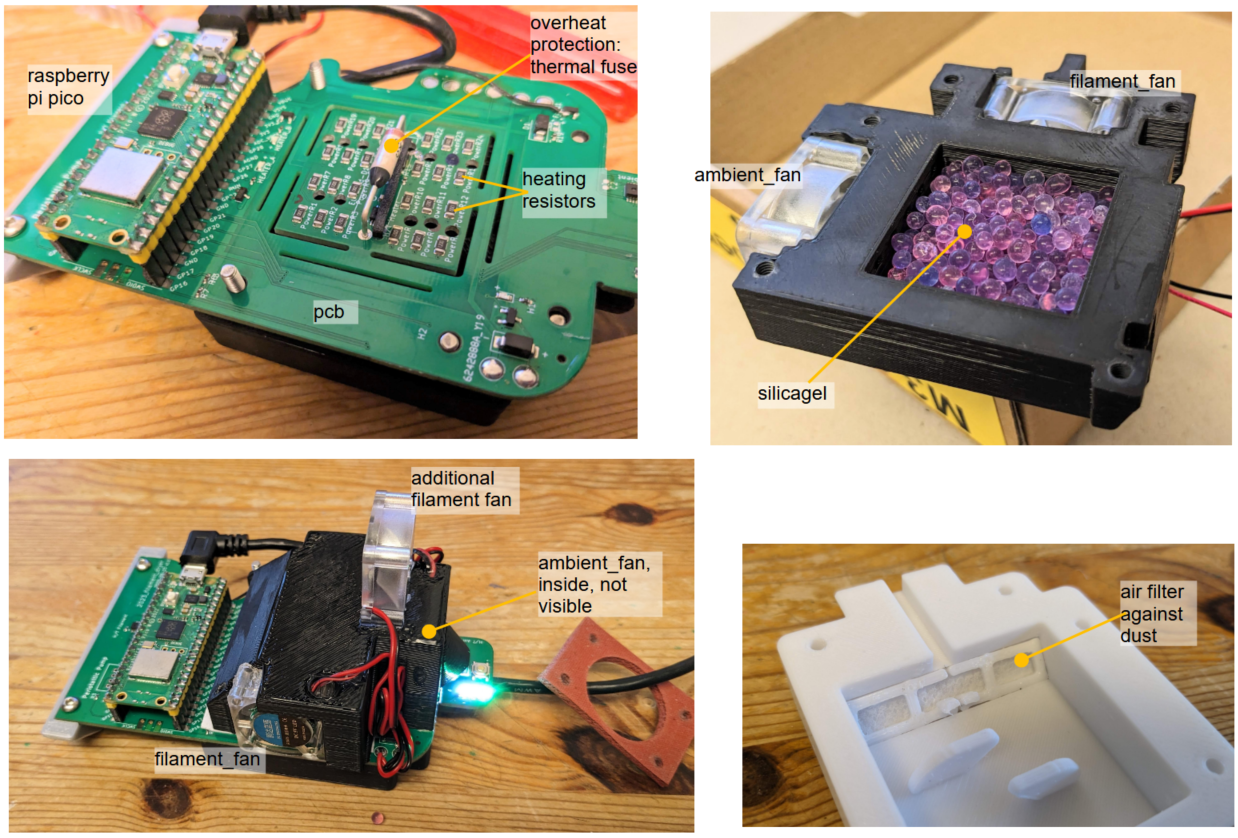
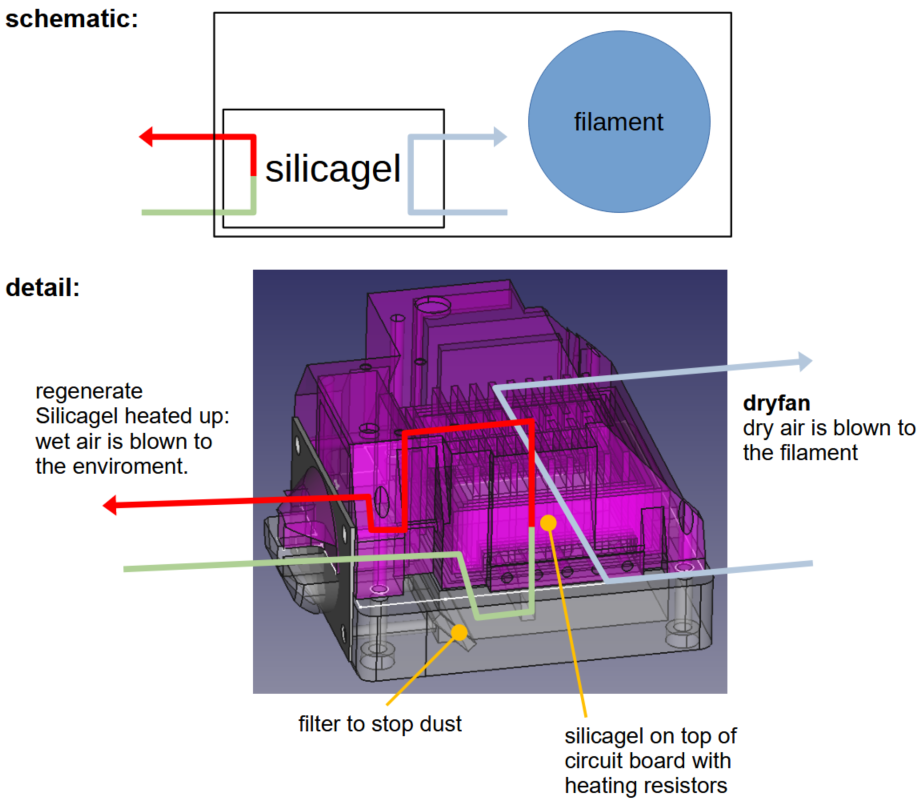
A plastic box (Aliexpress, Kingroon, USD23) is equiped with a dryer module. The module is pluged to USB power (5V, 1A max). The dryer contains about 10g of dried silicagel. A fan blows dry air around the filament. The silicagel will be automatically regenerated when saturated with water: its heated up and the wet air is blown to the enviroment. It takes about 5 days to dry 1 kg of 1.75 mm filament.
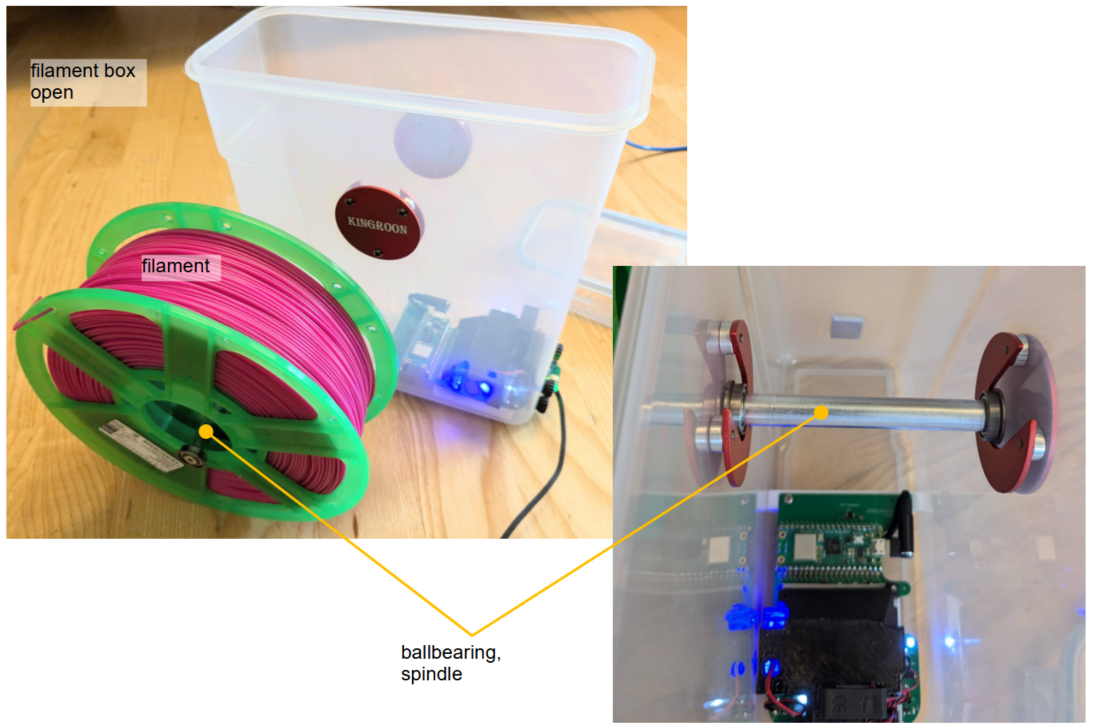
The filament roll is held by a spindle with ballbearings.
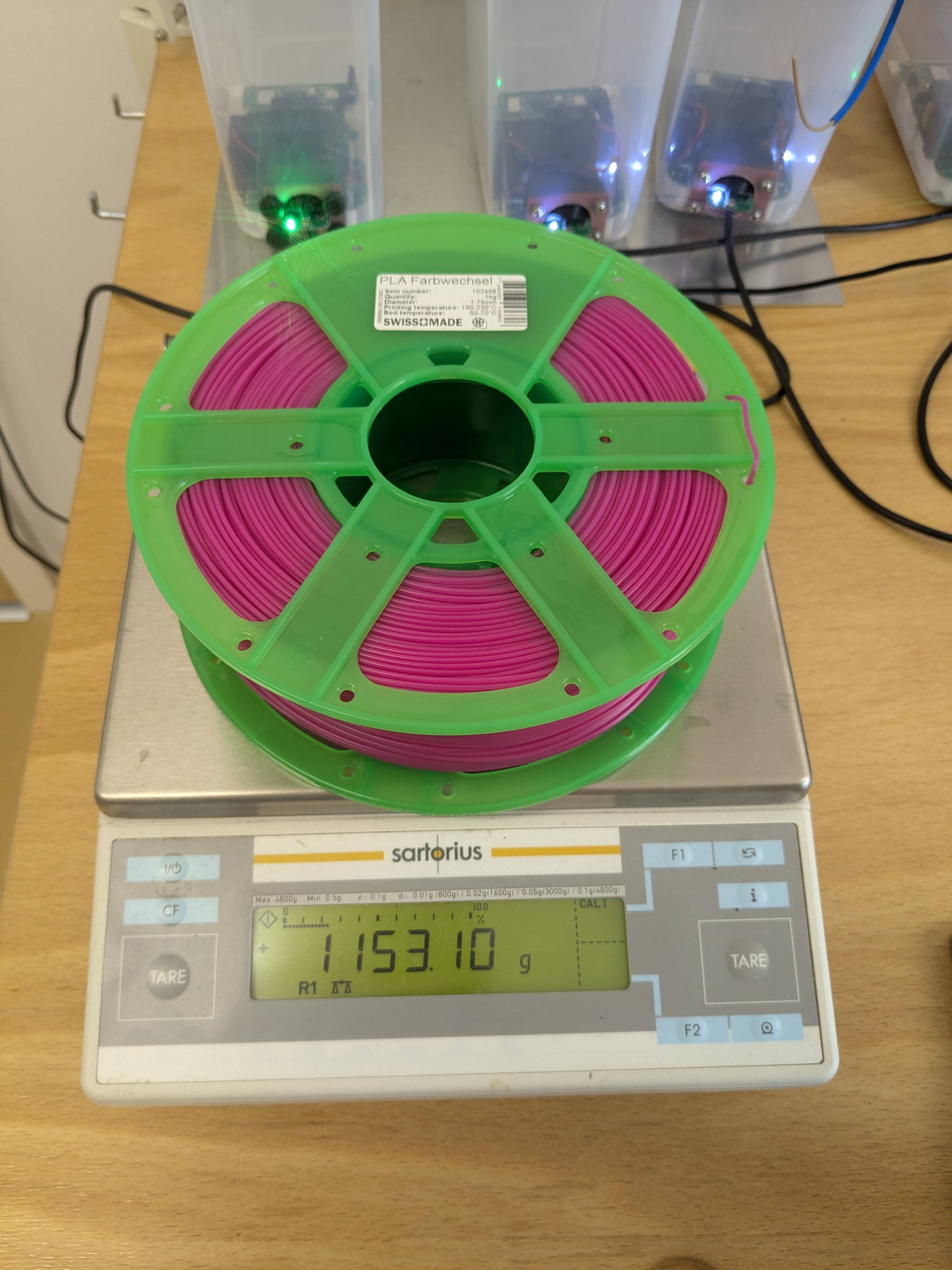
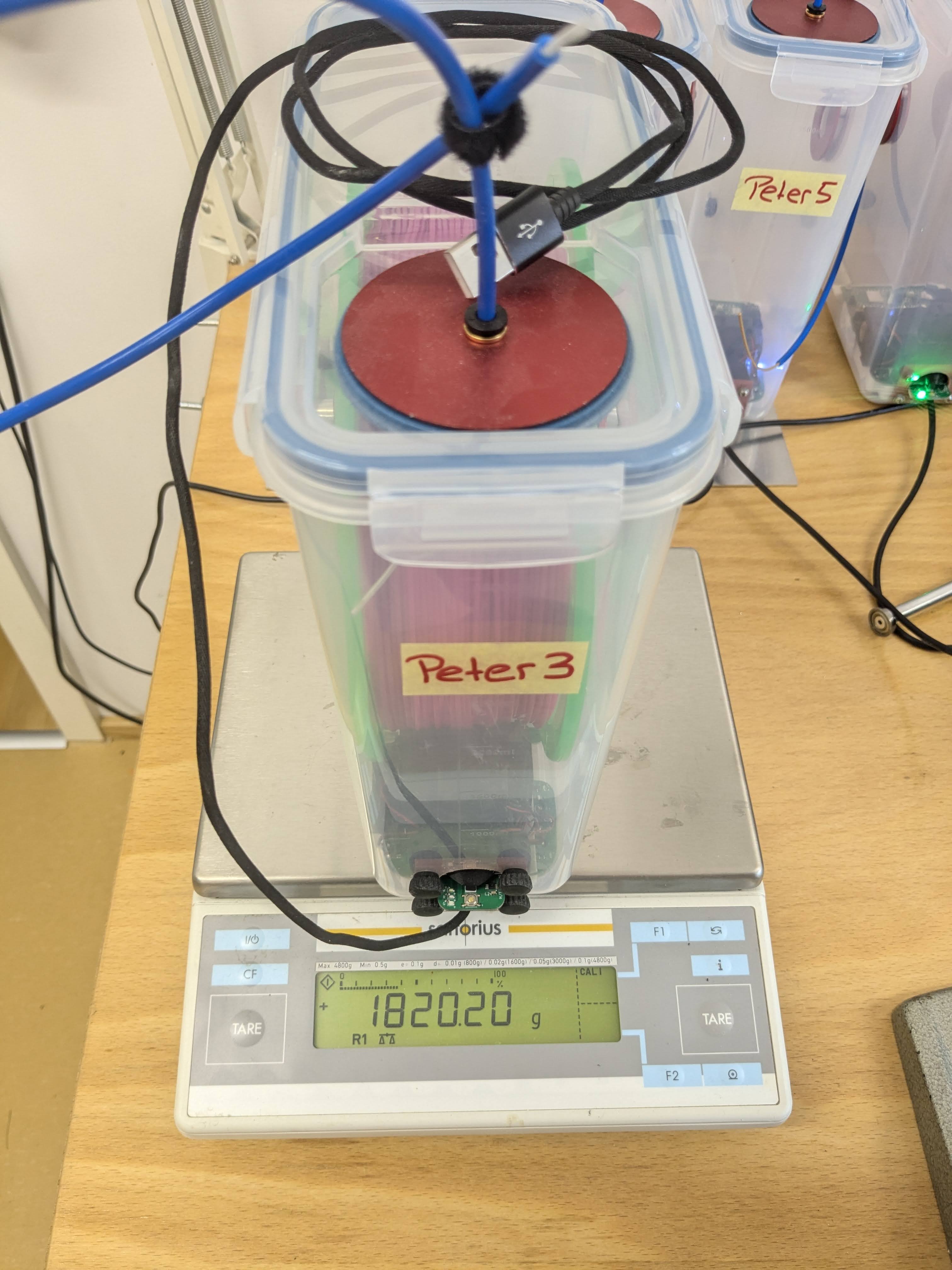
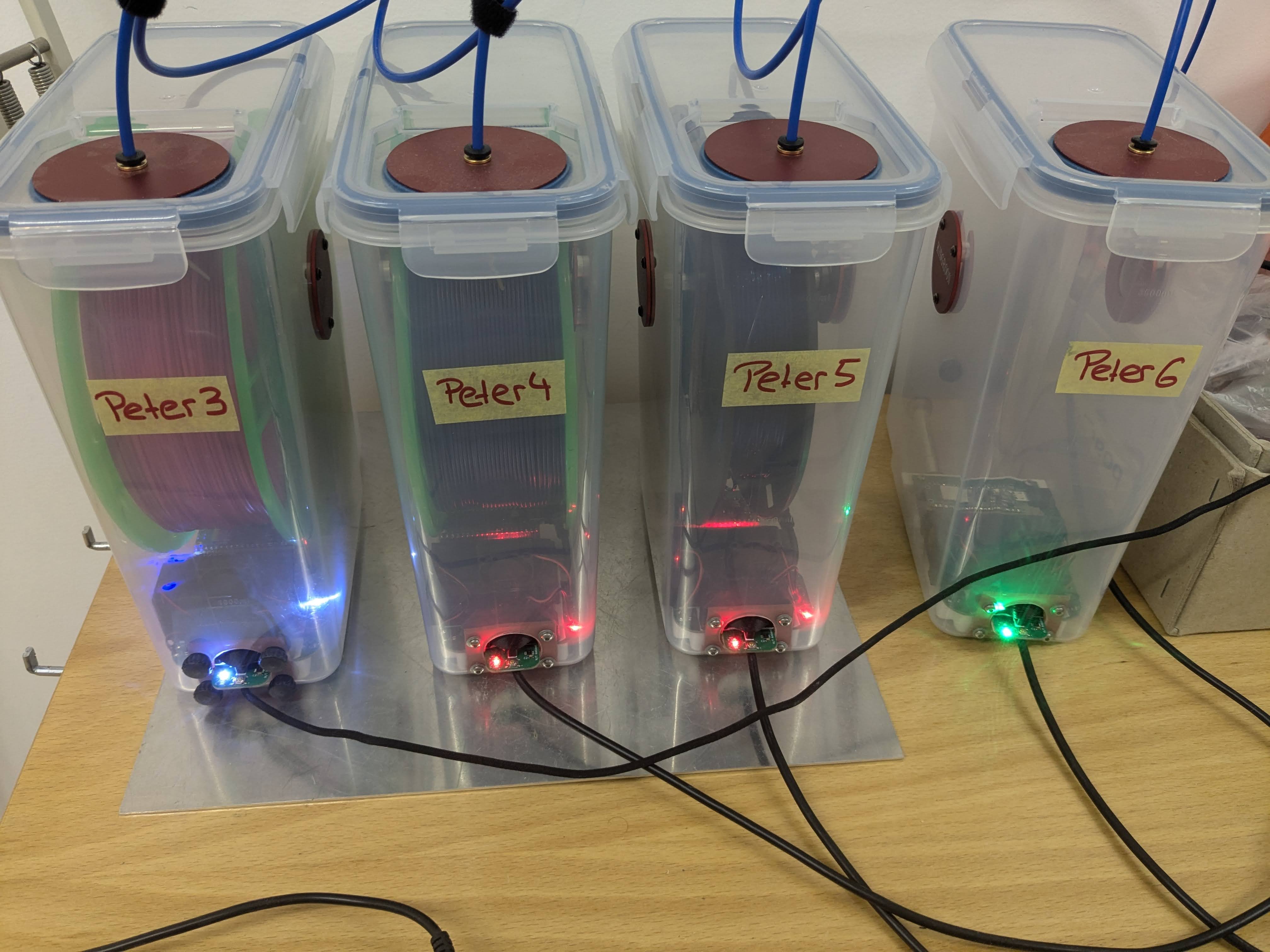
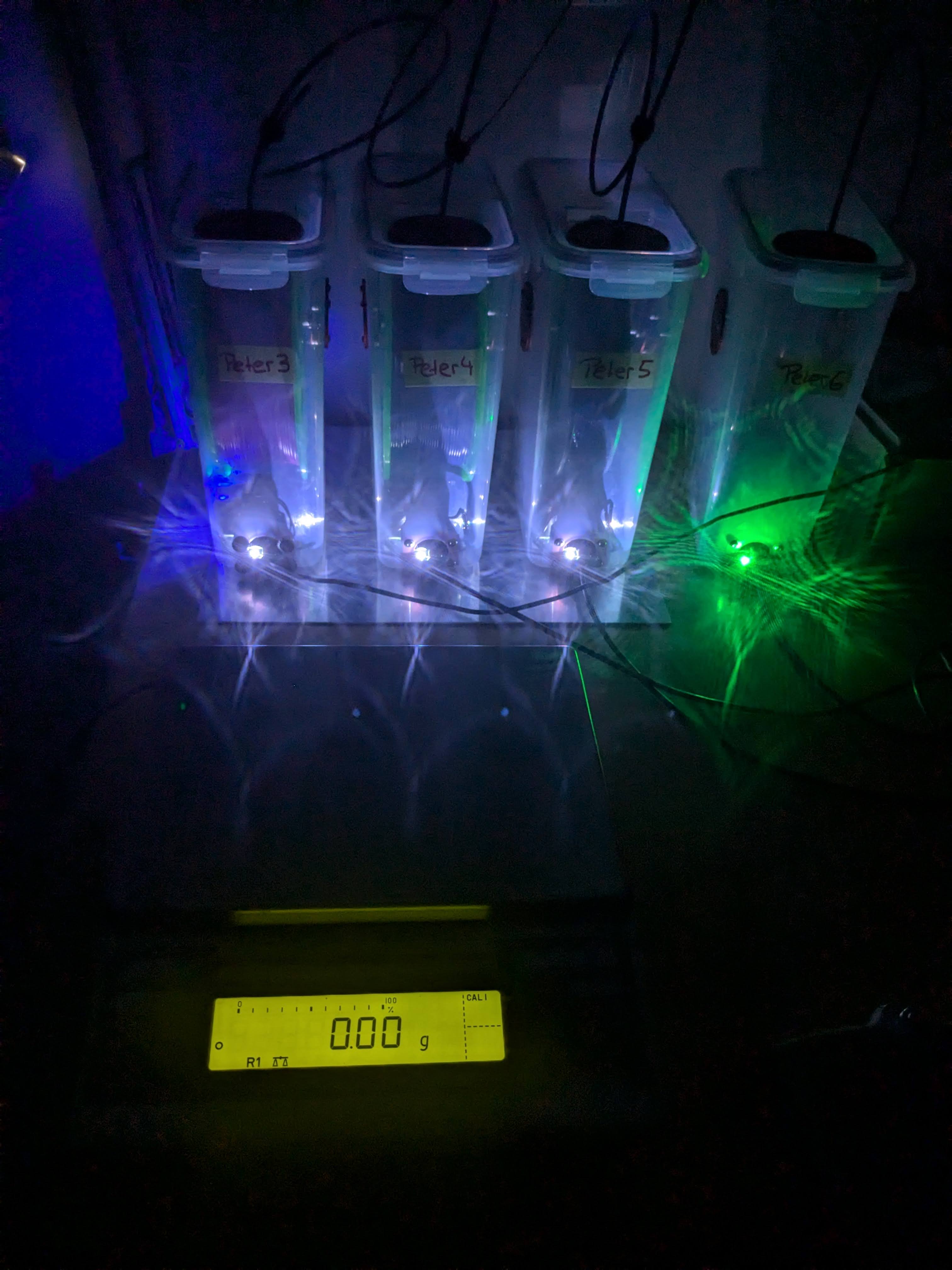
Three rolls of filament are placed in filament_dryers. PLA, PETG and TPU. The rolls have been laying around in my workshop for a long time and therefore I assume they are equally "wet". The filament_dryer is pluged in and I measure the weight of the hole dryer box over the next two weeks. In the diagramm I show the weight reduction relative to the filament weight (1 kg for example).
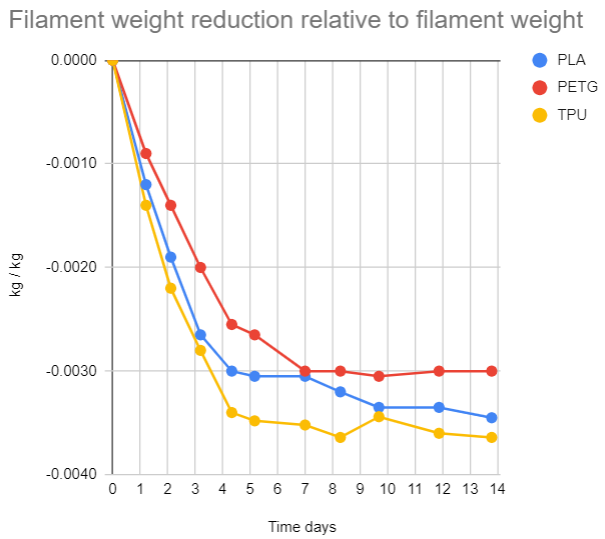
Filament types
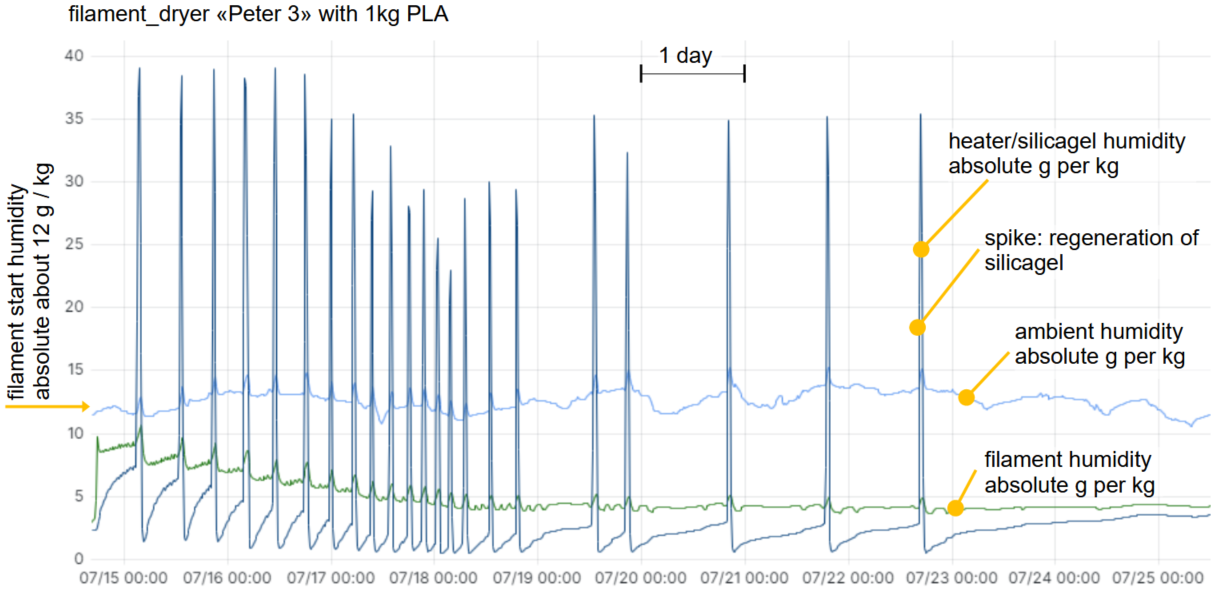 As an example the details of the drying over two weeks are shown.
I do show the absolute water content of the air in g per kg of air. 1 kg air corresponds to about 1 m3 air. The absolute humidity does not depend on temperature and after playing around with different himidity units for a long time, I decided to prefer this unit.
The humidity of the air around the filament changes from 12 g/kg at the start (the filament was laying around in my workshop at this himidity, ambient) to 4 g/kg after one week.
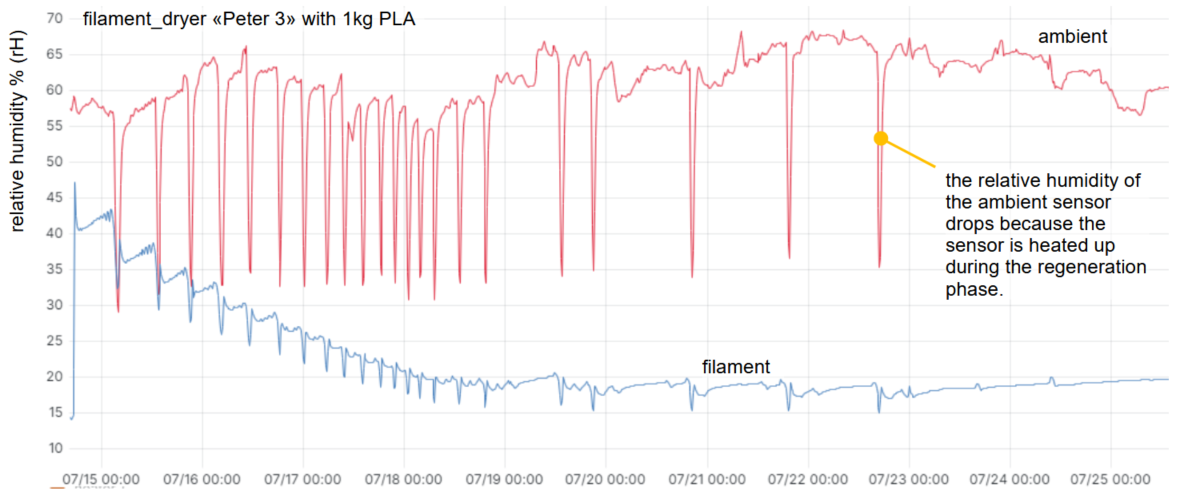 The relative humidity in my workshop is in the range of 60%. The relative humidity of the air arount the filament is decreased down to below 20%.
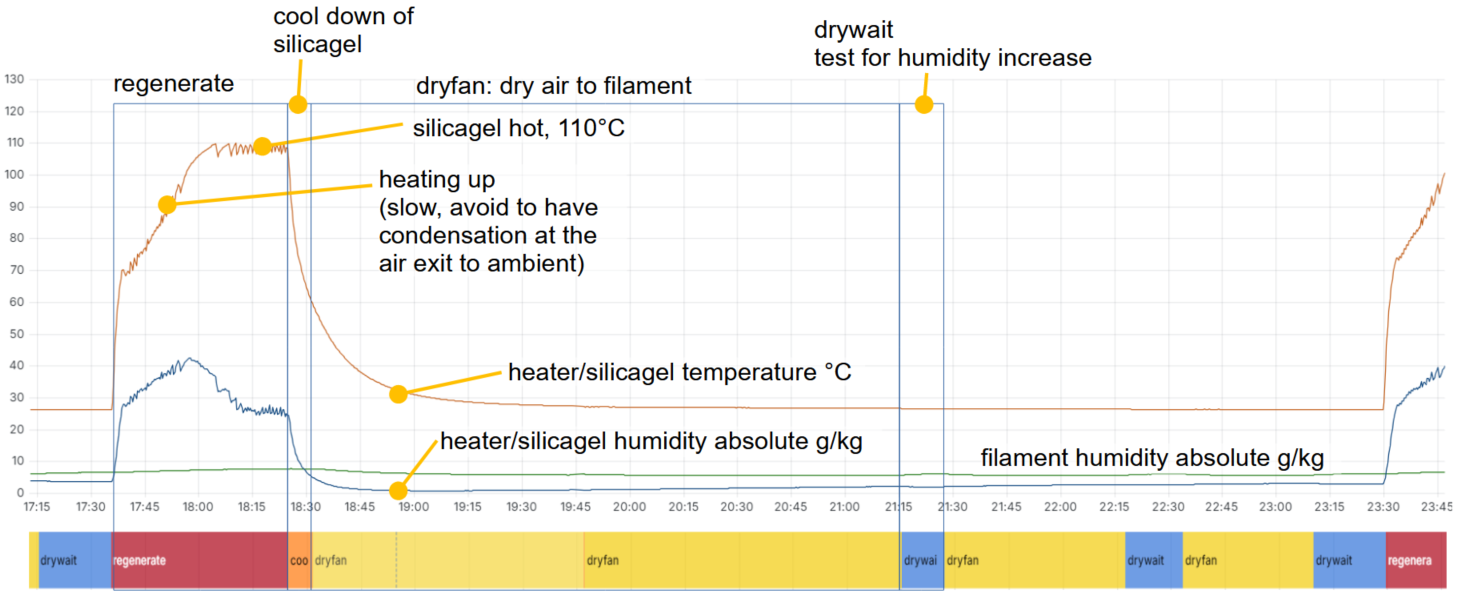 One cycle of regeneration and drying.
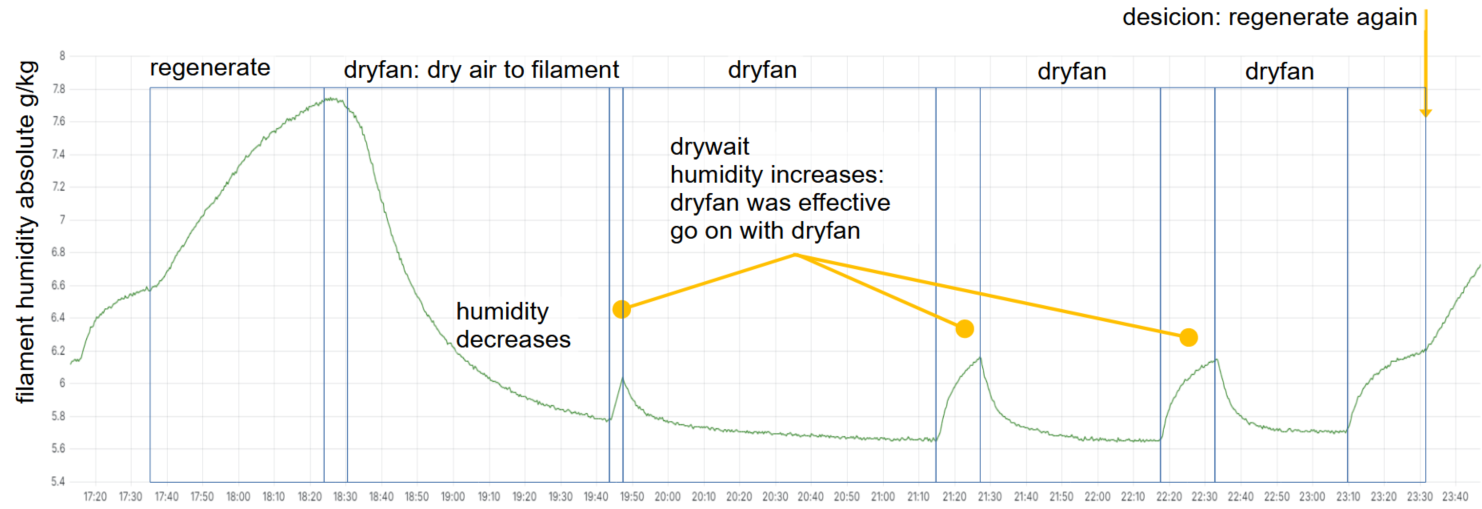 The decision how to proceed is made due to changes of measurenents. If we only observe changes we are not sensitive to measurements errors/offsets.
It is possible to log to grafana. Example
| Qty | Value | Footprint | References |
|---|---|---|---|
| 24 | 120 | Resistor_SMD:R_1206_3216Metric | PowerR1, PowerR2, PowerR10, PowerR11, PowerR12, PowerR13, PowerR14, PowerR15, PowerR16, PowerR17, PowerR18, PowerR19, PowerR20, PowerR21, PowerR22, PowerR23 +8 |
| 8 | 470R | Resistor_SMD:R_0402_1005Metric_Pad0.72x0.64mm_HandSolder | R1, R2, R6, R9, R10, R11, R19, R20 |
| 5 | MountingHole | 00_project_library:MountingHole_3.2mm_M3 | H1, H2, H3, H4, H5 |
| 5 | NMOS | 00_project_library:SOT-23 | FanQ1, FanQ2, FanQ3, PowerQ1, PowerQ2 |
| 4 | 10k | Resistor_SMD:R_0402_1005Metric_Pad0.72x0.64mm_HandSolder | R4, R5, R7, R8 |
| 3 | 10u | Capacitor_SMD:C_0603_1608Metric | C1, C2, C20 |
| 3 | General Purpose Diode | 00_project_library:D_SMA | D1, D2, D11 |
| 2 | WHITE | 00_project_library:LED_0603_1608Metric | D7, D10 |
| 1 | A+ | TestPoint:TestPoint_Pad_D3.0mm | TP7 |
| 1 | A- | TestPoint:TestPoint_Pad_D3.0mm | TP8 |
| 1 | B+ | TestPoint:TestPoint_Pad_D3.0mm | TP1 |
| 1 | B- | TestPoint:TestPoint_Pad_D3.0mm | TP2 |
| 1 | G | 00_project_library:LED_0603_1608Metric | D9 |
| 1 | H/T Ambient | 00_project_library:SON50P250X250X90-9T110X180N | U3 |
| 1 | H/T Filament | 00_project_library:SON50P250X250X90-9T110X180N | U1 |
| 1 | H/T Heater | 00_project_library:SON50P250X250X90-9T110X180N | U2 |
| 1 | HEATER_A | 00_project_library:LED_0603_1608Metric | D3 |
| 1 | HEATER_B | 00_project_library:LED_0603_1608Metric | D4 |
| 1 | Pico | 00_project_library:RPi_Pico | P1 |
| 1 | R | 00_project_library:LED_0603_1608Metric | D8 |
| 1 | RED | 00_project_library:LED_0603_1608Metric | D6 |
| 1 | S+ | TestPoint:TestPoint_Pad_D3.0mm | TP9 |
| 1 | S- | TestPoint:TestPoint_Pad_D3.0mm | TP10 |
| 1 | Thermal Fulse | 00_project_library:Thermal Fuse (R_Axial_Power_L25.0mm_W6.4mm_P27.94mm) | Elmwood-D139-2 |
| 1 | USER | 00_project_library:SW_TS-1187A-B-A-B | USER_BUTTON1 |
| 1 | W | 00_project_library:LED_0603_1608Metric | D5 |
| 1 | dryer_print3D | 00_project_library:dryer_print3d | dryer_print3D1 |
The 73 most common of 192 parts.

osiweb/unified_retro_keyboard
Project to provide keyboard replacements for various classic computers, as well as classic ASCII keyboard

Alzymologist/Kampela
Hardware signer and key storage for Substrate ecosystem

18Markus1984/Volume-Knob
An Arduino pro micro project with a rotary encoder to control volume or mute the sound.

mandraga/SombreroBms
A battery management system (BMS) for small vehicles mainly 36V and 48V (golf carts & quads).

Cipulot/m0118_integrated_usb
Drop-in replacement USB-C PCB for the Apple M0118 powered by QMK and VIAL.


It measures 70 × 122 mm and has 2 copper layers, 1.6 mm thick.
192 parts. The full list of its parts is on this page, with links to each part's symbol and footprint where PCBKit's library has them.
From the petermaerki/2023_filament_dryer_git repository on GitHub, at the commit this page was made from: the board is hardware/kicad/filament_dryer.kicad_pcb and its schematic hardware/kicad/filament_dryer.kicad_sch. PCBKit opens the board in the browser, with nothing to install.
Its repository states no licence, so its author keeps all rights: ask petermaerki before reusing the design.