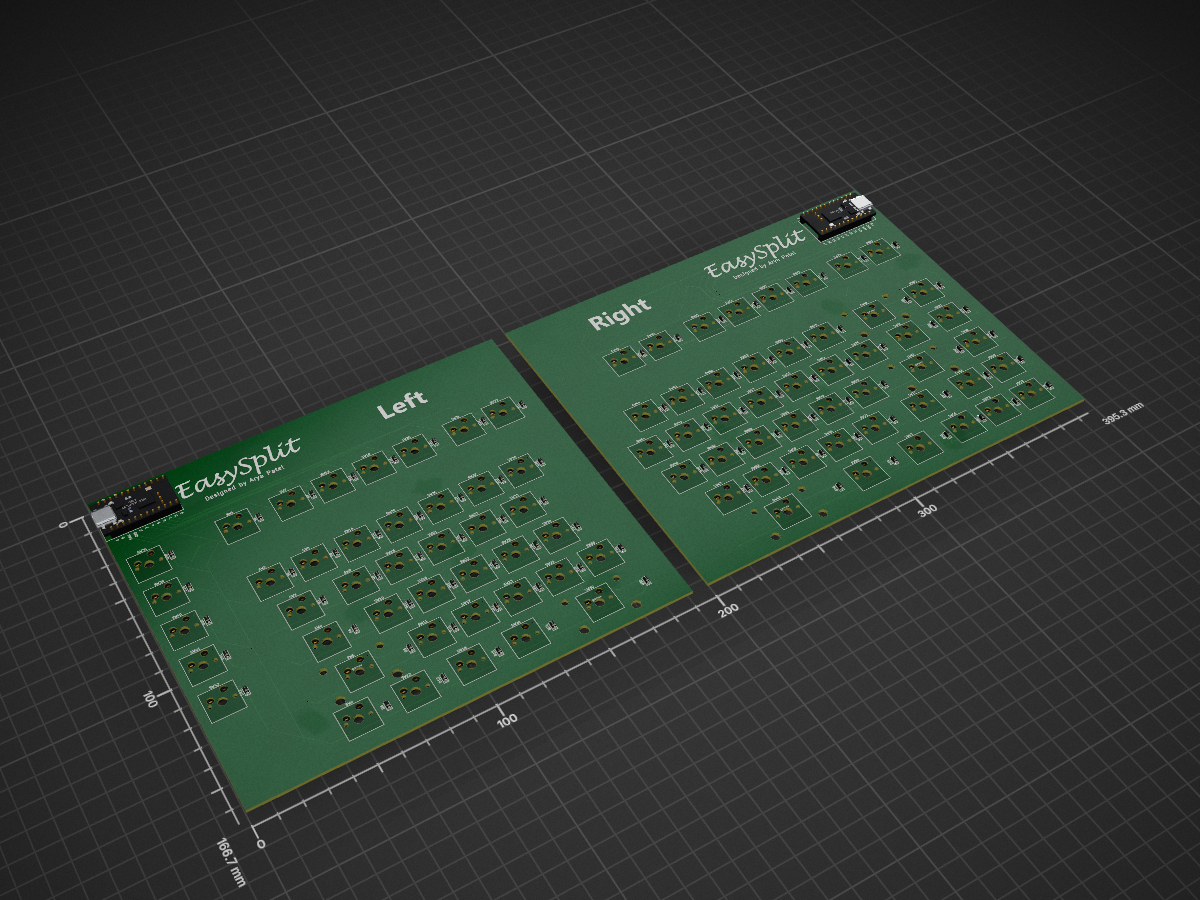
EasySplit - Right
parya7254/EasySplit
A split keyboard with a traditional Layout! It will feature low-profile switches for portability, a nice!nano (clone) as the main MCU for both sides, and a battery so that it can be used on the go!

A split keyboard with a traditional Layout! It will feature low-profile switches for portability, a nice!nano (clone) as the main MCU for both sides, and a battery so that it can be used on the go!
EasySplit is an open-source printed circuit board by parya7254, from the parya7254/EasySplit repository on GitHub. It is a 2-layer board of 395.3 × 166.7 mm with 185 parts on 143 nets, routed with 854 tracks and 141 vias.
It is built around the 1N4148W. Its parts include 89 diodes, 89 switches and 2 ICs. It belongs with the keyboards and input boards and the nRF52 and nRF5x boards of this library.
A hot-swappable split keyboard with a traditional Layout! It will feature MX Switches, a nice!nano (clone) as the main MCU for both sides, and a battery so that it can be used on the go!
In school, I type A LOT. And typing on a school chromebook, is well, okay I guess, and I want to have a better typing experience when I type things, and well, I like making my own things and finding my own solutions. So I made this split keyboard. It's wireless, battery-powered, and best of all, made by ME. This keyboard will help me type my essays faster, work more efficiently, and also turn in my assignments ON TIME. Ahhh, yes, that's the feeling of making your own solutions and being proud of it.
The PCB was designed using KiCAD and the case for it was designed in Fusion360. The pictures of the schematic and the PCB are below:
This is the schematic which was designed in KiCad:
And this is the actual PCB which was also designed in KiCad:
These will be the parts that I will use to build and assemble my split keyboard along with the links to get them:
| Qty | Value | Footprint | References |
|---|---|---|---|
| 89 | 1N4148W | Diode_SMD:D_SOD-123 | D1, D2, D10, D11, D12, D13, D14, D15, D16, D17, D18, D19, D20, D21, D22, D23 +73 |
| 74 | SW_Push | ScottoKeebs_Hotswap:Hotswap_MX_1.00u | SW1, SW2, SW10, SW11, SW13, SW14, SW15, SW16, SW17, SW19, SW20, SW21, SW22, SW23, SW25, SW26 +58 |
| 4 | SW_Push | ScottoKeebs_Hotswap:Hotswap_MX_1.50u | SW3, SW54, SW60, SW81 |
| 4 | SW_Push | ScottoKeebs_Hotswap:Hotswap_MX_1.25u | SW6, SW12, SW18, SW24 |
| 3 | SW_Push | ScottoKeebs_Hotswap:Hotswap_MX_2.25u | SW5, SW30, SW82 |
| 2 | Nice_Nano_V2 | ScottoKeebs_MCU:Nice_Nano_V2 | U1, U2 |
| 2 | SW_Push | ScottoKeebs_Hotswap:Hotswap_MX_1.75u | SW4, SW77 |
| 1 | SW_Push | ScottoKeebs_Hotswap:Hotswap_MX_2.75u | SW48 |
| 1 | SW_Push | ScottoKeebs_Hotswap:Hotswap_MX_2.00u | SW80 |
The 180 most common of 185 parts.

parya7254/EasySplit
A split keyboard with a traditional Layout! It will feature low-profile switches for portability, a nice!nano (clone) as the main MCU for both sides, and a battery so that it can be used on the go!

parya7254/EasySplit
A split keyboard with a traditional Layout! It will feature low-profile switches for portability, a nice!nano (clone) as the main MCU for both sides, and a battery so that it can be used on the go!

fossasia/pslab-hardware
PSLab Hardware Design and Schematics https://pslab.io

pierrechevalier83/ferris
A low profile split keyboard designed to satisfy one single use case elegantly


MickiusMousius/Rolio46Keyboard
A split wireless keyboard based on the Corne and Sofle


sadekbaroudi/bgkeeb
This is a reversible 100mm x 100mm pcb with support for mx or choc switches (no hotswap), per key led, rotary encoders, and exposes the SDA/SCL/GND/VCC lines in the form of the pimoroni trackball pins (meaning you can…

It measures 395.3 × 166.7 mm and has 2 copper layers, 1.6 mm thick.
185 parts, built around the 1N4148W. The full list of its parts is on this page, with links to each part's symbol and footprint where PCBKit's library has them.
From the parya7254/EasySplit repository on GitHub, at the commit this page was made from: the board is PCB/EasySplit.kicad_pcb and its schematic PCB/EasySplit.kicad_sch. PCBKit opens the board in the browser, with nothing to install.
Its repository states no licence, so its author keeps all rights: ask parya7254 before reusing the design.