Skip to the content
2 layers170 × 170 mmOptogenetics, the printed circuit board in 3D

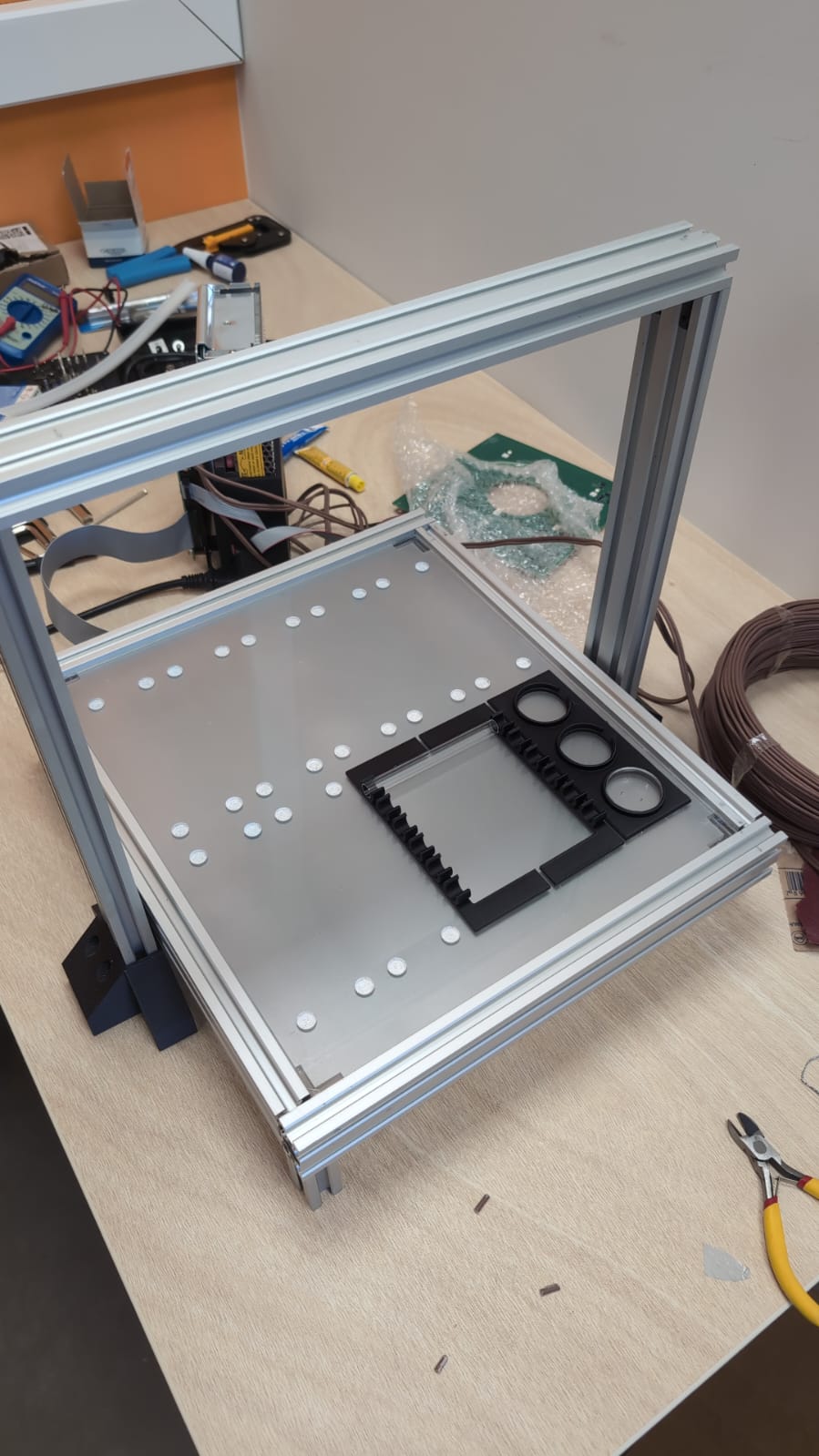
In collaboration with BFKLAB, we are developing a system to measure behaviour of fruit flies. The system is high-throughput, that is, we can measure several animals at a time.

Size
170 × 170 mm
Copper layers
2
Thickness
1.6 mm
Parts
98
Nets
98
Pads
284
Tracks, vias
522, 51
Pours
5
Routed
Yes
KiCad
KiCad 10.0 (file 20260206)
Created
22 Oct 2025
Updated
24 Aug 2026

Overview

Optogenetics is an open-source printed circuit board by open-neuroscience, from the open-neuroscience/Fly_highthroughput repository on GitHub, published under the GPL-3.0 licence. It is a 2-layer board of 170 × 170 mm with 98 parts on 98 nets, routed with 522 tracks and 51 vias.

It is built around the LM2596S-ADJ. Its parts include 26 diodes, 22 resistors, 19 ICs, 16 transistors and 8 capacitors.

Main components

1

README

README.md

Fly highthroughput

In collaboration with BFKLAB, we are developing a system to measure behaviour of fruit flies. The system is high-throughput, that is, we can measure several animals at a time.

The system will have interchangeable plates (round plates, narrow corridors) at the bottom, so different assays can be performed.

Other characteristics:

  • Vibration motors to disturb awake/sleep patterns
  • Bottom infrared illumination
  • RGB LEDs for Optogenetics
  • White LEDs for simulating day/night cycles

Initial version:

Parts

98
QtyValueFootprintReferences
16220Resistor_SMD:R_2010_5025Metric_Pad1.40x2.65mm_HandSolderR1, R2, R3, R4, R5, R6, R7, R8, R9, R10, R11, R12, R13, R14, R15, R16
16Q_NMOS_GDSPackage_TO_SOT_SMD:SOT-89-3Q1, Q2, Q3, Q4, Q5, Q6, Q7, Q8, Q9, Q10, Q11, Q12, Q13, Q14, Q15, Q16
12AL5809-150P1-7AL5809:POWERDI123-C2_DIO-MU1, U2, U3, U4, U5, U6, U7, U8, U9, U10, U11, U12
12Inolux_IN-P55TATRGBLED_SMD:LED_Inolux_IN-P55TATRGB_PLCC6_5.0x5.5mm_P1.8mmD1, D2, D3, D4, D5, D6, D7, D8, D9, D10, D11, D12
12LEDLED_SMD:LED_Everlight-SMD3528_3.5x2.8mm_67-21STD13, D14, D15, D16, D17, D18, D19, D20, D21, D22, D23, D24
4AL5809-20P1-7AL5809:POWERDI123-C2_DIO-MU13, U14, U15, U16
4MountingHoleMountingHole:MountingHole_3.2mm_M3H1, H2, H3, H4
21.5nFCapacitor_SMD:C_1206_3216Metric_Pad1.33x1.80mm_HandSolderC10, C13
2100µFCapacitor_SMD:C_Elec_6.3x5.4C11, C14
222µHInductor_SMD:L_12x12mm_H4.5mmL1, L2
2510Resistor_SMD:R_2010_5025Metric_Pad1.40x2.65mm_HandSolderR26, R28
2680µFCapacitor_SMD:C_Elec_10x10.2C9, C12
2LM2596S-ADJPackage_TO_SOT_SMD:TO-263-5_TabPin3U21, U22
2Schottky 5ADiode_SMD:D_SMB_HandsolderingD25, D26
10.1uFCapacitor_SMD:C_1206_3216Metric_Pad1.33x1.80mm_HandSolderC5
11uFCapacitor_SMD:C_Elec_4x5.4C6
12.7kResistor_SMD:R_2010_5025Metric_Pad1.40x2.65mm_HandSolderR27
12kResistor_SMD:R_2010_5025Metric_Pad1.40x2.65mm_HandSolderR21
13.9kResistor_SMD:R_2010_5025Metric_Pad1.40x2.65mm_HandSolderR25
1540Resistor_SMD:R_2010_5025Metric_Pad1.40x2.65mm_HandSolderR22
1Conn_02x06_Odd_EvenConnector_IDC:IDC-Header_2x06_P2.54mm_HorizontalJ1
1LM317_SOT-223Package_TO_SOT_SMD:SOT-223-3_TabPin2U19

More from open-neuroscience/Fly_highthroughput

3
  • 2 layers106 × 97.5 mmFly highthroughput, the printed circuit board in 3D

    Fly highthroughput

    open-neuroscience/Fly_highthroughput

    In collaboration with BFKLAB, we are developing a system to measure behaviour of fruit flies. The system is high-throughput, that is, we can measure several animals at a time.

    44 partsGPL-3.0
  • 2 layers88 × 78 mmInfrared n motors, the printed circuit board in 3D

    Infrared n motors

    open-neuroscience/Fly_highthroughput

    In collaboration with BFKLAB, we are developing a system to measure behaviour of fruit flies. The system is high-throughput, that is, we can measure several animals at a time.

    29 partsGPL-3.0
  • 2 layersMotors only, the printed circuit board in 3D

    Motors only

    open-neuroscience/Fly_highthroughput

    In collaboration with BFKLAB, we are developing a system to measure behaviour of fruit flies. The system is high-throughput, that is, we can measure several animals at a time.

    12 partsGPL-3.0

Similar boards

  • 2 layers90 × 53.4 mmOpenOx, the printed circuit board in 3D

    OpenOx

    hacklabkyiv/openox-pcb

    PCB design for OpenOx - open source oxygen concentrator

    43 parts7GPL-3.0
  • 2 layers78.7 × 58.4 mmAGV SENSOR PCB 2, the printed circuit board in 3D

    AGV SENSOR PCB 2

    Ashutoshkarve007/STM32_Learning

    Learining STM32

    53 parts3
  • 2 layers40 × 60 mmScaner v1, the printed circuit board in 3D

    Scaner v1

    Aleksei327/ESP32-C5-OBD2-Scanner

    DIY dual-CAN OBD2 adapter on Seeed XIAO ESP32-C5 with a Flutter Android app. Working prototype, tested on a Citroën C3 II: full read-only ECU scan, PSA fault codes, live data. Single-sided home-etched KiCad board.

    34 parts2
  • 2 layers85.1 × 99.1 mmProject f, the printed circuit board in 3D

    Project f

    Nodraak/SpeedOfLight

    Reenactment of experiment(s) to measure the speed of light

    15 parts2
  • 2 layers105.6 × 72 mmSolar mppt charge controller, the printed circuit board in 3D

    Solar mppt charge controller

    Pendu1699/solar-mppt-charge-controller

    ESP32-based solar MPPT charge controller, custom PCB, perturb & observe tracking algorithm, logged efficiency test data.

    25 parts2MIT
  • 2 layers100 × 100 mmFSAE BaseBoard, the printed circuit board in 3D

    FSAE BaseBoard

    Pereyzaquer/Formuna-SAE-UTN-FRBA

    UTN-FRBA Formula SAE

    71 parts2
  • 6 layers100.5 × 101.5 mmCustom ESC, the printed circuit board in 3D

    Custom ESC

    0BitsnBytes/McQueen

    an overpowered rc car that poses a danger to my safety :)

    192 parts1GPL-3.0

Questions

How big is the Optogenetics PCB?

It measures 170 × 170 mm and has 2 copper layers, 1.6 mm thick.

What parts does the Optogenetics use?

98 parts, built around the LM2596S-ADJ. The full list of its parts is on this page, with links to each part's symbol and footprint where PCBKit's library has them.

Where can I download the Optogenetics KiCad files?

From the open-neuroscience/Fly_highthroughput repository on GitHub, at the commit this page was made from: the board is electronics/optogenetics/optogenetics.kicad_pcb and its schematic electronics/Infrared_n_motors/Infrared_n_motors.kicad_sch. PCBKit opens the board in the browser, with nothing to install.

Can I use the Optogenetics design in my own project?

Its repository publishes it under the GPL-3.0 licence: you may reuse it on that licence's terms (keep the author's notice, and for a copyleft licence share your changes alike).