2 layers25.9 × 56.8 mm
F PANEL Shim
mikegoelzer/ESP32-Remote-USB-HID
USB dongle for remote emulation of USB HID keyboard and other server board control signals
5 parts1

 mikegoelzer/ESP32-Remote-USB-HID1
USB dongle for remote emulation of USB HID keyboard and other server board control signals
USBHIDKey is an open-source printed circuit board by mikegoelzer, from the mikegoelzer/ESP32-Remote-USB-HID repository on GitHub. It is a 4-layer board of 65 × 32 mm with 59 parts on 82 nets, routed with 449 tracks and 65 vias.
It is built around the ESP32-S3-MINI-1-N8, CP2102N-A02-GQFN28 and TPS62823DLCT, with the TPD2EUSB30ADRTR, BAT60AE6327HTSA1 and ESD5Z5.0T1G among its other parts. Its parts include 15 resistors, 9 diodes, 8 capacitors, 6 ICs and 5 switches. It belongs with the keyboards and input and computers and single-board computers boards and the ESP32 boards of this library.


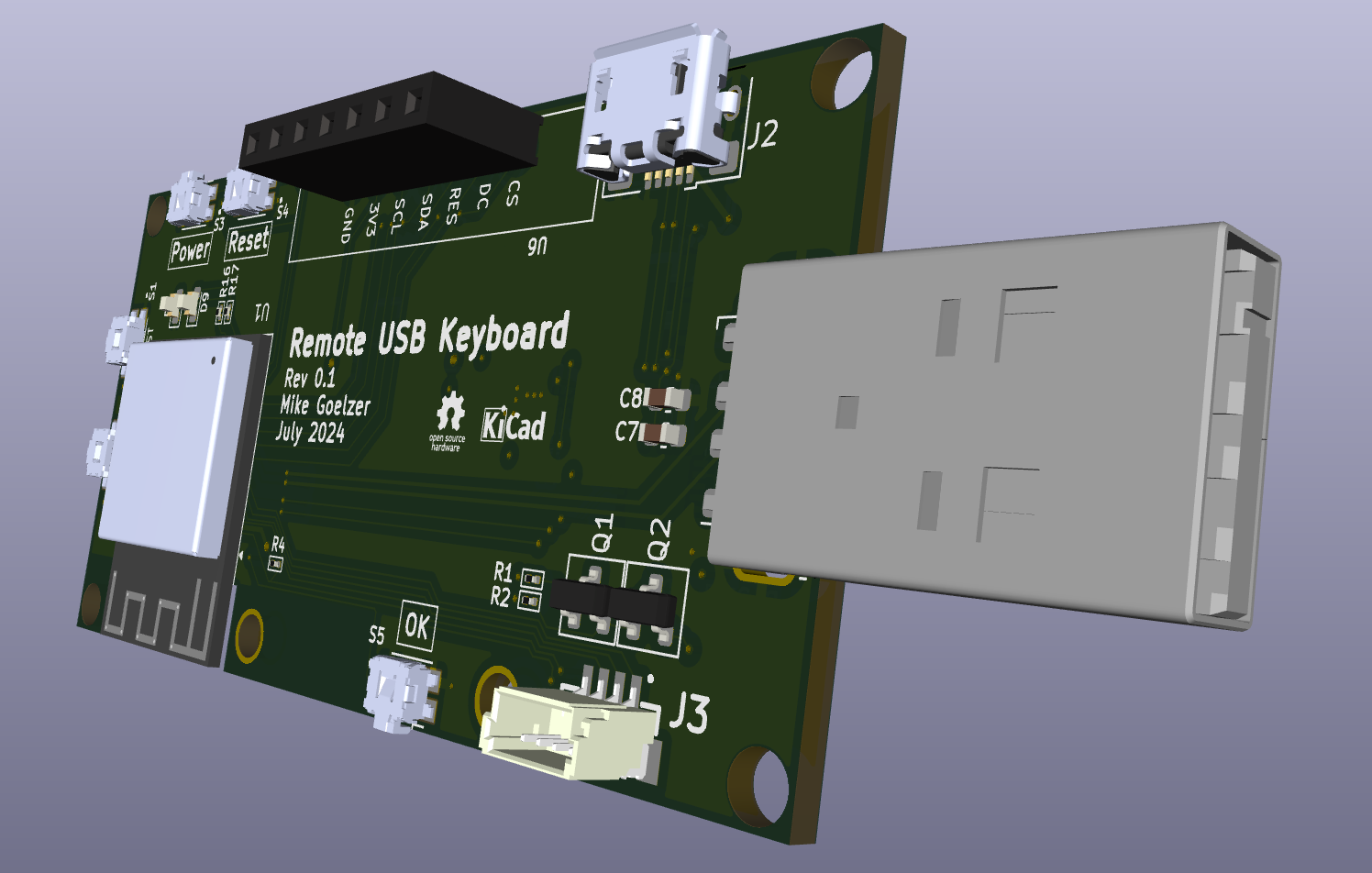
This project is the hardware and firmware for an ESP32-based remote USB keyboard. It's a dongle that plugs into a USB port on a computer and sends keystrokes that it receives over Wifi. The connector J3 also allows for wiring up to the PC motherboard's F_PANEL control pins, allowing for remote on/off and remote reboot.
If you run a JST 4-conductor wire to F_PANEL there is a small adapter PCB that plugs it into the motherboard connector.
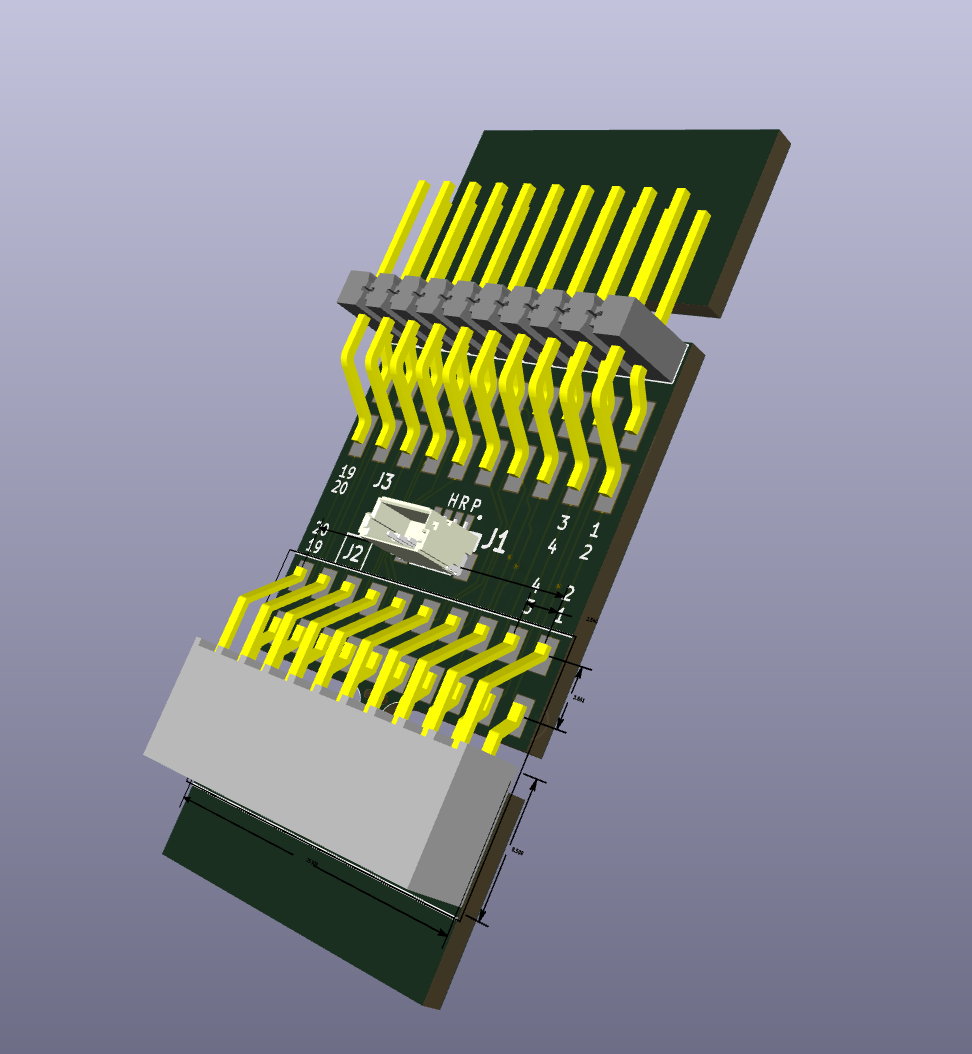
There are two Kicad projects, one for the USB key and one for the small adapter PCB:
The firmware is in the esp32-firmware directory. See its README for details.
| Qty | Value | Footprint | References |
|---|---|---|---|
| 5 | 10uF | Capacitor_SMD:C_0603_1608Metric | C1, C3, C4, C5, C7 |
| 5 | EVQ-P7L01P | USB-HID-Key-Parts:SW_EVQ-P7L01P | S1, S2, S3, S4, S5 |
| 4 | 10k | PCM_Resistor_SMD_AKL:R_0201_0603Metric | R1, R2, R9, R11 |
| 4 | MountingHole | MountingHole:MountingHole_3mm | H1, H2, H3, H4 |
| 3 | 1k | PCM_Resistor_SMD_AKL:R_0201_0603Metric | R10, R16, R17 |
| 2 | 0.1uF | Capacitor_SMD:C_0603_1608Metric | C2, C8 |
| 2 | 330 | PCM_Resistor_SMD_AKL:R_0201_0603Metric | R12, R13 |
| 2 | BAT60A | Diode_SMD:D_SOD-323 | D1, D2 |
| 2 | ESD5Z5.0T1G | Diode_SMD:D_SOD-523 | D3, D4 |
| 2 | Green | LED_SMD:LED_0603_1608Metric | D5, D8 |
| 2 | LOGO | LOGO | G***, G*** |
| 2 | MMBT4124 | PCM_Package_TO_SOT_SMD_AKL:SOT-23 | Q1, Q2 |
| 2 | TPD2EUSB30A | Package_TO_SOT_SMD:Texas_DRT-3 | U3, U4 |
| 1 | (3.3V) | TestPoint:TestPoint_Pad_2.0x2.0mm | TP2 |
| 1 | (5V) | TestPoint:TestPoint_Pad_2.0x2.0mm | TP3 |
| 1 | 100k | PCM_Resistor_SMD_AKL:R_0201_0603Metric | R8 |
| 1 | 120pF | Capacitor_SMD:C_0201_0603Metric | C6 |
| 1 | 1K | PCM_Resistor_SMD_AKL:R_0201_0603Metric | R3 |
| 1 | 22.1k | PCM_Resistor_SMD_AKL:R_0201_0603Metric | R5 |
| 1 | 2k (1%) | PCM_Resistor_SMD_AKL:R_0201_0603Metric | R4 |
| 1 | 453k | PCM_Resistor_SMD_AKL:R_0201_0603Metric | R7 |
| 1 | 47.5k | PCM_Resistor_SMD_AKL:R_0201_0603Metric | R6 |
| 1 | 470nH DFE201610E-R47M | USB-HID-Key-Parts:DFE201610E-R47M=P2 | L1 |
| 1 | Amber | LED_SMD:LED_0603_1608Metric | D9 |
| 1 | Amber (RX) | LED_SMD:LED_0603_1608Metric | D6 |
| 1 | BM04B | USB-HID-Key-Parts:BM04B-SRSS-TB_LFSN_ | J3 |
| 1 | BSH111BKR | Package_TO_SOT_SMD:SOT-23 | Q3 |
| 1 | CP2102N-Axx-xQFN28 | Package_DFN_QFN:QFN-28-1EP_5x5mm_P0.5mm_EP3.35x3.35mm | U2 |
| 1 | ESP32-S3-MINI-1 | RF_Module:ESP32-S2-MINI-1 | U1 |
| 1 | GND | TestPoint:TestPoint_Pad_2.0x2.0mm | TP1 |
| 1 | Green (TX) | LED_SMD:LED_0603_1608Metric | D7 |
| 1 | HiLetGo 0.95" OLED | USB-HID-Key-Parts:OLED 0.95in Receptacle+Holes Only Footprint | U6 |
| 1 | TPS62823DLC | Package_SON:Texas_VSON-HR-8_1.5x2mm_P0.5mm | U5 |
| 1 | USB_A | Connector_USB:USB_A_Molex_48037-2200_Horizontal | J1 |
| 1 | USB_B_Micro | Connector_USB:USB_Micro-B_Amphenol_10118193-0001LF_Horizontal | J2 |
mikegoelzer/ESP32-Remote-USB-HID
USB dongle for remote emulation of USB HID keyboard and other server board control signals

mikegoelzer/Homebrew-ECP5-SBC
Kicad files for homebrew hobbyist computer with custom RISC-V CPU


Project-Emerge/rover-circuit
The Rover Circuit is a comprehensive controller board designed for robotics applications, specifically targeted at robot rovers.

AnotherMike-exe/KiCadBlocks
Reusable KiCad 10 PCB layout blocks: module reference boards, design block fragments and host setup docs

bhageneder/GesticulatuionMobileManipulator
Embedded Engineering Project Summer 2024

ShawnHymel/rpi-pico-debugger-shoe
Stackable debugger board for the Raspberry Pi Pico. Solder long headers to this debugger board in order to connect the Pico to it.
It measures 65 × 32 mm and has 4 copper layers, 1.6 mm thick.
59 parts, built around the ESP32-S3-MINI-1-N8, CP2102N-A02-GQFN28, TPS62823DLCT and TPD2EUSB30ADRTR. The full list of its parts is on this page, with links to each part's symbol and footprint where PCBKit's library has them.
From the mikegoelzer/ESP32-Remote-USB-HID repository on GitHub, at the commit this page was made from: the board is USBHIDKey/USBHIDKey.kicad_pcb and its schematic F_PANEL Shim/F_PANEL Shim.kicad_sch. PCBKit opens the board in the browser, with nothing to install.
Its repository states no licence, so its author keeps all rights: ask mikegoelzer before reusing the design.