
2 layers21.4 × 25.2 mm

 mars2860/cicada6
The quadcopter based on ESP8266 wifi module
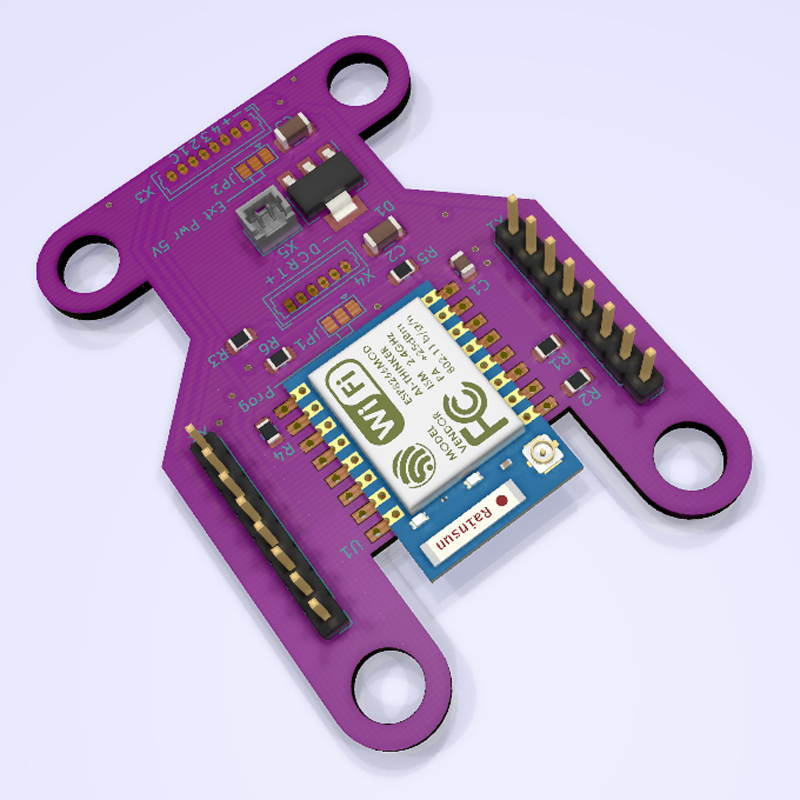
Cicada micro is an open-source printed circuit board by mars2860, from the mars2860/cicada repository on GitHub, published under the GPL-3.0 licence. It is a 2-layer board of 31 × 26.7 mm with 25 parts on 21 nets, routed with 256 tracks and 14 vias.
It is built around the ESP-07. Its parts include 8 resistors, 6 crystals, 3 capacitors, 1 IC and 1 diode. It belongs with the robots and motor control and radio and wireless boards and the ESP32 and ESP8266 boards of this library.
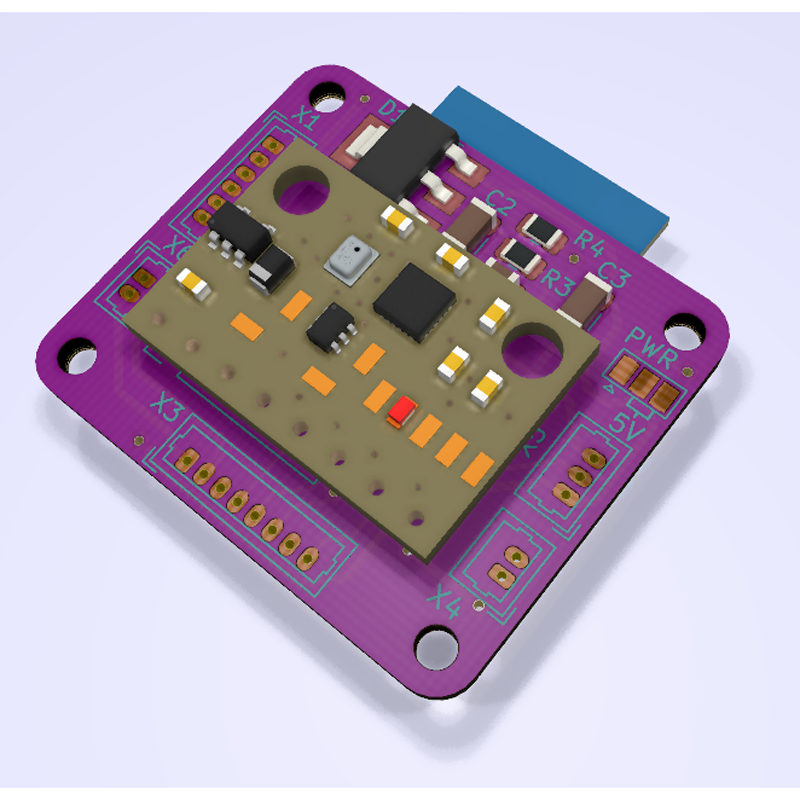
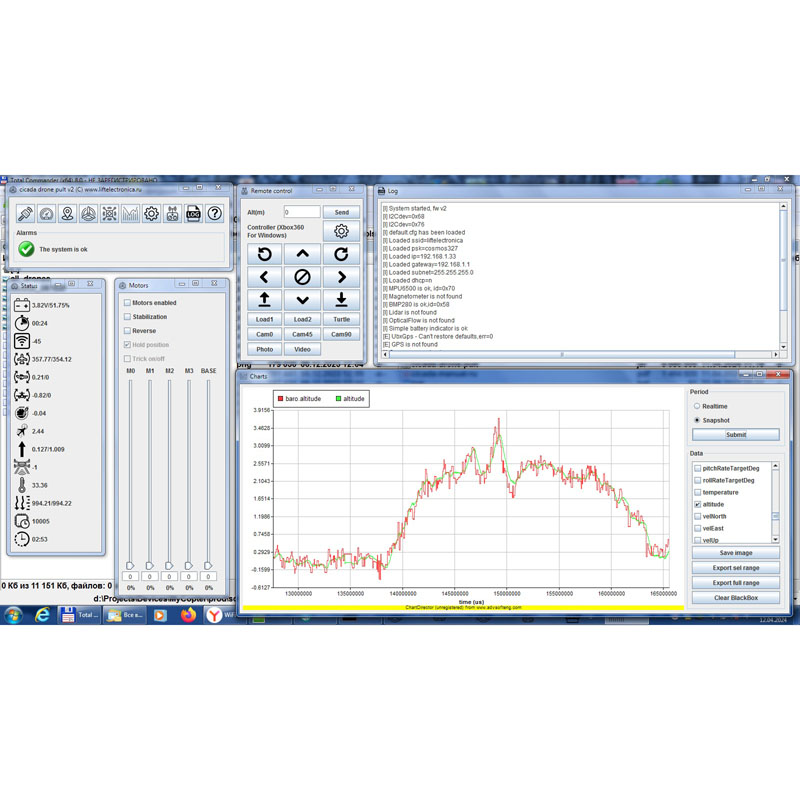
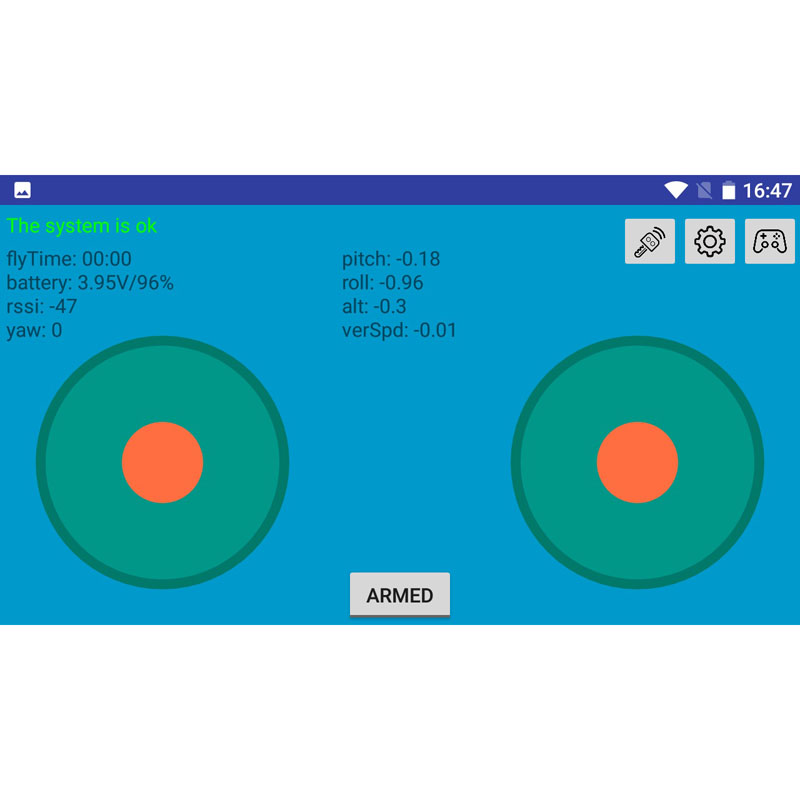
The Cicada Project is the flight controller based on ESP8266 Wifi module. You can make it yourself to come in the world of drone developers. Cicada doesn't have a hardware pult with sticks. To control a drone there is desktop application developed on Java and mobile application for Android v7 and higher. You can connect a gamepad to your smartphone or desktop to control a drone. The flight controller can work in WiFi normal mode as WiFi station or WiFi Access Point. Also It can work in WiFi Broadcast mode (WiFi monitor mode). To work in broadcast mode you have to connect the special wifi broadcast serial modem to your smartphone or desktop. The serial modem is easy. You can do it yourself easy. Just ESP-07 module + UART-USB bridge. Flash in ESP-07 the modem firmware which is placed in the folder /firmware/WifiBroadcastModemFw.
| Min | Typ | Max | |
| 1. Supply voltage | 3,4V | 5V | |
| 2. Update frequency | 100 Hz | ||
| 3. Control from notebook or smartphone through WiFi net. | 2.4 GHz | ||
| 4. Instant telemetry through WiFi net. Charts of all parameters. BlackBox is stored on host. Telemetry packets is sent every 10ms. | |||
| 5. Control devices: * Gamepad (supported by desktop and mobile applications) * Keyboard (supported by desktop application only) * Virtual keyboard (supported by desktop application only) * Virtual gamepad (supported by mobile application only) | |||
| 6. Control range | 100 meters | ||
| 7. Stabilization modes: * Stabilization of body angular rates * Stabilization of yaw,pitch,roll angles * Stabilization of vertical velocity (only if barometer or lidar are available in the system) * Stabilization of horizontal velocity (only if optical flow sensor or GPS are available in the system) | |||
| 8. Supported sensors and devices: * MPU9250 - imu chip * MPU6500 - imu chip * MPU6050 - imu chip * QMC5883L - magnetometer * BMP280 - barometer * VL53L1X - lidar * TFmini Plus (in I2C mode) - lidar * HCSR04 (in I2C mode) - sonar * BN180 and other GPS modules with UBX protocol * Analog 0-3V sensor of battery current * Servo 500-2400us to control camera pitch angle * Camera Runcam Split4 (only supported start/stop video commands) | |||
| 9. Electronic speed controllers: * DSHOT-300 to control BLDC motors * All listed below PWM-modesе to direct control coreless dc motors * PWM 2.5 kHz, resolution 2000 * PWM 5 kHz, resolution 1000 * PWM 10 kHz, resolution 500 * PWM 20 kHz, resolution 250 * PWM 40 kHz, resolution 125 * PWM 50 kHz, resolution 100 | |||
| 10. Dimensions * cicada-main-v4 * cicada-micro-v2 | 58,67mm х 41,65mm 26,67mm x 30,98mm | ||
| 11. Installation dimensions * cicada-main-v4 * cicada-micro-v2 | 48,51mm х 31,49mm 21,84mm x 26,16mm | ||
| 12. Weight * cicada-main-v4 with cicada-gy91-v3 * cicada-micro-v2 | 16g 6g |
Examples of drones you can find in drones folder of this project.
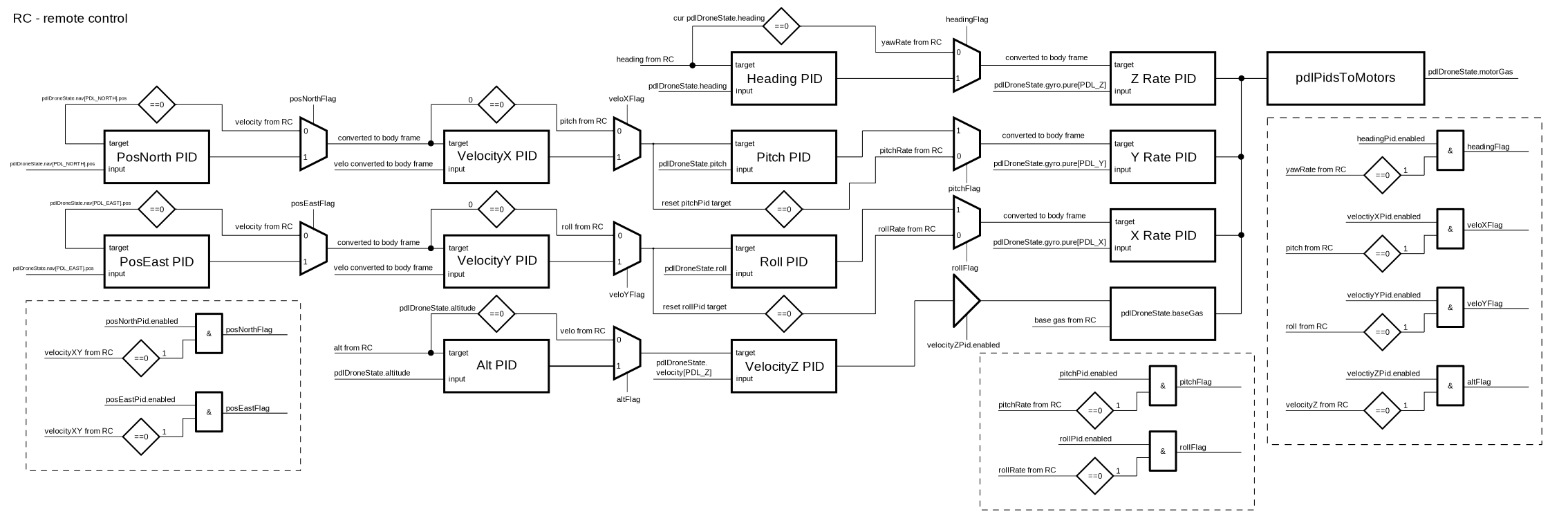
The firmware is based on PDL. Portable Drone Logic (PDL) is the lightweight pure C library implements a common drone logic. The goal of PDL is to be easy to use and easy to port to your hardware platform. PDL supports only quadcopters at this time.
It provides for you
PDL is a part of this project. But you can use it to create firmware for your own hardware platform. Documentation is available in /firmware/CicadaFw/libraries/pdl
To build firmware you need
Firmware supports update by the air. It is based on ESP8266HTTPUpdateServer.
| Qty | Value | Footprint | References |
|---|---|---|---|
| 6 | 3k3 | Resistor_SMD:R_0805_2012Metric | R3, R4, R5, R6, R7, R8 |
| 2 | 20 uF | Capacitor_SMD:C_1206_3216Metric | C2, C3 |
| 2 | Jumper_3_Bridged12 | Jumper:SolderJumper-3_P1.3mm_Open_Pad1.0x1.5mm | JP1, PWR |
| 1 | 100 nF | Capacitor_SMD:C_0805_2012Metric | C1 |
| 1 | 30k | Resistor_SMD:R_0805_2012Metric | R2 |
| 1 | 390k | Resistor_SMD:R_0805_2012Metric | R1 |
| 1 | ESC | Connector_Molex:Molex_PicoBlade_53047-1610_1x08_P1.25mm_Vertical | X3 |
| 1 | ESP-07 | custom:ESP-07-ThroughMount | U1 |
| 1 | Ext Pwr 5V | Connector_Molex:Molex_PicoBlade_53047-0410_1x02_P1.25mm_Vertical | X6 |
| 1 | GPS | Connector_Molex:Molex_PicoBlade_53047-1210_1x06_P1.25mm_Vertical | X1 |
| 1 | GY-91 Module | Connector_PinHeader_2.54mm:PinHeader_1x05_P2.54mm_Vertical | X2 |
| 1 | LDL1117SR33 | Package_TO_SOT_SMD:SOT-223-3_TabPin2 | D1 |
| 1 | Runcam | Connector_Molex:Molex_PicoBlade_53047-0410_1x02_P1.25mm_Vertical | X4 |
| 1 | Servo | Connector_Molex:Molex_PicoBlade_53047-0610_1x03_P1.25mm_Vertical | X5 |
The 21 most common of 25 parts.


GonzaCerv/noah-hardware
This repo contains all the hardware description for the Noah project. Here lies 3D models, electronics PCB and Firmware software of the robot.


ezcGman/tiny-power-meter
A very tiny 3-phase power meter to measure your homes power consumption and report to Home Assistant!

martin2250/SinglePhaseEnergyMonitor
an adapter to plug between a device and an outlet, to monitor electricity usage and provide data to influxdb


AirMQ/AirMQ-sensor
Root repository for AirMQ hardware project
It measures 31 × 26.7 mm and has 2 copper layers, 1.6 mm thick.
25 parts, built around the ESP-07. The full list of its parts is on this page, with links to each part's symbol and footprint where PCBKit's library has them.
From the mars2860/cicada repository on GitHub, at the commit this page was made from: the board is hardware/design/cicada-micro/cicada-micro.kicad_pcb. PCBKit opens the board in the browser, with nothing to install.
Its repository publishes it under the GPL-3.0 licence: you may reuse it on that licence's terms (keep the author's notice, and for a copyleft licence share your changes alike).