
2 layers87.6 × 100.8 mm
EtherKraken
karmakrafts/EtherKraken
A RP3A0 SiP based controller with 34 programmable IOs, Cortex M0 co-processor, 2MB of flash, SPI, I²C, UART and 100Base-T connectivity.
84 parts3Apache-2.0

 lefaris/TeXploR-quasi
This repository contains the system design documentation and quasistatic simulation for TeXploR2 (Tensegrity eXploratory Robot 2), a curved-link tensegrity robot capable of dynamic rolling locomotion through internal…
TeXploRV2 is an open-source printed circuit board by lefaris, from the lefaris/TeXploR-quasi repository on GitHub. It is a 2-layer board of 57.1 × 76.2 mm with 8 parts on 23 nets, routed with 91 tracks and 0 vias.
It is built around the RASPBERRY PI ZERO 2 W. It belongs with the Raspberry Pi (Linux) boards of this library.


This repository contains the system design documentation and quasistatic simulation for TeXploR2 (Tensegrity eXploratory Robot 2), a curved-link tensegrity robot capable of dynamic rolling locomotion through internal mass shifting. This work represents a significant advancement over the original TeXploR. This repo is supplemental for System Design of Tensegrity Robot Exhibiting Non-Intuitive Behavior accepted to IEEE ICRA 2026.
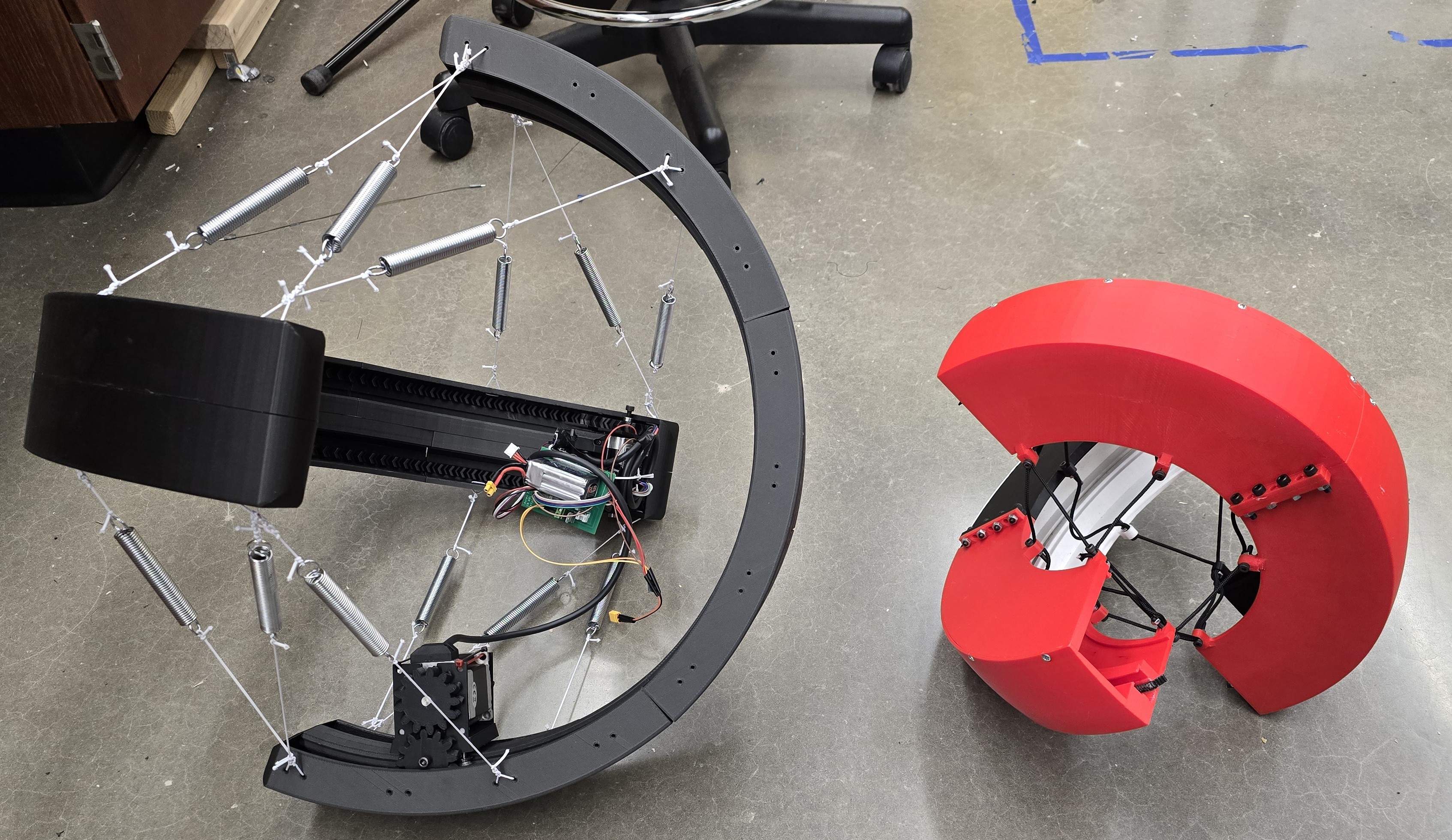 TeXploR2 (left, black) compared to the original TeXploR (right, red). TeXploR2 is completely redesigned for smoother dynamic movement regardless of shifting mass orientation (e.g., hanging upside down). The prototype is also significantly larger for additional central payload capabilities.
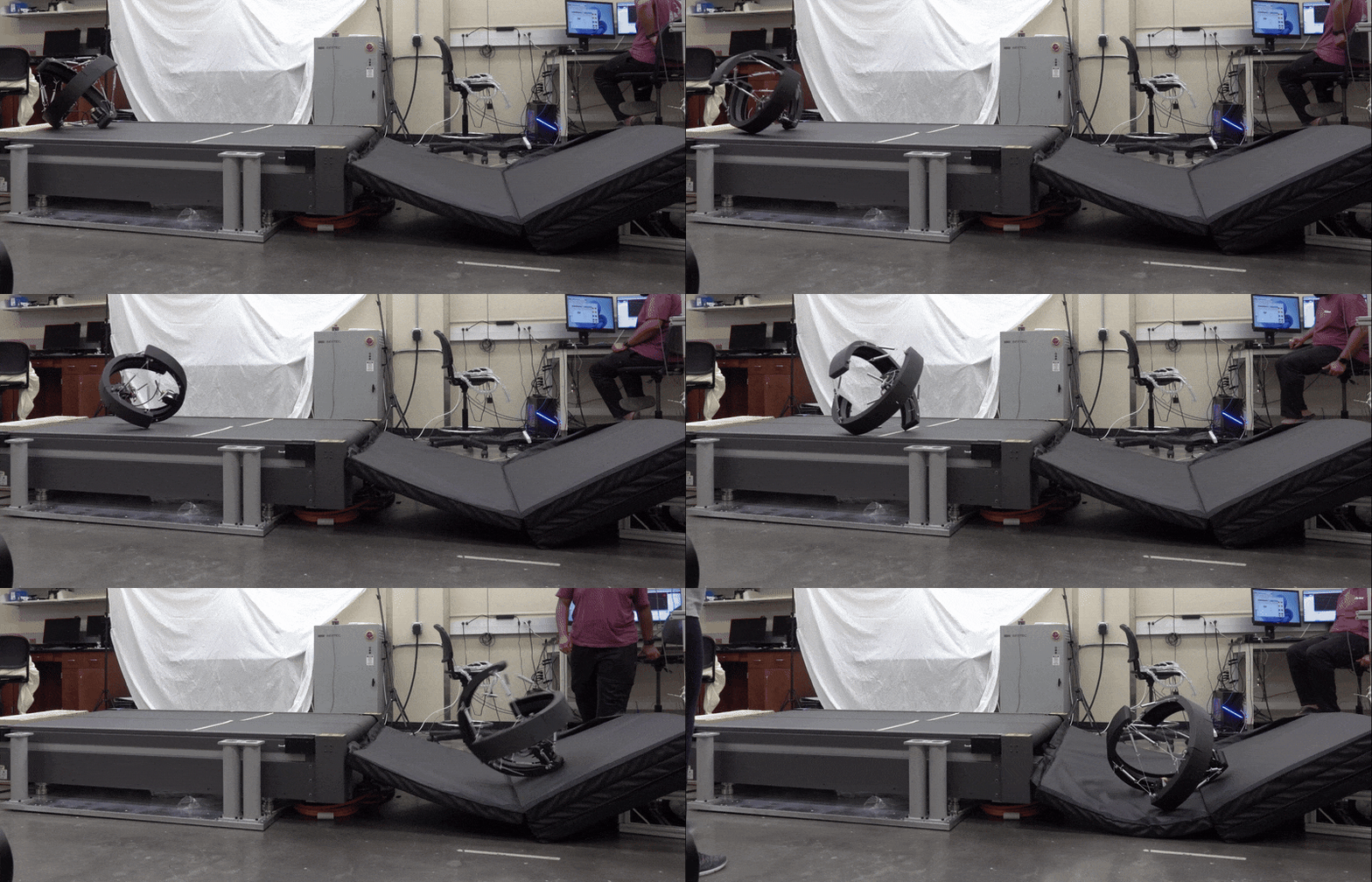
TeXploR2 is a curved-link tensegrity robot that achieves efficient rolling while maintaining stability through discontinuities present at arc endpoints. Unlike traditional straight-link tensegrity robots that contain slower toppling/walking locomotion gaits, TeXploR2's spherical-like design enables rolling.
This work showcases the system design for the TeXploR2 prototype. We also introduce non-intuitive state switching behavior that enables state transitions without requiring the shifting mass to reach arc endpoints. This enables faster state jumping and trajectory control.
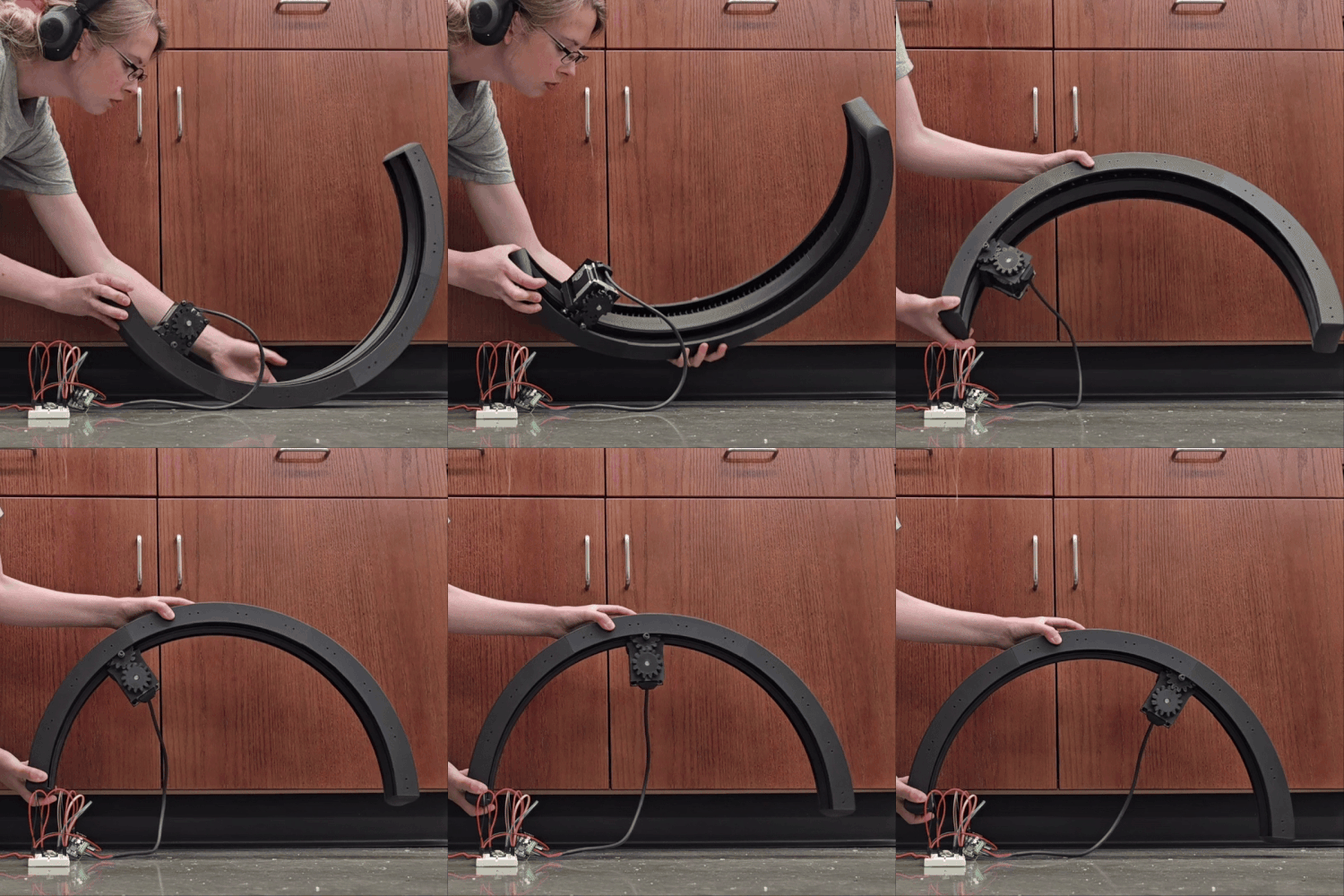
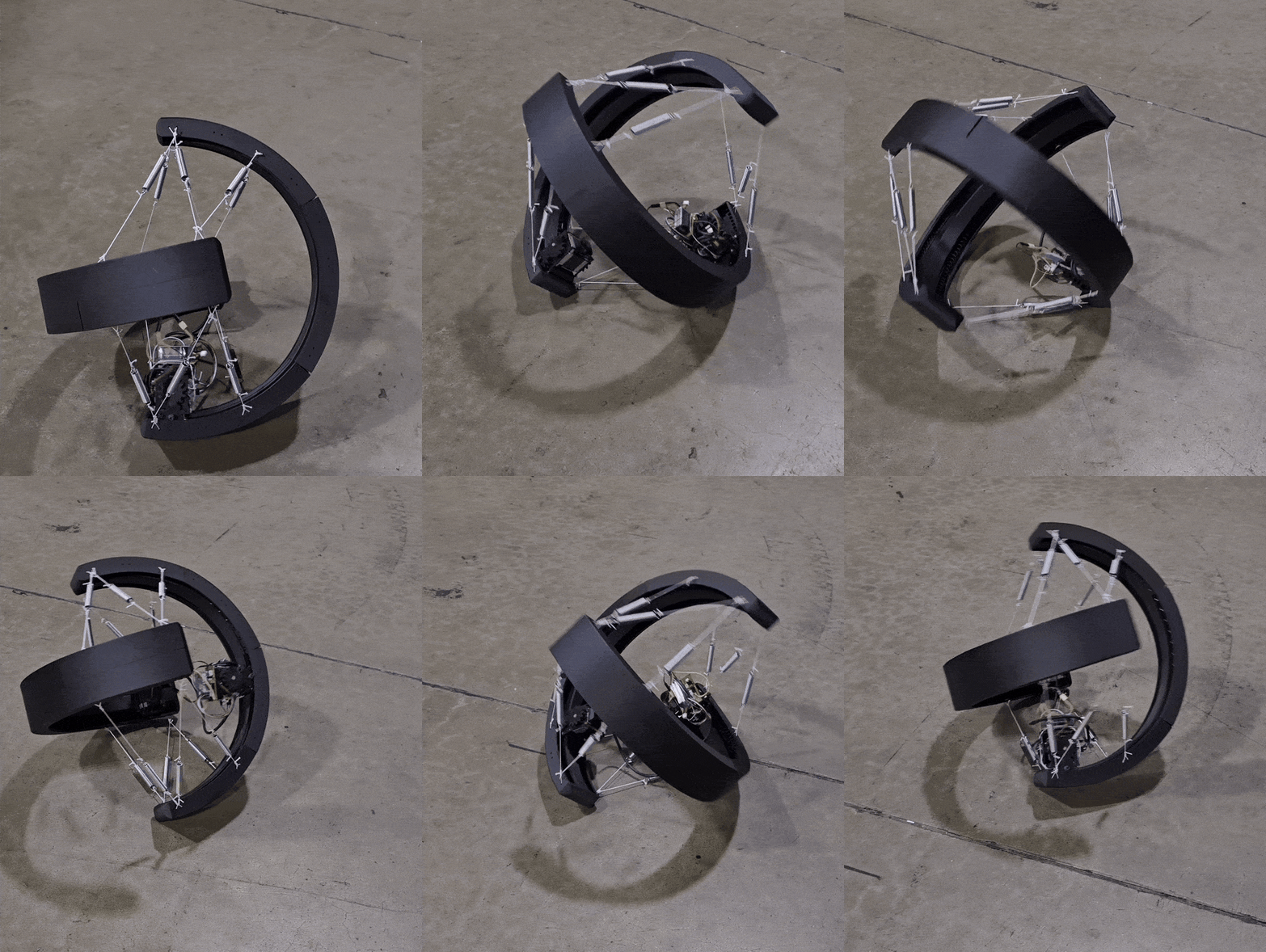
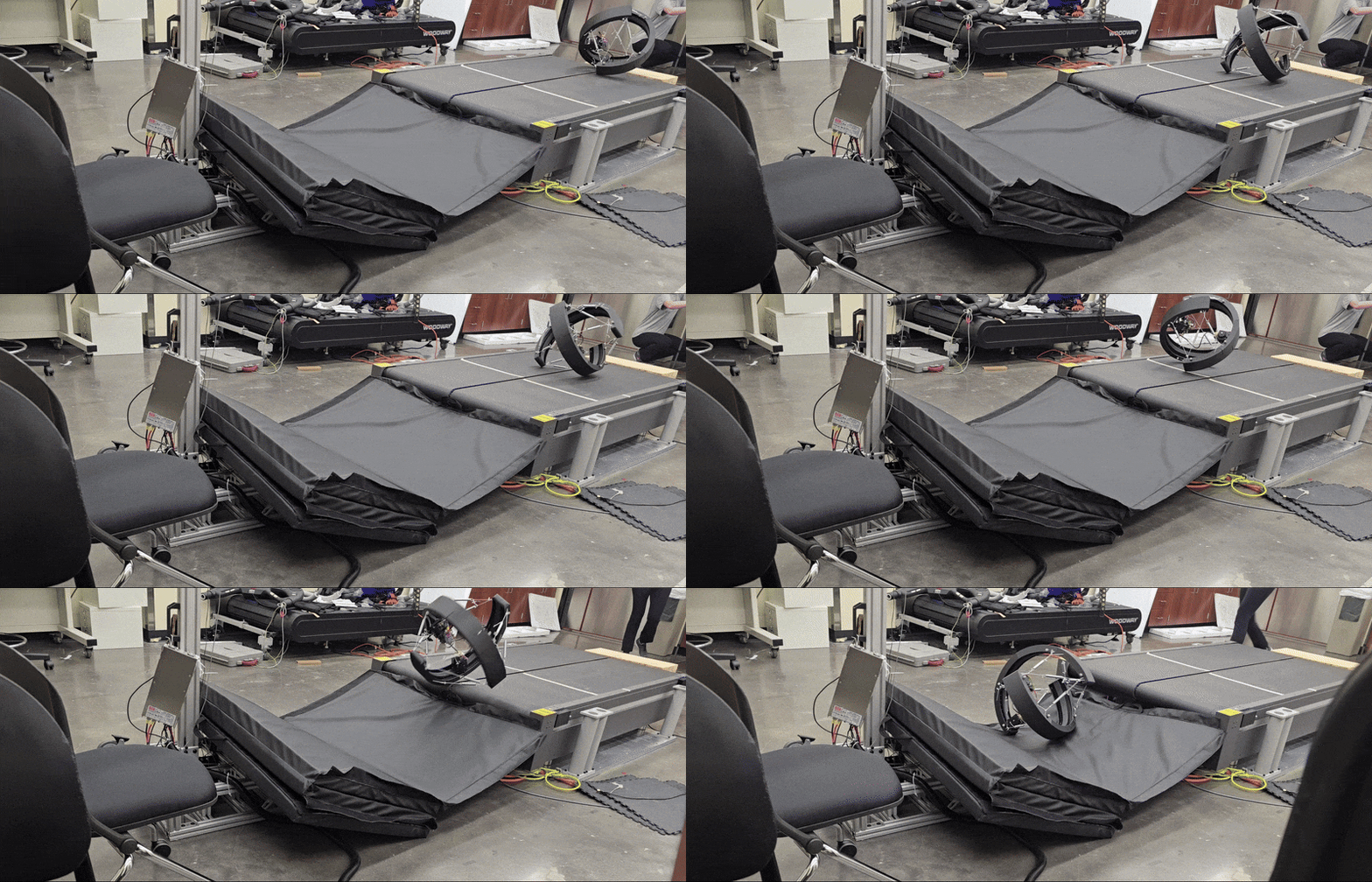
TeXploR-quasi/
├── quasistatic_modeling/   # MATLAB quasistatic simulation code
│   └── visualization/      # Simulation visualization
├── experiments/            # Motion capture data and test scripts
├── design_files/           # TeXploR2 design files
│   ├── CAD/                # Fusion files
│   └── PCB/                # KiCAD files
└── figures/ # Demo figures/videosClone the repository
git clone https://github.com/lefaris/TeXploR-quasi.git
cd TeXploR-quasi
Set up MATLAB path
addpath(genpath('quasistatic_modeling'))Run quasistatic simulation
cd quasistatic_modeling
run('TExploRStaticsDerivationsQuasi3(0, 90)')| Component | Specification |
|---|---|
| Arc Diameter | 585mm (vs. 403mm TeXploR v1) |
| Arc Width | 98mm (vs. 83mm TeXploR v1) |
| Arc Mass | ~1,300g each |
| Shifting Mass | 1,150g each |
| Mass Ratio | 0.88:1 (shifting:arc) |
| Material | Onyx (Markforged) |
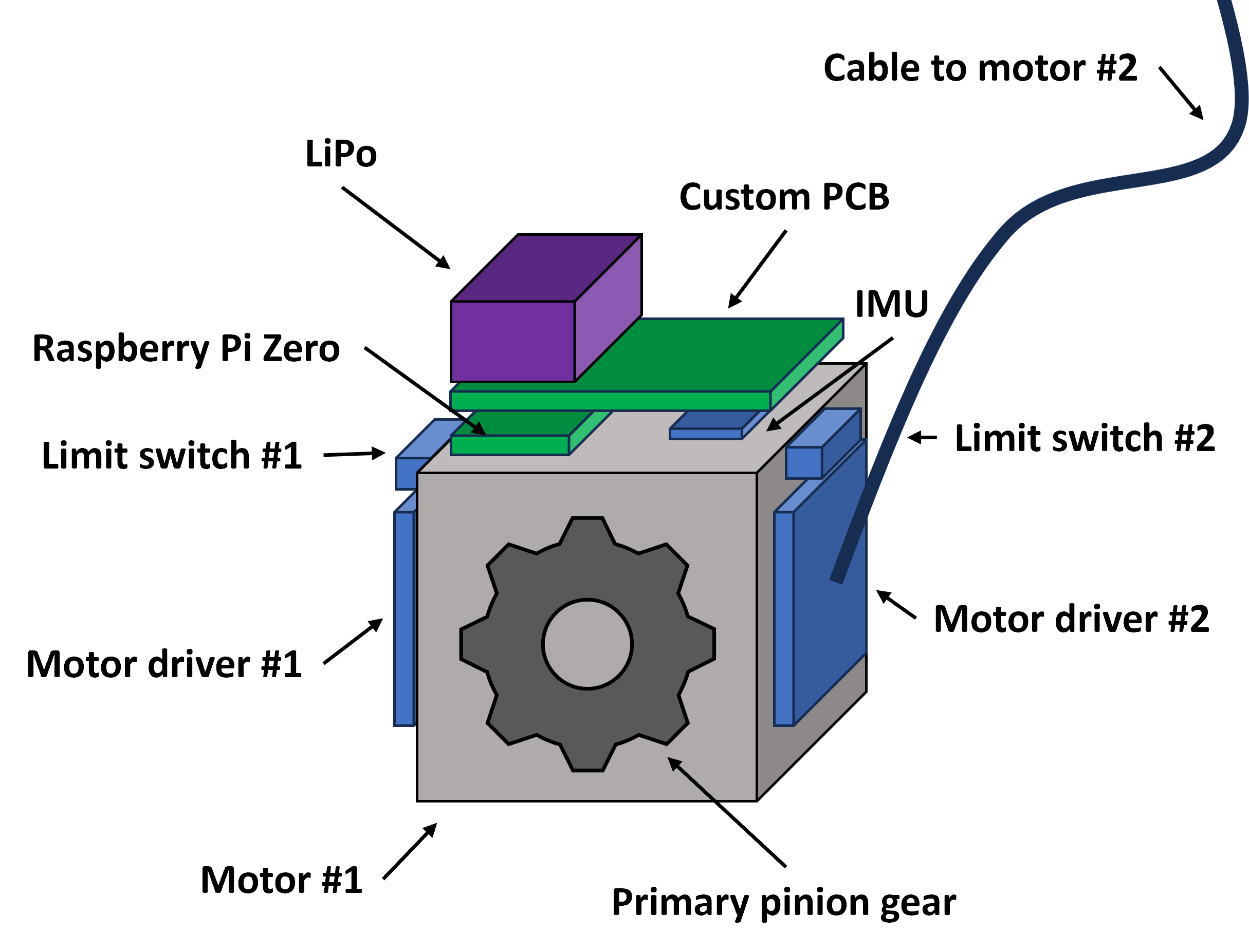
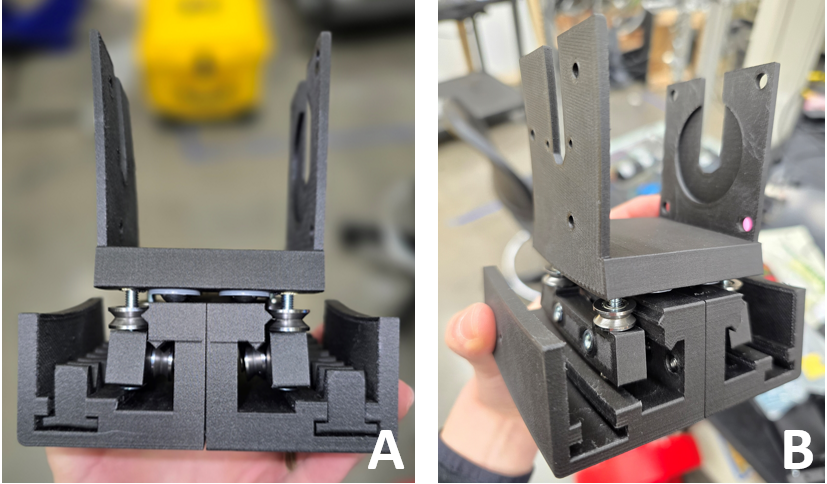
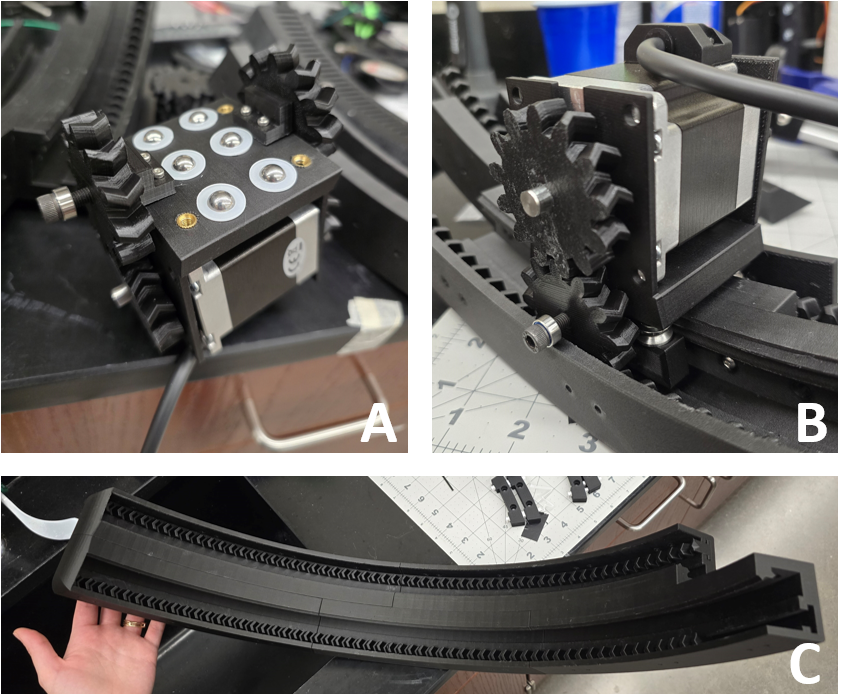
If you use this work in your research, please cite both papers:
@inproceedings{texplor2_2026,
  title={System Design of Tensegrity Robot Exhibiting Non-Intuitive Behavior},
  author={Ervin, Lauren and Bezawada, Harish and Vikas, Vishesh},
  booktitle={2026 IEEE International Conference on Robotics and Automation (ICRA)},
  year={2026},
  organization={IEEE}
}
arXiv preprint: arXiv (Coming Soon)
@article{texplor_2024,
  title={Geometric Static Modeling Framework for Piecewise-Continuous Curved-Link Multi Point-of-Contact Tensegrity Robots},
  author={Ervin, Lauren and Vikas, Vishesh},
  journal={IEEE Robotics and Automation Letters},
  year={2024},
  volume={9},
  number={12},
  pages={11066-11073},
  doi={10.1109/LRA.2024.3486199}
}This project is released for academic and research purposes.
| Qty | Value | Footprint | References |
|---|---|---|---|
| 4 | TeXploRV2:JST-PH4 | BNO1, BNO2, LS1, LS2 | |
| 1 | TeXploRV2:JST-PH6 | DRIVER | |
| 1 | 691137710002 | TeXploRV2:691137710002_16177944 | POWER |
| 1 | 7805TV | TeXploRV2:TO220V_262 | REGULATOR |
| 1 | RASPBERRY_PI_ZERO_2_W | TeXploRV2:MODULE_RASPBERRY_PI_ZERO_2_W | U1 |
karmakrafts/EtherKraken
A RP3A0 SiP based controller with 34 programmable IOs, Cortex M0 co-processor, 2MB of flash, SPI, I²C, UART and 100Base-T connectivity.


dihermos/GaiaBeronia
Gaia Beronia is an inspired on Flipper Zero embeeded system. It uses a system based on Python running on Linux in a Raspberry Pi Zero 2W.

impatrq/TEARIS
TEARIS (TEA + auris, latín: oído) es un sistema innovador de auriculares con cancelación activa de ruido adaptativa, creado para personas con Trastorno del Espectro Autista (TEA), PTSD, fibromialgia, migrañas crónicas y…


Sierra-College-Robotics-Club/GlowClock
PCB and Code for Sierra College Robotics Club Glow Clock

Stogalosu/Smart-Chess-Board
A smart chess board that connects to your phone and automatically makes moves

It measures 57.1 × 76.2 mm and has 2 copper layers, 1.6 mm thick.
8 parts, built around the RASPBERRY PI ZERO 2 W. The full list of its parts is on this page, with links to each part's symbol and footprint where PCBKit's library has them.
From the lefaris/TeXploR-quasi repository on GitHub, at the commit this page was made from: the board is design_files/PCB/TeXploRV2.kicad_pcb. PCBKit opens the board in the browser, with nothing to install.
Its repository states no licence, so its author keeps all rights: ask lefaris before reusing the design.