2 layers80 × 55 mm
Head
lachlanhurst/dukki
Bipedal robot based on Microduck, rebuilt around Unitree J288 servos and a Radxa CM4.
68 parts2MIT

 lachlanhurst/dukki2
Bipedal robot based on Microduck, rebuilt around Unitree J288 servos and a Radxa CM4.
Bridge is an open-source printed circuit board by lachlanhurst, from the lachlanhurst/dukki repository on GitHub, published under the MIT licence. It is a 2-layer board of 45 × 80 mm with 72 parts on 74 nets, routed with 605 tracks and 187 vias.
It is built around the LMR51606XDBVR-MS, BZT52C12S and 1N4148WS, with the B5819W, BAT54WS and BZT52C15 among its other parts. Its parts include 18 resistors, 15 capacitors, 10 connectors, 8 diodes and 6 fuses. It belongs with the robots and motor control and interfaces and adapters boards and the STM32 boards of this library.


[!IMPORTANT] Everything in here is very much a work in progress!
A rework of the Pollen Robotics Microduck with a few hardware changes:
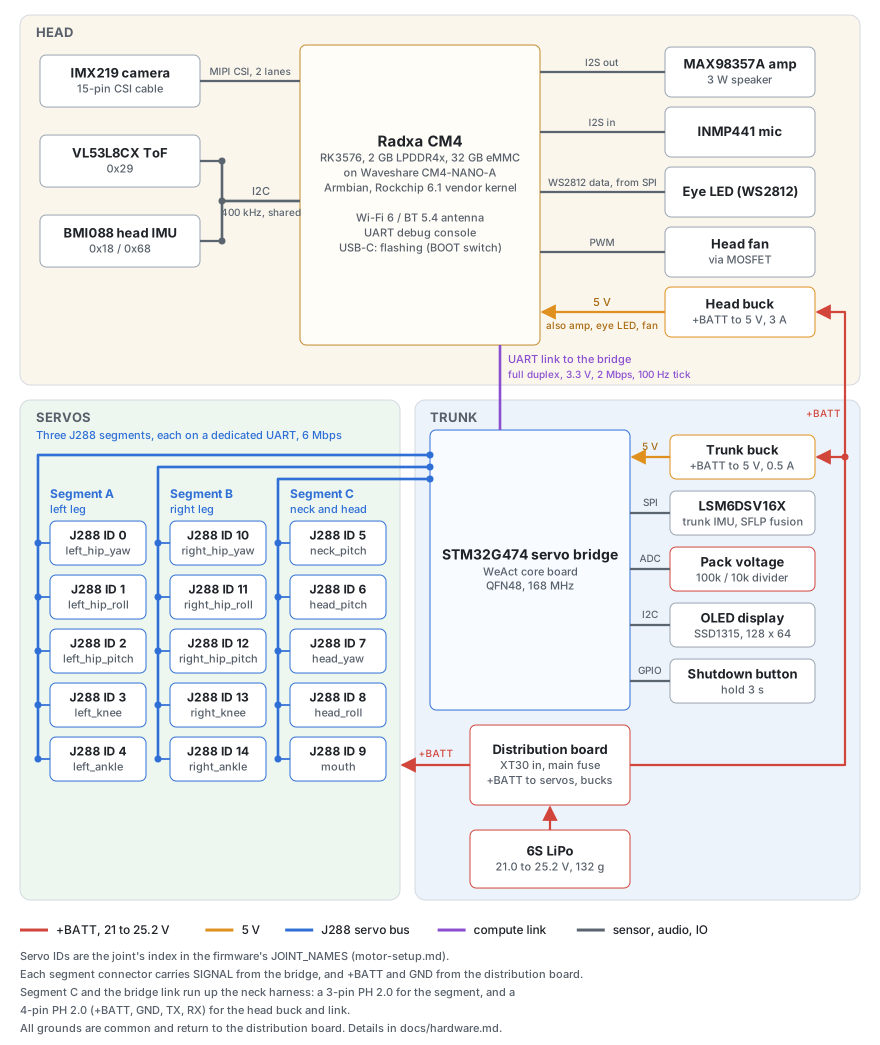
This repository holds the Dukki documentation, the hardware design files (KiCad), and the code that doesn't fit neatly into one of the forked repos, such as the STM32 servo bridge firmware, compute module setup scripts and J288 bench test tools. Changes elsewhere live on branches of forked repos: the robot firmware in microduck (dukki), RL training in microduck_rl (dukki-j288), the J288 actuator model in bam (unitree-j288) and the head IMU driver in bmi088-rs (configurable-addresses).
Hardware is the main design document. It covers each subsystem (servos, compute, the STM32 servo bridge, IMUs, power, audio, camera, ToF) and compares it with the OG robot.
Compute setup takes a Radxa CM4 from the box to a board on WiFi at microduck.local. That includes flashing Armbian to the eMMC.
Servo setup is the bench procedure for each J288 before assembly. You set the bus ID with Unitree's Windows tool, record the firmware version, run a motion check and label the servo for its joint.
J288 bench testing has the results from characterising one servo: bus timing, friction, armature, torque limits and heating. The main finding is that peak output torque is about 0.45 N·m, close to the XL330.
Camera setup and audio setup bring up the IMX219 camera and the MAX98357A speaker and INMP441 microphone on the CM4.
MIT, see LICENSE. The third-party datasheets and schematics in docs/datasheets/ belong to their publishers and are not covered by it.
| Qty | Value | Footprint | References |
|---|---|---|---|
| 5 | 2.2u 50V | Capacitor_SMD:C_0805_2012Metric | C1, C5, C6, C7, C8 |
| 4 | 0R | Resistor_SMD:R_0603_1608Metric | R5, R6, R7, R8 |
| 4 | 1M | Resistor_SMD:R_0603_1608Metric | R13, R15, R20, R22 |
| 4 | 4A | Fuse:Fuse_1206_3216Metric | F2, F3, F4, F5 |
| 4 | M2 | MountingHole:MountingHole_2.2mm_M2 | H1, H2, H3, H4 |
| 3 | 100n 50V | Capacitor_SMD:C_0603_1608Metric | C9, C10, C13 |
| 3 | 2N7002 | Package_TO_SOT_SMD:SOT-23 | Q2, Q3, Q5 |
| 2 | 100k | Resistor_SMD:R_0603_1608Metric | R11, R14 |
| 2 | 10k | Resistor_SMD:R_0603_1608Metric | R4, R12 |
| 2 | 10u 50V X7R | Capacitor_SMD:C_1210_3225Metric | C3, C4 |
| 2 | 1u 50V X7R | Capacitor_SMD:C_0805_2012Metric | C14, C15 |
| 2 | 22u 25V | Capacitor_SMD:C_0805_2012Metric | C11, C12 |
| 2 | 470k | Resistor_SMD:R_0603_1608Metric | R1, R2 |
| 2 | BZT52C12S | Diode_SMD:D_SOD-323 | D9, D13 |
| 1 | 10A | Fuse:Fuse_1206_3216Metric | F1 |
| 1 | 130k | Resistor_SMD:R_0603_1608Metric | R9 |
| 1 | 1N4148WS | Diode_SMD:D_SOD-323 | D12 |
| 1 | 1k | Resistor_SMD:R_0603_1608Metric | R3 |
| 1 | 2.2M | Resistor_SMD:R_0603_1608Metric | R21 |
| 1 | 22k | Resistor_SMD:R_0603_1608Metric | R10 |
| 1 | 2A | Fuse:Fuse_1206_3216Metric | F6 |
| 1 | 33u | Inductor_SMD:L_Sunlord_SWPA6045S | L1 |
| 1 | 47n 50V | Capacitor_SMD:C_0603_1608Metric | C2 |
| 1 | B5819W | Diode_SMD:D_SOD-123 | D8 |
| 1 | BAT54WS | Diode_SMD:D_SOD-323 | D11 |
| 1 | BZT52C15 | Diode_SMD:D_SOD-123 | D1 |
| 1 | Ext 5V | Connector_PinHeader_2.54mm:PinHeader_1x04_P2.54mm_Vertical | J9 |
| 1 | Head | Connector_JST:JST_PH_B4B-PH-K_1x04_P2.00mm_Vertical | J6 |
| 1 | LMR51606XDBVR | Package_TO_SOT_SMD:SOT-23-6 | U1 |
| 1 | LSM6DSV16X breakout | LSM6DSV16X_Breakout:LSM6DSV16X_Breakout | U3 |
| 1 | MMBT3906 | Package_TO_SOT_SMD:SOT-23 | Q4 |
| 1 | NCE40P70K | Package_TO_SOT_SMD:TO-252-2 | Q1 |
| 1 | OLED | Connector_JST:JST_PH_B5B-PH-K_1x05_P2.00mm_Vertical | J7 |
| 1 | PA5 breakout | Connector_PinHeader_2.54mm:PinHeader_1x04_P2.54mm_Vertical | J10 |
| 1 | Power button | Connector_JST:JST_PH_B2B-PH-K_1x02_P2.00mm_Vertical | J8 |
| 1 | SMBJ26A | Diode_SMD:D_SMB | D2 |
| 1 | Seg A | Connector_JST:JST_PH_B3B-PH-K_1x03_P2.00mm_Vertical | J2 |
| 1 | Seg B | Connector_JST:JST_PH_B3B-PH-K_1x03_P2.00mm_Vertical | J3 |
| 1 | Seg C | Connector_JST:JST_PH_B3B-PH-K_1x03_P2.00mm_Vertical | J4 |
| 1 | Seg D | Connector_JST:JST_PH_B3B-PH-K_1x03_P2.00mm_Vertical | J5 |
| 1 | WeAct STM32G474 QFN48 | WeAct_STM32G474CoreBoard:WeAct_STM32G474CoreBoard_QFN48 | U2 |
| 1 | XT30U-M | Connector_AMASS:AMASS_XT30U-M_1x02_P5.0mm_Vertical | J1 |
| 1 | bridge = always on | Jumper:SolderJumper-2_P1.3mm_Open_RoundedPad1.0x1.5mm | JP2 |
| 1 | cut to isolate buck | Jumper:SolderJumper-2_P1.3mm_Bridged_RoundedPad1.0x1.5mm | JP1 |
| 1 | green | LED_SMD:LED_0603_1608Metric | D3 |
lachlanhurst/dukki
Bipedal robot based on Microduck, rebuilt around Unitree J288 servos and a Radxa CM4.

levdan159/abx-motion
ABX-Motion 12V-32V ESP32-S3 4-Layer Robotics Controller (Dual 100W DC Servo H-Bridges, Dual Steppers, Dual Relays, CAN, RS-485, USB-C)

ssbingo/samba-solar-track
Samba Solar Track – Solarnachführung mit Sturmschutz: Handbuch, Platine und Gehäuse für den Nachbau (10,1-Zoll-Version)

ClemensElflein/xESC
The xESC is an easy to use, low cost electronic speed controller (ESC) design for sensored brushless DC (BLDC) motors.

BCIT-BAJA/BCIT-BAJA-DAQ
The telemetry system for BCIT-BAJA car, collects strain across suspension components of car to allow BAJA to optimize material and reinforce weak areas of suspension.


MidwestMotorBoy/Battery-Bank
Monolith: an ultralight IP67 power bank for backpacking. 4S BAK 65E 21700 (91 Wh, under the 100 Wh airline limit), two bidirectional 100 W USB-C PD ports, Bluetooth LE (TI CC2340) with an iPhone app.

baldengineer/Mega-IIe
Using the Mega II from a IIgs to make a Apple IIe compatible computer: The Mega IIe!

deep-th/CAN_Logger
This is a compact and reliable CAN logger board built for automotive and industrial applications. It features the ESP32-S3 microcontroller and MCP25625 CAN controller with integrated transceiver, supporting two…
It measures 45 × 80 mm and has 2 copper layers, 1.6 mm thick.
72 parts, built around the LMR51606XDBVR-MS, BZT52C12S, 1N4148WS and B5819W. The full list of its parts is on this page, with links to each part's symbol and footprint where PCBKit's library has them.
From the lachlanhurst/dukki repository on GitHub, at the commit this page was made from: the board is hardware/bridge/bridge.kicad_pcb and its schematic hardware/bridge/bridge.kicad_sch. PCBKit opens the board in the browser, with nothing to install.
Its repository publishes it under the MIT licence: you may reuse it on that licence's terms (keep the author's notice, and for a copyleft licence share your changes alike).