4 layers60.2 × 60.5 mm
ESP32 FlightController
durveshpathak1989/kicad-local-agent
Free local Ollama agent for generating and validating KiCad project files
73 partsMIT

 kaorii-ako/Poket
ESP32-S3 Bluetooth MP3 player - custom PCB + 3D-printed case, built from scratch
Poket is an open-source printed circuit board by kaorii-ako, from the kaorii-ako/Poket repository on GitHub. It is a 4-layer board of 80 × 54 mm with 104 parts on 68 nets, routed with 876 tracks and 304 vias.
It is built around the CP2102N-A02-GQFN24, PAM8908JER and AP2112K-3.3, with the ESP32-WROOM-32E-N16R2, PCM5102APW and USBLC6-2SC6 among its other parts. Its parts include 36 capacitors, 36 resistors, 8 ICs, 7 switches and 6 connectors. It belongs with the radio and wireless boards and the ESP32 boards of this library.


A pocket Bluetooth MP3 player built around an ESP32-S3.
Plays MP3s off a microSD card and sends them either to Bluetooth headphones (A2DP source) or out a 3.5 mm jack.
Rev B changed the MCU. The board started on an ESP32-S3, which turned out to have Bluetooth LE only — no BR/EDR — so A2DP could never have worked on it.
soc_caps.hin ESP-IDF spells it out: the S3 definesSOC_BLE_SUPPORTEDand notSOC_BT_CLASSIC_SUPPORTED. The classic ESP32 in the WROOM-32E-R2 has both, keeps its 2 MB PSRAM inside the chip package (so GPIO16/17 stay free, unlike a WROVER), and costs a USB-UART bridge because it has no native USB. 0.96" OLED, rotary encoder, three transport buttons, LiPo with USB-C charging and a coulomb-counting fuel gauge.
| MCU | ESP32-WROOM-32E-N16R2 (16 MB flash, 2 MB in-package PSRAM) |
| Storage | microSD over SPI |
| DAC | PCM5102A (I2S, internal PLL — no MCLK needed) |
| Headphone amp | PAM8908, charge-pump / ground-centred output |
| Charger | MCP73831, 500 mA, P-FET load share |
| Fuel gauge | BQ27441-G1 with 10 mΩ sense resistor |
| Rail | AP2112K-3.3, separate ferrite-isolated 3V3A for the audio |
| USB | CP2102N-A02 bridge + cross-coupled auto-reset (this part has no native USB) |
| Board | 80 × 54 mm, 4 layer (Sig / solid GND / Sig / Sig) |
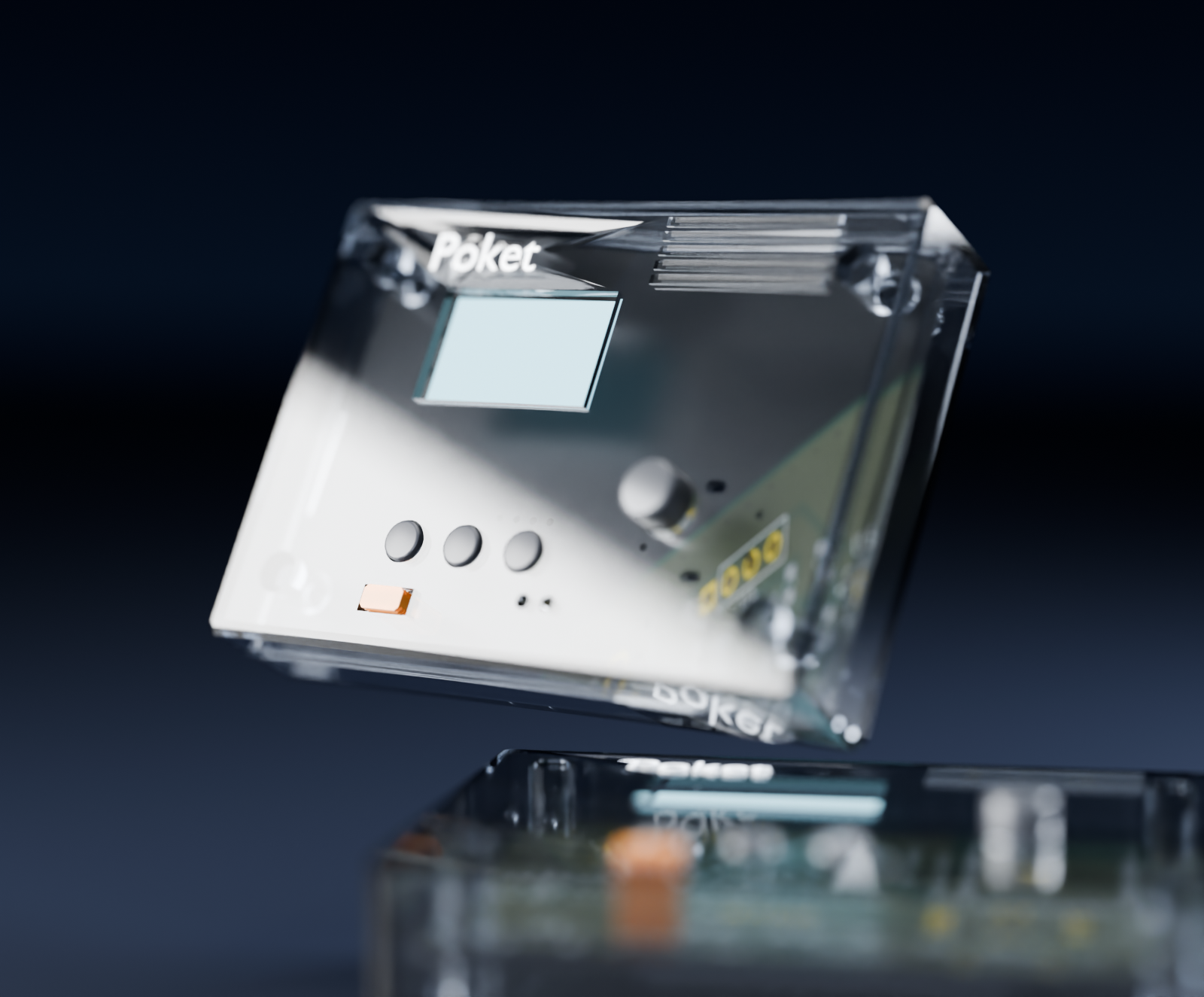
| Case | 86 × 60 × 16.8 mm, 3D printed, two shells + slider cap, chamfered edges |
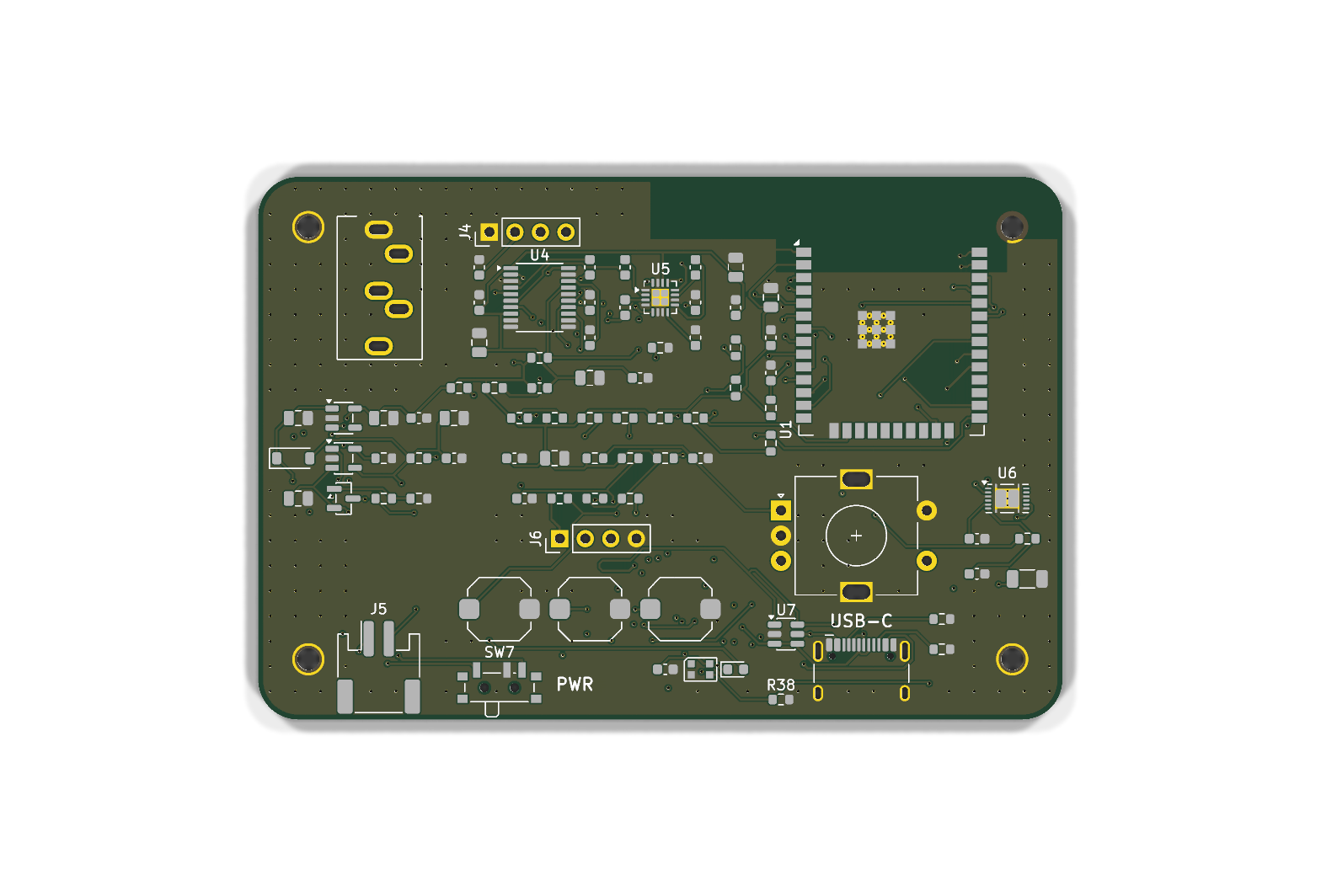
Top side: ESP32-S3 module and its antenna keepout top-right, audio chain and power block under where the OLED sits, encoder centre-right, three transport buttons along the bottom, USB-C bottom-right, 3.5 mm jack top-left.
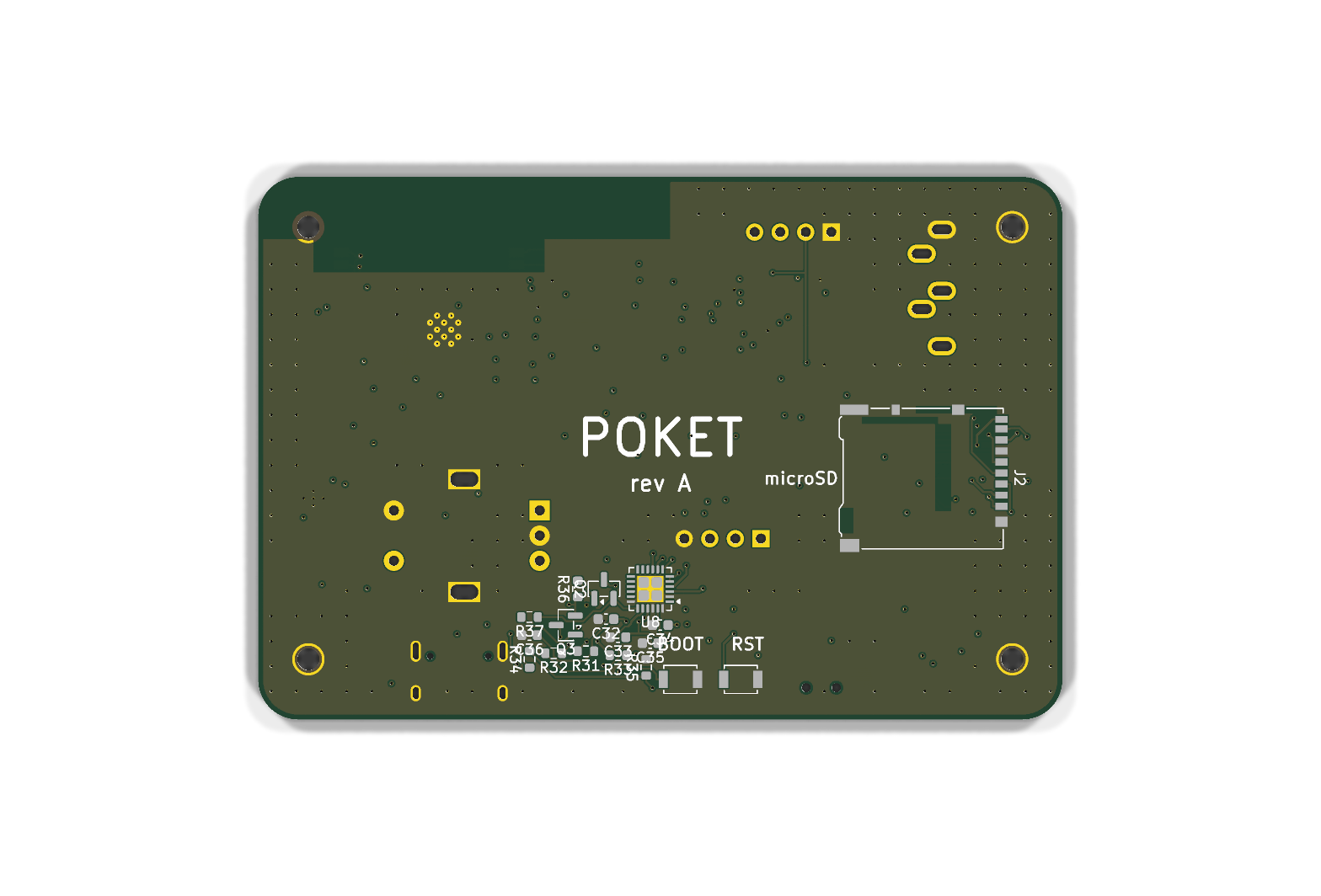
Bottom side carries the microSD socket and the BOOT/RESET buttons, so the top face stays clean. Right: all four copper layers together — In1.Cu is a solid ground plane with no signal on it at all.
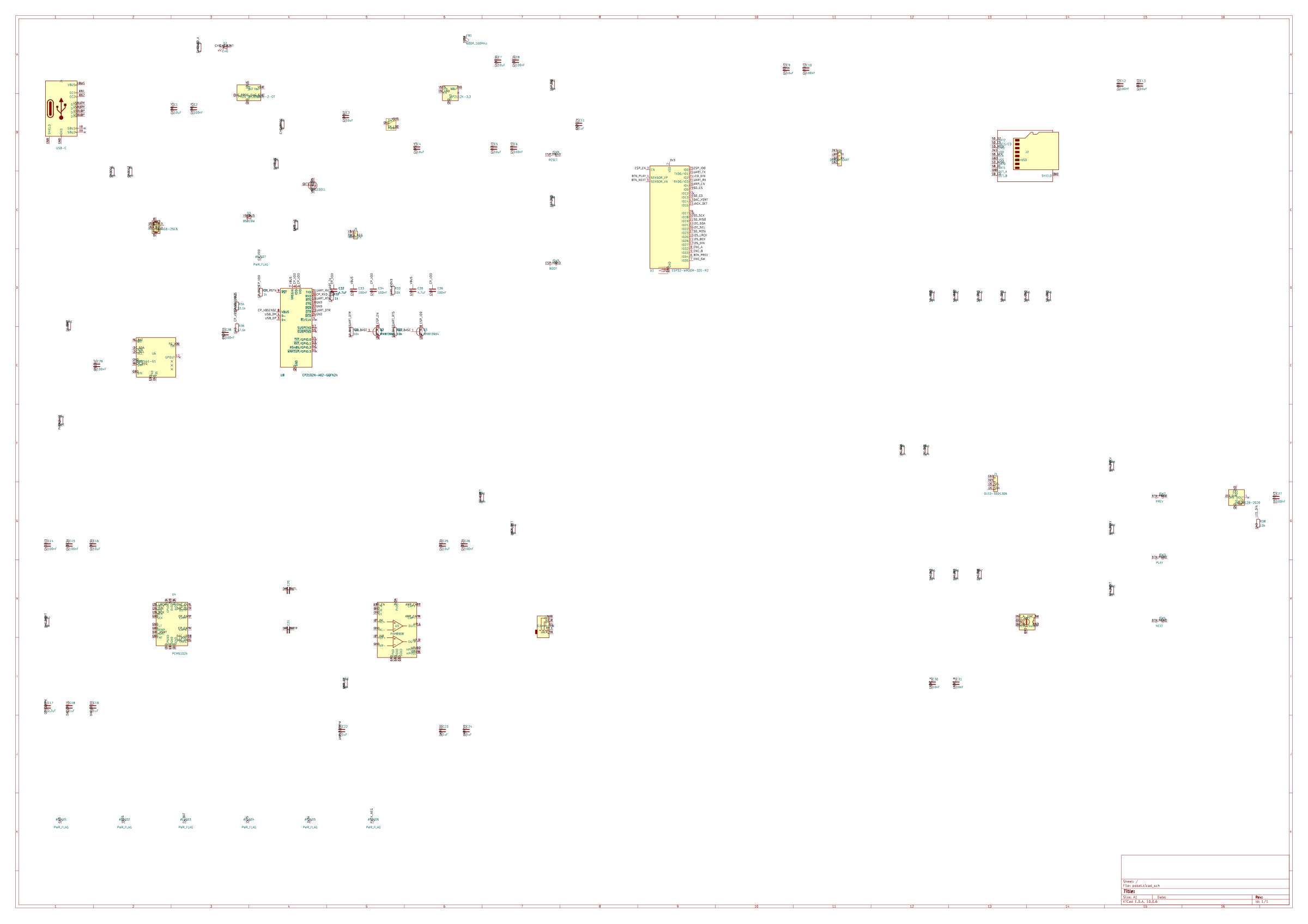
Full schematic (also as a PDF: docs/poket-schematic.pdf).
ERC clean — 0 errors, 0 warnings.
ESP-IDF v5.3, C. Reads MP3s off the card with a vendored minimp3, decodes into PSRAM and pushes PCM to either sink — I2S to the PCM5102A, or A2DP source to a paired pair of headphones.
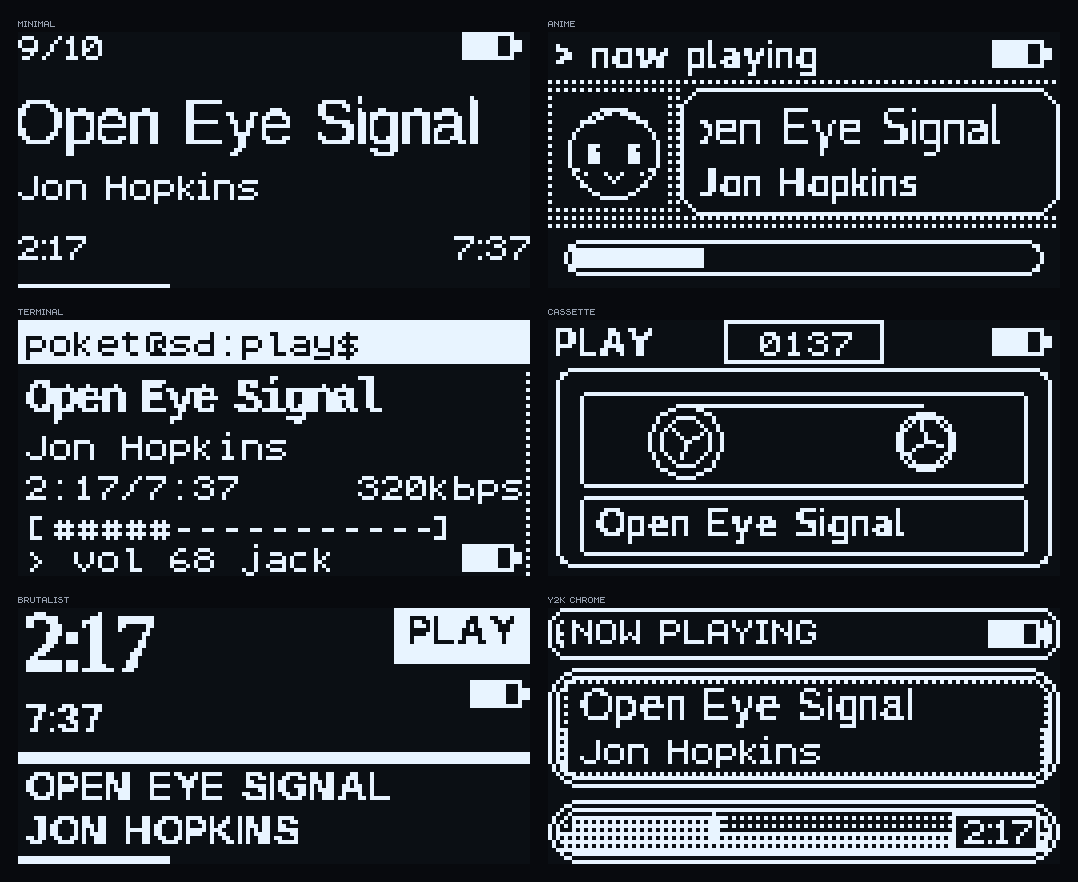
Six themes ship, and they are not palette swaps — a 1-bit 128 x 64 panel has no colour to vary, so each one earns its difference through layout, typeface, iconography and motion. Clockwise from top-left: Minimal, Anime (a face that blinks on its own timer), Cassette (reels that wind across as the track plays), Y2K Chrome, Brutalist, Terminal. A seventh slot takes a custom theme uploaded from the browser; that one is data, not code, so an uploaded pack can lay out screens but can never execute on the device.
The two smallest faces are a hand-drawn 5x8 bitmap table
(tools/font5x8.py) — rasterising an outline at
7-8 px loses whole stems, and a 1-bit panel has no antialiasing to hide that
with. The rest come from real faces through
tools/mkfont.py.
ESP-IDF v5.3, target esp32. Full detail in
firmware/README.md.
. $HOME/esp/esp-idf/export.sh
cd firmware
idf.py set-target esp32          # once
idf.py build
idf.py -p /dev/ttyUSB0 flash monitor
sdkconfig.defaults carries the flash size, PSRAM, Classic Bluetooth and the
partition table, so a clean tree builds without menuconfig. The CP2102N bridge
handles reset and boot mode, so flashing needs no button presses; if auto-reset
ever fails, hold BOOT, tap RESET, release BOOT.
Then: put MP3s in /Music on a FAT32 card, power on, long-press the encoder,
join the Poket-XXXX network shown on screen and open http://192.168.4.1.
Hold the encoder and Poket brings up its own Wi-Fi access point and serves a
page: drag MP3s onto it to write them to the card, browse the library, drive
transport, and pick the screen theme with a live 128 x 64 preview. The
preview is not an artist's impression — web/proto/oled.js is a port of
ui/gfx.c and runs the same theme code against the same generated glyph bytes,
painted at an integer zoom so one panel pixel is exactly N x N screen pixels
with smoothing off.
Four design directions are prototyped in
firmware/web/proto/ — open index.html:
jcard.html | ink on cassette card stock; upload zone is a blank Side B |
bench.html | desk instrument — keycaps with travel, knurled knob, amber readout |
fab.html | the board documenting itself: silkscreen on solder mask, designators, title block |
plain.html | the canon settings page; the control the other three have to beat |
Wi-Fi and Bluetooth share one radio, so while the page is being served audio routes out the 3.5 mm jack.
video/poket-promo.mp4 | 22 s product film — five shots, titles |
video/poket-assembly.mp4 | 6.5 s — parts drop in, then a turntable |
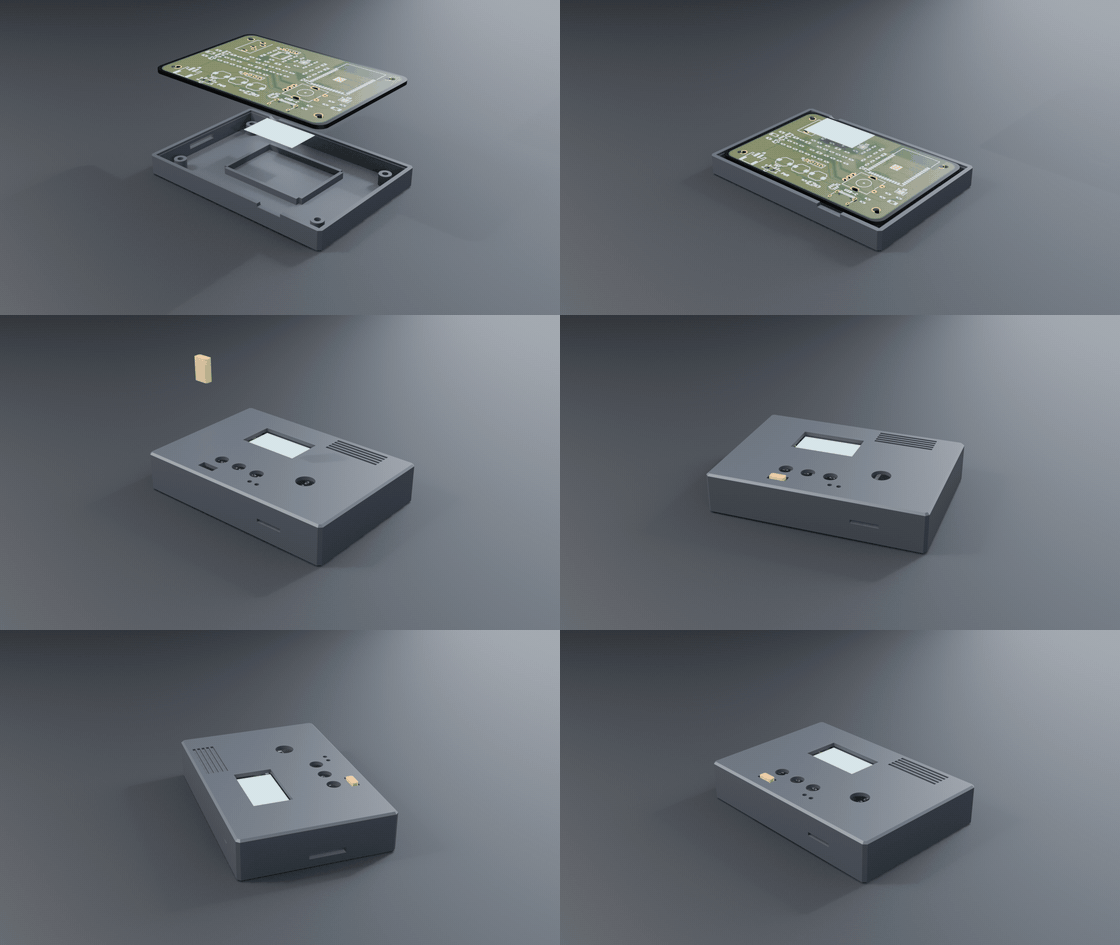
Both are rendered from the same Blender scene, which rebuilds from scratch
with blender/build_scene.py (set MODE to "promo" or "assembly").
Encode the PNG sequences with tools/encode_video.sh.
docs/BOM.md — bill of materials, ~$46/unitdocs/ASSEMBLY.md — how to build onedocs/DESIGN.md — why each part was chosen, and the trade-offsdocs/SUBMISSION.md — what's done, what isn'tJOURNAL.md — build logpoket.kicad_sch / .kicad_pcb / .kicad_pro KiCad 10 project
firmware/ ESP-IDF app - drivers, audio, UI themes, web app
cad/enclosure.py parametric enclosure (FreeCAD, headless)
enclosure/*.step, *.stl exported case parts
docs/ BOM, assembly, design notes, schematic PDF
fab/ gerbers, drill, pick-and-place
images/ renders and screenshots
blender/ animation scene + board textures
video/ promo + assembly animations
tools/ fab export, video encode, PCB helper scripts
JOURNAL.md build logflatpak run --filesystem=host --command=FreeCADCmd org.freecad.FreeCAD cad/enclosure.pyEverything is driven by the constants at the top of cad/enclosure.py, so
if the PCB outline or a connector moves, change the number and re-run.
PETG or PLA, 0.2 mm layers, 4 perimeters, 20 % infill, no supports needed. Front shell prints face-down, back shell prints tray-up. 4 × M2 heat-set inserts (3.2 mm OD) in the front shell bosses; 4 × M2 × 12 screws from the back.
Hardware — ERC 0 errors, 0 warnings; DRC 0 errors, 0 schematic-parity
issues, every signal net routed. The enclosure booleans against the real board
STEP with 0.0000 mm³ interference. Gerbers, drill and pick-and-place in
fab/ are generated from this revision.
Firmware — complete and building. ESP-IDF v5.3, idf.py build succeeds from
a clean tree; poket.bin is 1.5 MB with 64 % of the app partition free. Drivers,
the audio path with A2DP linking, microSD over SPI, the library scanner, .m3u
playlists, the 1-bit graphics layer with six themes, the Wi-Fi access point, the
HTTP server and the web app are all in firmware/. Build and flash instructions:
firmware/README.md.
Not built. No board has been fabricated, no part soldered, and no firmware
has ever run on hardware. Every image here is a render. The design is verified
in software and the firmware compiles — but "passes DRC and builds" and "works"
are different claims, and only the first is being made. Full gap list:
docs/SUBMISSION.md.
Three ground-pour fragments are untied, two of which carry a bypass capacitor's ground. Documented rather than hidden.
Not yet reviewed by another person. This needs a second pair of eyes before fabrication, and nobody has given it one yet.
When someone does, record it here: who reviewed it, when, what they flagged, and what changed as a result. An unreviewed board is a board with exactly one person's blind spots in it — and this project has already had one part choice that a reviewer would very likely have caught (the ESP32-S3 cannot do A2DP, which is the whole point of the device).
Worth a reviewer's attention in particular:
Q2 drives EN, Q3 drives IO0, emitters
cross). Both came from datasheets rather than from a copied schematic.MIT for code, CERN-OHL-S v2 for the hardware design files. See LICENSE.
| Qty | Value | Footprint | References |
|---|---|---|---|
| 22 | 10k | Resistor_SMD:R_0603_1608Metric | R11, R12, R13, R14, R15, R16, R17, R18, R19, R25, R26, R27, R28, R29, R30, R33 +6 |
| 14 | 100nF | Capacitor_SMD:C_0603_1608Metric | C2, C6, C8, C10, C12, C14, C15, C26, C27, C28, C29, C33, C34, C36 |
| 9 | 10uF | Capacitor_SMD:C_0805_2012Metric | C1, C3, C4, C5, C7, C9, C13, C16, C25 |
| 8 | 1uF | Capacitor_SMD:C_0603_1608Metric | C11, C18, C19, C20, C21, C22, C23, C24 |
| 4 | 1k | Resistor_SMD:R_0603_1608Metric | R4, R23, R31, R32 |
| 4 | MountingHole_2.2mm | MountingHole:MountingHole_2.2mm | MH1, MH2, MH3, MH4 |
| 2 | 10nF | Capacitor_SMD:C_0603_1608Metric | C30, C31 |
| 2 | 4.7k | Resistor_SMD:R_0603_1608Metric | R9, R10 |
| 2 | 4.7uF | Capacitor_SMD:C_0603_1608Metric | C32, C35 |
| 2 | 5.1k | Resistor_SMD:R_0603_1608Metric | R1, R2 |
| 2 | MMBT3904 | Package_TO_SOT_SMD:SOT-23 | Q2, Q3 |
| 1 | 0.01 | Resistor_SMD:R_1206_3216Metric | R24 |
| 1 | 100k | Resistor_SMD:R_0603_1608Metric | R20 |
| 1 | 1M | Resistor_SMD:R_0603_1608Metric | R6 |
| 1 | 2.2uF | Capacitor_SMD:C_0603_1608Metric | C17 |
| 1 | 22.1k | Resistor_SMD:R_0603_1608Metric | R34 |
| 1 | 2k | Resistor_SMD:R_0603_1608Metric | R3 |
| 1 | 3.5mm_TRS | Connector_Audio:Jack_3.5mm_CUI_SJ1-3535NG_Horizontal | J3 |
| 1 | 47.5k | Resistor_SMD:R_0603_1608Metric | R35 |
| 1 | 600R_100MHz | Inductor_SMD:L_0603_1608Metric | FB1 |
| 1 | AP2112K-3.3 | Package_TO_SOT_SMD:SOT-23-5 | U3 |
| 1 | B5819W | Diode_SMD:D_SOD-123 | D3 |
| 1 | BATT-JST | Connector_JST:JST_PH_S2B-PH-SM4-TB_1x02-1MP_P2.00mm_Horizontal | J5 |
| 1 | BOOT | Button_Switch_SMD:SW_SPST_B3U-1000P | SW5 |
| 1 | BQ27441-G1 | Package_SON:Texas_S-PDSO-N12 | U6 |
| 1 | CHG | LED_SMD:LED_0603_1608Metric | D2 |
| 1 | CP2102N-A02-GQFN24 | Package_DFN_QFN:QFN-24-1EP_4x4mm_P0.5mm_EP2.6x2.6mm | U8 |
| 1 | DEBUG-UART | Connector_PinHeader_2.54mm:PinHeader_1x04_P2.54mm_Vertical | J6 |
| 1 | DMG2301L | Package_TO_SOT_SMD:SOT-23 | Q1 |
| 1 | EC11E-Switch | Rotary_Encoder:RotaryEncoder_Alps_EC11E-Switch_Vertical_H20mm | SW1 |
| 1 | ESP32-WROOM-32E-N16R2 | ESP32-WROOM-32E | U1 |
| 1 | MCP73831-2-OT | Package_TO_SOT_SMD:SOT-23-5 | U2 |
| 1 | NEXT | Button_Switch_SMD:SW_Push_1TS009xxxx-xxxx-xxxx_6x6x5mm | SW4 |
| 1 | OLED-SSD1306 | Connector_PinHeader_2.54mm:PinHeader_1x04_P2.54mm_Vertical | J4 |
| 1 | PAM8908 | Package_DFN_QFN:QFN-16-1EP_3x3mm_P0.5mm_EP1.7x1.7mm | U5 |
| 1 | PCM5102A | Package_SO:TSSOP-20_4.4x6.5mm_P0.65mm | U4 |
| 1 | PLAY | Button_Switch_SMD:SW_Push_1TS009xxxx-xxxx-xxxx_6x6x5mm | SW3 |
| 1 | PREV | Button_Switch_SMD:SW_Push_1TS009xxxx-xxxx-xxxx_6x6x5mm | SW2 |
| 1 | PWR | Button_Switch_SMD:SW_SPDT_PCM12 | SW7 |
| 1 | RESET | Button_Switch_SMD:SW_SPST_B3U-1000P | SW6 |
| 1 | USB-C | Connector_USB:USB_C_Receptacle_HCTL_HC-TYPE-C-16P-01A | J1 |
| 1 | USBLC6-2SC6 | Package_TO_SOT_SMD:SOT-23-6 | U7 |
| 1 | WS2812B-2020 | LED_SMD:LED_WS2812B-2020_PLCC4_2.0x2.0mm | D1 |
| 1 | microSD | Connector_Card:microSD_HC_Hirose_DM3AT-SF-PEJM5 | J2 |
durveshpathak1989/kicad-local-agent
Free local Ollama agent for generating and validating KiCad project files

HYLDAIC/Flagshep-V1_Audio-Player
A high fidelity semi-portable audio player student project with provided PCB files, 3D files and Code

LispEngineer/stm-midi-poc1
MIDI synthesizer built around an STM32 - Proof of Concept #1 (counting from 0)

dasisdormax/esp32-c3-headset
WIP: An ESP32-C3 based bluetooth headset PCB with headphone jack

ismailcelik-tr/quake-sensor
ADXL355 + ESP32-S3 home seismograph — KiCad 10, 2-layer, script-generated schematic and PCB

offgridevices/offgrid-hardware
Open hardware from OffGrid Devices. One folder per board. CERN-OHL-S.

albertoboffi-PERSONAL/fra-clock
A one-off gift PCB designed in KiCad 10: an ESP32 clock with a ring of 180 WS2812B‑2020 LEDs, a photo printed in exposed copper on the front, two Makerverse 8 Ω / 5 W speakers driven by two MAX98357A I²S amplifiers…

It measures 80 × 54 mm and has 4 copper layers, 1.6 mm thick.
104 parts, built around the CP2102N-A02-GQFN24, PAM8908JER, AP2112K-3.3 and ESP32-WROOM-32E-N16R2. The full list of its parts is on this page, with links to each part's symbol and footprint where PCBKit's library has them.
From the kaorii-ako/Poket repository on GitHub, at the commit this page was made from: the board is poket.kicad_pcb and its schematic poket.kicad_sch. PCBKit opens the board in the browser, with nothing to install.
Its repository states no licence, so its author keeps all rights: ask kaorii-ako before reusing the design.