2 layers99.5 × 74 mm

 jibonaronno/kicad_projects
Practically there are 2 types of dimmer.
Nodemcu01 is an open-source printed circuit board by jibonaronno, from the jibonaronno/kicad_projects repository on GitHub, published under the CC0-1.0 licence. It is a 2-layer board of 79.1 × 95.4 mm with 52 parts on 47 nets, routed with 286 tracks and 15 vias.
It is built around the HLK-PM01, TLP291-4 and IRF740. Its parts include 18 resistors, 10 diodes, 6 capacitors, 6 transistors and 5 connectors. It belongs with the ESP8266 boards of this library.


Practically there are 2 types of dimmer.
Based on the swithing time position after zero cross detection.
Here is a simple concept of raising and trailing edge switching.
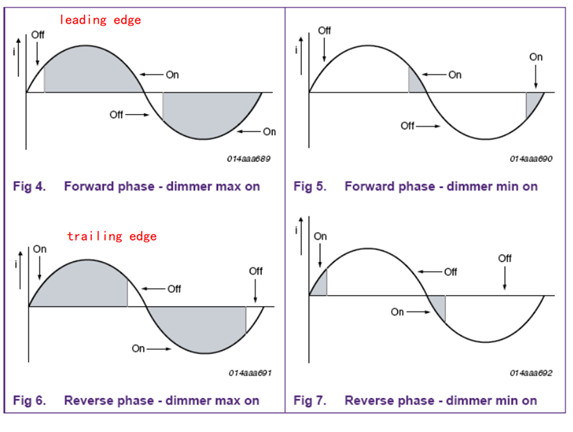
This project focused on trailing edge dimmer construction.
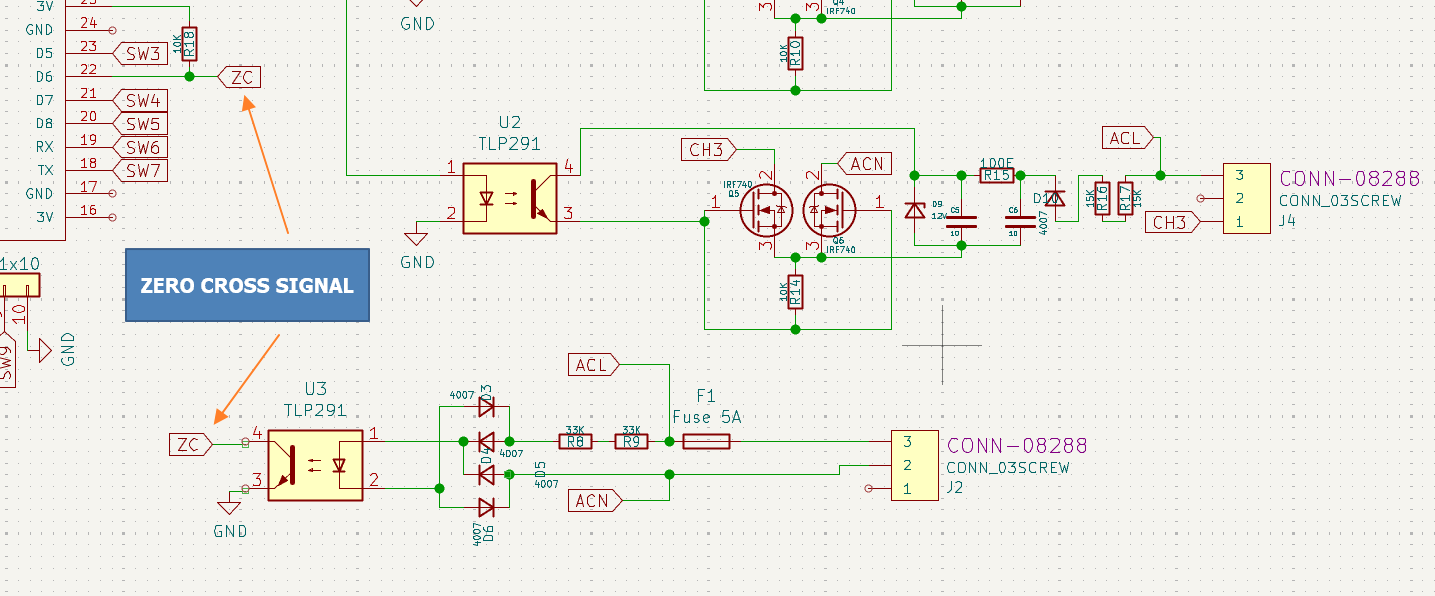
Here it stores energy in C5 and C6 from power line ACL and ACN. From the perspective it only uses positive cycle of the phase to store energy. Turning on the mosfet is occured by Opto U2, and turning off is happened by R14 (10k) . So this dimmer is not suitable for more than 200W.
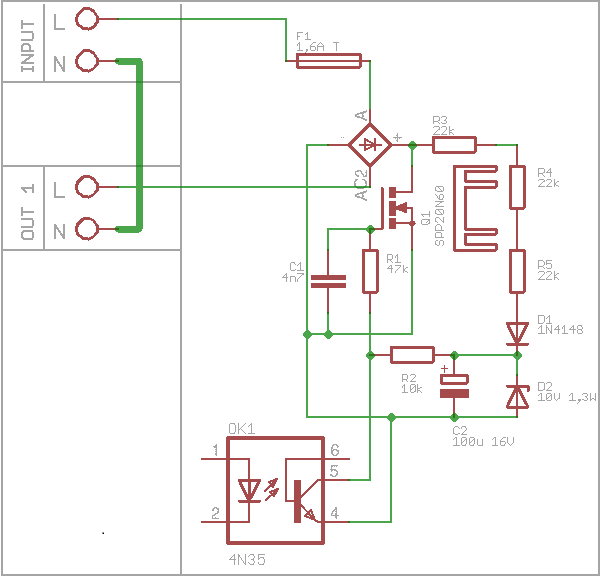
Found another solution as below:
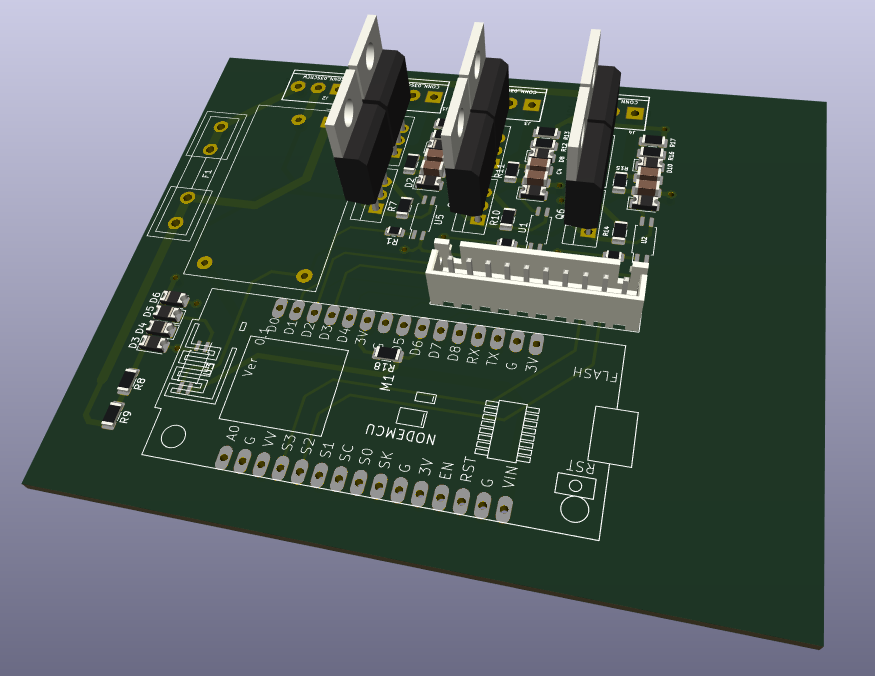
This 3 channel dimmer is build on ESP8266 NodeMCU . Complete Kicad Drawing is available in https://github.com/jibonaronno/kicad_projects/tree/main/dimmer_trailing_edge/nodemcu01
The Arduino code is available under qnod01 folder. It is required to provide correct Wifi credentials the the Arduino code and also need to find the IP address of NodeMCU. After successfull connection between Wifi and NodeMCU, user can browse to the NodeMCU IP Address from phone browser and control dimming.
| Qty | Value | Footprint | References |
|---|---|---|---|
| 7 | 4007 | Diode_SMD:D_1206_3216Metric | D1, D3, D4, D5, D6, D8, D10 |
| 6 | 10 | Capacitor_SMD:C_1206_3216Metric | C1, C2, C3, C4, C5, C6 |
| 6 | 15K | Resistor_SMD:R_1206_3216Metric | R4, R5, R12, R13, R16, R17 |
| 6 | IRF740 | Package_TO_SOT_THT:TO-220-3_Vertical | Q1, Q2, Q3, Q4, Q5, Q6 |
| 4 | 10K | Resistor_SMD:R_1206_3216Metric | R7, R10, R14, R18 |
| 4 | CONN_03SCREW | Connectors:SCREWTERMINAL-3.5MM-3 | J1, J2, J3, J4 |
| 4 | TLP291 | Package_SO:SOIC-4_4.55x2.6mm_P1.27mm | U1, U2, U3, U5 |
| 3 | 100E | Resistor_SMD:R_1206_3216Metric | R6, R11, R15 |
| 3 | 12V | Diode_SMD:D_1206_3216Metric | D2, D7, D9 |
| 3 | 220E | Resistor_SMD:R_0805_2012Metric | R1, R2, R3 |
| 2 | 33K | Resistor_SMD:R_1206_3216Metric | R8, R9 |
| 1 | Conn_01x10 | Connector_JST:JST_XH_B10B-XH-A_1x10_P2.50mm_Vertical | J5 |
| 1 | Fuse 5A | FuseHolder:Fuseholder5x20_horiz_open_inline_Type-I | F1 |
| 1 | HLK-PM01 | Converter_ACDC:Converter_ACDC_HiLink_HLK-PMxx | PS1 |
| 1 | NODEMCU | nodemcu2:nodemcu2-NODEMCU | M1 |


b3nn/3DVisionAVR-Hardware
Hardware design files and info for 3DVisionAVR, a clone for 3D Vision Emitter using IR


SonOfCheevap/PierogiNixie-PSU
A simple 12v to 150v-250v DC-DC Power supply for use with nixie tubes.

CatoLynx/LAWO-Arduino
Arduino Nano adapter board for LAWO XY5 flipdot displays


It measures 79.1 × 95.4 mm and has 2 copper layers, 1.6 mm thick.
52 parts, built around the HLK-PM01, TLP291-4 and IRF740. The full list of its parts is on this page, with links to each part's symbol and footprint where PCBKit's library has them.
From the jibonaronno/kicad_projects repository on GitHub, at the commit this page was made from: the board is dimmer_trailing_edge/nodemcu01/nodemcu01.kicad_pcb and its schematic dimmer_trailing_edge/nodemcu01/nodemcu01.kicad_sch. PCBKit opens the board in the browser, with nothing to install.
Its repository publishes it under the CC0-1.0 licence: you may reuse it on that licence's terms (keep the author's notice, and for a copyleft licence share your changes alike).