
2 layers60 × 33 mm
G850 kiss
hwreverse/PokeConSerial
Serial Interfaces for Pocket Computers (ポケコン) (Sharp, Casio, TRS80-M100,...)
31 parts6MIT
 hwreverse/PokeConSerial6
Serial Interfaces for Pocket Computers (ポケコン) (Sharp, Casio, TRS80-M100,...)
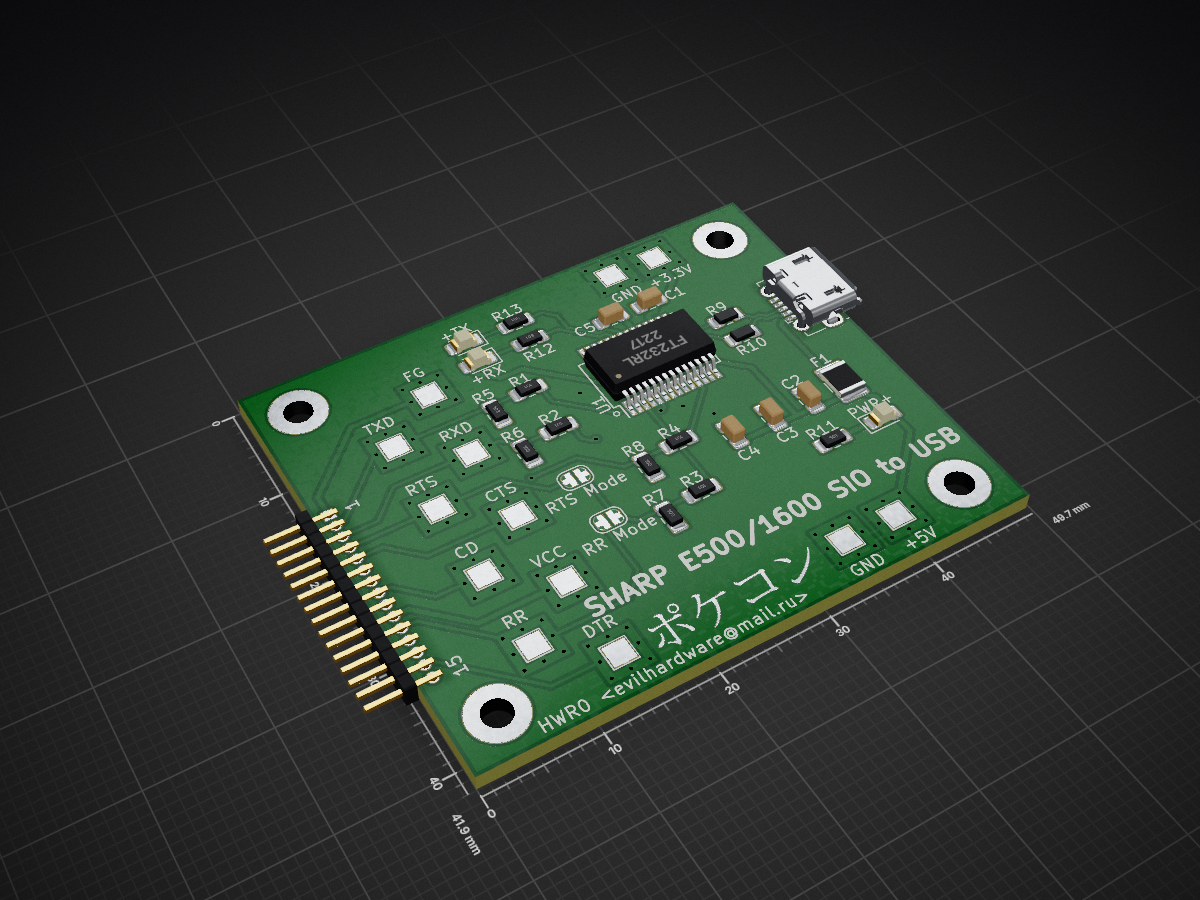
PC1600SIO is an open-source printed circuit board by hwreverse, from the hwreverse/PokeConSerial repository on GitHub, published under the MIT licence. It is a 2-layer board of 49.7 × 41.9 mm with 45 parts on 27 nets, routed with 181 tracks and 112 vias.
It is built around the FT232RL. Its parts include 15 connectors, 13 resistors, 5 capacitors, 3 diodes and 1 IC. It belongs with the interfaces and adapters boards of this library.
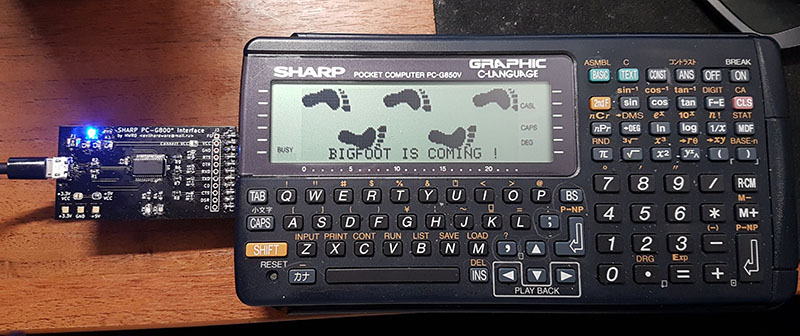
USB to Serial (FT232RL based) Interface for the SHARP G800* line of Pocket Computers (G811, G850, G850V, G850S, G850VS)
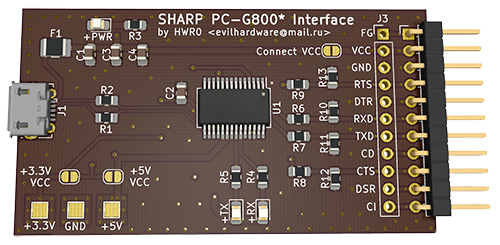
NB1: the 11pin adapter is a 1x11 pin 2.54mm (100mil) male connector
NB2: Use VCC Connect if for some reason, you want to power the device from USB (use with EXTREME care!!)
NB3: Bridge the 5V VCCIO Solder Jumper to work with the G850*, this sets the I/O Level to 5V
The USB-B-micro Receptacle in this schema is a Molex 105017-0001 / 105017-1001, every diode / R / C is 0805, FT232RL is a SSOP28, the Polyfuse is a 1210 500mA or similar
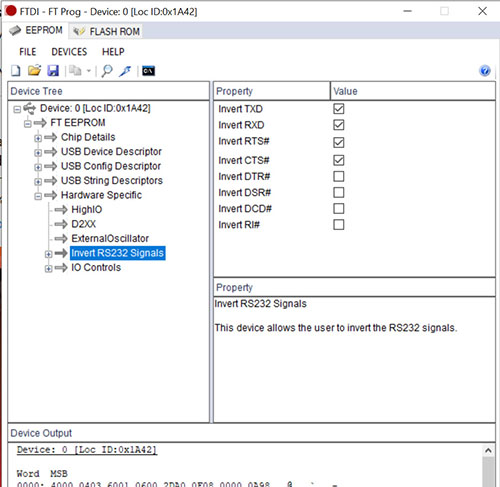
As the Sharp Pocket computers use inverted Levels, you have to invert RXD, TXD, RTS# and CTS# on your FT232RL chip too.
You do this by downloading the program FTProg from the FTDI Site : Here.
You need also to configure CBUS0 as RXLED and CBUS1 as TXLED in order to gain LED Functionality.
AND FOR HEAVENS' SAKE: Never set the FT chip to External OSC (Escpecially on this board where it does not have an External Oscillator) lest you are self-destructive and want to brick your chip !
| Qty | Value | Footprint | References |
|---|---|---|---|
| 13 | SolidPad-Connector | Connector:SolidPad_4x4mm_2x2mmCore | J2, J3, J4, J5, J6, J7, J9, J10, J11, J12, J13, J14, J15 |
| 4 | 100R | Resistor_SMD:R_0805_2012Metric_Pad1.15x1.40mm_HandSolder | R1, R2, R3, R4 |
| 4 | 10K | Resistor_SMD:R_0805_2012Metric_Pad1.15x1.40mm_HandSolder | R5, R6, R7, R8 |
| 4 | MountingHole_Pad | MountingHole:MountingHole_2.5mm_Pad | H1, H2, H3, H4 |
| 3 | 100nF | Capacitor_SMD:C_0805_2012Metric_Pad1.15x1.40mm_HandSolder | C1, C3, C5 |
| 3 | 500R | Resistor_SMD:R_0805_2012Metric_Pad1.15x1.40mm_HandSolder | R11, R12, R13 |
| 2 | 0-15R | Resistor_SMD:R_0805_2012Metric_Pad1.15x1.40mm_HandSolder | R9, R10 |
| 1 | 10nF | Capacitor_SMD:C_0805_2012Metric_Pad1.15x1.40mm_HandSolder | C2 |
| 1 | 10uF | Capacitor_SMD:C_0805_2012Metric_Pad1.15x1.40mm_HandSolder | C4 |
| 1 | Conn_01x15_Male | Connector_PinHeader_1.27mm:PinHeader_1x15_P1.27mm_Vertical | J1 |
| 1 | FT232RL | Package_SO:SSOP-28_5.3x10.2mm_P0.65mm | U1 |
| 1 | LOGO | Alexx:Pokekon_Soldermask | G*** |
| 1 | PWRLED | LED_SMD:LED_0805_2012Metric_Pad1.15x1.40mm_HandSolder | D1 |
| 1 | Polyfuse 1210 | Resistor_SMD:R_1210_3225Metric_Pad1.42x2.65mm_HandSolder | F1 |
| 1 | RR_Mode | Jumper:SolderJumper-2_P1.3mm_Open_RoundedPad1.0x1.5mm | JP1 |
| 1 | RTS_Mode | Jumper:SolderJumper-2_P1.3mm_Open_RoundedPad1.0x1.5mm | JP2 |
| 1 | RXLED | LED_SMD:LED_0805_2012Metric_Pad1.15x1.40mm_HandSolder | D2 |
| 1 | TXLED | LED_SMD:LED_0805_2012Metric_Pad1.15x1.40mm_HandSolder | D3 |
| 1 | USB_B_Micro | Connector_USB:USB_Micro-B_Molex-105017-0001 | J8 |
hwreverse/PokeConSerial
Serial Interfaces for Pocket Computers (ポケコン) (Sharp, Casio, TRS80-M100,...)

hwreverse/PokeConSerial
Serial Interfaces for Pocket Computers (ポケコン) (Sharp, Casio, TRS80-M100,...)

zmaker/arduino_cookbook
gli sketch del nuovo progetto Arduino Cookbook e dei video di YouTube


Ledger-Donjon/silicon-toaster
SiliconToaster is an open-source hardware electromagnetic fault injection device, designed for hardware security research. It has the following features:


jsjolund/dmx512-controller-board
Controller board for DMX512 compatible devices, built around the STM32F4 processor

It measures 49.7 × 41.9 mm and has 2 copper layers, 1.6 mm thick.
45 parts, built around the FT232RL. The full list of its parts is on this page, with links to each part's symbol and footprint where PCBKit's library has them.
From the hwreverse/PokeConSerial repository on GitHub, at the commit this page was made from: the board is PC1600SIO/PC1600SIO.kicad_pcb. PCBKit opens the board in the browser, with nothing to install.
Its repository publishes it under the MIT licence: you may reuse it on that licence's terms (keep the author's notice, and for a copyleft licence share your changes alike).