2 layers100 × 86 mm

 Hob-dev/Pockey1
A play on the word "Pocket", this keyboard is meant to be ultra-portable ultra-low profile using Cherry ULP, with a magnetic enclosure mechanism that let's you fit the keyboard in your pocket. The design is inspired by the Apple Magic Keyboard tilt and feel.
Pockey is an open-source printed circuit board by Hob-dev, from the Hob-dev/Pockey repository on GitHub. It is a 2-layer board of 94.4 × 72.4 mm with 57 parts on 70 nets, routed with 530 tracks and 64 vias.
It is built around the 74LVC1G11GW, BQ24075RGT and DW01A, with the FS8205, SRV05-4 and BLM15PX121SN1D11 among its other parts. Its parts include 20 switches, 11 capacitors, 11 resistors, 7 ICs and 3 connectors. It belongs with the keyboards and input boards and the nRF52 and nRF5x boards of this library.


An ultra-low-profile wireless split keyboard built around ultra-thin Cherry MX switches. Pockey follows the Apple Magic Keyboard design philosophy — including the gentle 4° typing tilt — for a slim, unobtrusive desk presence. Each half packs into a closed sandwich: the two halves are magnetically collapsible and snap together when stacked on top of one another, making the whole keyboard pocketable and travel-ready.
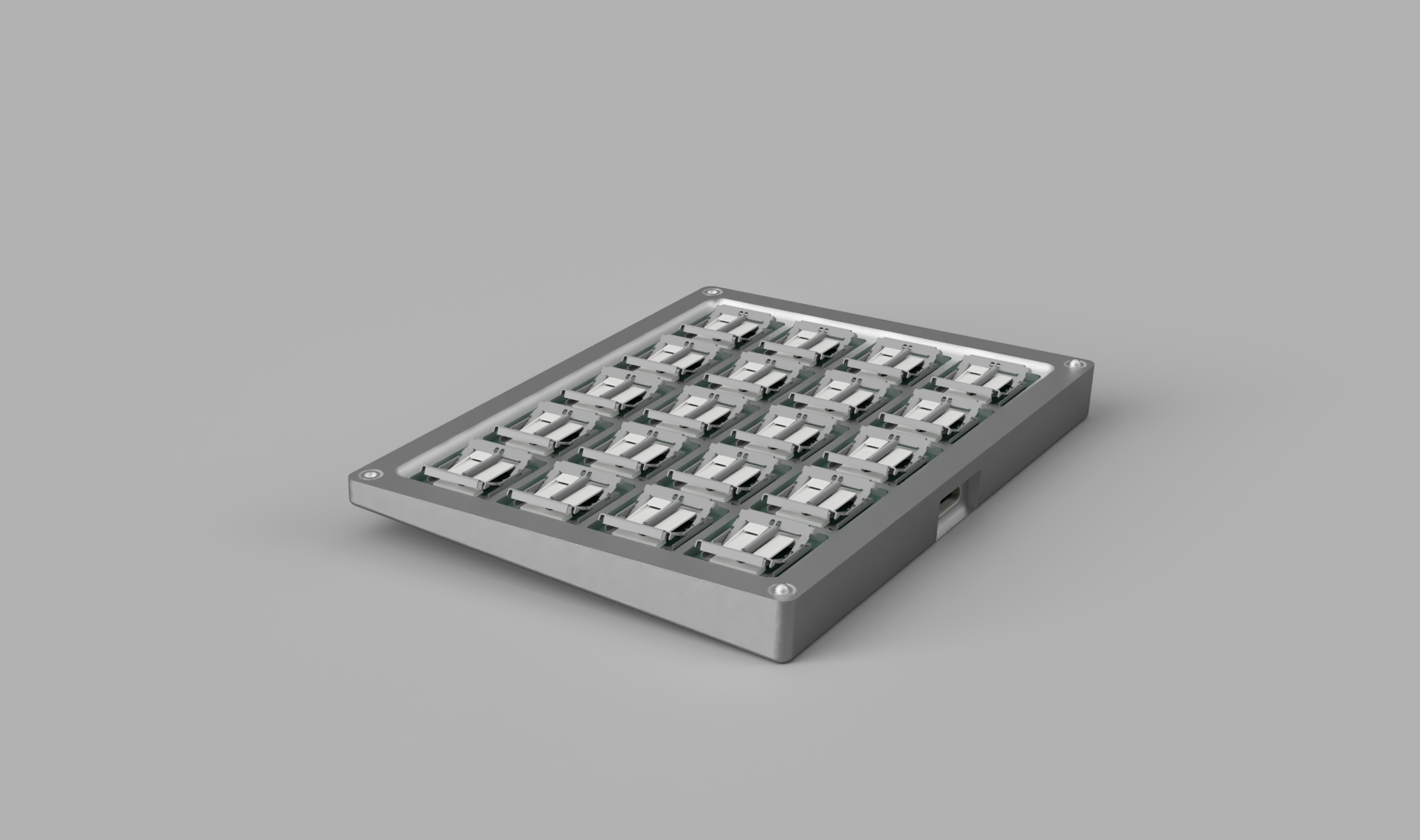
Functionally complete — finishing touches remain before fabrication (see "Known gaps" below).
Pockey.kicad_sch and LeftMatrix.kicad_sch were missing from the working directory at the time this repo was created — they were lost sometime after January 2025, and the three most recent backups (dated 2026-04-16) no longer contained them either.
They were restored from KiCad/backups/Pockey-2025-01-22_173850.zip — the last backup that still contained the real schematic files. The restored schematic is dated 2025-01-20 14:26 internally. Any schematic edits between that date and when the file went missing are not recoverable.
Pockey/
├── KiCad/              KiCad 7+ project — open Pockey.kicad_pro
│   ├── Pockey.kicad_pcb         Main board layout
│   ├── Pockey.kicad_sch         Top-level schematic (restored from backup)
│   ├── LeftMatrix.kicad_sch     Switch matrix sub-sheet (restored from backup)
│   ├── Pockey.kicad_pro         KiCad project file
│   ├── Pockey.kicad_prl         Local KiCad state
│   ├── fp-info-cache            KiCad footprint cache
│   ├── backups/                 Dated snapshots — incl. the one the schematic was recovered from
│   └── Pockey-backups/          KiCad auto-backup folder (created on project reopen)
├── Renders/            Pockey_2025-Jan-21 CAD render of populated PCB
├── 3D/                 Pockey.step — mechanical model of the board + case
├── Fabrication/        PCB outline DXFs (V2 = previous, V3 = current)
└── JLCPCB/ Empty — gerbers not yet generatedJLCPCB/ is an empty placeholder..step source is included.LeftMatrix — only the .sch file was recovered.._* AppleDouble metadata files and the three "bad" 2026-04-16 backup zips that did not contain the real schematic.| Qty | Value | Footprint | References |
|---|---|---|---|
| 20 | SW_PUSH | Cherry_ULP:Cherry_ULP_SMD | SW1, SW2, SW3, SW4, SW5, SW10, SW11, SW12, SW13, SW14, SW15, SW16, SW17, SW18, SW19, SW20 +4 |
| 5 | 4u7 | Capacitor_SMD:C_0402_1005Metric | C4, C5, C6, C8, C9 |
| 3 | 100n | Capacitor_SMD:C_0402_1005Metric | C7, C10, C11 |
| 3 | 10k | Resistor_SMD:R_0402_1005Metric | R8, R9, R10 |
| 2 | 12p | Capacitor_SMD:C_0402_1005Metric | C1, C2 |
| 2 | 1k5 | Resistor_SMD:R_0402_1005Metric | R4, R11 |
| 2 | 5k1 | Resistor_SMD:R_0402_1005Metric | R1, R2 |
| 1 | 10 uH | Inductor_SMD:L_0603_1608Metric | L2 |
| 1 | 100R | Resistor_SMD:R_0402_1005Metric | R6 |
| 1 | 1k | Resistor_SMD:R_0402_1005Metric | R7 |
| 1 | 1u | Capacitor_SMD:C_0402_1005Metric | C3 |
| 1 | 2k | Resistor_SMD:R_0402_1005Metric | R5 |
| 1 | 32.768 KHz | Crystal:Crystal_SMD_2012-2Pin_2.0x1.2mm | Y1 |
| 1 | 47k | Resistor_SMD:R_0402_1005Metric | R3 |
| 1 | 74LVC1G11 | Package_TO_SOT_SMD:SOT-363_SC-70-6 | U4 |
| 1 | 750 mA | Fuse:Fuse_0603_1608Metric | F1 |
| 1 | BLM15PX121SN1D | Inductor_SMD:L_0402_1005Metric | L1 |
| 1 | BQ24075 | Package_DFN_QFN:VQFN-16-1EP_3x3mm_P0.5mm_EP1.6x1.6mm | U3 |
| 1 | Battery | PCM_marbastlib-various:Molex_Pico-EZmate_78171-0002_1x02-1MP_P1.20mm_Vertical | J3 |
| 1 | DW01A | Package_TO_SOT_SMD:SOT-23-6 | U7 |
| 1 | FS8205 | Package_TO_SOT_SMD:SOT-23-6 | U6 |
| 1 | HRO_TYPE-C-31-M-12 | PCM_marbastlib-various:USB_C_Receptacle_HRO_TYPE-C-31-M-12 | J1 |
| 1 | MAX17048 | Package_DFN_QFN:DFN-8-1EP_2x2mm_P0.5mm_EP0.6x1.2mm | U5 |
| 1 | SRV05-4 | PCM_marbastlib-various:SOT-23-6-routable | U2 |
| 1 | SW_PUSH | PCM_marbastlib-various:SW_T1A2QR | RSW1 |
| 1 | TC2030_SWD | PCM_marbastlib-various:CON_TC2030_outlined | J2 |
| 1 | nRF52840_E73-2G4M08S1C | PCM_marbastlib-various:nRF52840_E73-2G4M08S1C | U1 |
It measures 94.4 × 72.4 mm and has 2 copper layers, 1.6 mm thick.
57 parts, built around the 74LVC1G11GW, BQ24075RGT, DW01A and FS8205. The full list of its parts is on this page, with links to each part's symbol and footprint where PCBKit's library has them.
From the Hob-dev/Pockey repository on GitHub, at the commit this page was made from: the board is KiCad/Pockey.kicad_pcb and its schematic KiCad/LeftMatrix.kicad_sch. PCBKit opens the board in the browser, with nothing to install.
Its repository states no licence, so its author keeps all rights: ask Hob-dev before reusing the design.


