2 layers94.4 × 72.4 mm
Pockey
Hob-dev/Pockey
A play on the word "Pocket", this keyboard is meant to be ultra-portable ultra-low profile using Cherry ULP, with a magnetic enclosure mechanism that let's you fit the keyboard in your pocket.
57 parts1
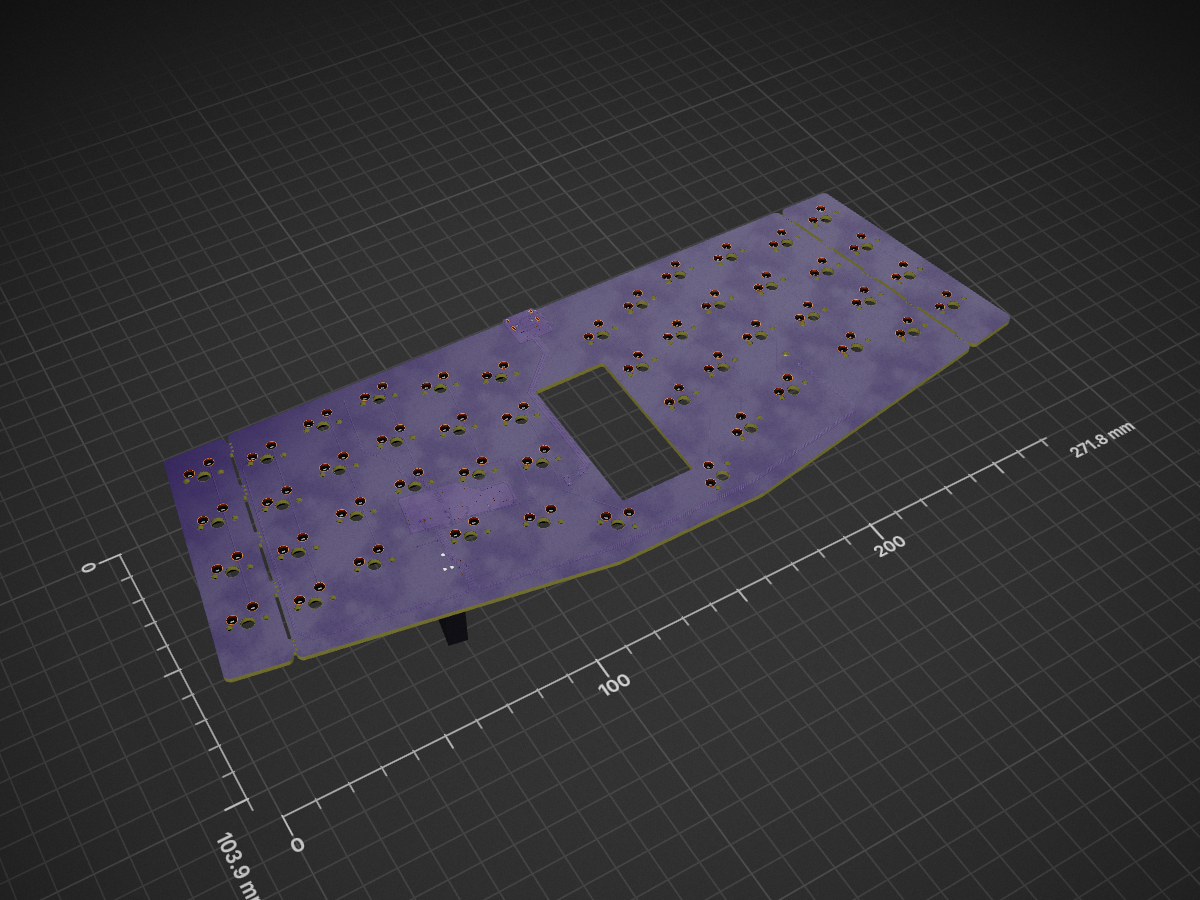
 ebastler/cornholius37
ZMK-based replacement PCB for Cornelius keyboard
Hotswap ble is an open-source printed circuit board by ebastler, from the ebastler/cornholius repository on GitHub. It is a 2-layer board of 271.8 × 103.9 mm with 146 parts on 110 nets, routed with 991 tracks and 89 vias.
It is built around the 74LVC1G11GW, BQ24075RGT and SRV05-4, with the 1N4148WT, BLM15PX121SN1D11 and TYPE-C-31-M-12 among its other parts. Its parts include 49 diodes, 14 capacitors, 11 resistors, 5 ICs and 3 connectors. It belongs with the keyboards and input and radio and wireless boards and the nRF52 and nRF5x boards of this library.


Cornholius is, first and foremost, a Bluetooth Low Energy capable replacement PCB for the Foostan Cornelius. Key and connector positions as well as PCB outline and plate were derived from the original Cornelius repository, but altered to fit the scope of this project - Thank you for open sourcing these files! In accordance with the license chosen by foostan, this project was published under the same license: CC BY-NC-SA 4.0


 .
Parts of this project:
The PCB is designed to be 100% assemblable by jlcpcb in their "economic" PCBA option (without hotswap sockets), or the more expensive "standard" PCBA option incl. hotswap sockets. It uses an Ebyte nRF52840_E73-2G4M08S1C BLE module, which is part of their component library, so no external components must be ordered from other shops. This module is configured for full 2-stage DC-DC operation in high voltage mode for maximum battery life.
Battery management is handled by a TI BQ24075 battery management/power path IC, with a charge current of approx. 440 mA and all relevant protections in place. The PCB is designed for a HAC-006 (Nintendo Switch Joycon) battery, as replacement cells for it are affordable and easy to source, and are plug and play for Cornholius, incl. the right connector. It should lead to an estimated battery life of up to 8 months (according to ZMK power profiler).
If you want to use any other battery type, make sure it has a Molex Pico EZmate 2-pin connector, and the correct polarity. Connecting a battery with mismatched polarity may damage the PCB and can potentially turn into a fire hazard.
The 6th column on the PCB can be snapped off, turning it into a 5col PCB.
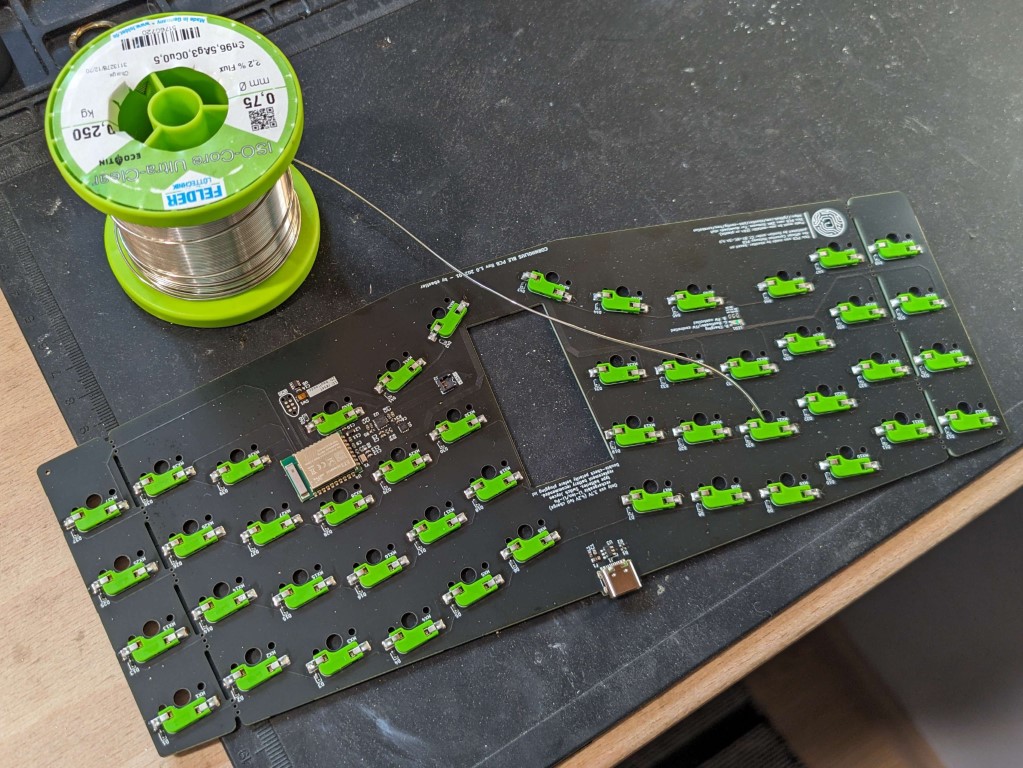
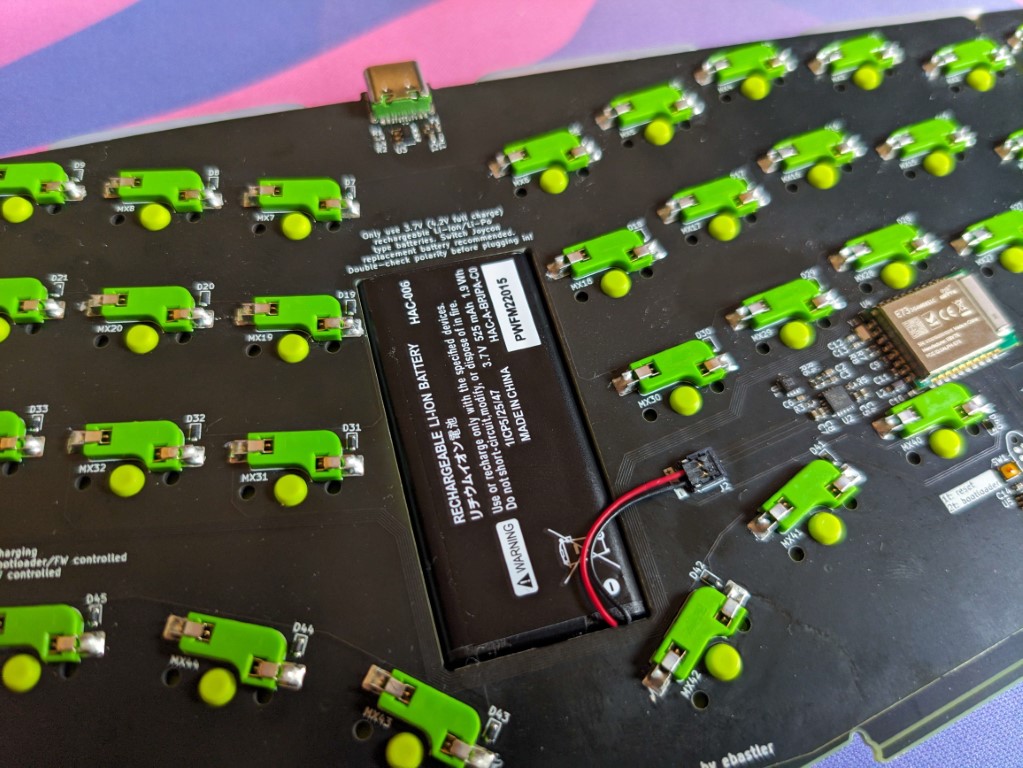
Flashing an nRF52840 forn the first time requires hardware tools. Joric wrote up a very good guide on how to program nRF52 series chips in the nrfmicro github wiki. If you have never flashed a nRF52 series chip before, I suggest reading it before proceeding to order any hardware.
The PCB features a TC2030 flashing header footprint, configured in TC2030-CTX-NL pinout. It should be possible to solder wires to this footprint and connect to a debug probe, but I have not tried.
Precompiled bootloader files can be found in the Github Actions tab of my fork of the Adafruit nRF52 Bootloader.
Once the PCBs have a bootloader, they can be programmed via a UF2 mass-storage-device bootloader. Double-tapping the reset button (or using keybinds, once ZMK is running) will send the device to bootloader.
Gerber files and assembly files can be found in the hotswap_ble/fab subfolder. Use 1.6mm FR4 substrate.
The jlcpcb assembly files are tested and were working at the time when I ordered prototypes, however, jlcpcb sometimes changes part numbers, or parts run out of stock and need to be replaced by new parts. Please proceed with caution and carefully check both BOM and position/alignment/orientation of all components when uploading to their site.
The plate is made from FR4 substrate, without any copper plating, to minimie interference with the antenna. It also has a hole above the PCB's status LED to keep it visible. While it is compatible with Cornelius cases, the outline and the gasket tabs were slightly altered from the original Cornelius plate to allow for o-ring mount in Cornholius.
Gerber files and assembly files can be found in the plate_ble/fab subfolder. Use 1.6mm FR4 substrate.
For more information regarding the case and necessary mounting hardware, visit my Printables page. All files were published there, as well as a list of hardware needed for the assembly. The case will need a Cornholius plate for the o-ring mounting, regular Cornelius plates might fit but are untested.
| Qty | Value | Footprint | References |
|---|---|---|---|
| 48 | 1N4148WT | Diode_SMD:D_SOD-523 | D1, D2, D10, D11, D12, D13, D14, D15, D16, D17, D18, D19, D20, D21, D22, D23 +32 |
| 48 | MX | PCM_marbastlib-mx:SW_MX_HS_1u | MX1, MX2, MX10, MX11, MX12, MX13, MX14, MX15, MX16, MX17, MX18, MX19, MX20, MX21, MX22, MX23 +32 |
| 6 | 4u7 | Capacitor_SMD:C_0402_1005Metric | C1, C2, C4, C7, C10, C11 |
| 4 | 1u | Capacitor_SMD:C_0402_1005Metric | C3, C5, C8, C9 |
| 3 | 10k | Resistor_SMD:R_0402_1005Metric | R3, R7, R8 |
| 3 | 1k | Resistor_SMD:R_0402_1005Metric | R9, R10, R11 |
| 2 | 100n | Capacitor_SMD:C_0402_1005Metric | C6, C14 |
| 2 | 12p | Capacitor_SMD:C_0402_1005Metric | C12, C13 |
| 2 | 5k1 | Resistor_SMD:R_0402_1005Metric | R1, R2 |
| 1 | 10 uH | Inductor_SMD:L_0603_1608Metric | L2 |
| 1 | 1k5 | Resistor_SMD:R_0402_1005Metric | R5 |
| 1 | 2k2 | Resistor_SMD:R_0402_1005Metric | R6 |
| 1 | 32.768 KHz | Crystal:Crystal_SMD_2012-2Pin_2.0x1.2mm | Y1 |
| 1 | 47k | Resistor_SMD:R_0402_1005Metric | R4 |
| 1 | 500mA | Fuse:Fuse_0603_1608Metric | F1 |
| 1 | 74LVC1G11 | Package_TO_SOT_SMD:SOT-363_SC-70-6 | U5 |
| 1 | 78171-0002 | PCM_marbastlib-various:Molex_Pico-EZmate_78171-0002_1x02-1MP_P1.20mm_Vertical | J2 |
| 1 | BLM15PX121SN1D | Inductor_SMD:L_0402_1005Metric | L1 |
| 1 | BQ24075 | Package_DFN_QFN:VQFN-16-1EP_3x3mm_P0.5mm_EP1.6x1.6mm | U2 |
| 1 | IND | PCM_marbastlib-xp-various:LED_1206R | LED1 |
| 1 | LOGO | projectlib:logo_silk_10 | G*** |
| 1 | MAX17048 | Package_DFN_QFN:DFN-8-1EP_2x2mm_P0.5mm_EP0.7x1.3mm | U1 |
| 1 | RST | PCM_marbastlib-various:SW_T1A2QR | SW1 |
| 1 | SRV05-4 | PCM_marbastlib-various:SOT-23-6-routable | U3 |
| 1 | TC2030_SWD | PCM_marbastlib-various:CON_TC2030_outlined | J3 |
| 1 | TYPE-C-31-M-12 | PCM_marbastlib-various:USB_C_Receptacle_HRO_TYPE-C-31-M-12 | J1 |
| 1 | nRF52840_E73-2G4M08S1C | PCM_marbastlib-xp-various:nRF52840_E73-2G4M08S1C | U4 |
The 136 most common of 146 parts.
It measures 271.8 × 103.9 mm and has 2 copper layers, 1.6 mm thick.
146 parts, built around the 74LVC1G11GW, BQ24075RGT, SRV05-4 and 1N4148WT. The full list of its parts is on this page, with links to each part's symbol and footprint where PCBKit's library has them.
From the ebastler/cornholius repository on GitHub, at the commit this page was made from: the board is hotswap_ble/hotswap_ble.kicad_pcb and its schematic hotswap_ble/hotswap_ble.kicad_sch. PCBKit opens the board in the browser, with nothing to install.
Its repository states no licence, so its author keeps all rights: ask ebastler before reusing the design.
Hob-dev/Pockey
A play on the word "Pocket", this keyboard is meant to be ultra-portable ultra-low profile using Cherry ULP, with a magnetic enclosure mechanism that let's you fit the keyboard in your pocket.


