2 layers24.1 × 21.6 mm
 hacker-fab/phoenix3
tube furnace
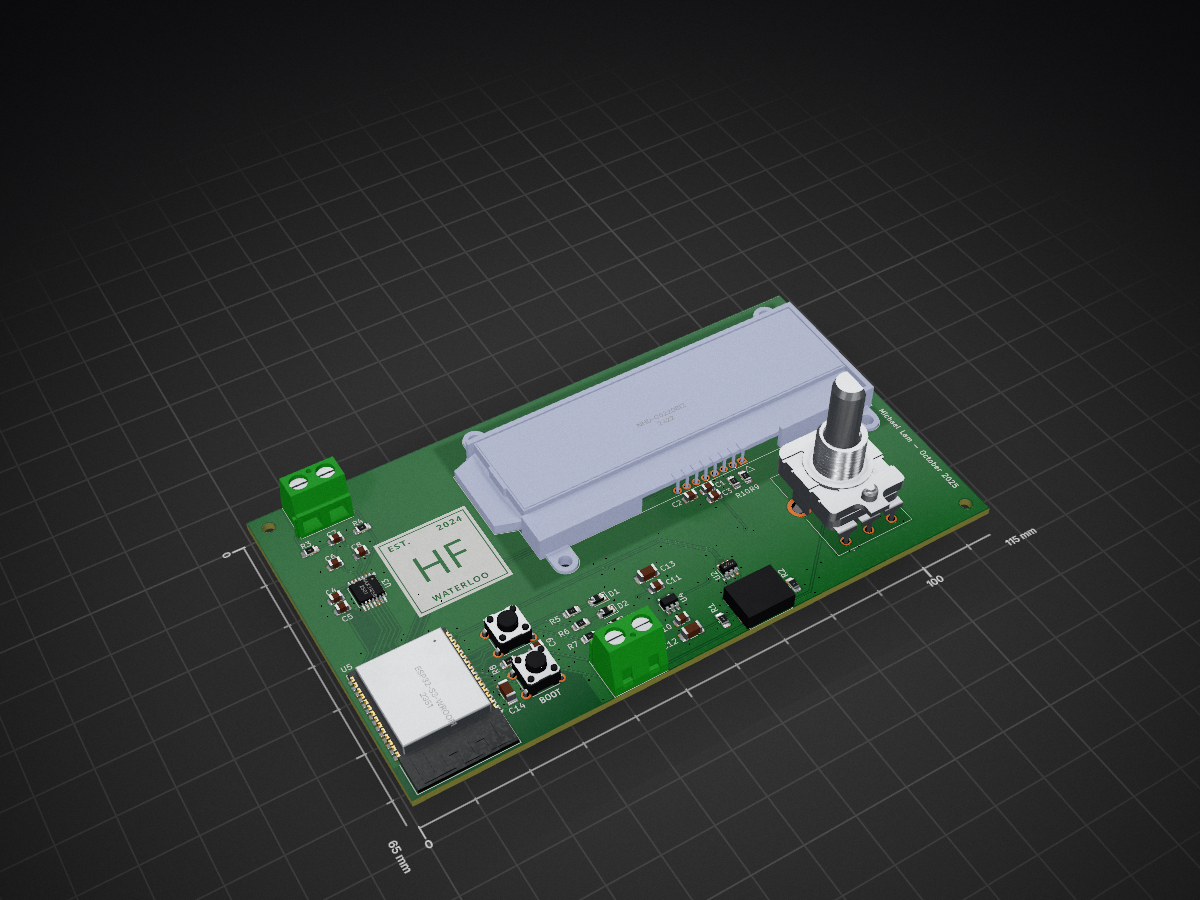
Phoenix v2 is an open-source printed circuit board by hacker-fab, from the hacker-fab/phoenix repository on GitHub, published under the MIT licence. It is a 2-layer board of 115 × 65 mm with 41 parts on 57 nets, routed with 244 tracks and 150 vias.
It is built around the ESP32-S3-WROOM-1-N8, MAX31856 and USBLC6-2SC6. Its parts include 14 capacitors, 10 resistors, 5 ICs, 3 diodes and 3 connectors. It belongs with the ESP32 boards of this library.


Phoenix is a tube furnace used for thermal oxidation and annealing.
It uses PID control to follow custom temperature profiles and works on both MicroPython on the ESP32 and a simulated Python desktop environment.
|
Fig 1. Tube furnace in action |
Fig 2. Simulated PID following a heat profile |
Fig 3. Controlling ramp rate to prevent thermal shock |
python3 -m venv .venv
source .venv/bin/activate
pip install -r requirements.txtInstall micropython
https://github.com/micropython/micropython/tree/master/ports/unix#readmeInstall typing
micropython -m mip install github:josverl/micropython-stubs/mip/typing.mpyInstall udataclasses
cd ~/.micropython/lib
# extract src/udataclasses
git clone https://github.com/dhrosa/udataclasses.git tmp
mv tmp/src/udataclasses .
rm -rf tmpesptool erase-flash
esptool --baud 460800 write-flash 0 images/ESP32_GENERIC_S3-SPIRAM_OCT-20250809-v1.26.0.bin
mpremote
mpremote connect /dev/ttyUSB0 fs cp main.py :| Qty | Value | Footprint | References |
|---|---|---|---|
| 6 | 1uF | Capacitor_SMD:C_0805_2012Metric | C1, C2, C3, C9, C10, C11 |
| 5 | 5.1k | Resistor_SMD:R_0805_2012Metric_Pad1.20x1.40mm_HandSolder | R1, R2, R8, R9, R10 |
| 3 | 100nF | Capacitor_SMD:C_0805_2012Metric | C4, C5, C7 |
| 3 | 10uF | Capacitor_SMD:C_1206_3216Metric_Pad1.33x1.80mm_HandSolder | C12, C13, C14 |
| 3 | 220 | Resistor_SMD:R_0805_2012Metric_Pad1.20x1.40mm_HandSolder | R5, R6, R7 |
| 3 | LED | Diode_SMD:D_0805_2012Metric_Pad1.15x1.40mm_HandSolder | D1, D2, D3 |
| 2 | 100 | Resistor_SMD:R_0805_2012Metric_Pad1.20x1.40mm_HandSolder | R3, R4 |
| 2 | 10nF | Capacitor_SMD:C_0805_2012Metric | C6, C8 |
| 2 | Screw_Terminal_01x02 | !footprints:TE_282837-2 | J2, J3 |
| 1 | BOOT | Button_Switch_THT:SW_TH_Tactile_Omron_B3F-102x | SW2 |
| 1 | ESP32-S3-WROOM-1 | RF_Module:ESP32-S3-WROOM-1 | U5 |
| 1 | LOGO | !footprints:HF_logo | G*** |
| 1 | MAX31856 | Package_SO:TSSOP-14_4.4x5mm_P0.65mm | U3 |
| 1 | NHD-C0220BIZ | Display:NHD-C0220BiZ | U1 |
| 1 | RESET | Button_Switch_THT:SW_TH_Tactile_Omron_B3F-102x | SW1 |
| 1 | RotaryEncoder_Switch | !footprints:PEC164120FS0012 | SW3 |
| 1 | USBLC6-2SC6 | Package_TO_SOT_SMD:SOT-23-6 | U2 |
| 1 | ~ | !footprints:UJ20-C-H-G-SMT-1-P16-TR | J1 |
| 1 | ~ | !footprints:SOT-23-5 | U4 |
The 39 most common of 41 parts.


spacebiz24/Thermal-Profiling
A Thermal Profiling Platform built with ATMega328P and MAX31856


IITB-Rocket-Team-Avionics/Ember
Experimental Flight Computer with potential mitigations of previous issues faced by FLYTE and a testbed for new systems.

It measures 115 × 65 mm and has 2 copper layers, 1.56 mm thick.
41 parts, built around the ESP32-S3-WROOM-1-N8, MAX31856 and USBLC6-2SC6. The full list of its parts is on this page, with links to each part's symbol and footprint where PCBKit's library has them.
From the hacker-fab/phoenix repository on GitHub, at the commit this page was made from: the board is schematics/phoenix_v2/phoenix_v2.kicad_pcb and its schematic schematics/phoenix_v0/phoenix.kicad_sch. PCBKit opens the board in the browser, with nothing to install.
Its repository publishes it under the MIT licence: you may reuse it on that licence's terms (keep the author's notice, and for a copyleft licence share your changes alike).