2 layers25.4 × 48.9 mm
 glenoverby/Sequencer
An Arduino sequencer for amateur radio
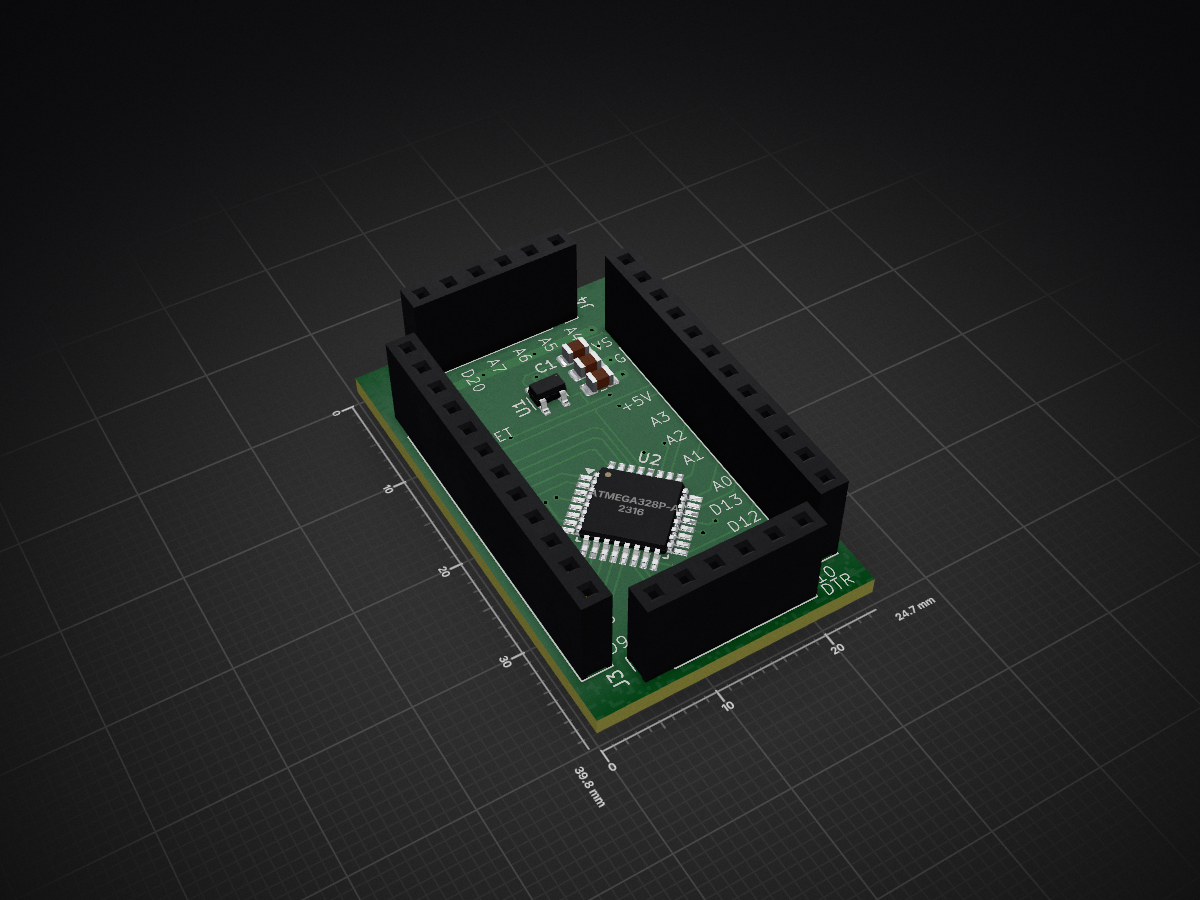
Mega328basic1 is an open-source printed circuit board by glenoverby, from the glenoverby/Sequencer repository on GitHub. It is a 2-layer board of 24.7 × 39.8 mm with 11 parts on 31 nets, routed with 169 tracks and 30 vias.
It is built around the ATMEGA328P-AU and MIC5205-5.0YM5. Its parts include 5 capacitors, 4 connectors and 2 ICs. It belongs with the AVR (ATmega, ATtiny) boards of this library.


An Arduino sequencer for amateur radio
This is an Arduino project used for sequencing transmit / receive relays, amplifiers and transverters in order to prevent transmitting into a relay when it is switching, and to protect recevier inputs from transmitters or amplifiers.
I've written a full description of othe project.
The source code is in this repository under Software and the KiCad files for a PCB are under Hardware/sequencer3. I had this board manufactured by OshPark in 2024.
I wanted to reduce the cost of this project, and the MegaAVR chip itself is about a tenth of the price of an Arduino board. I can get by with just the AVR and a few support chips. I made an arduino style board for the ATMega328 in a TQFP package.
| Qty | Value | Footprint | References |
|---|---|---|---|
| 4 | C | Capacitor_SMD:C_0805_2012Metric_Pad1.18x1.45mm_HandSolder | C1, C3, C4, C5 |
| 2 | Conn_01x06 | Connector_PinSocket_2.54mm:PinSocket_1x06_P2.54mm_Vertical | J3, J4 |
| 2 | Conn_01x12 | Connector_PinSocket_2.54mm:PinSocket_1x12_P2.54mm_Vertical | J1, J2 |
| 1 | 2.2uF | Capacitor_SMD:C_0805_2012Metric_Pad1.18x1.45mm_HandSolder | C2 |
| 1 | ATmega328P-A | Package_QFP:TQFP-32_7x7mm_P0.8mm | U2 |
| 1 | MIC5205-5.0YM5 | Package_TO_SOT_SMD:SOT-23-5 | U1 |
It measures 24.7 × 39.8 mm and has 2 copper layers, 1.6 mm thick.
11 parts, built around the ATMEGA328P-AU and MIC5205-5.0YM5. The full list of its parts is on this page, with links to each part's symbol and footprint where PCBKit's library has them.
From the glenoverby/Sequencer repository on GitHub, at the commit this page was made from: the board is Hardware/Mega328basic1/Mega328basic1.kicad_pcb and its schematic Hardware/Mega328basic1/Mega328basic1.kicad_sch. PCBKit opens the board in the browser, with nothing to install.
Its repository states no licence, so its author keeps all rights: ask glenoverby before reusing the design.

morzack/CO2-PCB-Monitor
Design and manufacturing files for a desktop atmospheric CO2 monitor


skumlos/atmega328pb-nano
An Arduino Mini Pro clone using a Atmega328PB instead to have 2 I2C busses

adsehgal/Bench_Power_Supply
A design for a custom bench top power supply for prototyping.

