Skip to the content
2 layers93.6 × 55 mmNeurolab, the printed circuit board in 3D

Neurolab Hardware

Size
93.6 × 55 mm
Copper layers
2
Thickness
1.6 mm
Parts
174
Nets
119
Pads
556
Tracks, vias
1,709, 153
Pours
2
Routed
Yes
KiCad
KiCad 5 (file 20171130)
Created
11 Jan 2016
Updated
2 Jun 2021

Overview

Neurolab is an open-source printed circuit board by fossasia, from the fossasia/neurolab-hardware repository on GitHub, published under the Apache-2.0 licence. It is a 2-layer board of 93.6 × 55 mm with 174 parts on 119 nets, routed with 1,709 tracks and 153 vias.

It is built around the AD8422ARMZ-R7, AD8475ARM and MAX7480ESA+, with the ADP1720ARMZ-3.3-R7, ADP1720ARMZ-5-R7 and ADR445BR among its other parts. Its parts include 69 capacitors, 50 resistors, 22 connectors, 20 ICs and 2 diodes.

Main components

8

README

README.md

Neurolab Hardware

Repository for Neurolab Open Hardware platform.

Build Status Gitter Mailing List Twitter Follow

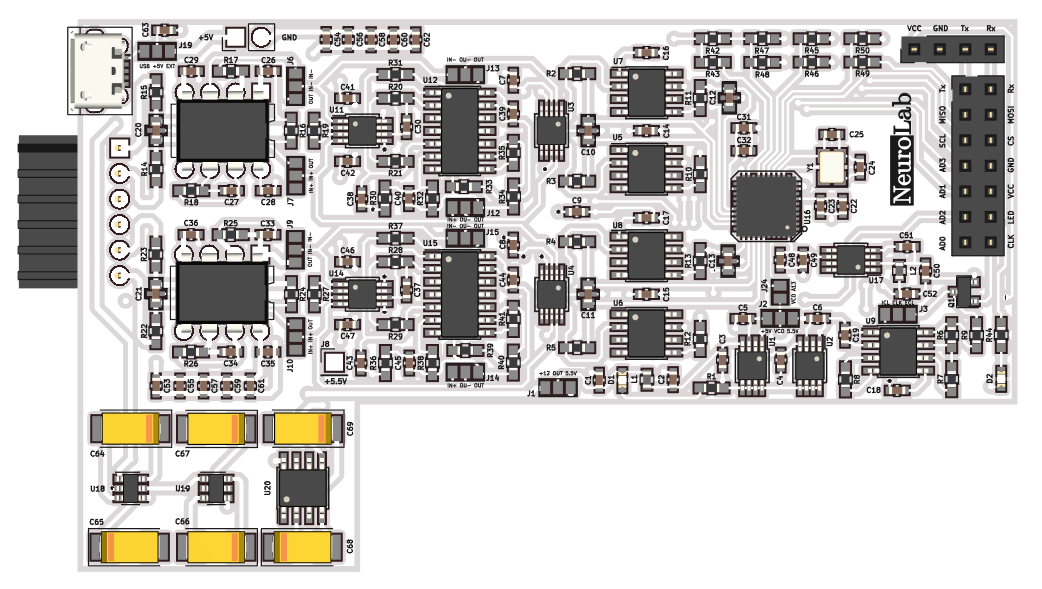
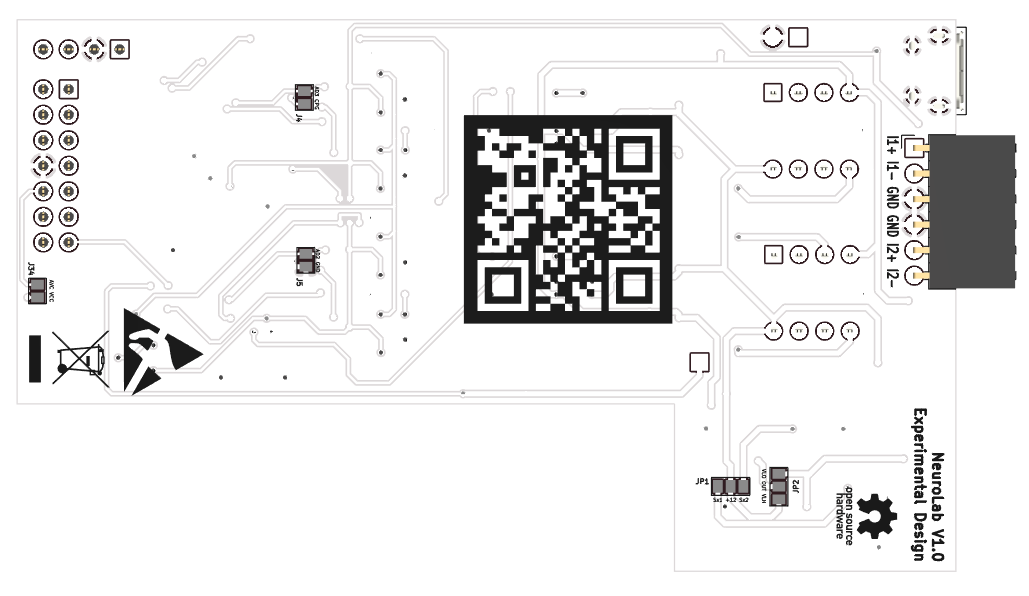
We are developing a neuro-device to collect brainwaves as a headband with integrated electronics. This repository holds the PCB schematics and layouts for the Neurolab Hardware.

Front SideBack Side

Buy

Communication

Goal and Roadmap

The goal of the Neurolab project is to develop an easy to use open hardware measurement headset device for brain waves that can be plugged into an Android smartphone and a software application and enables us to understand our brains better.

Our brains communicate through neurotransmitters and their activity emits electricity. The neuroheadset measures that electricity on the skin of the forehead and the software processes the signal so that it can translated into a visual or auditory representation. The data that can be collected can be analysed to identify mental health, stress, relaxation and even diseases like Alzheimer.

Current devices in the medical industry are usually not accessible by doctors due to their high pricing. They are also complicated to use. The idea of the device is to integrate it into a headband and focus on signals that can be obtained through the frontal lobe.

A difference to existing projects like OpenBCI is that it will not be necessary to 3D print large headsets. Instead we are focusing on creating a device that collects as much data as possible through the forehead. To achieve this goal we are using high-grade sensors and flexible electronics.

License

This project is licensed under the Apache License 2.0. A copy of LICENSE is to be present along with the source code. To obtain the software under a different license, please contact FOSSASIA.

Parts

174
QtyValueFootprintReferences
222.2uCapacitors_SMD:C_0603C1, C2, C3, C4, C41, C42, C46, C47, C48, C51, C52, C53, C54, C55, C56, C57 +6
150.1uCapacitors_SMD:C_0603C14, C15, C16, C17, C18, C23, C28, C29, C31, C35, C36, C49, C50, C61, C62
12GS3Connectors:GS3J1, J2, J3, J6, J7, J9, J10, J12, J13, J14, J15, J19
9100kResistors_SMD:R_0603_HandSolderingR7, R17, R18, R25, R26, R34, R35, R40, R41
81MResistors_SMD:R_0603_HandSolderingR20, R28, R31, R32, R33, R37, R38, R39
84.7kResistors_SMD:R_0603_HandSolderingR2, R3, R4, R5, R14, R15, R22, R23
6100uCapacitors_Tantalum_SMD:CP_Tantalum_Case-C_EIA-6032-28_ReflowC64, C65, C66, C67, C68, C69
61uCapacitors_SMD:C_0603C22, C30, C32, C37, C39, C44
52kResistors_SMD:R_0603_HandSolderingR16, R24, R45, R48, R50
40.1uNeuro:Decouple_Cap_0603C10, C11, C12, C13
410kResistors_SMD:R_0603_HandSolderingR8, R9, R42, R43
41kResistors_SMD:R_0603_HandSolderingR6, R46, R47, R49
44.02kResistors_SMD:R_0603_HandSolderingR21, R29, R30, R36
44.7nCapacitors_SMD:C_0603C26, C27, C33, C34
4470Resistors_SMD:R_0603_HandSolderingR10, R11, R12, R13
447pCapacitors_SMD:C_0603C38, C40, C43, C45
4GS2Connectors:GS2J4, J5, J24, J34
4MAX7480ESA+Housings_SOIC:SOIC-8_3.9x4.9mm_Pitch1.27mmU5, U6, U7, U8
34.7uCapacitors_SMD:C_0603C5, C6, C63
21nNeuro:Decouple_Cap_0603C20, C21
2200Resistors_SMD:R_0603_HandSolderingR19, R27
28pFCapacitors_SMD:C_0603C24, C25
2AD8422ARMZHousings_SSOP:MSOP-8_3x3mm_Pitch0.65mmU11, U14
2AD8475Housings_SSOP:MSOP-10_3x3mm_Pitch0.5mmU3, U4
2BLM15HB121SN1Inductors_SMD:L_0603L1, L2
2OP4117Housings_SOIC:SOIC-14_3.9x8.7mm_Pitch1.27mmU12, U15
2OPA2111KPHousings_DIP:DIP-8_W7.62mmU10, U13
2TC1240ATO_SOT_Packages_SMD:SOT-23-6U18, U19
12.2nCapacitors_SMD:C_0603C19
120kResistors_SMD:R_0603_HandSolderingR1
12N7002TO_SOT_Packages_SMD:SOT-23Q1
15.1kResistors_SMD:R_0603_HandSolderingR44
15.5VPin_Headers:Pin_Header_Straight_1x01_Pitch2.54mmJ8
17660Housings_SOIC:SOIC-8_3.9x4.9mm_Pitch1.27mmU20
1AD7173SMD_Packages:LFCSP-40-1EPU16
1ADP1720ARMZ-3.3Housings_SSOP:MSOP-8_3x3mm_Pitch0.65mmU2
1ADP1720ARMZ-5Housings_SSOP:MSOP-8_3x3mm_Pitch0.65mmU1
1ADR445BRHousings_SSOP:MSOP-8_3x3mm_Pitch0.65mmU17
1BlueLEDs:LED_0603D1
1BluetoothPin_Headers:Pin_Header_Straight_1x04_Pitch2.54mmJ32
1ChannelPin_Headers:Pin_Header_Angled_1x06_Pitch2.54mmJ16
1ExternalPin_Headers:Pin_Header_Straight_1x02_Pitch2.54mmJ17
1FA-20HCrystals:Crystal_SMD_SeikoEpson_FA238-4pin_3.2x2.5mmY1
1LED_ALTLEDs:LED_0603D2
1LOGONeuro:QRG***
1LOGONeuro:LogoG***
1ProMiniPin_Headers:Pin_Header_Straight_2x07_Pitch2.54mmJ11
1TLC555CDHousings_SOIC:SOIC-8_3.9x4.9mm_Pitch1.27mmU9
1USB_OTGConnectors:USB_Micro-BJ18
1VVVConnectors:GS3JP2
1VoltOutConnectors:GS3JP1

The 171 most common of 174 parts.

Similar boards

  • 2 layers65 × 70 mmViBravo September 2024, the printed circuit board in 3D

    ViBravo September 2024

    udellc/Vibrosonics

    Documentation (Doxygen) \ Hardware: Adafruit ESP32 Feather, MAX9744 Amplifier board, TT25-8 puck transducer, 3.5mm audio jack cable \ Dependencies: AudioLab · AudioPrism · Fast4ier

    54 parts6GPL-3.0
  • 2 layers145 × 98 mmStmshieldfull, the printed circuit board in 3D

    Stmshieldfull

    sgenomics/pcbs

    There are my personal PCBs... contact me for licensing information.

    178 parts2
  • 2 layers246 × 152 mmHVSC5, the printed circuit board in 3D

    HVSC5

    munz74/HVSC_KICAD

    HVSC schematics development

    374 parts1
  • 2 layers48.1 × 30.4 mmThermometer Schematic, the printed circuit board in 3D

    Thermometer Schematic

    pavlovvalkan/AD7124-4BRUZ-RL-Based-PCB

    AD7124-4BRUZ-RL Based PCB for Two 4-Wire P100 RTD Kelvin Measurement

    45 partsMIT
  • 4 layers88.9 × 79.4 mmLink, the printed circuit board in 3D

    Link

    oats-center/avena-rs

    Avena On The Road: Bringing pavement health data to your fingertips

    170 parts3
  • 2 layers32.7 × 21.8 mmCoilArrayBlock, the printed circuit board in 3D

    CoilArrayBlock

    jackefraley/Three-Axis-Coil-Sensor

    15 parts
  • 4 layers49.4 × 111.4 mmEeg hardware v1, the printed circuit board in 3D

    Eeg hardware v1

    es-ude/eeg-hardware

    Repo of the Custom Hardware Design Files of the EEG-based Gaming Controller

    412 partsMIT

Questions

How big is the Neurolab PCB?

It measures 93.6 × 55 mm and has 2 copper layers, 1.6 mm thick.

What parts does the Neurolab use?

174 parts, built around the AD8422ARMZ-R7, AD8475ARM, MAX7480ESA+ and ADP1720ARMZ-3.3-R7. The full list of its parts is on this page, with links to each part's symbol and footprint where PCBKit's library has them.

Where can I download the Neurolab KiCad files?

From the fossasia/neurolab-hardware repository on GitHub, at the commit this page was made from: the board is schematics/neurolab.kicad_pcb. PCBKit opens the board in the browser, with nothing to install.

Can I use the Neurolab design in my own project?

Its repository publishes it under the Apache-2.0 licence: you may reuse it on that licence's terms (keep the author's notice, and for a copyleft licence share your changes alike).