2 layers150 × 100 mm

 falsonix/fx19
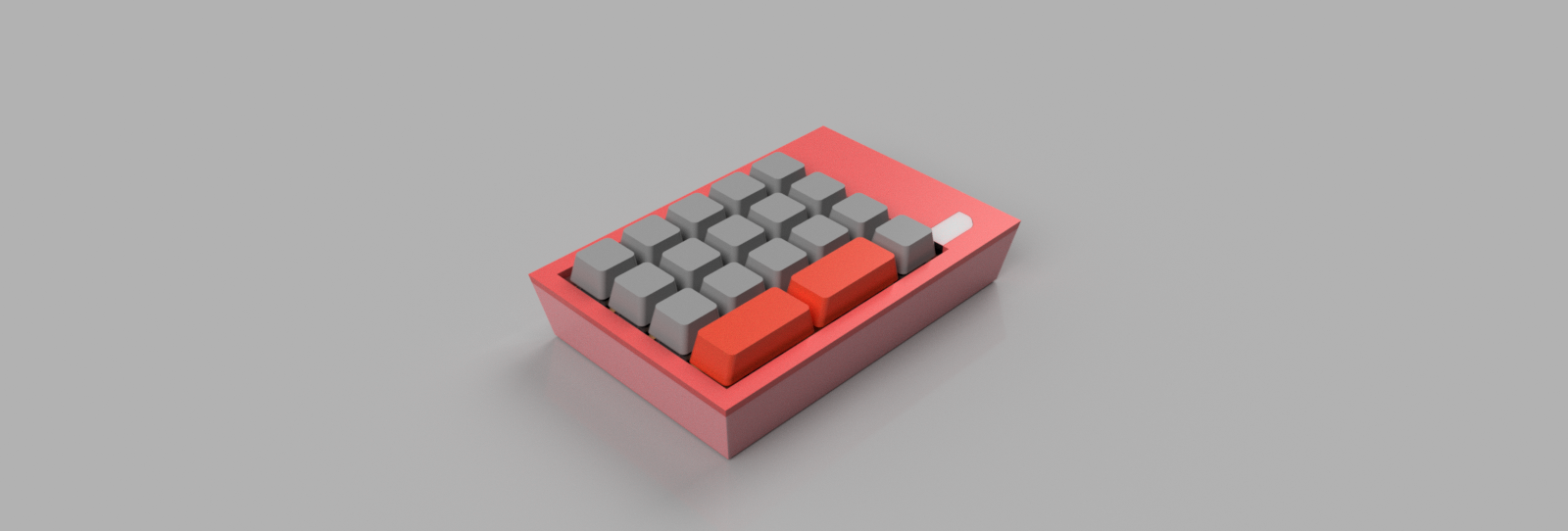
Custom mechanical number pad for personal computers
Numpad project is an open-source printed circuit board by falsonix, from the falsonix/fx19 repository on GitHub, published under the CC-BY-SA-4.0 licence. It is a 2-layer board of 76.5 × 120 mm with 78 parts on 63 nets, routed with 471 tracks and 45 vias.
It is built around the ATMEGA32U4 and WS2812E-1313. Its parts include 24 diodes, 19 switches, 14 capacitors, 6 resistors and 1 IC. It belongs with the AVR (ATmega, ATtiny) boards of this library.

Custom mechanical number pad for personal computers
This work is licensed under a Creative Commons Attribution-ShareAlike 4.0 International License.

| Qty | Value | Footprint | References |
|---|---|---|---|
| 18 | D | keyboard_parts:D_SOD123_axial | D1, D2, D3, D4, D5, D6, D7, D10, D11, D12, D13, D14, D15, D16, D17, D18 +2 |
| 18 | KEYSW | keebs:Mx_Alps_100 | K1, K2, K3, K4, K5, K6, K7, K10, K11, K12, K13, K14, K15, K16, K17, K18 +2 |
| 6 | 100nf | Capacitor_SMD:C_0805_2012Metric_Pad1.18x1.45mm_HandSolder | C9, C10, C11, C12, C13, C14 |
| 6 | WS2812E-1313 | rgbleds:LED-SMD_4P-L1.3-W1.3-P0.80_WS2812E-1313 | LED1, LED2, LED3, LED4, LED5, LED6 |
| 5 | TestPoint_Pad_D1.0mm | TestPoint:TestPoint_Pad_D1.0mm | MISO, MOSI, RESET, SCK, VCC |
| 4 | 0.1u | Capacitor_SMD:C_0805_2012Metric_Pad1.18x1.45mm_HandSolder | C3, C4, C5, C6 |
| 2 | 10k | Resistor_SMD:R_0805_2012Metric_Pad1.20x1.40mm_HandSolder | R1, R2 |
| 2 | 22 | Resistor_SMD:R_0805_2012Metric_Pad1.20x1.40mm_HandSolder | R5, R6 |
| 2 | 22p | Capacitor_SMD:C_0805_2012Metric_Pad1.18x1.45mm_HandSolder | C1, C2 |
| 2 | 5.1k | Resistor_SMD:R_0805_2012Metric_Pad1.20x1.40mm_HandSolder | R3, R4 |
| 1 | 1u | Capacitor_SMD:C_0805_2012Metric_Pad1.18x1.45mm_HandSolder | C8 |
| 1 | 4.7u | Capacitor_SMD:C_0805_2012Metric_Pad1.18x1.45mm_HandSolder | C7 |
| 1 | ATMEGA32U4 | Package_QFP:TQFP-44_10x10mm_P0.8mm | U1 |
| 1 | FA-238 16.0000MB-C3 | Crystal:Crystal_SMD_SeikoEpson_FA238-4Pin_3.2x2.5mm_HandSoldering | XTAL1 |
| 1 | LED | LED_SMD:LED_1206_3216Metric_Pad1.42x1.75mm_HandSolder | PWRLED1 |
| 1 | SW_PUSH | Button_Switch_SMD:SW_SPST_TL3342 | SW1 |
| 1 | USB_C_Receptacle_USB2.0_14P | Connector_USB:USB_C_Receptacle_HRO_TYPE-C-31-M-12 | J1 |
The 72 most common of 78 parts.

joshajohnson/Hub16
A macro pad with 16 keys, two rotary encoders, a four port USB hub, and plenty of LEDs!

tmk/USB2USB_Converter
USB to USB keyboard protocol converter supported by TMK keyboard firmware


evyd13/gh80-series
GH80-1800, GH80-3700 and GH80-3003 by Evy (aka anykeys.eu)


It measures 76.5 × 120 mm and has 2 copper layers, 1.6 mm thick.
78 parts, built around the ATMEGA32U4 and WS2812E-1313. The full list of its parts is on this page, with links to each part's symbol and footprint where PCBKit's library has them.
From the falsonix/fx19 repository on GitHub, at the commit this page was made from: the board is pcb/numpad_project.kicad_pcb and its schematic pcb/numpad_project.kicad_sch. PCBKit opens the board in the browser, with nothing to install.
Its repository publishes it under the CC-BY-SA-4.0 licence: you may reuse it on that licence's terms (keep the author's notice, and for a copyleft licence share your changes alike).