2 layers229.9 × 93.3 mm

 ethanjamesauto/modular_8bit_computer2
Bunny for isabel is an open-source printed circuit board by ethanjamesauto, from the ethanjamesauto/modular_8bit_computer repository on GitHub. It is a 2-layer board of 14.7 × 9.7 mm with 44 parts on 66 nets, routed with 5 tracks and 2 vias.
It is built around the LM324, TLV61070ADBV and NE555D. Its parts include 19 resistors, 9 capacitors, 4 transistors, 3 ICs and 1 switch. It belongs with the AVR (ATmega, ATtiny) boards of this library.


This is the repository for an 8-bit computer system that is built using cards with a standardized interface.
Here's an example of a card:
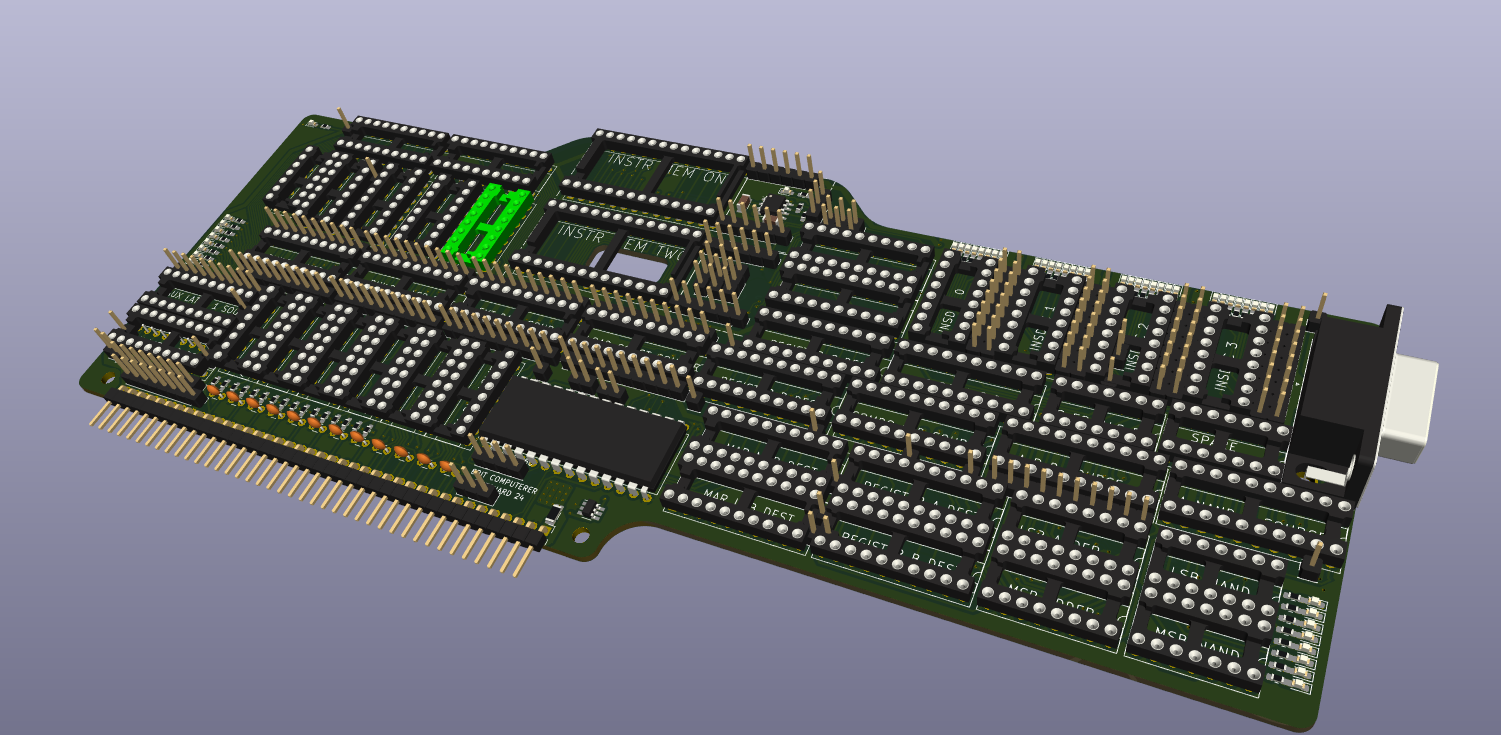
// The main bus wires (32+8=40 wires total)
// On the bus connector, all buses have LSBs closer to the power pins and MSBs farther away
wire VCC_5V;
wire GND;
wire clk;			      // generated by motherboard clock generator
wire rst_n;			    // probably a button on the motherboard
wire VCC_3V3;
wire we_n;			      // active LOW
wire oe_n;			      // active LOW
wire int_n;			    // pulled up by motherboard; driven down by any peripheral (could be used for interrupts)
wire [7:0] data;
wire [15:0] addr;	  // 64k address space is suppored by default. More address bits may be added later
wire [7:0] aux_bus;| Qty | Value | Footprint | References |
|---|---|---|---|
| 11 | R | Resistor_SMD:R_0603_1608Metric_Pad0.98x0.95mm_HandSolder | R1, R2, R3, R4, R7, R8, R9, R10, R17, R18, R19 |
| 5 | C | Resistor_SMD:R_0603_1608Metric_Pad0.98x0.95mm_HandSolder | C1, C2, C7, C8, C9 |
| 4 | 100k | Resistor_SMD:R_0603_1608Metric_Pad0.98x0.95mm_HandSolder | R5, R11, R13, R15 |
| 4 | 10M | Resistor_SMD:R_0603_1608Metric_Pad0.98x0.95mm_HandSolder | R6, R12, R14, R16 |
| 4 | 1n | Resistor_SMD:R_0603_1608Metric_Pad0.98x0.95mm_HandSolder | C3, C4, C5, C6 |
| 4 | 2N3904 | Package_TO_SOT_THT:TO-92_Inline | Q1, Q2, Q3, Q4 |
| 4 | Motor_Servo | Connector_PinHeader_2.54mm:PinHeader_1x03_P2.54mm_Vertical | M1, M2, M3, M4 |
| 1 | 1k | Resistor_SMD:R_0603_1608Metric_Pad0.98x0.95mm_HandSolder | Rlo1 |
| 1 | 9k | Resistor_SMD:R_0603_1608Metric_Pad0.98x0.95mm_HandSolder | Rhi1 |
| 1 | Arduino_Nano_Every | Module:Arduino_Nano | A1 |
| 1 | Battery | Connector_PinHeader_2.54mm:PinHeader_1x02_P2.54mm_Vertical | BT1 |
| 1 | LM324 | Package_DIP:DIP-14_W7.62mm | U2 |
| 1 | NE555D | Package_SO:SOIC-8_3.9x4.9mm_P1.27mm | U3 |
| 1 | SW_Push_Dual | Button_Switch_SMD:SW_DIP_SPSTx02_Slide_KingTek_DSHP02TJ_W5.25mm_P1.27mm_JPin | SW1 |
| 1 | TLV61070A | Package_TO_SOT_SMD:SOT-23-6 | U1 |


michaelalim226/open-loop-sawtooth-generator
KiCad PCB design for an open-loop DC sawtooth wave generator.

jusdisgi/TooManyKeys
Work in progress, new version of BiggieSplays with lots of bells and whistles

bash227/ECG-Motor-Control-Power-Management-PCB
A multi-function PCB integrating biomedical signal acquisition (ECG), DC motor control, and advanced power management for wearable applications.


jusdisgi/LightFury
Light Fury Keyboard: Ergo Split with 54 PG1316S keyswitches, 54 LEDs, LCDs, and Roller Encoders.

Autonomous-Motorsports-Purdue/AMP_RCv2
Files relating to version 2 of the remote control PCB for AMP kart

cvanbibber/USB-Charger
A simple USB charger board for soldering, with USB-C bidirectional port, USB-A, and micro-USB as an introduction to pcb design and usb standards.
It measures 14.7 × 9.7 mm and has 2 copper layers, 1.6 mm thick.
44 parts, built around the LM324, TLV61070ADBV and NE555D. The full list of its parts is on this page, with links to each part's symbol and footprint where PCBKit's library has them.
From the ethanjamesauto/modular_8bit_computer repository on GitHub, at the commit this page was made from: the board is bunny for isabel/bunny_for_isabel/bunny_for_isabel.kicad_pcb. PCBKit opens the board in the browser, with nothing to install.
Its repository states no licence, so its author keeps all rights: ask ethanjamesauto before reusing the design.