Skip to the content
6 layers14.8 × 12.6 mmPower Board, the printed circuit board in 3D

Power Board

esl-epfl/X-MODs3

Modular hardware platform based on the RISC-V X-HEEP family architecture developed at ESL, targeting ultra-low-power consumption and miniaturization, facilitating the creation of wearable devices for clinical trials

Size
14.8 × 12.6 mm
Copper layers
6
Thickness
0.8 mm
Parts
31
Nets
30
Pads
127
Tracks, vias
127, 95
Pours
30
Routed
Yes
KiCad
KiCad 8.0 (file 20240108)
Created
17 Sep 2024
Updated
13 May 2025

Overview

Power Board is an open-source printed circuit board by esl-epfl, from the esl-epfl/X-MODs repository on GitHub. It is a 6-layer board of 14.8 × 12.6 mm with 31 parts on 30 nets, routed with 127 tracks and 95 vias.

It is built around the MAX17262REWL+T, MAX77654MENV+T and RK73Z1ETTP, with the CRCW0402100KFKEDC, CRCW040210K0FKEDHP and DFE201612E-1R5M=P2 among its other parts. Its parts include 16 capacitors, 10 resistors, 2 ICs, 1 connector and 1 inductor. It belongs with the wearables boards of this library.

Main components

6

README

README.md

X-MODs: Modular PCBs for Wearable Healthcare Devices

A collection of compact, power-efficient PCB modules designed for rapid prototyping and development of wearable healthcare devices, with a focus on biosignal acquisition.

X-MODs Overview

Overview

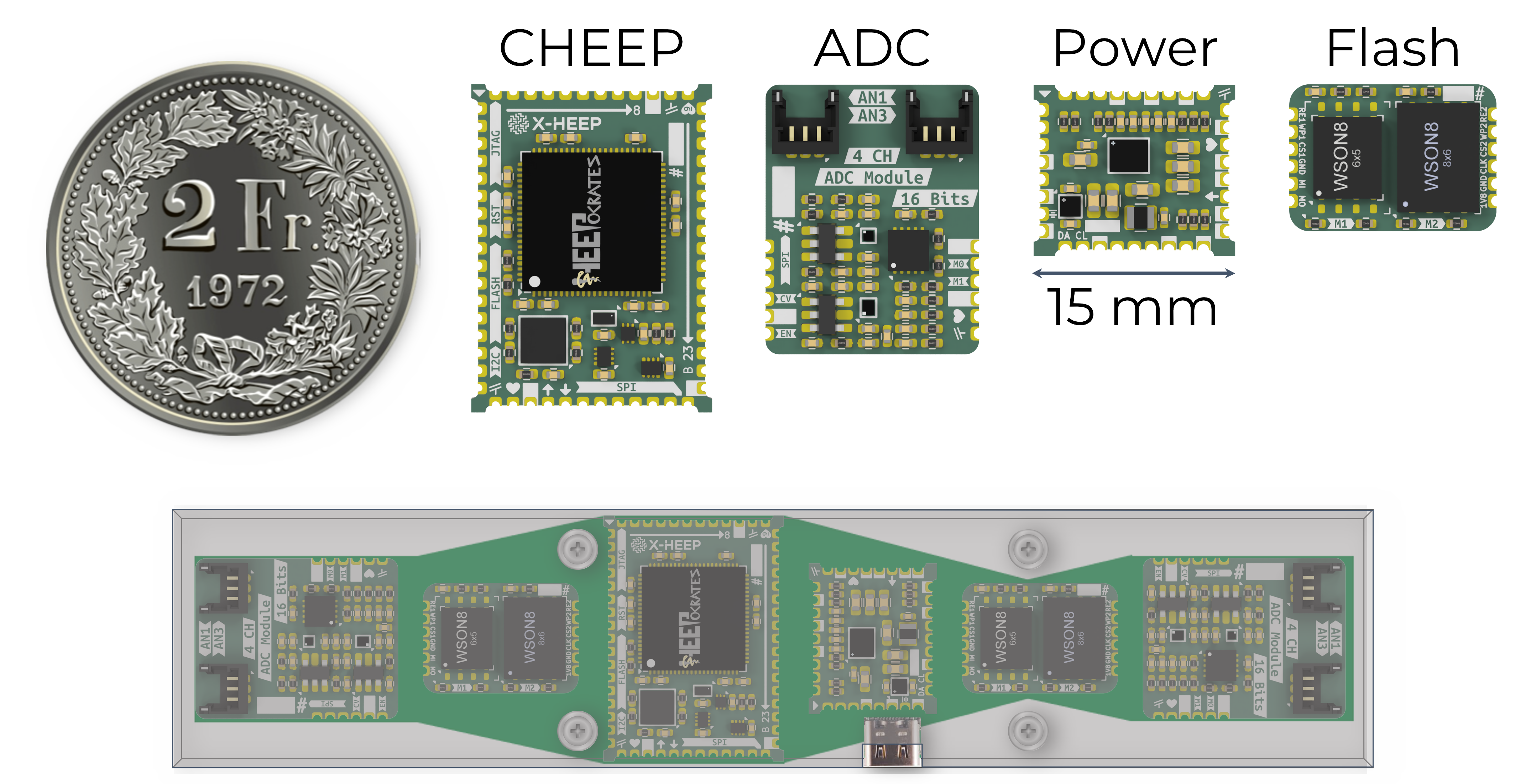
X-MODs provides a modular hardware approach that bridges the gap between fully custom designs and off-the-shelf solutions. The system consists of four specialized modules and their corresponding debug boards, enabling quick prototyping while maintaining the small form factor required for wearable applications.

Modules

CHEEP Module Open in KiCanvas

  • Built around the HEEPocrates RISC-V SoC
  • Multiple communication interfaces (UART, I2C, SPI)

Power Module Open in KiCanvas

  • High-efficiency PMIC
  • 5 independent voltage rails
  • LiPo battery charging capability
  • Integrated coulomb counter for accurate battery monitoring

ADC Module Open in KiCanvas

  • 16-bit precision
  • 4 multiplexed input channels
  • 1 MSPS sampling rate
  • Optimized for biosignal acquisition

Memory Module Open in KiCanvas

  • Dual NOR flash configuration
  • Expandable storage capacity
  • Pin-compatible with various memory sizes
  • Designed for autonomous data acquisition

Socket Boards

Each module comes with a companion scoket board featuring:

  • Spring-loaded pogo pins for solderless connections
  • Easy module swapping capabilities
  • Breadboard-compatible format
  • Testing and validation infrastructure

Applications

These modules are particularly suited for:

  • EEG signal acquisition
  • Wearable medical devices
  • Clinical trial prototypes
  • Academic research projects
  • Low-power embedded systems

Contact

Please contact the authors for additional information

Developed at the Embedded Systems Laboratory (ESL), EPFL.

Parts

31
QtyValueFootprintReferences
70R00X-MODs_PcbLib:R0402R2, R5, R6, R7, R10, R11, R12
522u0 10VX-MODs_PcbLib:C0603C5, C6, C7, C8, C9
41u00 10VX-MODs_PcbLib:C0402C11, C14, C15, C16
2100KX-MODs_PcbLib:R0402R8, R9
22u20 16VX-MODs_PcbLib:C0402C12, C13
24u70 25VX-MODs_PcbLib:C0603C3, C4
1100n 10VX-MODs_PcbLib:C0402C1
110K0X-MODs_PcbLib:R0402R1
11u50X-MODs_PcbLib:L0806L1
13n30 16VX-MODs_PcbLib:C0402C10
1470n 6V3X-MODs_PcbLib:C0402C2
1LOGOLOGOG***
1MAX17262REWL+TX-MODs_PcbLib:WLCSP-9_1.468x1.448mm_P0.4mmU1
1MAX77654MENV+TX-MODs_PcbLib:WLCSP-30_2.788x2.338mm_P0.4mmU2
1~X-MODs_PcbLib:Power_Board_Castellated_Conn_1.27mmJ1

More from esl-epfl/X-MODs

7
  • 6 layers15.6 × 19.7 mmADC Board, the printed circuit board in 3D

    ADC Board

    esl-epfl/X-MODs

    Modular hardware platform based on the RISC-V X-HEEP family architecture developed at ESL, targeting ultra-low-power consumption and miniaturization, facilitating the creation of wearable devices for clinical trials

    74 parts3
  • 4 layers64.9 × 71.4 mmCHEEP Board Socket, the printed circuit board in 3D

    CHEEP Board Socket

    esl-epfl/X-MODs

    Modular hardware platform based on the RISC-V X-HEEP family architecture developed at ESL, targeting ultra-low-power consumption and miniaturization, facilitating the creation of wearable devices for clinical trials

    70 parts3
  • 6 layers17.5 × 23.9 mmCHEEP Board, the printed circuit board in 3D

    CHEEP Board

    esl-epfl/X-MODs

    Modular hardware platform based on the RISC-V X-HEEP family architecture developed at ESL, targeting ultra-low-power consumption and miniaturization, facilitating the creation of wearable devices for clinical trials

    46 parts3
  • 4 layers38 × 47.3 mmPower Board Socket, the printed circuit board in 3D

    Power Board Socket

    esl-epfl/X-MODs

    Modular hardware platform based on the RISC-V X-HEEP family architecture developed at ESL, targeting ultra-low-power consumption and miniaturization, facilitating the creation of wearable devices for clinical trials

    41 parts3
  • 4 layers64.1 × 16.2 mmADC Board Socket, the printed circuit board in 3D

    ADC Board Socket

    esl-epfl/X-MODs

    Modular hardware platform based on the RISC-V X-HEEP family architecture developed at ESL, targeting ultra-low-power consumption and miniaturization, facilitating the creation of wearable devices for clinical trials

    25 parts3
  • 4 layers69.3 × 16.3 mmMemory Board Socket, the printed circuit board in 3D

    Memory Board Socket

    esl-epfl/X-MODs

    Modular hardware platform based on the RISC-V X-HEEP family architecture developed at ESL, targeting ultra-low-power consumption and miniaturization, facilitating the creation of wearable devices for clinical trials

    22 parts3
  • 6 layers15.2 × 10.8 mmMemory Board, the printed circuit board in 3D

    Memory Board

    esl-epfl/X-MODs

    Modular hardware platform based on the RISC-V X-HEEP family architecture developed at ESL, targeting ultra-low-power consumption and miniaturization, facilitating the creation of wearable devices for clinical trials

    19 parts3

Similar boards

  • 4 layers53.4 × 38.4 mmGSR Board, the printed circuit board in 3D

    GSR Board

    esl-epfl/GSR_monitor

    Discrete validation platform for the HEEPidermis low-power SoC, designed for low-noise Galvanic Skin Response (GSR) measurements

    159 parts1
  • 4 layers71.5 × 71.5 mmElixir, the printed circuit board in 3D

    Elixir

    golioth/elixir-hw

    An open source hardware device that has cellular, wifi, bluetooth, GPS, and more!

    249 parts36CERN-OHL-P-2.0
  • 4 layers80.1 × 22.2 mmM2-smart iot module, the printed circuit board in 3D

    M2-smart iot module

    antmicro/m2-smart-iot-module

    https://antmicro.com/blog/2021/08/open-hardware-smart-m2-radio-module-for-iot/

    212 parts30Apache-2.0
  • 6 layers69.6 × 30 mmLpddr4-testbed, the printed circuit board in 3D

    Lpddr4-testbed

    antmicro/lpddr4-testbed

    Experimental breakout board for a signle 200-ball WFBGA LPDDR4 chip in SO-DIMM DDR4 form factor.

    68 parts27Apache-2.0
  • 4 layers89 × 54 mmOBCProto, the printed circuit board in 3D

    OBCProto

    Kmshanley/PicoSat-Initiative

    The pocket cube standard requires satellites to be 5x5x5cm and under 250 grams. Upon completion of this Wentworth PicoSat it will become one of the smallest satellites capable of high resolution imagery from LEO.

    126 parts3GPL-3.0
  • 6 layers57 × 25.9 mmR7FS7MOD, the printed circuit board in 3D

    R7FS7MOD

    Brazil-L/Lumeward-OpenSource

    Open-source Lumeward firmware and development tools

    228 parts2Apache-2.0
  • 2 layers62.2 × 25.4 mmEnchantiW106, the printed circuit board in 3D

    EnchantiW106

    aburt2/enchantiW106

    firmware and hardware files for the enchantiW106

    66 parts1

Questions

How big is the Power Board PCB?

It measures 14.8 × 12.6 mm and has 6 copper layers, 0.8 mm thick.

What parts does the Power Board use?

31 parts, built around the MAX17262REWL+T, MAX77654MENV+T, RK73Z1ETTP and CRCW0402100KFKEDC. The full list of its parts is on this page, with links to each part's symbol and footprint where PCBKit's library has them.

Where can I download the Power Board KiCad files?

From the esl-epfl/X-MODs repository on GitHub, at the commit this page was made from: the board is Module_Boards/Power_Board/Power_Board.kicad_pcb and its schematic Module_Boards/ADC_Board/ADC_Board.kicad_sch. PCBKit opens the board in the browser, with nothing to install.

Can I use the Power Board design in my own project?

Its repository states no licence, so its author keeps all rights: ask esl-epfl before reusing the design.