Skip to the content
4 layers89 × 54 mmOBCProto, the printed circuit board in 3D

The pocket cube standard requires satellites to be 5x5x5cm and under 250 grams. Upon completion of this Wentworth PicoSat it will become one of the smallest satellites capable of high resolution imagery from LEO.

Size
89 × 54 mm
Copper layers
4
Thickness
1 mm
Parts
126
Nets
190
Pads
656
Tracks, vias
2,162, 440
Pours
9
Routed
Yes
KiCad
KiCad 7 (file 20221018)
Created
19 Jan 2023
Updated
17 Jul 2024

Overview

OBCProto is an open-source printed circuit board by Kmshanley, from the Kmshanley/PicoSat-Initiative repository on GitHub, published under the GPL-3.0 licence. It is a 4-layer board of 89 × 54 mm with 126 parts on 190 nets, routed with 2,162 tracks and 440 vias.

It is built around the STM32H723ZGT6, INA236AIDDFR and RP604K331A-TR, with the TPS62840DLCR, W25N01GVZEIGTR and APS6404L-SQN-ZR among its other parts. Its parts include 53 capacitors, 19 ICs, 15 resistors, 12 connectors and 2 inductors. It belongs with the STM32 boards of this library.

Main components

8

README

README.md

PicoSat-Initiative

The Wentworth Picosat initiative is a group at Wentworth Institute of technology dedicated to making a pocket cube satellite capable of earth observation from LEO.
The pocket cube standard requires satellites to be 5x5x5cm and under 250 grams. Upon completion of this Wentworth PicoSat it will become one of the smallest satellites capable of high resolution imagery from LEO.

Organization

This repository is divided into two primary sections:

Test

Contains all firmware related to testing boards or individual components.

Flight

Contains the development for the main flight firmware that will be deployed in space.

Getting Started

The easiest way to get started is by using the Stm32CubeIDE.

Downloadable here: https://www.st.com/en/development-tools/stm32cubeide.html

From here you should be able to import the various project files (.ioc) and CubeIDE will handle setup, build tools, and compilation.

High Level Overview

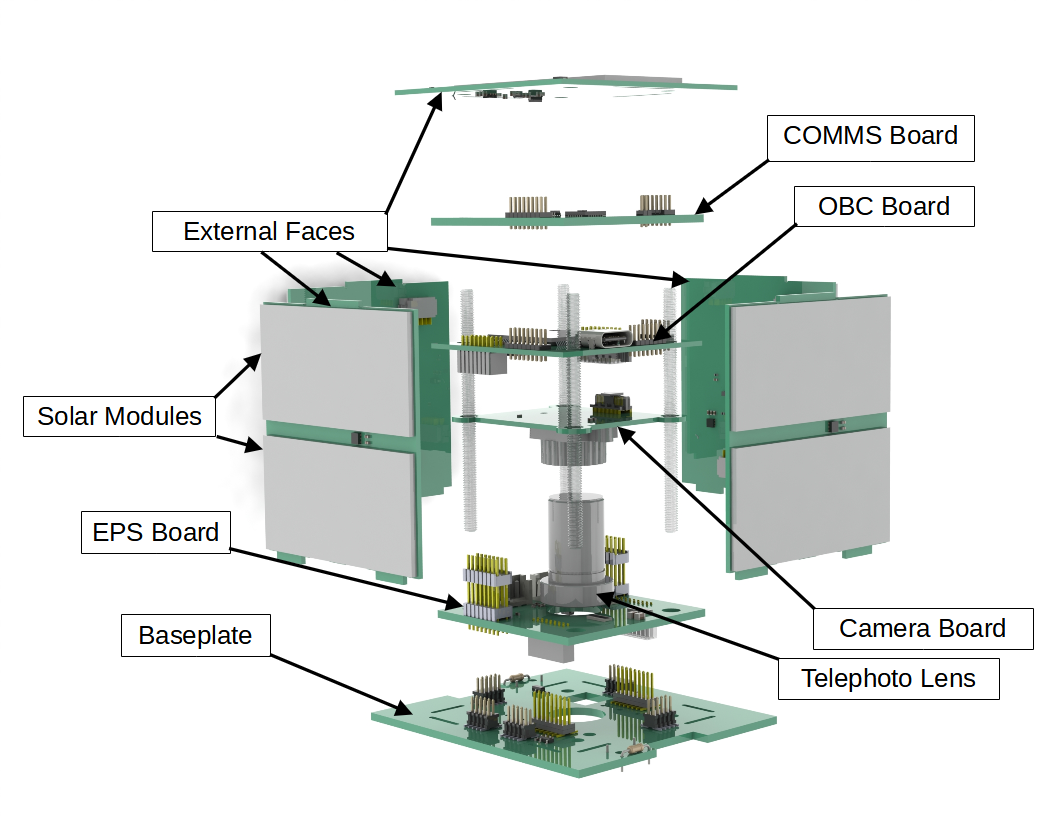
Exploded and Annotated Render of the Satellite's Internal Stack

The Satellite is composed of several subsystems:

  • Onboard Computer System (OBC)
    • Responsible for handling commands from the ground station
    • Running ADCS algorithms
    • Commanding the image sensor to take pictures
      • Compressing and Storing these pictures until downlink
    • Gathering telemetry from sensors
      • Feeding telemetry to the appropriate subsystem
        • I.e. LUX sensor data to ADCS
    • Managing Satellite Energy consumption
      • Monitoring battery health and determining wakeup periods
  • Electrical Power System (EPS)
    • Responsible for generating, storing, and regulating electrical power
  • Communications (COMMS)
    • Responsible for uplink and downlink to ground station
  • Attitude Control and determination (ADCS)
    • Responsible for determining the attitude (rotation) of the satellite
    • Responsible for executing rotational maneuvers

Hardware Overview

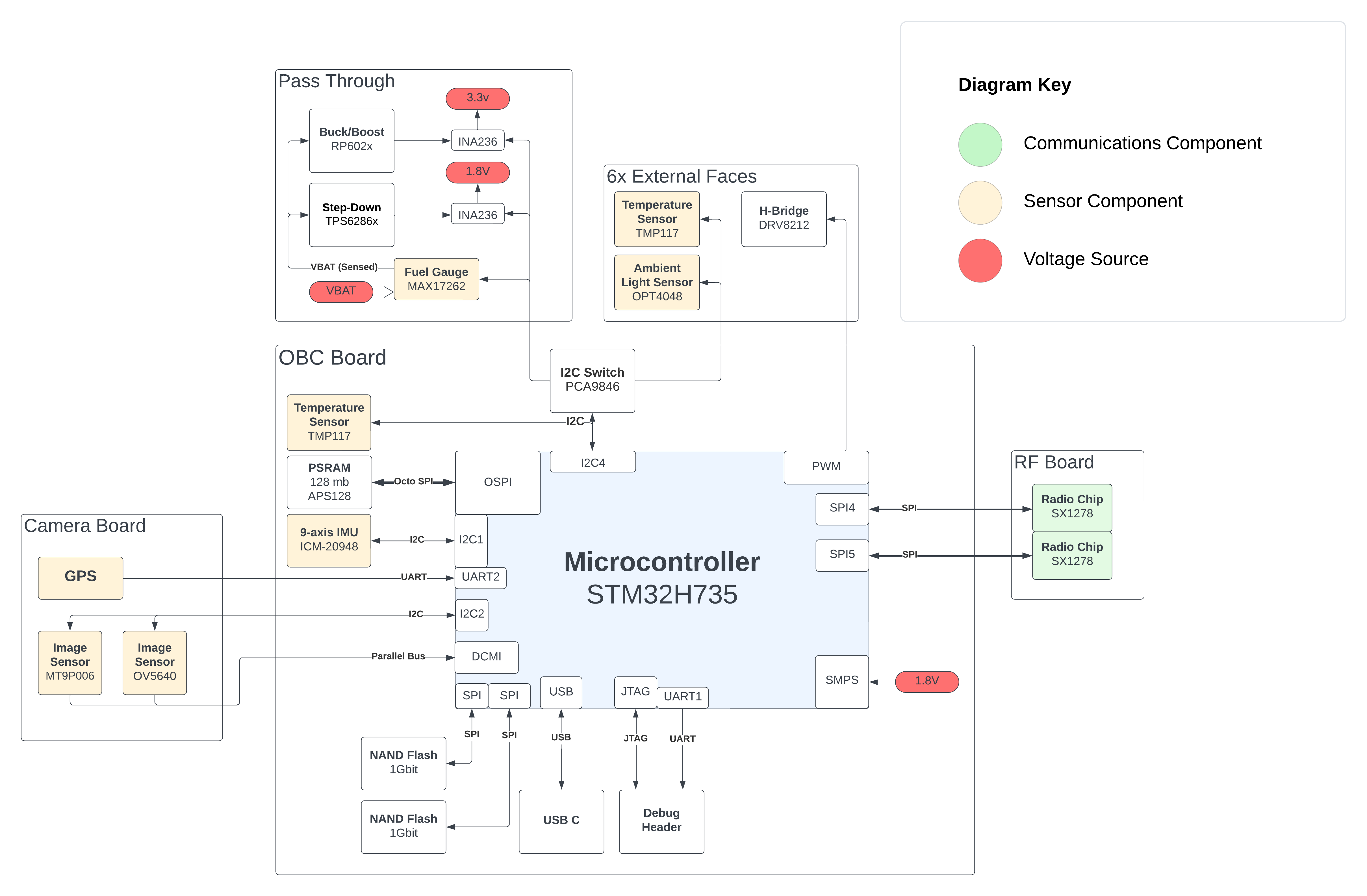
System diagram of all satellite components

Contact

You can join our discord with the link above or contact us directly via email:

OBC Team Lead (Kieran Shanley): kmshanley01@gmail.com

Parts

126
QtyValueFootprintReferences
33100nFCapacitor_SMD:C_0402_1005MetricC4, C10, C11, C12, C13, C22, C24, C25, C26, C27, C28, C29, C30, C33, C35, C40 +17
124.7kResistor_SMD:R_0402_1005MetricR1, R2, R3, R4, R5, R6, R7, R8, R9, R10, R11, R12
51uFCapacitor_SMD:C_0402_1005MetricC14, C20, C21, C34, C53
54.7uFCapacitor_SMD:C_0402_1005MetricC3, C16, C23, C31, C32
410uFCapacitor_SMD:C_0402_1005MetricC15, C17, C18, C19
4TBDCapacitor_SMD:C_0402_1005MetricC36, C37, C38, C39
4TMP117MAIDRVRTMP117MAIDRVR:SON65P200X200X80-7NIC4, IC8, IC12, IC13
22.2uFCapacitor_SMD:C_0402_1005MetricC1, C2
22.2uHInductor_SMD:L_1008_2520MetricL1, L2
220mResistor_SMD:R_1020_2550MetricR14, R15
2ALERTTestPoint:TestPoint_Pad_1.0x1.0mmTP13, TP14
2Crystal_GND24Crystal:Crystal_SMD_2520-4Pin_2.5x2.0mmY1, Y2
2INA236AIDDFRINA236AIDDFR:SOP65P280X110-8NIC6, IC7
2SPI Radio1Connector_PinHeader_2.54mm:PinHeader_1x06_P2.54mm_VerticalJ1, J5
2WAKUPTS04-66-75-BK-160-SMT:TS046675BK160SMTIC14, IC15
110kResistor_SMD:R_0402_1005MetricR13
11V5 SupplyConnector_PinHeader_2.54mm:PinHeader_1x02_P2.54mm_VerticalJ9
12337019-12337019-1:23370191J12
12V8 SupplyConnector_PinHeader_2.54mm:PinHeader_1x02_P2.54mm_VerticalJ8
1APS12808L-OBMX-BAAPS12808L-OBMX-BA:BGA24C100P5X5_600X800X120IC10
1APS6404L-SQN-ZRAPS6404L-SQN-ZR:APS6404L-SQN-ZRU3
1Boot_SelTestPoint:TestPoint_Pad_1.5x1.5mmTP12
1CE SelectConnector_PinHeader_2.54mm:PinHeader_1x03_P2.54mm_VerticalJP5
1GPIOConnector_PinHeader_2.54mm:PinHeader_1x10_P2.54mm_VerticalJ11
1GPS RSTTestPoint:TestPoint_Pad_1.5x1.5mmTP11
1GroudDetectConnector_PinHeader_2.54mm:PinHeader_1x02_P2.54mm_VerticalJP2
1I2C1_SCLTestPoint:TestPoint_Pad_2.0x2.0mmTP1
1I2C1_SDATestPoint:TestPoint_Pad_2.0x2.0mmTP2
1I2C2_SCLTestPoint:TestPoint_Pad_2.0x2.0mmTP3
1I2C2_SDATestPoint:TestPoint_Pad_2.0x2.0mmTP4
1I2C4_SCLTestPoint:TestPoint_Pad_2.0x2.0mmTP5
1I2C4_SDATestPoint:TestPoint_Pad_2.0x2.0mmTP6
1ICM-20948ICM-20948:QFN40P300X300X105-25N-DIC9
1JRCLKConnector_PinHeader_2.54mm:PinHeader_1x02_P2.54mm_VerticalJP7
1LOGOGraphics:leopardG***
1LOGOGraphics:IEEE_LogoG***
1MAX17262REWL+TMAX17262REWL+T:BGA9C40P3X3_147X145X69IC3
1MPU PwrConnector_PinHeader_2.54mm:PinHeader_1x02_P2.54mm_VerticalJP1
1NAND Flash PwrConnector_PinHeader_2.54mm:PinHeader_1x02_P2.54mm_VerticalJP3
1ORION-B16Venus838FLPx:U-SkyTraq-ORION-B16U4
1OV5640 FREXTestPoint:TestPoint_Pad_2.0x2.0mmTP9
1OV5640 ModuleConnector_PinHeader_2.54mm:PinHeader_2x09_P2.54mm_VerticalJ4
1OV5640 STROBETestPoint:TestPoint_Pad_2.0x2.0mmTP8
1OV5640-A71AOV5640-A71A:BGA71C50P11X11_598X584X81U2
1PCA9543APWRPCA9543APWR:SOP65P640X120-14NIC5
1RP604K331A-TRRP604K331A-TR:SON50P270X300X60-13NIC2
1SRAM PowerConnector_PinHeader_2.54mm:PinHeader_1x02_P2.54mm_VerticalJP4
1STLinkConnector_PinHeader_1.27mm:PinHeader_2x07_P1.27mm_VerticalJ3
1STM32H723ZGT6STM32H723ZGT6:QFP50P2200X2200X160-144NIC1
1Small SRAM PwrConnector_PinHeader_2.54mm:PinHeader_1x02_P2.54mm_VerticalJP6
1Switch BypassConnector_PinHeader_2.54mm:PinHeader_2x04_P2.54mm_VerticalJ10
1Switch ResetTestPoint:TestPoint_Pad_2.0x2.0mmTP10
1TPS62840DLCRTPS62840DLCR:SON50P200X150X100-8NU1
1UART2Connector_PinHeader_2.54mm:PinHeader_1x04_P2.54mm_VerticalJ7
1VBAT TerminalTerminalBlock_TE-Connectivity:TerminalBlock_TE_282834-2_1x02_P2.54mm_HorizontalJ6
1VBUS TerminalTerminalBlock_TE-Connectivity:TerminalBlock_TE_282834-2_1x02_P2.54mm_HorizontalJ2
1VCMSINKTestPoint:TestPoint_Pad_2.0x2.0mmTP7
1W25N01GVZEIG_TRW25N01GVZEIG_TR:SON127P800X600X80-9N-DIC11

More from Kmshanley/PicoSat-Initiative

12
  • 8 layers40 × 40 mmOBC Flight, the printed circuit board in 3D

    OBC Flight

    Kmshanley/PicoSat-Initiative

    The pocket cube standard requires satellites to be 5x5x5cm and under 250 grams. Upon completion of this Wentworth PicoSat it will become one of the smallest satellites capable of high resolution imagery from LEO.

    90 parts3GPL-3.0
  • 4 layers40 × 40 mmPassthroughBoardRev0 C, the printed circuit board in 3D

    PassthroughBoardRev0 C

    Kmshanley/PicoSat-Initiative

    The pocket cube standard requires satellites to be 5x5x5cm and under 250 grams. Upon completion of this Wentworth PicoSat it will become one of the smallest satellites capable of high resolution imagery from LEO.

    53 parts3GPL-3.0
  • 4 layers64 × 58 mmFinal baseplate model 66, the printed circuit board in 3D

    Final baseplate model 66

    Kmshanley/PicoSat-Initiative

    The pocket cube standard requires satellites to be 5x5x5cm and under 250 grams. Upon completion of this Wentworth PicoSat it will become one of the smallest satellites capable of high resolution imagery from LEO.

    41 parts3GPL-3.0
  • 4 layers40 × 40 mmCommsRev0, the printed circuit board in 3D

    CommsRev0

    Kmshanley/PicoSat-Initiative

    The pocket cube standard requires satellites to be 5x5x5cm and under 250 grams. Upon completion of this Wentworth PicoSat it will become one of the smallest satellites capable of high resolution imagery from LEO.

    39 parts3GPL-3.0
  • 4 layers58 × 64 mmBaseplateRev1, the printed circuit board in 3D

    BaseplateRev1

    Kmshanley/PicoSat-Initiative

    The pocket cube standard requires satellites to be 5x5x5cm and under 250 grams. Upon completion of this Wentworth PicoSat it will become one of the smallest satellites capable of high resolution imagery from LEO.

    38 parts3GPL-3.0
  • 4 layers46 × 50.4 mmExternalFaces, the printed circuit board in 3D

    ExternalFaces

    Kmshanley/PicoSat-Initiative

    The pocket cube standard requires satellites to be 5x5x5cm and under 250 grams. Upon completion of this Wentworth PicoSat it will become one of the smallest satellites capable of high resolution imagery from LEO.

    34 parts3GPL-3.0
  • 8 layers47.8 × 47.8 mmExternalFaces, the printed circuit board in 3D

    ExternalFaces

    Kmshanley/PicoSat-Initiative

    The pocket cube standard requires satellites to be 5x5x5cm and under 250 grams. Upon completion of this Wentworth PicoSat it will become one of the smallest satellites capable of high resolution imagery from LEO.

    31 parts3GPL-3.0
  • 4 layers50 × 50 mmTopExternalFaceRev0, the printed circuit board in 3D

    TopExternalFaceRev0

    Kmshanley/PicoSat-Initiative

    The pocket cube standard requires satellites to be 5x5x5cm and under 250 grams. Upon completion of this Wentworth PicoSat it will become one of the smallest satellites capable of high resolution imagery from LEO.

    31 parts3GPL-3.0
  • 4 layers58 × 64 mmBaseplateRev1 B, the printed circuit board in 3D

    BaseplateRev1 B

    Kmshanley/PicoSat-Initiative

    The pocket cube standard requires satellites to be 5x5x5cm and under 250 grams. Upon completion of this Wentworth PicoSat it will become one of the smallest satellites capable of high resolution imagery from LEO.

    30 parts3GPL-3.0
  • 4 layers58 × 64 mmBaseplate rev1 mock3, the printed circuit board in 3D

    Baseplate rev1 mock3

    Kmshanley/PicoSat-Initiative

    The pocket cube standard requires satellites to be 5x5x5cm and under 250 grams. Upon completion of this Wentworth PicoSat it will become one of the smallest satellites capable of high resolution imagery from LEO.

    29 parts3GPL-3.0
  • 4 layers34.5 × 38.5 mmCameraBoard, the printed circuit board in 3D

    CameraBoard

    Kmshanley/PicoSat-Initiative

    The pocket cube standard requires satellites to be 5x5x5cm and under 250 grams. Upon completion of this Wentworth PicoSat it will become one of the smallest satellites capable of high resolution imagery from LEO.

    27 parts3GPL-3.0
  • 2 layers58 × 112.7 mmBaseplate mock 2 rev 1, the printed circuit board in 3D

    Baseplate mock 2 rev 1

    Kmshanley/PicoSat-Initiative

    The pocket cube standard requires satellites to be 5x5x5cm and under 250 grams. Upon completion of this Wentworth PicoSat it will become one of the smallest satellites capable of high resolution imagery from LEO.

    22 parts3GPL-3.0

Similar boards

  • 4 layers55.9 × 25.4 mmEnchantiS3, the printed circuit board in 3D

    EnchantiS3

    aburt2/EnchantiS3

    Repository for the hardware and firmware files for the EnchantiS3 board

    68 parts
  • 2 layers49.5 × 43.5 mmVoltage current monitor schematic, the printed circuit board in 3D

    Voltage current monitor schematic

    rsx-utoronto/RSX-CANSAT-2027

    This repository contains all files created by the Aerial Team of Robotics for Space eXploration (RSX) at the University of Toronto, supporting our entry in the 2027 CanSat Competition.

    13 parts5
  • 4 layers159 × 21.7 mmKSS V50, the printed circuit board in 3D

    KSS V50

    anaidan/KSS_V50

    Kinetic Sun Sculpture V50

    128 parts
  • 4 layers71 × 51.5 mmWLED Controller, the printed circuit board in 3D

    WLED Controller

    GreatMesa/Bike-Led-Controller

    Custom LED Bike Ring & Controller PCB

    69 parts
  • 4 layers38.4 × 18.4 mmServo ESC, the printed circuit board in 3D

    Servo ESC

    GreatMesa/Servo-ESC

    Custom 4-Layer Boards for better servo control.

    43 partsMIT

Questions

How big is the OBCProto PCB?

It measures 89 × 54 mm and has 4 copper layers, 1 mm thick.

What parts does the OBCProto use?

126 parts, built around the STM32H723ZGT6, INA236AIDDFR, RP604K331A-TR and TPS62840DLCR. The full list of its parts is on this page, with links to each part's symbol and footprint where PCBKit's library has them.

Where can I download the OBCProto KiCad files?

From the Kmshanley/PicoSat-Initiative repository on GitHub, at the commit this page was made from: the board is Hardware/OBCProto/OBCProto.kicad_pcb and its schematic Hardware/BaseplateRev0/baseplate.kicad_sch. PCBKit opens the board in the browser, with nothing to install.

Can I use the OBCProto design in my own project?

Its repository publishes it under the GPL-3.0 licence: you may reuse it on that licence's terms (keep the author's notice, and for a copyleft licence share your changes alike).