Skip to the content
6 layers15.2 × 10.8 mmMemory Board, the printed circuit board in 3D

Memory Board

esl-epfl/X-MODs3

Modular hardware platform based on the RISC-V X-HEEP family architecture developed at ESL, targeting ultra-low-power consumption and miniaturization, facilitating the creation of wearable devices for clinical trials

Size
15.2 × 10.8 mm
Copper layers
6
Thickness
0.8 mm
Parts
19
Nets
11
Pads
74
Tracks, vias
142, 47
Pours
4
Routed
Yes
KiCad
KiCad 8.0 (file 20240108)
Created
17 Sep 2024
Updated
13 May 2025

Overview

Memory Board is an open-source printed circuit board by esl-epfl, from the esl-epfl/X-MODs repository on GitHub. It is a 6-layer board of 15.2 × 10.8 mm with 19 parts on 11 nets, routed with 142 tracks and 47 vias.

It is built around the MX25U25643GZ4I00/TR and CRCW040210K0FKEDHP. Its parts include 7 resistors, 2 capacitors, 2 ICs and 1 connector. It belongs with the wearables boards of this library.

Main components

2

README

README.md

X-MODs: Modular PCBs for Wearable Healthcare Devices

A collection of compact, power-efficient PCB modules designed for rapid prototyping and development of wearable healthcare devices, with a focus on biosignal acquisition.

X-MODs Overview

Overview

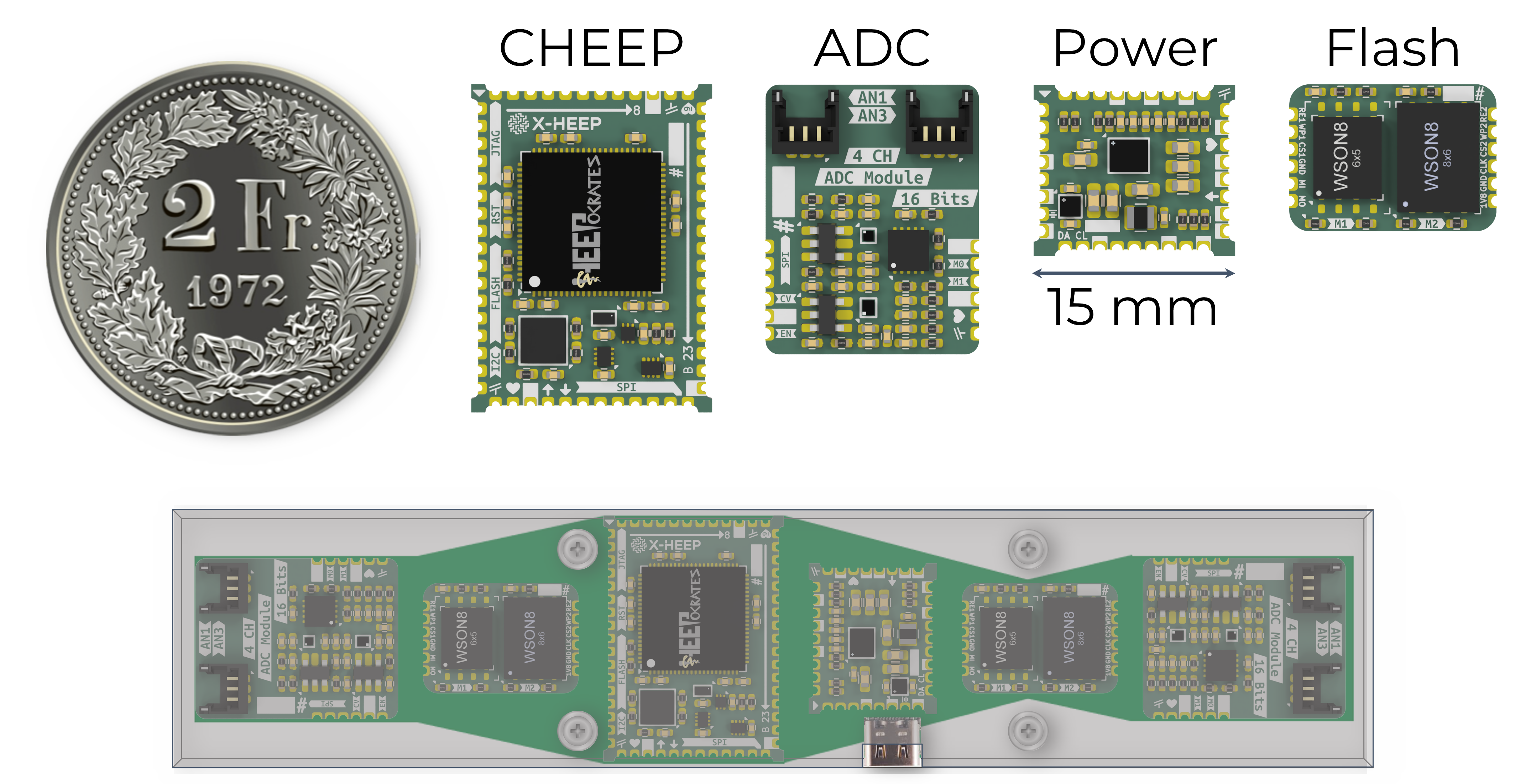
X-MODs provides a modular hardware approach that bridges the gap between fully custom designs and off-the-shelf solutions. The system consists of four specialized modules and their corresponding debug boards, enabling quick prototyping while maintaining the small form factor required for wearable applications.

Modules

CHEEP Module Open in KiCanvas

  • Built around the HEEPocrates RISC-V SoC
  • Multiple communication interfaces (UART, I2C, SPI)

Power Module Open in KiCanvas

  • High-efficiency PMIC
  • 5 independent voltage rails
  • LiPo battery charging capability
  • Integrated coulomb counter for accurate battery monitoring

ADC Module Open in KiCanvas

  • 16-bit precision
  • 4 multiplexed input channels
  • 1 MSPS sampling rate
  • Optimized for biosignal acquisition

Memory Module Open in KiCanvas

  • Dual NOR flash configuration
  • Expandable storage capacity
  • Pin-compatible with various memory sizes
  • Designed for autonomous data acquisition

Socket Boards

Each module comes with a companion scoket board featuring:

  • Spring-loaded pogo pins for solderless connections
  • Easy module swapping capabilities
  • Breadboard-compatible format
  • Testing and validation infrastructure

Applications

These modules are particularly suited for:

  • EEG signal acquisition
  • Wearable medical devices
  • Clinical trial prototypes
  • Academic research projects
  • Low-power embedded systems

Contact

Please contact the authors for additional information

Developed at the Embedded Systems Laboratory (ESL), EPFL.

Parts

19
QtyValueFootprintReferences
710K0X-MODs_PcbLib:R0402R1, R2, R3, R4, R5, R7, R8
2100n 10VX-MODs_PcbLib:C0402C1, C2
2LOGOLOGOG***, G***
1G***kibuzzard-6743EB8Dkibuzzard-6743EB8D
1G***kibuzzard-672506E3kibuzzard-672506E3
1G***kibuzzard-6743EB85kibuzzard-6743EB85
1G***kibuzzard-672506D5kibuzzard-672506D5
1G***kibuzzard-6725074Fkibuzzard-6725074F
1MX25U12832FZNI02-TRX-MODs_PcbLib:8-WSON_DUAL_(6x5mm)_8x6mnU1
1MX25U25643GZ4I00-TX-MODs_PcbLib:8-WSON_DUAL_6x5mm_(8x6mn)U2
1~X-MODs_PcbLib:Memory_Board_Castellated_Conn_1.27mmJ1

More from esl-epfl/X-MODs

7
  • 6 layers15.6 × 19.7 mmADC Board, the printed circuit board in 3D

    ADC Board

    esl-epfl/X-MODs

    Modular hardware platform based on the RISC-V X-HEEP family architecture developed at ESL, targeting ultra-low-power consumption and miniaturization, facilitating the creation of wearable devices for clinical trials

    74 parts3
  • 4 layers64.9 × 71.4 mmCHEEP Board Socket, the printed circuit board in 3D

    CHEEP Board Socket

    esl-epfl/X-MODs

    Modular hardware platform based on the RISC-V X-HEEP family architecture developed at ESL, targeting ultra-low-power consumption and miniaturization, facilitating the creation of wearable devices for clinical trials

    70 parts3
  • 6 layers17.5 × 23.9 mmCHEEP Board, the printed circuit board in 3D

    CHEEP Board

    esl-epfl/X-MODs

    Modular hardware platform based on the RISC-V X-HEEP family architecture developed at ESL, targeting ultra-low-power consumption and miniaturization, facilitating the creation of wearable devices for clinical trials

    46 parts3
  • 4 layers38 × 47.3 mmPower Board Socket, the printed circuit board in 3D

    Power Board Socket

    esl-epfl/X-MODs

    Modular hardware platform based on the RISC-V X-HEEP family architecture developed at ESL, targeting ultra-low-power consumption and miniaturization, facilitating the creation of wearable devices for clinical trials

    41 parts3
  • 6 layers14.8 × 12.6 mmPower Board, the printed circuit board in 3D

    Power Board

    esl-epfl/X-MODs

    Modular hardware platform based on the RISC-V X-HEEP family architecture developed at ESL, targeting ultra-low-power consumption and miniaturization, facilitating the creation of wearable devices for clinical trials

    31 parts3
  • 4 layers64.1 × 16.2 mmADC Board Socket, the printed circuit board in 3D

    ADC Board Socket

    esl-epfl/X-MODs

    Modular hardware platform based on the RISC-V X-HEEP family architecture developed at ESL, targeting ultra-low-power consumption and miniaturization, facilitating the creation of wearable devices for clinical trials

    25 parts3
  • 4 layers69.3 × 16.3 mmMemory Board Socket, the printed circuit board in 3D

    Memory Board Socket

    esl-epfl/X-MODs

    Modular hardware platform based on the RISC-V X-HEEP family architecture developed at ESL, targeting ultra-low-power consumption and miniaturization, facilitating the creation of wearable devices for clinical trials

    22 parts3

Similar boards

  • 4 layers80.1 × 22.2 mmM2-smart iot module, the printed circuit board in 3D

    M2-smart iot module

    antmicro/m2-smart-iot-module

    https://antmicro.com/blog/2021/08/open-hardware-smart-m2-radio-module-for-iot/

    212 parts30Apache-2.0
  • 6 layers69.6 × 30 mmLpddr4-testbed, the printed circuit board in 3D

    Lpddr4-testbed

    antmicro/lpddr4-testbed

    Experimental breakout board for a signle 200-ball WFBGA LPDDR4 chip in SO-DIMM DDR4 form factor.

    68 parts27Apache-2.0
  • 4 layers53.4 × 38.4 mmGSR Board, the printed circuit board in 3D

    GSR Board

    esl-epfl/GSR_monitor

    Discrete validation platform for the HEEPidermis low-power SoC, designed for low-noise Galvanic Skin Response (GSR) measurements

    159 parts1
  • 8 layers110 × 90 mmLpddr4-test board, the printed circuit board in 3D

    Lpddr4-test board

    Singleboardcomputer/hardware_for_kintex

    495 parts1
  • 4 layers50.7 × 40 mmP1 wireless indicator, the printed circuit board in 3D

    P1 wireless indicator

    Manul-Electronics/sp1_reader

    Standalone reader based on an ESP32 for P1 protocol

    42 parts
  • 8 layers66 × 8.7 mmJetson Carrier PX4-Fusion-, the printed circuit board in 3D

    Jetson Carrier PX4-Fusion-

    PranavNedunghat/Jetson-Carrier-PX4-Fusion-

    This project contains open hardware design files for a baseboard supporting the NVIDIA Jetson Nano, Xavier NX and TX2 NX SoMs.

    520 partsApache-2.0
  • 6 layersGamen, the printed circuit board in 3D

    Gamen

    ArnavMK/WaveForge

    A fully custom Solid State Hybrid Guitar Amplifier

    19 parts4

Questions

How big is the Memory Board PCB?

It measures 15.2 × 10.8 mm and has 6 copper layers, 0.8 mm thick.

What parts does the Memory Board use?

19 parts, built around the MX25U25643GZ4I00/TR and CRCW040210K0FKEDHP. The full list of its parts is on this page, with links to each part's symbol and footprint where PCBKit's library has them.

Where can I download the Memory Board KiCad files?

From the esl-epfl/X-MODs repository on GitHub, at the commit this page was made from: the board is Module_Boards/Memory_Board/Memory_Board.kicad_pcb and its schematic Module_Boards/ADC_Board/ADC_Board.kicad_sch. PCBKit opens the board in the browser, with nothing to install.

Can I use the Memory Board design in my own project?

Its repository states no licence, so its author keeps all rights: ask esl-epfl before reusing the design.