Skip to the content
4 layers69.3 × 16.3 mmMemory Board Socket, the printed circuit board in 3D

Memory Board Socket

esl-epfl/X-MODs3

Modular hardware platform based on the RISC-V X-HEEP family architecture developed at ESL, targeting ultra-low-power consumption and miniaturization, facilitating the creation of wearable devices for clinical trials

Size
69.3 × 16.3 mm
Copper layers
4
Thickness
1.6 mm
Parts
22
Nets
11
Pads
36
Tracks, vias
86, 86
Pours
2
Routed
Yes
KiCad
KiCad 8.0 (file 20240108)
Created
17 Sep 2024
Updated
13 May 2025

Overview

Memory Board Socket is an open-source printed circuit board by esl-epfl, from the esl-epfl/X-MODs repository on GitHub. It is a 4-layer board of 69.3 × 16.3 mm with 22 parts on 11 nets, routed with 86 tracks and 86 vias.

It belongs with the wearables boards of this library.

README

README.md

X-MODs: Modular PCBs for Wearable Healthcare Devices

A collection of compact, power-efficient PCB modules designed for rapid prototyping and development of wearable healthcare devices, with a focus on biosignal acquisition.

X-MODs Overview

Overview

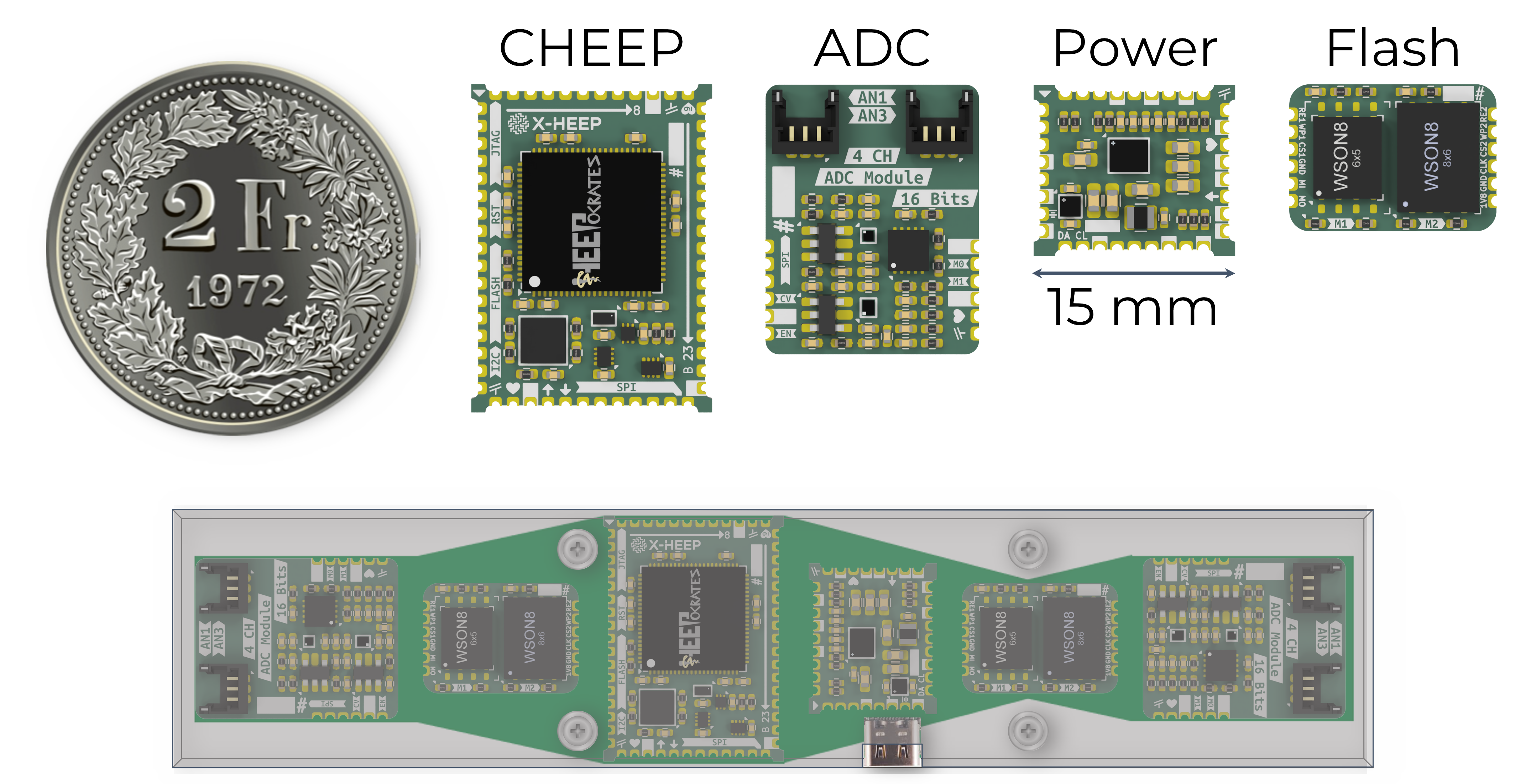
X-MODs provides a modular hardware approach that bridges the gap between fully custom designs and off-the-shelf solutions. The system consists of four specialized modules and their corresponding debug boards, enabling quick prototyping while maintaining the small form factor required for wearable applications.

Modules

CHEEP Module Open in KiCanvas

  • Built around the HEEPocrates RISC-V SoC
  • Multiple communication interfaces (UART, I2C, SPI)

Power Module Open in KiCanvas

  • High-efficiency PMIC
  • 5 independent voltage rails
  • LiPo battery charging capability
  • Integrated coulomb counter for accurate battery monitoring

ADC Module Open in KiCanvas

  • 16-bit precision
  • 4 multiplexed input channels
  • 1 MSPS sampling rate
  • Optimized for biosignal acquisition

Memory Module Open in KiCanvas

  • Dual NOR flash configuration
  • Expandable storage capacity
  • Pin-compatible with various memory sizes
  • Designed for autonomous data acquisition

Socket Boards

Each module comes with a companion scoket board featuring:

  • Spring-loaded pogo pins for solderless connections
  • Easy module swapping capabilities
  • Breadboard-compatible format
  • Testing and validation infrastructure

Applications

These modules are particularly suited for:

  • EEG signal acquisition
  • Wearable medical devices
  • Clinical trial prototypes
  • Academic research projects
  • Low-power embedded systems

Contact

Please contact the authors for additional information

Developed at the Embedded Systems Laboratory (ESL), EPFL.

Parts

22
QtyValueFootprintReferences
2LOGOLOGOG***, G***
1G***kibuzzard-67252564kibuzzard-67252564
1G***kibuzzard-6717DE61kibuzzard-6717DE61
1G***kibuzzard-67252580kibuzzard-67252580
1G***kibuzzard-67252B3Dkibuzzard-67252B3D
1G***kibuzzard-66CFCF0Dkibuzzard-66CFCF0D
1G***kibuzzard-67530B9Ckibuzzard-67530B9C
1G***kibuzzard-6725258Fkibuzzard-6725258F
1G***kibuzzard-67251D7Fkibuzzard-67251D7F
1G***kibuzzard-67251D93kibuzzard-67251D93
1G***kibuzzard-67252575kibuzzard-67252575
1G***kibuzzard-67251D83kibuzzard-67251D83
1G***kibuzzard-67252588kibuzzard-67252588
1G***kibuzzard-6725254Akibuzzard-6725254A
1G***kibuzzard-672525A5kibuzzard-672525A5
1G***kibuzzard-672525B8kibuzzard-672525B8
1G***kibuzzard-672529BAkibuzzard-672529BA
1G***kibuzzard-6725282Dkibuzzard-6725282D
1G***kibuzzard-6725259Akibuzzard-6725259A
1~X-MODs_PcbLib:Memory_Board_Socket_Conn_1.27mmJ1
1~X-MODs_PcbLib:Memory_Board_Header_Conn_2.54mmJ2

More from esl-epfl/X-MODs

7
  • 6 layers15.6 × 19.7 mmADC Board, the printed circuit board in 3D

    ADC Board

    esl-epfl/X-MODs

    Modular hardware platform based on the RISC-V X-HEEP family architecture developed at ESL, targeting ultra-low-power consumption and miniaturization, facilitating the creation of wearable devices for clinical trials

    74 parts3
  • 4 layers64.9 × 71.4 mmCHEEP Board Socket, the printed circuit board in 3D

    CHEEP Board Socket

    esl-epfl/X-MODs

    Modular hardware platform based on the RISC-V X-HEEP family architecture developed at ESL, targeting ultra-low-power consumption and miniaturization, facilitating the creation of wearable devices for clinical trials

    70 parts3
  • 6 layers17.5 × 23.9 mmCHEEP Board, the printed circuit board in 3D

    CHEEP Board

    esl-epfl/X-MODs

    Modular hardware platform based on the RISC-V X-HEEP family architecture developed at ESL, targeting ultra-low-power consumption and miniaturization, facilitating the creation of wearable devices for clinical trials

    46 parts3
  • 4 layers38 × 47.3 mmPower Board Socket, the printed circuit board in 3D

    Power Board Socket

    esl-epfl/X-MODs

    Modular hardware platform based on the RISC-V X-HEEP family architecture developed at ESL, targeting ultra-low-power consumption and miniaturization, facilitating the creation of wearable devices for clinical trials

    41 parts3
  • 6 layers14.8 × 12.6 mmPower Board, the printed circuit board in 3D

    Power Board

    esl-epfl/X-MODs

    Modular hardware platform based on the RISC-V X-HEEP family architecture developed at ESL, targeting ultra-low-power consumption and miniaturization, facilitating the creation of wearable devices for clinical trials

    31 parts3
  • 4 layers64.1 × 16.2 mmADC Board Socket, the printed circuit board in 3D

    ADC Board Socket

    esl-epfl/X-MODs

    Modular hardware platform based on the RISC-V X-HEEP family architecture developed at ESL, targeting ultra-low-power consumption and miniaturization, facilitating the creation of wearable devices for clinical trials

    25 parts3
  • 6 layers15.2 × 10.8 mmMemory Board, the printed circuit board in 3D

    Memory Board

    esl-epfl/X-MODs

    Modular hardware platform based on the RISC-V X-HEEP family architecture developed at ESL, targeting ultra-low-power consumption and miniaturization, facilitating the creation of wearable devices for clinical trials

    19 parts3

Similar boards

  • 4 layers62.8 × 53.3 mmPSLab, the printed circuit board in 3D

    PSLab

    fossasia/pslab-grove-shield

    PSLab Grove Shield https://pslab.io

    22 parts1.5kApache-2.0
  • 4 layers91.5 × 65 mmSpotmicro, the printed circuit board in 3D

    Spotmicro

    hackclub/OnBoard

    💡 Join 1,000 teenagers and make your first PCB with a $100 grant!

    22 parts915
  • 4 layers113.3 × 64 mmBackplane, the printed circuit board in 3D

    Backplane

    dennisss/dacha

    Monorepo for awesome tools/projects/libraries

    22 parts397Apache-2.0
  • 4 layers78.1 × 77.5 mmAdc cape, the printed circuit board in 3D

    Adc cape

    loxodes/vna

    Under development open hardware microwave vector network analyzer

    22 parts205
  • 4 layers65 × 51.5 mmIntegralstick mead, the printed circuit board in 3D

    Integralstick mead

    azonenberg/starshipraider

    Open hardware test equipment

    22 parts193BSD-3-Clause
  • 4 layers41.5 × 41.6 mmRAM Module, the printed circuit board in 3D

    RAM Module

    ahmadexp/Open-Source-PC110

    Figuring out the missing technical documentation of the beloved PC110

    22 parts98
  • 4 layers29 × 61 mmCfxsx, the printed circuit board in 3D

    Cfxsx

    neggles/cfxsx

    CFexpress to M.2 NVMe drive adapter. Intended for Xbox Series X and S, but untested.

    22 parts69CC-BY-SA-4.0
  • 4 layersTiav3 s14160, the printed circuit board in 3D

    Tiav3 s14160

    OpenSiPM/sipm-bias-control

    Single channel silicon photomultipliers for high-speed fluorescence imaging

    22 parts44

Questions

How big is the Memory Board Socket PCB?

It measures 69.3 × 16.3 mm and has 4 copper layers, 1.6 mm thick.

What parts does the Memory Board Socket use?

22 parts. The full list of its parts is on this page, with links to each part's symbol and footprint where PCBKit's library has them.

Where can I download the Memory Board Socket KiCad files?

From the esl-epfl/X-MODs repository on GitHub, at the commit this page was made from: the board is Socket_Boards/Memory_Board_Socket/Memory_Board_Socket.kicad_pcb and its schematic Module_Boards/ADC_Board/ADC_Board.kicad_sch. PCBKit opens the board in the browser, with nothing to install.

Can I use the Memory Board Socket design in my own project?

Its repository states no licence, so its author keeps all rights: ask esl-epfl before reusing the design.