
2 layers25.9 × 17 mm
SnapVCC
electronut/ElectronutLabs-snapVCC
A tiny 3.3 V / 5 V voltage regulator that snaps right on top of a 9 volt battery.
45 parts77

A tiny 3.3 V / 5 V voltage regulator that snaps right on top of a 9 volt battery.
SnapVCC is an open-source printed circuit board by electronut, from the electronut/ElectronutLabs-snapVCC repository on GitHub. It is a 2-layer board of 25.9 × 17.3 mm with 25 parts on 10 nets, routed with 57 tracks and 0 vias.
It is built around the TPS560200DBV and IRLML9301TRPBF. Its parts include 4 capacitors, 4 resistors, 2 connectors, 1 IC and 1 diode. It belongs with the power boards of this library.


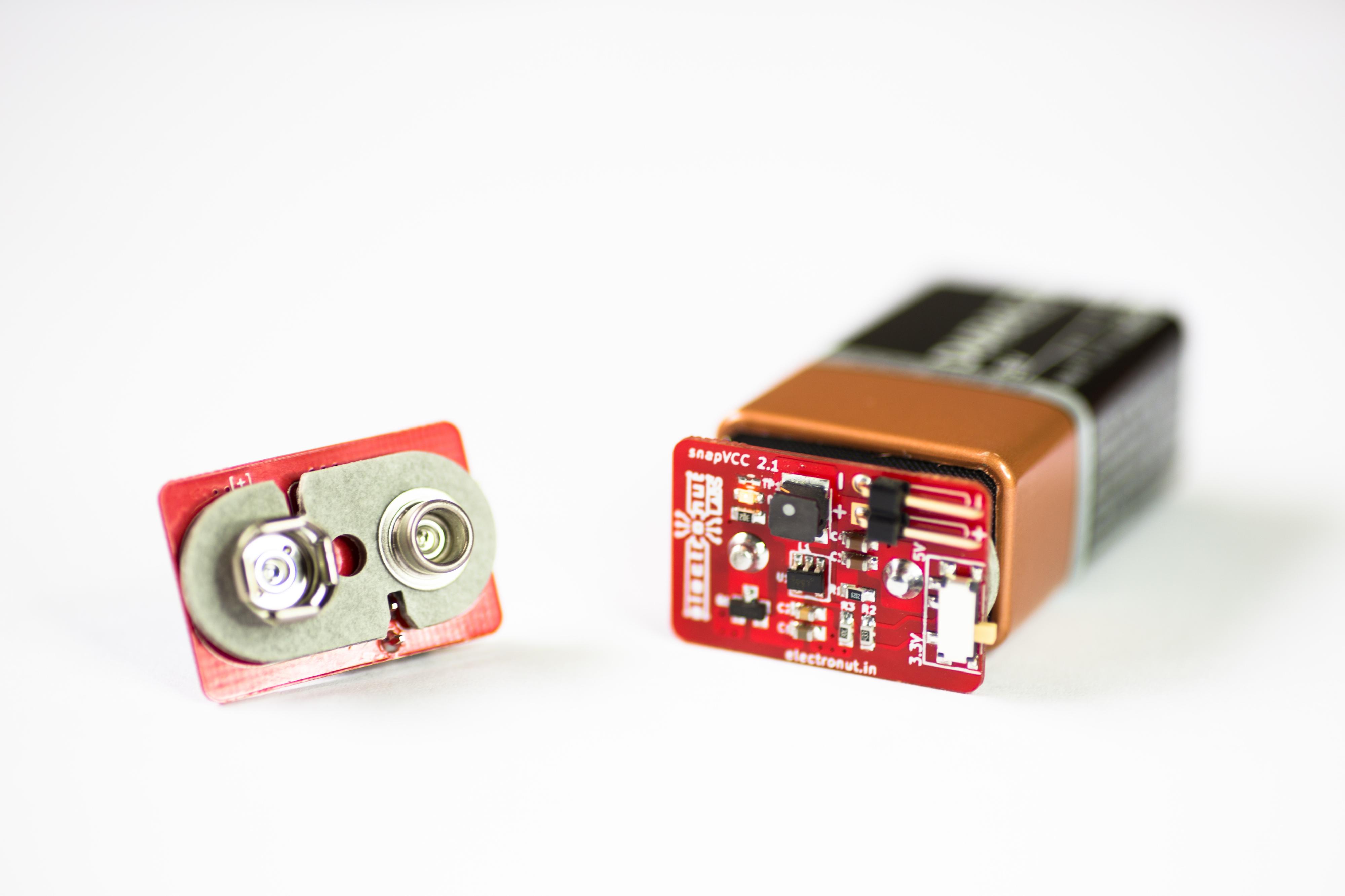
snapVCC is a highly portable and convenient power supply for your electronics projects. It’s designed to snap right on to a 9 V battery and give you 3.3 V or 5 V power wherever you need it.
| Characteristics | Values |
|---|---|
| Input Voltage Range | 4.7 V to 17 V |
| Output Voltage Range | Switchable between 3.3 V and 5 V |
| Output current | 500 mA continuous Current |
| Reverse polarity protection | P-MOSFET |
25.9 mm x 17.3 mm x 10.2 mm
SnapVCC is available for purchase from our Tindie store. Please email us at info@electronut.in if you have any questions.
You can find all code and design files related to SnapVCC in this repository.
Electronut Labs is an Embedded Systems company based in Bangalore, India. More information at our website.
| Qty | Value | Footprint | References |
|---|---|---|---|
| 9 | VAL** | snapVCC_lib:via | via, via, via, via, via, via, via, via, via |
| 3 | 10uF | snapVCC_lib:0603-CAP | C1, C3, C4 |
| 1 | 0.1uF | snapVCC_lib:0402-seeed | C2 |
| 1 | 10uH | snapVCC_lib:L-4mm | L1 |
| 1 | 20k | snapVCC_lib:0603-RES | R3 |
| 1 | 43k | snapVCC_lib:0603-RES | R2 |
| 1 | 62k | snapVCC_lib:0603-RES | R1 |
| 1 | 7.1k | snapVCC_lib:0603-RES | R4 |
| 1 | Battery Holder | snapVCC_lib:KEY967 | BT1 |
| 1 | CONN_01X02 | snapVCC_lib:H2-2.54 | P2 |
| 1 | CONN_01X03 | snapVCC_lib:PINHEAD1-3 | P1 |
| 1 | IRLML9301TRPbF | snapVCC_lib:SOT23 | Q1 |
| 1 | LED | snapVCC_lib:SML-P11_LED_0402 | D1 |
| 1 | LOGO | snapVCC_lib:logo-12mm | G*** |
| 1 | TPS560200 | snapVCC_lib:SOT-23-5 | U1 |
electronut/ElectronutLabs-snapVCC
A tiny 3.3 V / 5 V voltage regulator that snaps right on top of a 9 volt battery.

electronut/ElectronutLabs-snapVCC
A tiny 3.3 V / 5 V voltage regulator that snaps right on top of a 9 volt battery.

elcruzo/learned-pcb-placement
GNN-guided simulated annealing for PCB component placement. We train a Graph Attention Network on SA rollout data to learn which components to move and where, then use these predictions to bias the SA search.

ynsta/fwrtss
Open source hardware and software project of a regulated soldering station for RT soldering tips

mbouyer/marine_chartplotter
Hardware and software for an opencpn-based chartplotter

aguscsc/Bidirectional-Buck-DC-DC-converter
This repository contains the development steps for the making of a Bidirectional Buck DC-DC converter


ElektorLabs/lorawan-sensor-node-v2
Solar Powered LoRaWAN Sensor Node V2


Cath272/ESP32-Low-Power-Temp-Monitor
In the project files you may find ESP32-C3 instead of ESP32-C6. I named it wrong when i created the project. The issue is just the file names, the footprints are correct and use a C6.
It measures 25.9 × 17.3 mm and has 2 copper layers, 1.6 mm thick.
25 parts, built around the TPS560200DBV and IRLML9301TRPBF. The full list of its parts is on this page, with links to each part's symbol and footprint where PCBKit's library has them.
From the electronut/ElectronutLabs-snapVCC repository on GitHub, at the commit this page was made from: the board is pcb/ver1.1/snapVCC.kicad_pcb. PCBKit opens the board in the browser, with nothing to install.
Its repository states no licence, so its author keeps all rights: ask electronut before reusing the design.