
2 layers243.2 × 106 mm

 dpapavas/lagrange-keyboard137
A configurable, handwired, ergonomic keyboard
Keyboard mcu is an open-source printed circuit board by dpapavas, from the dpapavas/lagrange-keyboard repository on GitHub, published under the AGPL-3.0 licence. It is a 2-layer board of 30 × 65 mm with 26 parts on 41 nets, routed with 317 tracks and 12 vias.
It is built around the ATMEGA32U4-AU. Its parts include 8 capacitors, 7 connectors, 4 resistors, 1 IC and 1 switch. It belongs with the keyboards and input boards and the AVR (ATmega, ATtiny) boards of this library.
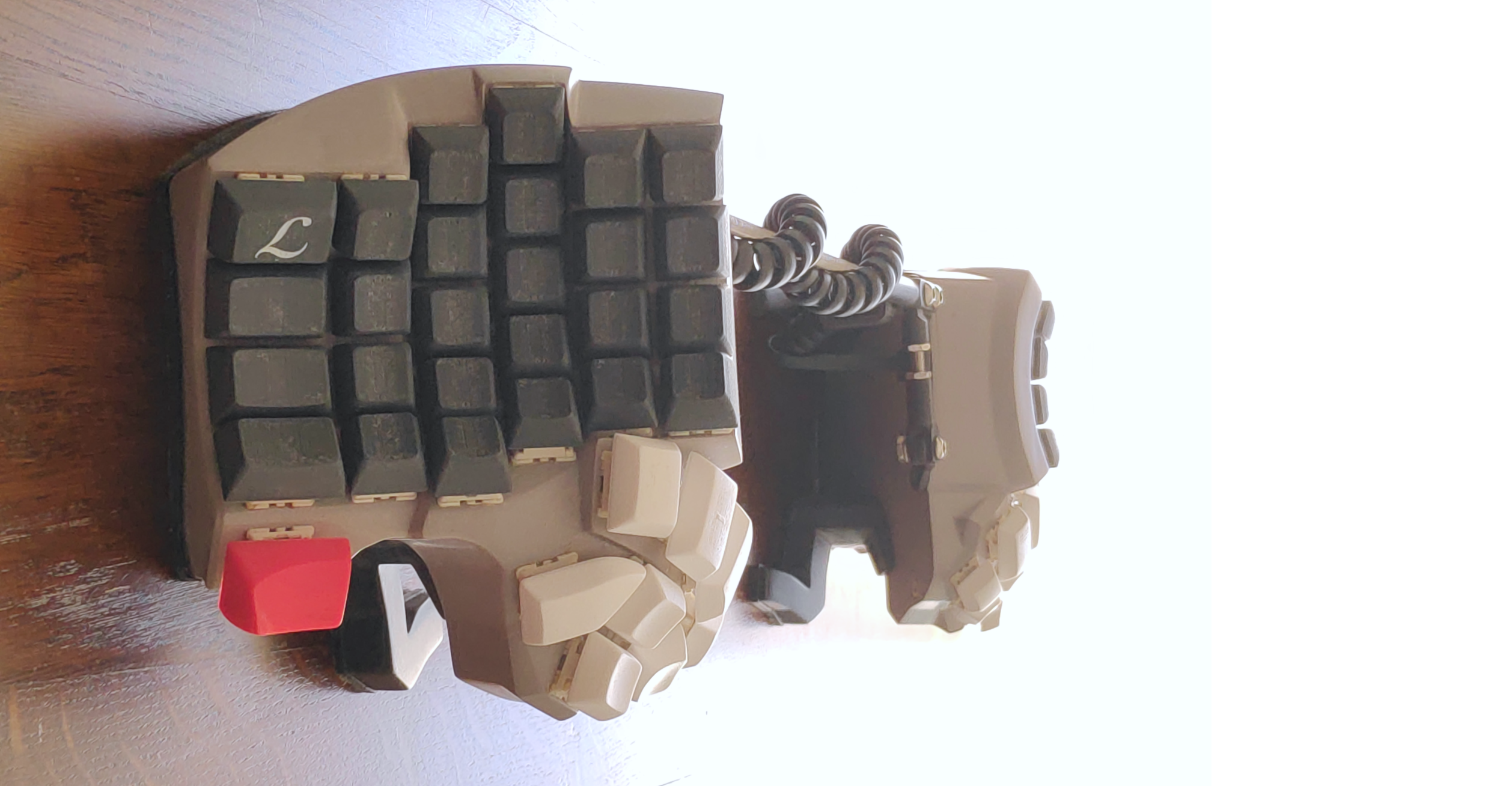
The Lagrange is a configurable, split, handwired keyboard, designed for ergonomics. This is meant in the sense that as many keys as possible should be accessible with the minimum possible effort, although some less reachable keys are also incorporated in the design as they can still be useful. Features that attempt to improve ergonomics include concave main sections, convex thumb sections, a tenting stand, palm keys and specially designed keycap shapes. To get a better idea of what all this looks like, see the 3D model of the final assembly and the photos of my build in the doc/ directory.
The Lagrange is of course inspired by the designs that preceded it, most notably the Dactyl and the Dactyl-ManuForm. Differences with these designs and additional contributions to the art include:
A further goal of the design was to comprise parts, both mechanical and electrical, that fit together and that can be easily assembled to result in something that can withstand the wear and tear of daily use.
If you want to build your own Lagrange, you can find detailed instructions in BUILD.md.
Copyright © 2020 Dimitris Papavasiliou
This program (which includes everything except the things/, kicad/ and doc/ directories, is distributed under the GNU Affero General Public License Version 3. The controller PCB design residing in kicad/, is distributed under the GNU General Public License Version 3. Finally, the generated models residing in things/, as well as the material in doc/, are licensed under a Creative Commons Attribution-ShareAlike 4.0 International License.
| Qty | Value | Footprint | References |
|---|---|---|---|
| 4 | 100nF | Capacitor_SMD:C_0603_1608Metric_Pad1.05x0.95mm_HandSolder | C4, C6, C7, C8 |
| 4 | MountingHole_Pad | MountingHole:MountingHole_3.2mm_M3_Pad | H1, H2, H3, H4 |
| 2 | 22 5% | Resistor_SMD:R_0603_1608Metric_Pad1.05x0.95mm_HandSolder | R1, R2 |
| 2 | 22p | Capacitor_SMD:C_0603_1608Metric_Pad1.05x0.95mm_HandSolder | C2, C3 |
| 2 | Conn_01x08 | Connector_JST:JST_PH_B8B-PH-K_1x08_P2.00mm_Vertical | J2, J3 |
| 1 | 10K | Resistor_SMD:R_0603_1608Metric_Pad1.05x0.95mm_HandSolder | R3 |
| 1 | 10uF | Capacitor_SMD:C_0805_2012Metric_Pad1.15x1.40mm_HandSolder | C1 |
| 1 | 1k | Resistor_SMD:R_0603_1608Metric_Pad1.05x0.95mm_HandSolder | R4 |
| 1 | 1uF 10% | Capacitor_SMD:C_0603_1608Metric_Pad1.05x0.95mm_HandSolder | C5 |
| 1 | 6P6C | Custom:RJ25_TE_5520425 | J4 |
| 1 | ATmega32U4-AU | Custom:TQFP-44_10x10mm_P0.8mm_Countoured | U1 |
| 1 | Conn_01x02 | Connector_PinHeader_2.54mm:PinHeader_1x02_P2.54mm_Vertical | J6 |
| 1 | Conn_01x06 | Connector_JST:JST_PH_B6B-PH-K_1x06_P2.00mm_Vertical | J5 |
| 1 | Conn_02x03_Odd_Even | Connector_PinHeader_2.54mm:PinHeader_2x03_P2.54mm_Vertical | J7 |
| 1 | Crystal_GND24 | Custom:Crystal_SMD_Abracon_ABM3B-4Pin_5.0x3.2mm_HandSoldering | Y1 |
| 1 | SW_Push | Button_Switch_SMD:SW_SPST_TL3305B | SW1 |
| 1 | USB_B | Custom:USB_B_TE_5787834_Vertical | J1 |
It measures 30 × 65 mm and has 2 copper layers, 1.6 mm thick.
26 parts, built around the ATMEGA32U4-AU. The full list of its parts is on this page, with links to each part's symbol and footprint where PCBKit's library has them.
From the dpapavas/lagrange-keyboard repository on GitHub, at the commit this page was made from: the board is kicad/keyboard_mcu.kicad_pcb. PCBKit opens the board in the browser, with nothing to install.
Its repository publishes it under the AGPL-3.0 licence: you may reuse it on that licence's terms (keep the author's notice, and for a copyleft licence share your changes alike).

tominabox1/Le-Chiffre-Keyboard
Great thanks goes to Jake at P3D for really making the case amazing and open sourcing his work. Check him out at P3Dstore.com

The-Royal/The_Royal_Open-Source-Projects
A Master Repository For All things Royal Made

dmcke5/ZenDeck
This is the second revision of my Mini PC based handheld Gaming PC! It is designed for a Beelink SER 5 Mini PC but could be adapted to other systems by changing the mounting brackets and outlet plate.


thebiguno/microcontroller-projects
A home for a bunch of microcontroller projects which don't warrant their own repos.

swiftrax/UnSplit
Ergo 40% mechanical keyboard with all components on the top with diodes arranged in an array

dmcke5/MiniPC_BMS
An all in one power managment solution for powering mini pc's with batteries!