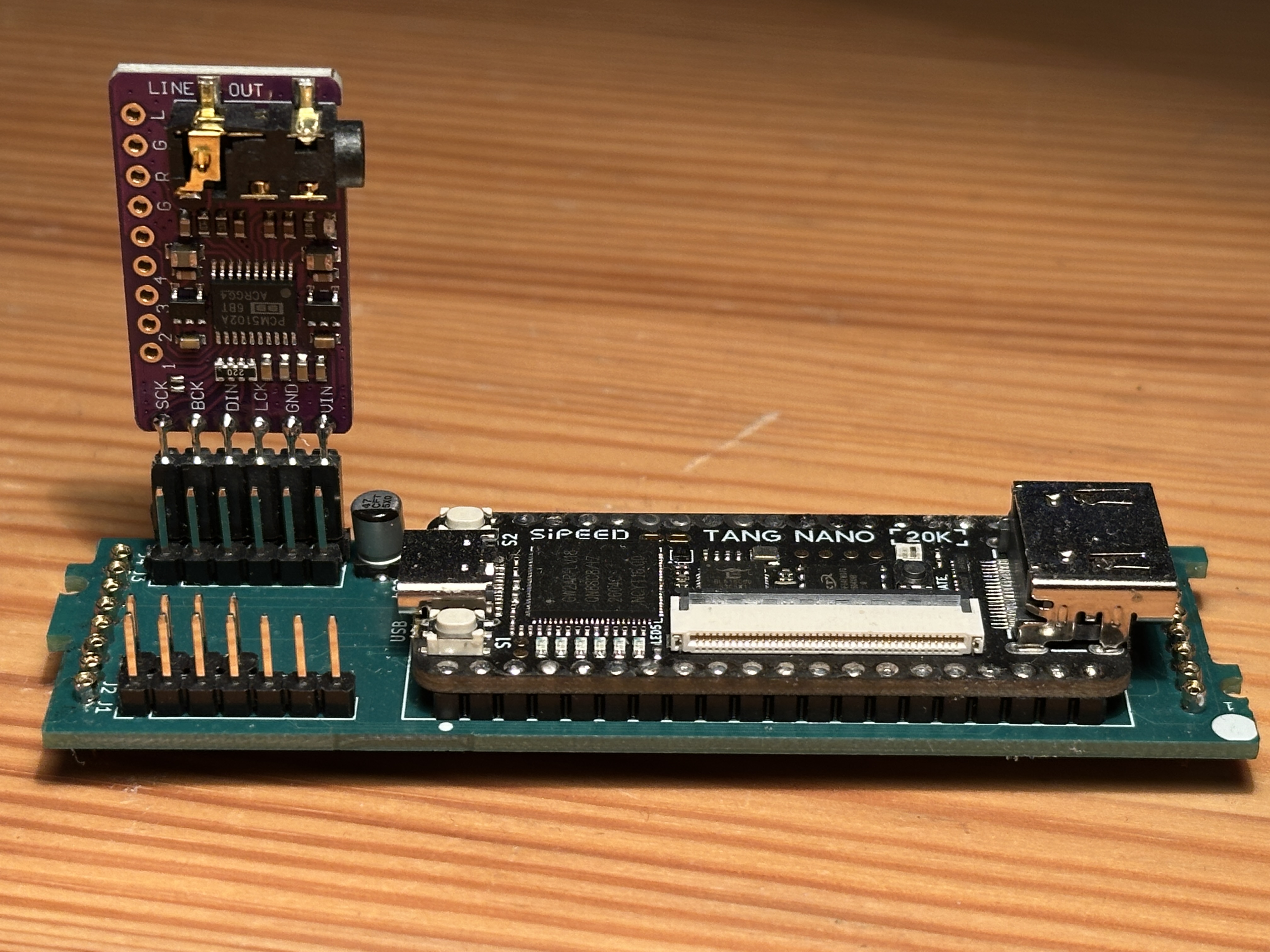
Tram tangnano is an open-source printed circuit board by dg1vs, from the dg1vs/Transputer-TRAM-TangNano repository on GitHub. It is a 4-layer board of 93 × 26.7 mm with 41 parts on 64 nets, routed with 682 tracks and 73 vias.
It is built around the SN74LVC1G06DBV, TXU0202DCU and SN74LVC1G04DBV, with the SN74LVC2GU04DBV, BAV70 and PMEG2010ER among its other parts. Its parts include 13 resistors, 12 capacitors, 9 ICs, 4 connectors and 3 diodes.
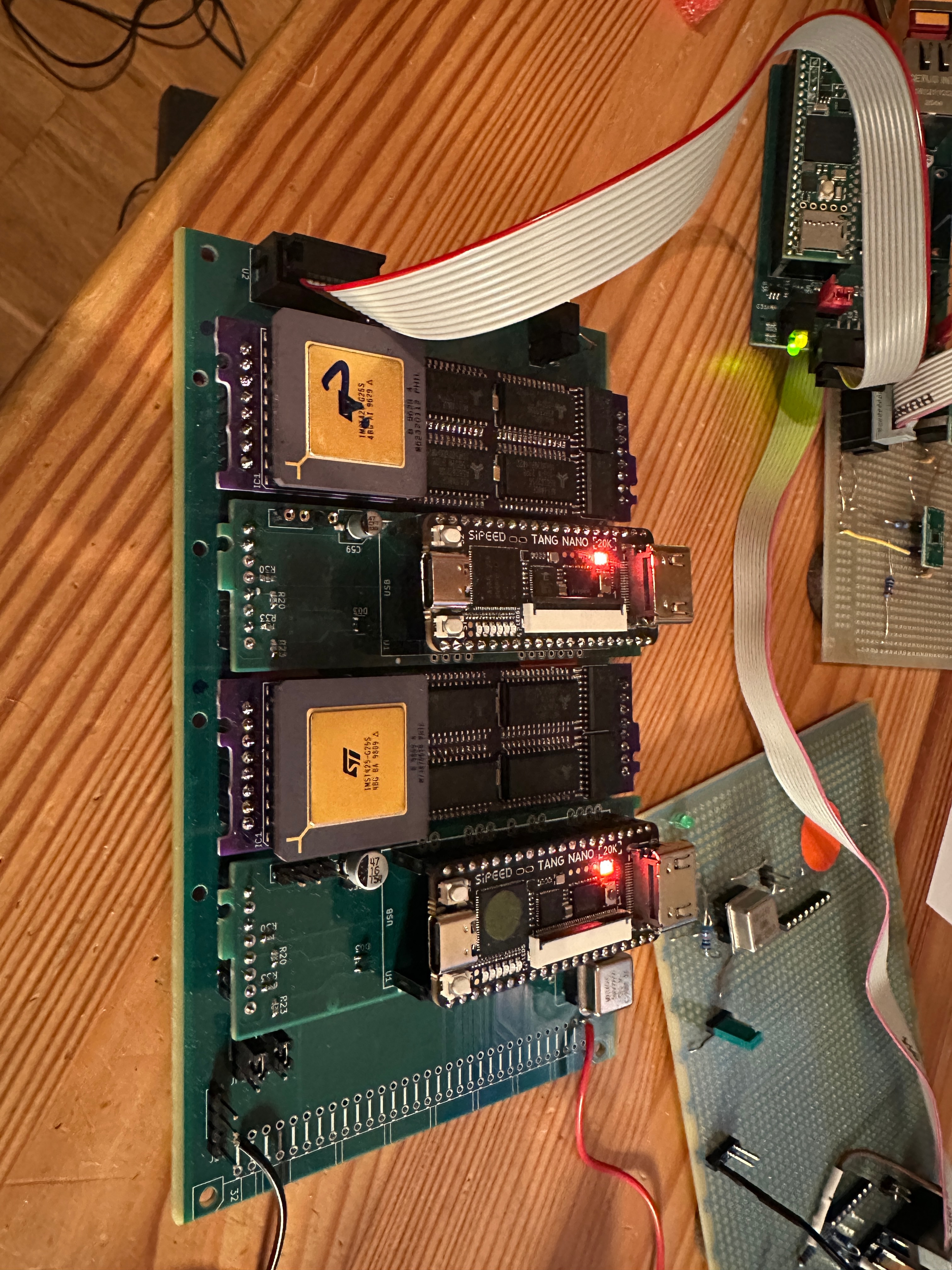
A TRAM-size FPGA Transputer module based on the Sipeed Tang Nano 20K.
The goal of this project is to provide a modern, compact Transputer module which can be used in systems designed for classic INMOS TRAMs, while replacing most of the increasingly difficult-to-obtain historical hardware with an FPGA implementation.
The project targets FPGA implementations of the T805 and T425 Transputers and is intended both for practical use in existing Transputer systems and for experimenting with Transputer hardware today.
The main idea behind this project is to provide a TRAM with an FPGA based implementation. For FPGA imlemetation please see the paper [1].
Main Features
TRAM-size PCB
Sipeed Tang Nano 20K FPGA module
FPGA implements the INMOS T805 and T425
Standard Transputer link interface
Four Transputer links
Support for the usual TRAM control signals
5 V / 3.3 V level adaptation between classic Transputer hardware and the FPGA
I²S audio support
Selected Transputer and FPGA signals available on pin headers
Can be used in systems with standard TRAM slots, including the ATW800/2
Ready-to-program Gowin .fs FPGA image available
Background
Original Transputer systems are still interesting platforms for experimenting with parallel computing, message-passing architectures and historical computer hardware.
One problem when building or restoring such systems is the availability of suitable Transputer processors and associated interface components.
At the same time, inexpensive modern FPGA modules such as the Tang Nano 20K provide enough resources to implement a Transputer together with additional peripheral logic in a very small form factor.
The idea behind Transputer-TRAM-TangNano is therefore simple:
Put a modern FPGA implementation of a Transputer into the mechanical and electrical environment of a classic TRAM.
This makes it possible to use the module together with existing Transputer hardware without requiring another custom host interface.
FPGA Transputer
The Tang Nano 20K carries the FPGA implementation of the Transputer.
The T425 is representative of the widely used 32-bit integer Transputers, while the T805 adds floating-point capabilities and was one of the most powerful members of the classic Transputer family.
The FPGA implementation used by this project is based on joint work by Andre , Claus (cpm) and me (dg1vs).
FPGA source code
A ready-to-program Gowin .fs bitstream file is available.
The FPGA HDL source code itself is currently not published as part of this repository.
This means that the supplied FPGA image can be used to operate the hardware, but rebuilding or modifying the FPGA design requires access to the original FPGA sources.
TRAM Interface
The module follows the basic interface concept of a classic Transputer TRAM.
The hardware provides the four standard Transputer communication links:
Link 0
Link 1
Link 2
Link 3
Each link consists of a LinkIn and LinkOut signal.
The TRAM interface also provides the normal Transputer control signals including:
ClockIn
Analyse
Reset
notError
Link-speed is set fixed to 20 Mbps
This allows the FPGA-based Transputer to behave like a conventional Transputer module from the point of view of the host system.
5 V / 3.3 V Level Adaptation
One of the less obvious challenges when combining original Transputer hardware with a modern FPGA is the difference in logic levels.
Classic TRAM and Transputer hardware operates in a 5 V environment, while the Tang Nano 20K and its FPGA I/O use 3.3 V logic.
Considerable attention was therefore given to the interface between these two voltage domains.
The current hardware design uses dedicated level-translation circuitry for the Transputer links. Four TXU0202 dual-channel level translators provide the eight signal paths required for the four LinkIn / LinkOut pairs.
Additional circuitry is used for the Transputer control, clock and status signals.
The intention is to make the module compatible with real Transputer hardware while protecting the modern FPGA from inappropriate signal levels.
Breakout Connectors
Several signals are additionally available on 2.54 mm pin headers.
These connectors are useful for:
Sound interface (quite cool for an transputer)
debugging
logic-analyzer measurements
FPGA experiments
connecting additional peripherals
accessing selected Transputer signals
experimenting with Transputer links
The PCB contains dedicated connectors for link, event and audio-related signals.
This makes the board useful not only as a replacement TRAM but also as a development platform for Transputer experiments.
Audio / I²S
Audio output is supported using the I²S/PCM facilities of the Tang Nano 20K.
The Tang Nano 20K contains onboard audio hardware, and the TRAM carrier additionally provides an audio connector for access to the relevant signals.
This allows Transputer or FPGA applications to generate sound without requiring a separate audio subsystem.
ATW800/2
The module can be used with the ATW800/2 Atari Transputer system.
The ATW800/2 provides conventional size-1 TRAM slots for physical Transputer modules, making the Transputer-TRAM-TangNano a natural companion for this system.
This project is a 4-TRAM Transputer Base-Board. TRAMs are small subassemblies of transputers (or other components with INMOS links), a few discrete components, and sometimes some RAM and/or application specific…
It measures 93 × 26.7 mm and has 4 copper layers, 1.6 mm thick.
What parts does the Tram tangnano use?
41 parts, built around the SN74LVC1G06DBV, TXU0202DCU, SN74LVC1G04DBV and SN74LVC2GU04DBV. The full list of its parts is on this page, with links to each part's symbol and footprint where PCBKit's library has them.
Where can I download the Tram tangnano KiCad files?
From the dg1vs/Transputer-TRAM-TangNano repository on GitHub, at the commit this page was made from: the board is hardware/tram_tangnano/tram_tangnano.kicad_pcb and its schematic hardware/tram_tangnano/tram_tangnano.kicad_sch. PCBKit opens the board in the browser, with nothing to install.
Can I use the Tram tangnano design in my own project?
Its repository states no licence, so its author keeps all rights: ask dg1vs before reusing the design.