

4 layers180 × 110 mm
PETER
dennowiggle/Retro-PETER
3.3V Retro computer project => FPGA + RCBUS + CPU boards making a custom system.
419 parts4LGPL-2.1

3.3V Retro computer project => FPGA + RCBUS + CPU boards making a custom system.
RANDY is an open-source printed circuit board by dennowiggle, from the dennowiggle/Retro-PETER repository on GitHub, published under the LGPL-2.1 licence. It is a 4-layer board of 30 × 110 mm with 12 parts on 80 nets, routed with 491 tracks and 150 vias.
It is built around the CC0603KRX7R9BB104 and 67996-160HLF. Its parts include 4 capacitors and 2 connectors.
Z8S180 On RCBUS Only.
ZORO is an RCBUS board with a Z180 CPU. There is no RAM or ROM memory hosted on the board.
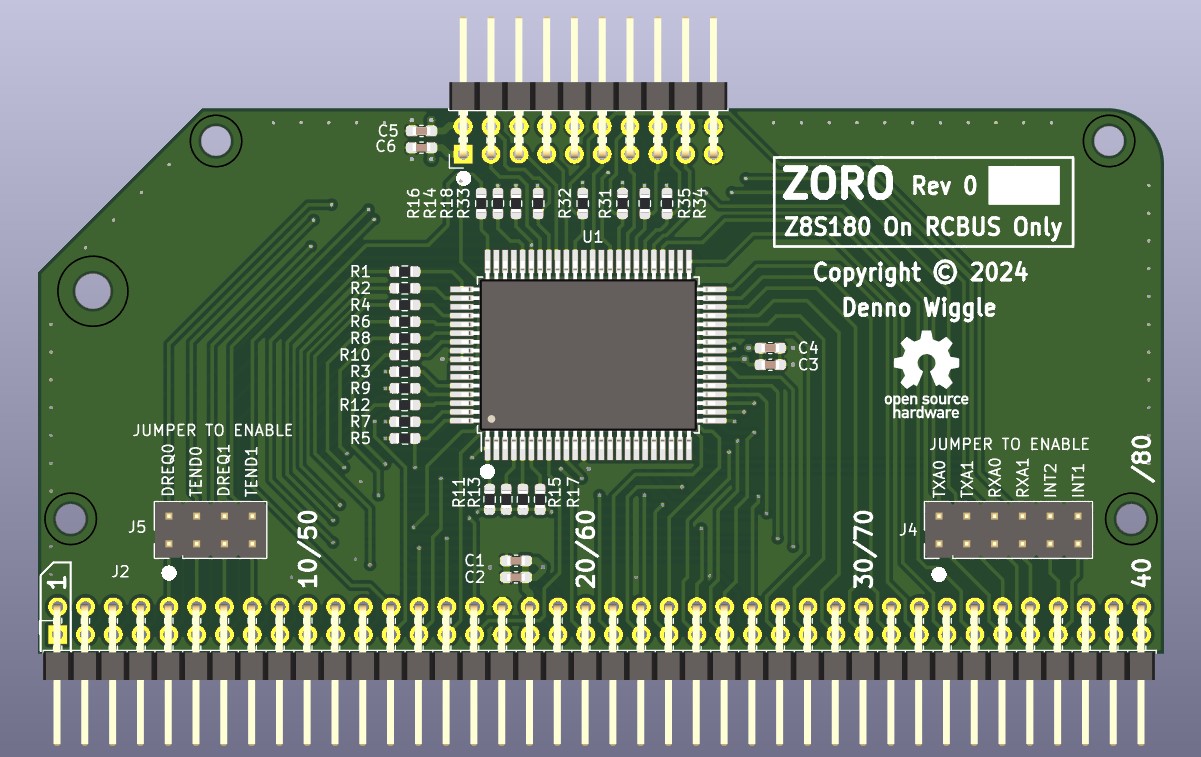
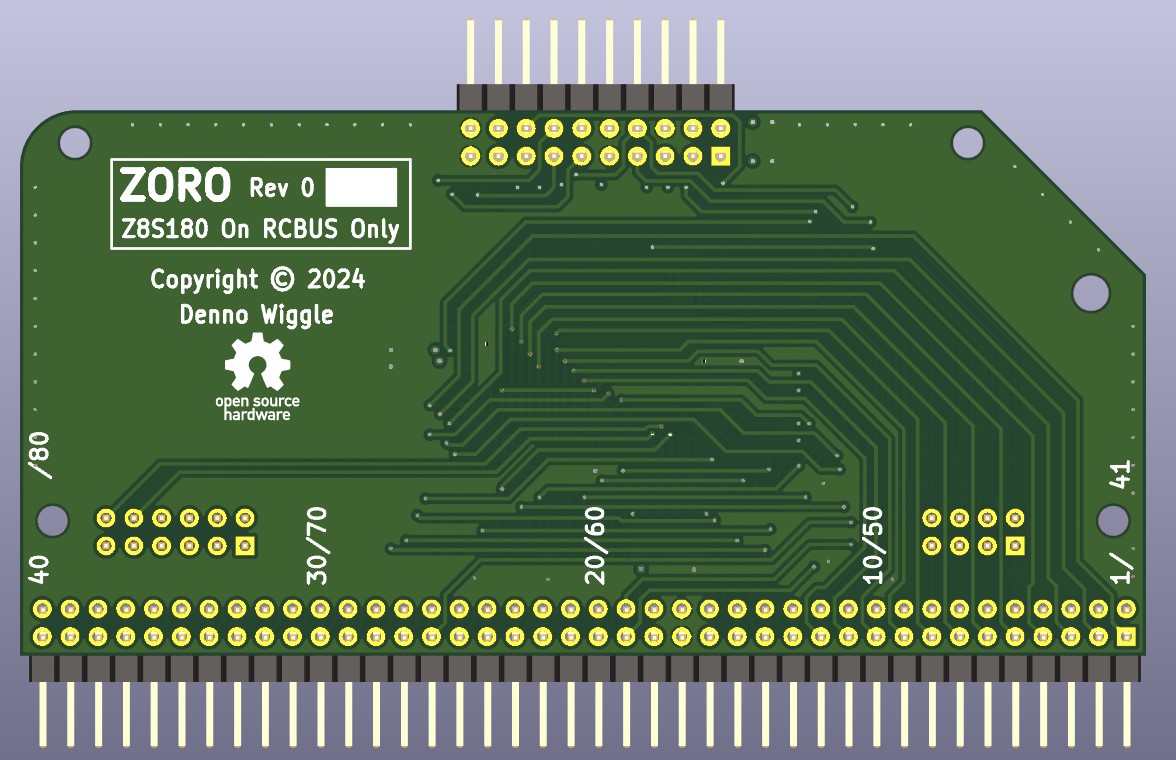
The 'output' directory contains the BOM, netlist, and PDF schematic.
Board design used KiCad 8.0.4.
Change J2 to Adam Tech part number PH2RA-80-UA to reduce insertion force.
| Qty | Value | Footprint | References |
|---|---|---|---|
| 4 | MountingHole | MountingHole:MountingHole_2.7mm_M2.5_DIN965 | H1, H2, H3, H4 |
| 2 | 100nF | Capacitor_SMD:C_0603_1608Metric_Pad1.08x0.95mm_HandSolder | C2, C4 |
| 2 | 4.7uF | Capacitor_SMD:C_0603_1608Metric_Pad1.08x0.95mm_HandSolder | C1, C3 |
| 2 | Logo_Open_Hardware_Small | Symbol:OSHW-Logo_7.5x8mm_SilkScreen | LOGO1, LOGO2 |
| 1 | Conn_02x30_Odd_Even | Connector_PinHeader_2.54mm:PinHeader_2x30_P2.54mm_Vertical | J1 |
| 1 | Conn_02x40_Top_Bottom | WTM_Library:PinSocket_2x40_P2.54mm_Horizontal_RCBUS80 | J2 |
dennowiggle/Retro-PETER
3.3V Retro computer project => FPGA + RCBUS + CPU boards making a custom system.

dennowiggle/Retro-PETER
3.3V Retro computer project => FPGA + RCBUS + CPU boards making a custom system.

dennowiggle/Retro-PETER
3.3V Retro computer project => FPGA + RCBUS + CPU boards making a custom system.

dennowiggle/Retro-PETER
3.3V Retro computer project => FPGA + RCBUS + CPU boards making a custom system.

dennowiggle/Retro-PETER
3.3V Retro computer project => FPGA + RCBUS + CPU boards making a custom system.

dennowiggle/Retro-PETER
3.3V Retro computer project => FPGA + RCBUS + CPU boards making a custom system.

dennowiggle/Retro-PETER
3.3V Retro computer project => FPGA + RCBUS + CPU boards making a custom system.

dennowiggle/Retro-PETER
3.3V Retro computer project => FPGA + RCBUS + CPU boards making a custom system.

jamro/tiny-engineer
A small desktop robot that brings an AI coding assistant to life, physically acting out when it reads files, thinks, writes code, and finishes work.


iMike78/nest-mini-drop-in-pcb
Drop-in PCB replacement for the Google Nest Mini v2 with ESP32-S3, ESP32-P4 and optional ESP32-C6. Inspired by Onju Voice and Home Assistant Voice PE.

iandchasse/silkscreen-pcb
Silkscreen: open-hardware ESP32-S3 e-paper reader mainboard (KiCad 9). Formerly the de-link hub.

Seeed-Studio/OSHW-reCamera-Series
reCamera is a series of open-source AI cameras.

AzonInc/Doorman
ESP32-S3 based Intercom Gateway (TCS / Koch / Niko / Scantron / Analogue Systems)


FujiNetWIFI/fujinet-hardware
Schematics and design files for FujiNet hardware
It measures 30 × 110 mm and has 4 copper layers, 1.6 mm thick.
12 parts, built around the CC0603KRX7R9BB104 and 67996-160HLF. The full list of its parts is on this page, with links to each part's symbol and footprint where PCBKit's library has them.
From the dennowiggle/Retro-PETER repository on GitHub, at the commit this page was made from: the board is Hardware/RANDY/RANDY.kicad_pcb and its schematic Hardware/Analyzer/Analyzer.kicad_sch. PCBKit opens the board in the browser, with nothing to install.
Its repository publishes it under the LGPL-2.1 licence: you may reuse it on that licence's terms (keep the author's notice, and for a copyleft licence share your changes alike).