4 layers71 × 100 mm
Oscar components
dchwebb/Oscar
Eurorack 3 Channel Oscilloscope based on ARM STM32F446 MCU
71 parts42Unlicense

 dchwebb/Oscar42
Eurorack 3 Channel Oscilloscope based on ARM STM32F446 MCU
Oscar is an open-source printed circuit board by dchwebb, from the dchwebb/Oscar repository on GitHub, published under the Unlicense licence. It is a 4-layer board of 71 × 110 mm with 51 parts on 88 nets, routed with 320 tracks and 50 vias.
It is built around the MCP6004-E/P and LM1117-3.3. Its parts include 16 capacitors, 13 resistors, 9 connectors, 5 ICs and 3 diodes. It belongs with the audio and music and sensors and measurement boards and the STM32 boards of this library.


Oscar is a three channel oscilloscope, tuner, spectrum analyser and MIDI event viewer designed for use in a Eurorack modular synthesiser.
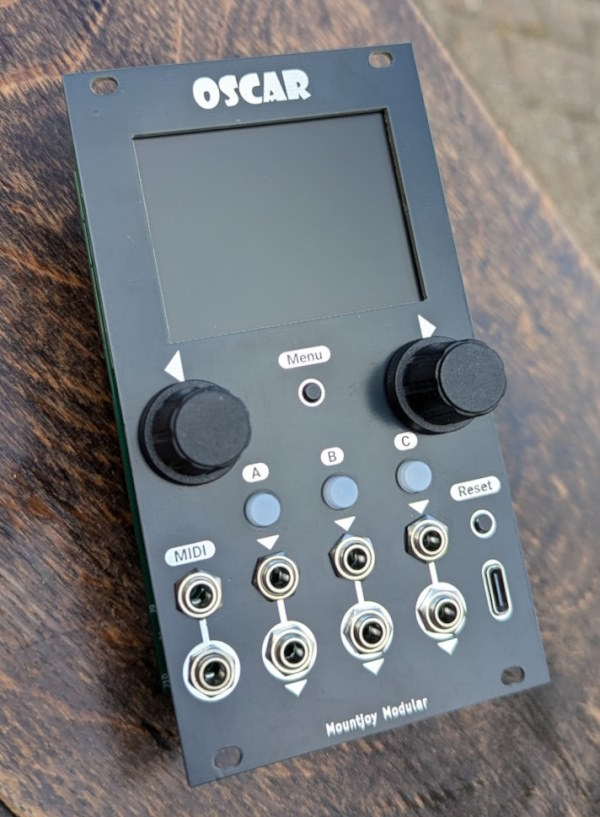
Version 3 changes:
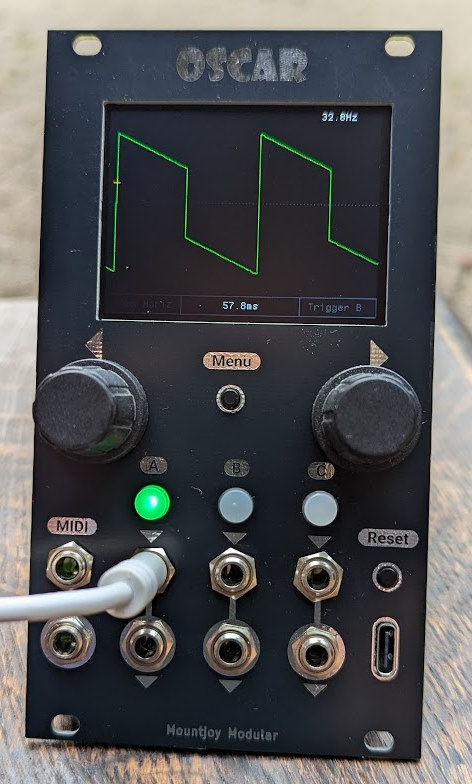
See Manual for more details.
The oscilloscope can display up to three channels at once, either in separate lanes or overlaid. Horizontal and vertical zoom are available and a trigger with adjustable x/y can be applied to any channel.
The tuner function allows for fast and accurate tuning of audio rate signals.
The spectrum analyser is used to show the frequency components of any signal. The frequencies of the principal harmonics are shown both graphically and numerically. An autotune function dynamically adjusts the sample rate to lock on the fundamental frequency of the signal. This gives an extremely clear view of the frequency spectrum whilst being fast enough for real-time use.
The waterfall plot shows the frequency spectrum over time in a 3 dimensional view.
The MIDI event viewer displays the MIDI channel, note on/off status, pitchbends, control changes and aftertouch. Clock speed is indicated with a flashing dot.
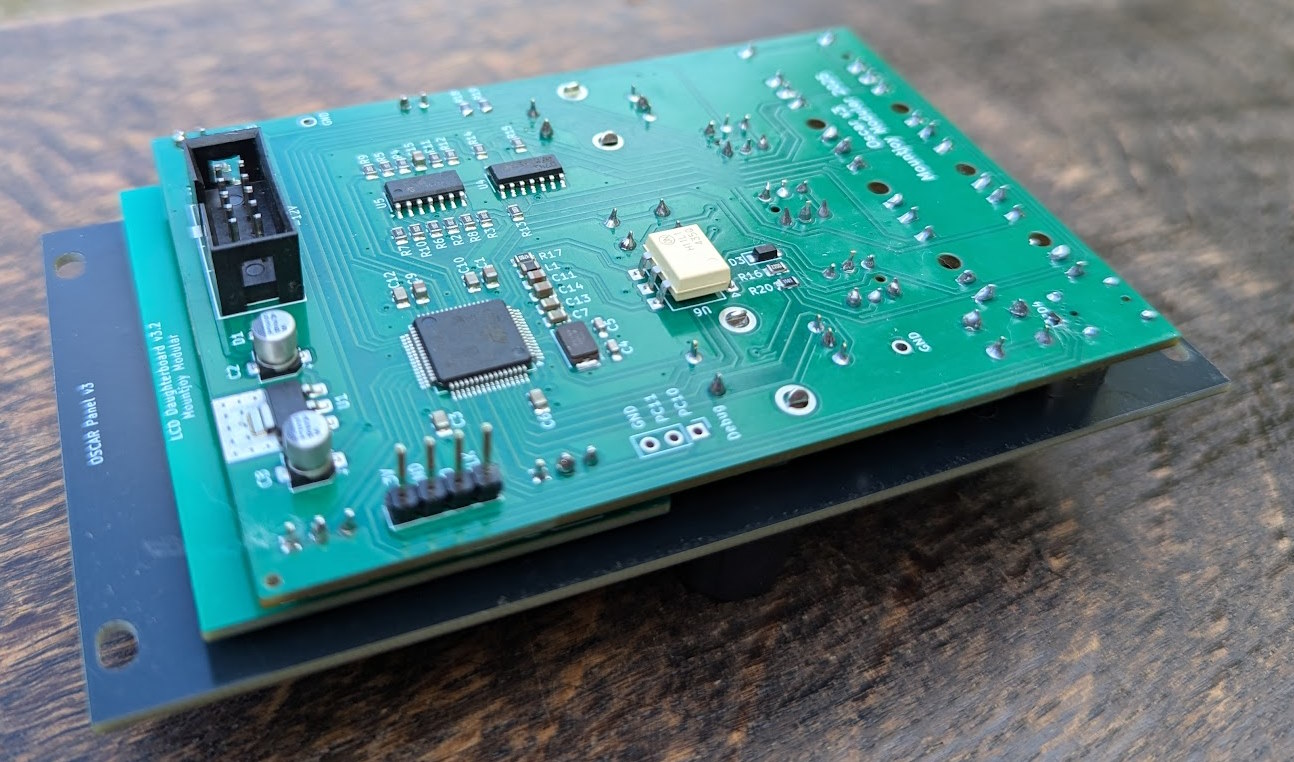
Oscar uses an SMT32F446 microcontroller to capture incoming signals with the internal ADC and display the results on a 320x240 LCD display via SPI. Code is written in C++ 20 using the STM32CubeIDE Eclipse-based IDE. Hardware interfacing is carried out through custom code (ie no STM HAL libraries).
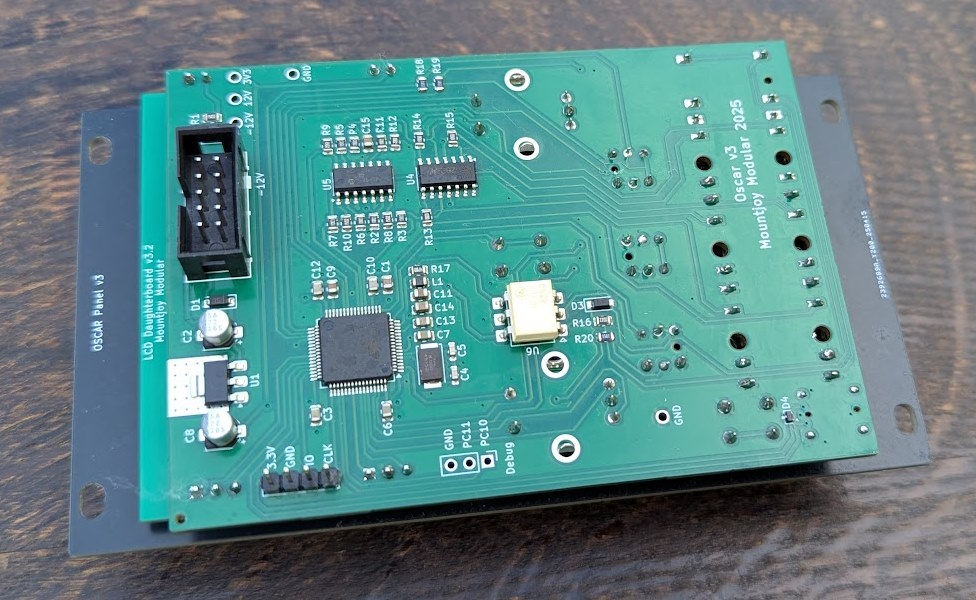
The microcontroller is clocked at 180MHz via an external 8MHz crystal oscillator. The analog inputs are scaled with an MCP6004 op-amp and the mult outputs buffered with a TL074 op-amp. The internal UART is used to capture serial MIDI data for display via a H11L1 optocoupler (to reduce the risk of ground hum).
The display is a 320x240 TFT LCD controlled with an ILI9341 driver. Screen refreshes are sent using SPI via DMA from the microcontroller. A USB C socket functions in USB 2.0 mode with an RCLAMP0502B providing ESD protection.
Analog signal capture is carried out via the internal 12 bit ADCs. Capture is controlled by a timer that is adjusted to the desired horizontal display frequency in oscilloscope mode. In Spectrum Analyser mode the autotune function dynamically alters the sampling rate to attempt to capture an integer multiple of the fundamental frequency of the incoming signal. This is done by inspecting the side-lobes of the FFT and altering the sampling rate to minimise the offset.
The tuner mode uses an overlapping FFT technique to increase accuracy. Using this mechanism samples 1 to 1024 are placed in one buffer and samples 512 to 1536 are placed in a second buffer. FFTs are carried out on each buffer and then the phase offset between the fundamental is measured. This can then be used to calculate the pitch with much enhanced accuracy for the additional processing time.
The Eurorack +/-12V rails have reverse polarity protection and filtering. The 3.3V MCU and DAC digital power supplies are provided by an LT1117-3.3 linear regulator. A common digital/analog ground plane is used.
| Qty | Value | Footprint | References |
|---|---|---|---|
| 8 | 100nF | Capacitors_SMD:C_0805_HandSoldering | C1, C4, C6, C7, C8, C9, C10, C16 |
| 6 | 100k | Resistors_SMD:R_0805_HandSoldering | R1, R2, R3, R4, R5, R6 |
| 3 | 100 | Resistors_SMD:R_0805_HandSoldering | R10, R11, R12 |
| 3 | 14k | Resistors_SMD:R_0805_HandSoldering | R7, R8, R9 |
| 2 | 18pF | Capacitors_SMD:C_0805_HandSoldering | C2, C3 |
| 2 | 1N5819 | Diodes_SMD:D_SOD-123 | D1, D2 |
| 2 | 22uF | Capacitors_SMD:CP_Elec_4x5.8 | C12, C13 |
| 2 | 47uF | Capacitors_SMD:CP_Elec_5x5.8 | C11, C14 |
| 1 | 1uF | Capacitors_SMD:CP_Elec_4x5.8 | C15 |
| 1 | 2.2uF | Capacitors_SMD:C_0805_HandSoldering | C5 |
| 1 | 680 | Resistors_SMD:R_0805_HandSoldering | R13 |
| 1 | ChA_Buff_Out | Custom_Footprints:THONKICONN_hole | J5 |
| 1 | ChB_Buff_Out | Custom_Footprints:THONKICONN_hole | J6 |
| 1 | ChC_Buff_Out | Custom_Footprints:THONKICONN_hole | J7 |
| 1 | ChannelA_In | Custom_Footprints:THONKICONN_hole | J2 |
| 1 | ChannelB_In | Custom_Footprints:THONKICONN_hole | J3 |
| 1 | ChannelC_In | Custom_Footprints:THONKICONN_hole | J4 |
| 1 | Crystal | Custom_Footprints:Crystal_SMD | Y1 |
| 1 | Eurorack_10_pin_power | Custom_Footprints:Eurorack_10_pin_header | J9 |
| 1 | ILI9341_SPI_Daughterboard | Custom_Footprints:ILI9341_SPI_daughterboard | U2 |
| 1 | L | Resistors_SMD:R_0805_HandSoldering | L1 |
| 1 | LED | LEDs:LED_D5.0mm | D3 |
| 1 | LM1117-3.3 | TO_SOT_Packages_SMD:TO-252-3_TabPin2 | U5 |
| 1 | Left_Encoder | Custom_Footprints:Encoder | SW1 |
| 1 | MCP6004 | SMD_Packages:SOIC-14_N | U3 |
| 1 | MIDI_In | Custom_Footprints:THONKICONN_hole | J8 |
| 1 | Right_Encoder | Custom_Footprints:Encoder | SW2 |
| 1 | STM32F446RETx | Package_QFP:LQFP-64_10x10mm_P0.5mm | U1 |
| 1 | SWD_Header | Custom_Footprints:SWD_header | J1 |
| 1 | SW_Push | Buttons_Switches_THT:SW_PUSH_6mm | SW3 |
| 1 | TL074 | SMD_Packages:SOIC-14_N | U4 |
dchwebb/Oscar
Eurorack 3 Channel Oscilloscope based on ARM STM32F446 MCU

dchwebb/Oscar
Eurorack 3 Channel Oscilloscope based on ARM STM32F446 MCU

westlicht/performer-hardware
PER|FORMER Eurorack Sequencer - Hardware Design Files

rusefi/hw_microRusEfi
microRusEfi board for rusEfi ECU

sinneb/esp32-hvcc
Heavy compiler (hvcc) sources running on ESP32-DevKitC powered eurorack module


dchwebb/Kishoof
Eurorack Wavetable Synthesizer; Dual channel; 64MB internal storage accessed via USB

dchwebb/Addatone
Eurorack Additive Oscillator based on Lattice FPGA and ARM MCU

mmalex/wagyu
hardware & software for a simple eurorack module to support some youtube livestreams

It measures 71 × 110 mm and has 4 copper layers, 1.6 mm thick.
51 parts, built around the MCP6004-E/P and LM1117-3.3. The full list of its parts is on this page, with links to each part's symbol and footprint where PCBKit's library has them.
From the dchwebb/Oscar repository on GitHub, at the commit this page was made from: the board is Old/Hardware_v2/oscar.kicad_pcb and its schematic Hardware_v3/lcd_Daughterboard.kicad_sch. PCBKit opens the board in the browser, with nothing to install.
Its repository publishes it under the Unlicense licence: you may reuse it on that licence's terms (keep the author's notice, and for a copyleft licence share your changes alike).