4 layers100 × 80 mm
 daniel360kim/ember
Thrust vector control rocket via differentiable simulation and reinforcement learning.
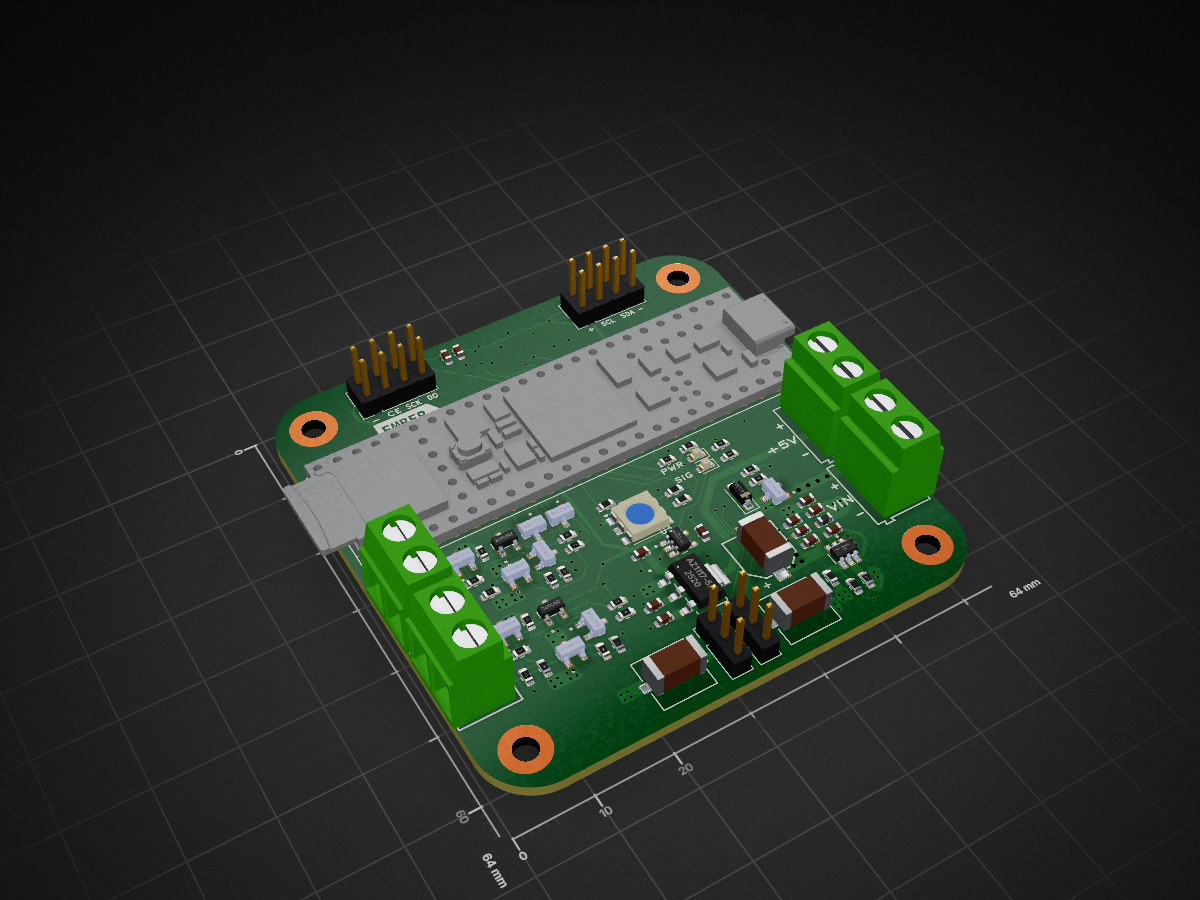
Flight computer is an open-source printed circuit board by daniel360kim, from the daniel360kim/ember repository on GitHub. It is a 4-layer board of 64 × 64 mm with 96 parts on 93 nets, routed with 730 tracks and 141 vias.
It is built around the TEENSY 4.1, NRF24L01 and BMP388, with the TPS563201DDCR, TPS73633DRBR and BAT54 among its other parts. Its parts include 37 resistors, 23 capacitors, 8 diodes, 8 connectors and 7 transistors. It belongs with the NXP (LPC, Kinetis, i.MX RT) boards of this library.


A differentiable 6-DOF rocket simulator that trains a neural flight controller by backpropagating through physics.
Ember is an end-to-end platform for developing thrust-vector-controlled (TVC) model rockets: a fully differentiable PyTorch flight dynamics engine, a neural attitude-control policy trained directly through the simulated physics, and a custom flight computer to fly the learned controller on real hardware.
The core idea is differentiable simulation (a.k.a. "diffsim"). Instead of treating the physics engine as an opaque, non-differentiable black box and learning a controller with reinforcement learning, Ember implements the entire 6-DOF rigid-body simulation in PyTorch so that gradients flow through every integration step, every aerodynamic force, and every actuator model. The attitude error at the end of a flight can be differentiated all the way back to the neural network's weights, letting the controller be optimized with plain gradient descent — the same way you would train any other neural network.
Ember is an active work in progress. The current state:
Working today
RocketEnv + EpisodeManager) with flight-phase termination (burnout, ground impact, excessive tilt).hardware/).On the roadmap
Learning a controller for an unstable, fast, safety-critical system like a TVC rocket is hard. The two conventional options each have a major drawback:
Differentiable simulation gets the best of both. Because the physics engine is written in an autodiff framework, the analytic gradient of the flight outcome with respect to the controller parameters is available for free. Training becomes a direct optimization problem:
"Given this rocket, what network weights minimize the attitude error over the boost phase?"
This is dramatically more sample-efficient than RL and far more flexible than classical control, because the exact gradient — not a noisy estimate — points the optimizer in the right direction on every single rollout.
                            ┌─────────────────────────────────────────────┐
   setpoint (upright) ─────►│  Neural Policy (MLP)                         │
                            │  attitude error + body rates → gimbal command│
                            └───────────────────┬─────────────────────────┘
                                                │  U (2-axis TVC torque cmd)
                                                ▼
        ┌───────────────────────────────────────────────────────────────┐
        │  Differentiable 6-DOF Physics (PyTorch)                        │
        │  motor thrust · TVC gimbal · aerodynamics · time-varying mass  │
        │  RK4 integration · quaternion attitude kinematics              │
        └───────────────────────────┬───────────────────────────────────┘
                                     │  trajectory X(t)   (fully differentiable)
                                     ▼
                            ┌────────────────────┐
                            │  Attitude-error    │
                            │  loss              │
                            └─────────┬──────────┘
                                      │
     ◄────────────────────────────────┘
        loss.backward(): gradient flows through the ENTIRE rollout,
through every RK4 step and physics term, back to the MLP weights.Everything in the physics path is a torch.Tensor operation, so the whole rollout is a single differentiable computation graph. A few deliberate engineering choices keep that graph intact and its gradients well-behaved:
def rk4_step(...):
    k1 = dynamics_fn(X, U, t)
    k2 = dynamics_fn(X + dt / 2 * k1, U, t + dt / 2)
    k3 = dynamics_fn(X + dt / 2 * k2, U, t + dt / 2)
    k4 = dynamics_fn(X + dt * k3, U, t + dt)
    X_new = X + (dt / 6) * (k1 + 2 * k2 + 2 * k3 + k4)
Out-of-place quaternion normalization. After each step the attitude quaternion is renormalized by constructing a new tensor rather than mutating in place, so backpropagation through the projection is safe (in-place writes are a classic way to silently break an autograd graph).
Branch-free physics. Discontinuous logic — like the piecewise F15 thrust curve — is written with torch.where instead of Python if statements, so gradients propagate across every phase of the burn.
Gradient-safe numerics. Operations that can produce infinite gradients (e.g. arccos at ±1 when computing angle of attack) clamp their inputs away from the singularity, keeping training stable.
Because the physics is written this way, loss.backward() on the training loss populates gradients on the neural network's parameters through thousands of chained physics operations, and a standard Adam optimizer step improves the controller. There is no reward function, no value network, and no policy-gradient estimator — just supervised optimization of a trajectory-level loss.
        for i in range(N_EPOCHS):
            initial_state = torch.zeros(BATCH_DIM, S.DIM)
            initial_state[..., S.ORI] = start_orientation

            history = episode_runner.run(
                initial_state=initial_state,
                setpoint=setpoint,
                policy=policy,
                vehicle=self.vehicle,
            )

            loss = self.calculate_loss(history.to_episode_result(), setpoint=setpoint)

            print(f"Epoch {i + 1}/{N_EPOCHS} — loss: {loss.item():.6f}")
            optimizer.zero_grad()
            loss.backward()
optimizer.step()Ember simulates a full six-degree-of-freedom rigid body with a compact, batched 15-dimensional state vector (simulation/src/vehicle/state.py):
| State | Indices | Description |
|---|---|---|
| Position | 0:3 | World-frame position (Z up) |
| Orientation | 3:7 | Attitude quaternion, scalar-last [x, y, z, w] |
| Velocity | 7:10 | World-frame linear velocity |
| Angular velocity | 10:13 | Body-frame angular rates |
| Gimbal angle | 13:15 | 2-axis TVC deflections (δx, δy) |
Each timestep, the vehicle sums the physical forces and torques and integrates the rigid-body equations of motion. The physics is decomposed into independently-testable, composable components:
ω × (Iω), integrated with swappable explicit-Euler or RK4 schemes.The entire vehicle is specified declaratively in YAML (simulation/configs/vehicles/atlas.yaml) — mass, motor, geometry, aero coefficients, and gimbal limits — so a rocket is fully described by data rather than code.
The policy is a small multilayer perceptron (simulation/src/policy/mlp.py) — deliberately kept tiny so it can eventually be exported and run in real time on a microcontroller. It observes the shortest-path body-frame attitude error (the x/y components of the error quaternion) together with the body angular rates, and outputs a 2-axis gimbal torque command squashed through tanh to respect the actuator's physical limits.
    def forward(self, X, setpoint):
        q  = normalize_quat(X[..., S.ORI])
        w_b = X[..., S.ANG_VEL]
        setpoint = normalize_quat(setpoint.expand(*q.shape[:-1], 4))

        q_error = quat_mul(quat_inv(q), setpoint)
        q_error = q_error * torch.where(q_error[..., 3:4] < 0, -1., 1.)
        error   = q_error[..., :2]

        input = torch.cat([error, X[..., S.ANG_VEL]], dim=-1)
        output = self.network(input)
        return self.max_output * torch.tanh(output)
A conventional PID controller (simulation/src/policy/pid.py) is included as a baseline for comparison against the learned policy.
Requires Python 3.10+.
git clone https://github.com/daniel360kim/ember.git
cd ember/simulation
pip install -e .
This installs torch, numpy, matplotlib, and pyyaml, and puts src/ on the import path so from vehicle.atlas_v1 import Atlas-style imports resolve.
cd ember/simulation
PYTHONPATH=src python src/runners/train_runner.py
This builds the Atlas vehicle, rolls it out under the MLP policy from a slightly tilted initial attitude, computes the attitude-error loss over the boost, and backpropagates through the entire flight to update the network — for 100 epochs. It plots the orientation and gimbal histories at the first, middle, and last epoch so you can watch the controller learn to stabilize the rocket.
The physics engine is covered by an extensive suite of unit and integration tests, including explicit checks that gradients flow correctly through the integrators, the rigid-body core, and the full vehicle dynamics.
cd ember/simulation
pytest                 # everything
pytest tests/vehicle/  # physics component & dynamics tests
pytest tests/runners/ # environment & rollout integration testsember/
├── simulation/ # Differentiable PyTorch simulator (main project)
│ ├── src/
│ │ ├── vehicle/ # 6-DOF physics
│ │ │ ├── atlas_v1.py # Concrete rocket: assembles the full dynamics
│ │ │ ├── base_vehicle.py # Vehicle interface + quaternion projection
│ │ │ ├── rigid_body.py # Newton–Euler derivative core
│ │ │ ├── mass_properties.py # Time-varying mass / CG / inertia
│ │ │ ├── integrators.py # euler_step, rk4_step (differentiable)
│ │ │ ├── state.py # 15-D state-vector layout
│ │ │ └── components/ # motor, cartesian_gimbal (TVC), aero
│ │ ├── policy/
│ │ │ ├── mlp.py # Neural attitude controller
│ │ │ └── pid.py # Classical baseline
│ │ ├── runners/
│ │ │ ├── rocket_env.py # Batched, Gym-like physics environment
│ │ │ ├── episode_manager.py # Policy-in-the-loop rollout engine
│ │ │ └── train_runner.py # Differentiable training entry point
│ │ └── utils/math.py # Quaternion algebra & kinematics
│ ├── configs/vehicles/atlas.yaml # Declarative vehicle definition
│ └── tests/ # Physics unit tests + gradient-flow checks
│
├── hardware/ # Custom flight computer (KiCad)
│ └── pcb/flight_computer/ # Teensy-based board: IMU, barometer,
│ # servo drivers, pyro channels, power
└── background/ # Early diffsim prototypes & experimentsThe hardware/ directory contains the KiCad design for a custom rocket flight computer — a Teensy-class board with an IMU, barometer, servo drivers for the TVC gimbal, pyro channels for recovery, and power management. The long-term goal of Ember is zero-shot sim-to-real transfer: train the attitude controller entirely in the differentiable simulator, then deploy the exact learned weights to this board to fly a physical rocket.
| Qty | Value | Footprint | References |
|---|---|---|---|
| 12 | 0.1 uF | Capacitor_SMD:C_0603_1608Metric | C1, C4, C5, C10, C12, C13, C14, C15, C16, C18, C19, C20 |
| 6 | 10k | Resistor_SMD:R_0603_1608Metric | R1, R8, R14, R23, R26, R38 |
| 6 | 10k 1% | Resistor_SMD:R_0603_1608Metric | R7, R17, R18, R19, R30, R32 |
| 5 | 100k | Resistor_SMD:R_0603_1608Metric | R9, R12, R21, R24, R37 |
| 4 | 10 uF | Capacitor_SMD:C_0603_1608Metric | C7, C17, C21, C22 |
| 4 | 100 | Resistor_SMD:R_0603_1608Metric | R10, R11, R20, R22 |
| 4 | 4.7k | Resistor_SMD:R_0603_1608Metric | R13, R15, R25, R27 |
| 4 | BAT54 | footprints:SOT95P240X120-3N | D2, D3, D4, D5 |
| 4 | MountingHole_Pad | MountingHole:MountingHole_3mm_Pad | H1, H2, H3, H4 |
| 3 | 1K | Resistor_SMD:R_0603_1608Metric | R28, R31, R41 |
| 3 | AO3401A | footprints:SOT95P240X120-3N | Q1, Q2, Q6 |
| 2 | 220 | Resistor_SMD:R_0603_1608Metric | R29, R36 |
| 2 | 220 uF | footprints:CAP_UCD_6P3X7P7_NCH | C24, C25 |
| 2 | 22uF | Capacitor_SMD:C_0603_1608Metric | C2, C3 |
| 2 | 2N7002 | footprints:SOT95P240X111-3N | Q3, Q5 |
| 2 | AO3400A | footprints:SOT95P240X120-3N | Q4, Q7 |
| 2 | LED | LED_SMD:LED_0603_1608Metric | D8, D9 |
| 2 | R | Resistor_SMD:R_0603_1608Metric | R33, R35 |
| 2 | Servo | Connector_PinHeader_2.54mm:PinHeader_1x03_P2.54mm_Vertical | J6, J7 |
| 1 | 10 nF | Capacitor_SMD:C_0603_1608Metric | C9 |
| 1 | 100 uF | footprints:WCAP-ASLI_6.3X7.7_DXL_ | C11 |
| 1 | 10K 1% | Resistor_SMD:R_0603_1608Metric | R16 |
| 1 | 10uF | Capacitor_SMD:C_0603_1608Metric | C6 |
| 1 | 110K 1% | Resistor_SMD:R_0603_1608Metric | R2 |
| 1 | 16K 1% | Resistor_SMD:R_0603_1608Metric | R3 |
| 1 | 18k 1% | Resistor_SMD:R_0603_1608Metric | R6 |
| 1 | 3.3 uH | Inductor_SMD:L_0603_1608Metric | L1 |
| 1 | 5V Terminal | footprints:691502710002 | J3 |
| 1 | AZ1117-5.0 | footprints:SOT223-5_DIO | U7 |
| 1 | Aux Ports | Connector_PinHeader_2.54mm:PinHeader_2x04_P2.54mm_Vertical | J9 |
| 1 | BATT_TERMINAL | footprints:691502710002 | J2 |
| 1 | BMP388 | footprints:XDCR_BMP388 | U4 |
| 1 | BZT52C5V1 | footprints:P35_SOD-123F | D7 |
| 1 | Buzzer | Buzzer_Beeper:Buzzer_Murata_PKMCS0909E | BZ1 |
| 1 | G*** | kibuzzard-6A2E09AC | kibuzzard-6A2E09AC |
| 1 | LED_RGB | LED_SMD:LED_RGB_5050-6 | D6 |
| 1 | LSM6DSRXTR | footprints:LGA-14L_STM | U5 |
| 1 | NRF24L01 | Connector_PinHeader_2.54mm:PinHeader_2x04_P2.54mm_Vertical | J1 |
| 1 | Pyro 1 | footprints:691502710002 | J4 |
| 1 | Pyro 2 | footprints:691502710002 | J5 |
| 1 | TPS563201DDCR | footprints:SOT95P280X110-6N | U2 |
| 1 | TPS73633DRBR | footprints:SOT95P280X145-5N | U3 |
| 1 | Teensy4.1 | footprints:Teensy41 | U6 |
| 1 | ~ | Resistor_SMD:R_0603_1608Metric | R34 |
It measures 64 × 64 mm and has 4 copper layers, 1.6 mm thick.
96 parts, built around the TEENSY 4.1, NRF24L01, BMP388 and TPS563201DDCR. The full list of its parts is on this page, with links to each part's symbol and footprint where PCBKit's library has them.
From the daniel360kim/ember repository on GitHub, at the commit this page was made from: the board is hardware/pcb/flight_computer/flight_computer.kicad_pcb and its schematic hardware/pcb/.kicad_sch. PCBKit opens the board in the browser, with nothing to install.
Its repository states no licence, so its author keeps all rights: ask daniel360kim before reusing the design.


Stefan-Olt/MISRC
MISRC Is a multi channel RF capture device for FM RF, S-Video, CVBS RAW capture and anything else, but intended and supported for the decode family of projects vhs-decode, ld-decode, hifi-decode.


HeyPCB/power-kit
Six open power and charging boards: KiCad 10, JLCPCB-ready, CERN-OHL-S-2.0

WeasalCrafter/linklite-v2
Programming and KiCad files for LinkLite v2: a modular lighting system with wireless control and syncing.


ibsal/LERT
LERT will launch humans to space in 2 months, please give me 10 trillion dollars pls